Peter Bleed
-
Posts
1,866 -
Joined
-
Last visited
-
Days Won
8
Content Type
Profiles
Forums
Events
Store
Downloads
Gallery
Everything posted by Peter Bleed
-
Could it be MICHIMASA? P
-
Forgive me for suggesting that DEALING in swords was a part of the the appreciation of Nippon-to. I offered this a a quip, but there is a larger point. Indeed, Japanese swords were excellent weapons. Young men trusted their lives to them. And in that situation the sword users wanted some evidence that these weapons would not let them down. To make trustworthy weapons Japanese smiths developed highly routine methods of making steel and heat treating it effectively. Those methods gave their sword visible characteristics that warriors could observe and that smiths could replicate. Japanese culture likes routine - and warriors like trustworthy weapons. Hada was a reflection of systematic production of carbon enriched iron. Hamon was a reflection of refined, systematic and controlled edge hardening. If you could SEE this stuff, you could determine that you were getting a "good" sword.es that produced Hada/Hamon are NOT unique to Japan, but they were practiced in highly routine ways in Japan. Smiths all over the pre-modern world developed means of adding a bit of carbon to iron and making the result tough enough to stand up to battle. What is UNIQUE(?) to Japan is the production of routine characteristics that let swords be objectively evaluated - visually. A sword without a HAMON might be OK, but if you are laying your life on the line, Japanese warriors wanted to see evidence of quality. A nice clear hamon could be taken as evidence that the blade was well made... Peter
-
I see the first signature as Bushu ju, SUKEMASA saku Peter
-
Effective? That is complex, but I will say they would not SELL worth a darn... Peter
-
New member. Questions on my Katana.
Peter Bleed replied to mjj21's topic in Military Swords of Japan
This would have been an interesting bit of research. I'm sorry I didn't have my ears on. This smith seems worthy, but -well- regional. Somebody seems to have thought highly of this sword, tho, given the way the signature was treated when it was shortened. Interesting! Peter -
I didn't jump right to the end and was stumped. Nice going, Manuel. Starting with the Ishido part was the way to go. Peter
-
This has been an interesting and informative thread... Peter
-
Visiting other collectors
Peter Bleed replied to Peter Bleed's topic in General Nihonto Related Discussion
Stephen, And of course you are right. There is a lot less snow in Arkansas than there is up north. And, now you have to deal with the whole campaign thing. Are you gonna caucus for Warren or Klobechar? Peter -
I know we live in a digital era. And, “Yes, yes,” I am saying this on a digital venue, but I have just returned from a wonderful visit with a wonderful sword friend and I want to encourage NMB members to reach out to actual, real, “sword owning PEOPLE.” I drove out to a friend’s home and brought a couple of swords that I was ready to discuss. These included an Ichiryusai SADATOSHI by a smith discussed in the last issue of Token Bijutsu. He also had a new blade that needed to be compared to one of mine so I brought it along for the sake of discussion. It was a nice comparison. I’m not sure mine was better or worse than his, but I certainly saw more as a result of the comparison. . . Well, the cutting test on his blade probably is better that the one on mine, but, hey! It was still useful to see them together. The point I am trying to make is that human contacts of sword collecting are very important. Nothing takes the place of seeing and closely inspecting real swords. And the best way to do that is to find others with whom you can discuss and inspect swords. Knowing how to read about swords and knowing how to look at picture of swords is useful, but nothing is better than looking at the real deal! Turn off your computers and go find another collector and look at swords! Peter
- 18 replies
-
- 13
-

-
I think this sword will NOT hold its value. It was a mass produced weapon that does not reflect or represent the artistry and high craft of Japanese swords. The tsuba is a nice example of a type that has attracted some attention. And the recycled WWII era menuki with a family crest are mildly interesting. But I doubt that there will ever be serious interest in this sort of sword. Peter
-
Newbie - First Purchase
Peter Bleed replied to ScottyT's topic in Auctions and Online Sales or Sellers
1) Find a collector, 2) Contact that person 3) ask for help and a time to chat about swords. 4) GO look at things that person has assembled.Be polite and curious.LOOK 5) get and read BOOKS on swords. 6) Ignore the person who offered you that 5000 Euro sword OMG! -
My bet's on "YUKI" as in Bizen Yukimitsu. pretty Bizen looking nakago IMHO
-
Wakisachi for identification
Peter Bleed replied to Arno67's topic in General Nihonto Related Discussion
Arno, You should start coming to American sword shows. Peter -
Wakisachi for identification
Peter Bleed replied to Arno67's topic in General Nihonto Related Discussion
Mia culpa, Jaques is correct this is a Tsunahiro, and probably a later generation of that line. I will stand by the rest of my assessment , "Nice rig" Peter -
Wakisachi for identification
Peter Bleed replied to Arno67's topic in General Nihonto Related Discussion
Looks like a nice, signed (TSUGUHIRO) Muromachi blade. Nice rig. Peter -
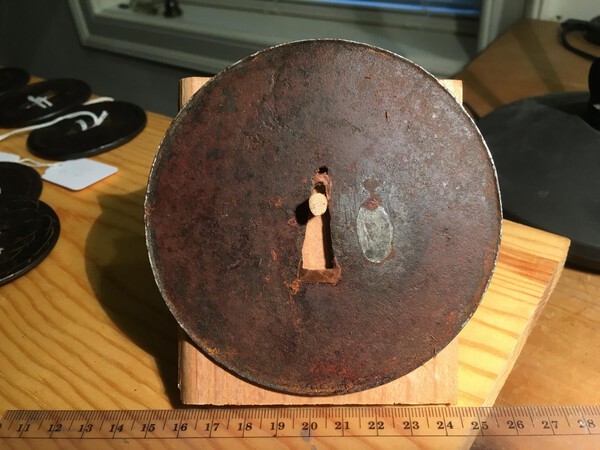
What we are seeing here is the fact that iron tsubas can be rather dynamic. Sometimes they can be is "poor" condition. A dab of wax offers a means of stopping red rust, 'washing' away the crust, and giving it a bit of color. It is 'first aid". I also think that rubbing this stuff on a guard is a lot better that doing anything like heating it or scouring it with some kind of abrasive. I am certainly not in anyway advocating this stuff. Peter
-
This stuff was made to be quick and easy and it is quite removable. It is far easier to remove than renaissance wax, I think. Please let me post another before and after (I'm trying to get ready to start sell some tosho tsuba and trying t0 get the orientation right) notice that the wax cleans the surface and kills red rust, but does nothing to holes in the patina. That means to me that it is less strident than etchants (feric cloride etc etc) that have been used and suggested. Peter

-
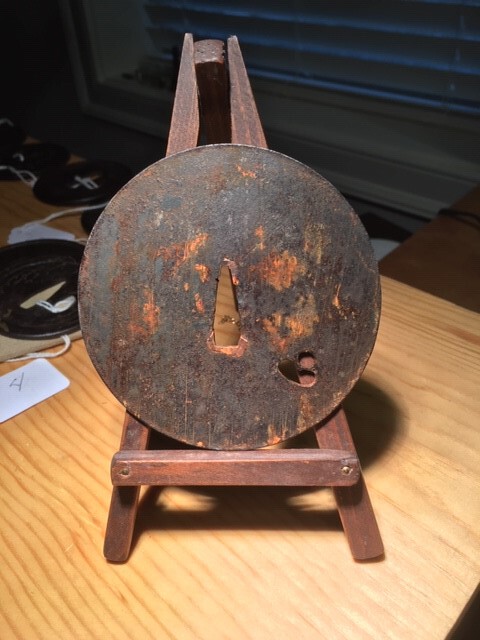
Here is a quick before and after comparison of a very thin touch of the wax to a dirty guard. In the old days, we could find masses of dirty "as found" tsuba and there was a role from this sort of stuff. Mebbe not so useful in this era of well organized and thoroughly assessed stuff. Peter

-
sorry about this errant post
-
Poking around a box of VERY old stuff, I just came across a jar of wax that I got many years ago from Tom Buttweilor. It contains wax that Tom made/sold/used to instantly refinish iron tsubas. It was eventually sold thru the JSSUS Newsletter. Tom would carry it to gun shows or wherever he might encounter an old guard. Rubbing a thin coat of the stuff on dirty iron guards gave them an instant improvement. The stuff is easily removed in hot water so it seems benign, although after 50 years it might be pretty crusty. What is current thinking about waxing iron fittings? Peter
-
I think that his sword has ALL of the evaluation it needs or deserves. Sending it thru another team MIGHT provide different opinions, but IMHO it won't yield more useful information. That thing in the boshi absolutely is NOT a hagiri. It is a forging kizu - and these things happen. And the Dotanuki guys were a line of country smiths. What more is there to say. This is a perfectly legitimate Edo period sword. Peter
-
Kenny, My sense is that $430 for this sword was very reasonable. Your babies will not starve. My "guess" is that this is an old sword that was shortened during the Edo period. Getting it polished would probably be beyond its value, but I think that it can be appreciated with ample cleaning (nothing abrasive). Hunting for a nice old tsuba and comfortable seppa will be fun and will make this a very presentable antique. Congratulations! Peter
-
Please help to identify these sword makers for further research
Peter Bleed replied to ichiku's topic in Nihonto
Nick How sword collecting has changed. There was a time when swords like these would require joyous effort, when someone lucky enough to fall heir to "Japanese swords that seem to be quite old" had to get out books and read discussions about swords. Doing that would provide insights about the history and complexity of Japanese sword production. It also required learning something about Japanese language, geography, and history. Now all a guy has to do is post some images and wait 20 minutes for a world-wide community of experts will tell you what you have. You have done that part, but I hope you won't be stopped by the success you have had. Dive in farther. Get some books. Meet other collectors. Where is Bushu or Kashu, or Nanto, or Higo for that matter Edo? And whats a Showa-to? Your fun is just beginning! Peter -
This has been a very interesting thread and I appreciate the insights that have been shared. I have no expertise about this topic and my opinion has shifted and changed. There certainly has been lots of interest and close inspection. I will not vulgarize the discourse, but I think it may be safe to say that this thread shows that sword collectors are NOT "Leg men.". Peter
-
Nihonto in Manchukuo Naval Shore Patrolman Fittings
Peter Bleed replied to Wolfmanreid's topic in Nihonto
Reid, You are doing a fine job of learning from what you have in hand.Good for you. I think you are only going to learn so much from this particular sword, tho. I am very doubtful about this Machokuo Naval Polic story. These are IMHO Meiji era civil authority fittings - police, guards, etc. I'll bet the Manchukuo Navy was - ahh - pretty small. The advice you have been given about the value of this sword seems reasonable. It could be anyhting under that scratches, but I would bet that the the sword could be brought back. The nakago will be bobbed off and reshaped and will probably be all right. I had one of these years ago. It was in good polish and was a nice long katana. When I finally brought it to the Chicago show it languished until a Japanese dealer bought AND AS SOON AS IT DID AND RIGHT IN FRONT OF ME another Japanese dealer asked him what he wanted for the fittings. They haggled for a minutes and right there in front of me, the blade was stripped and given to the second guy for HALF of what the first guy had just paid me! All this to say that the fittings of you sword carry collectors' value. You might want to treat the blade as a "tsunagi." Peter