MauroP
-
Posts
888 -
Joined
-
Last visited
-
Days Won
5
Content Type
Profiles
Forums
Events
Store
Downloads
Gallery
Everything posted by MauroP
-
Dear Jake, I would be pleased to include your tsuba/hakogaki. I had to discard many other examples I found since they lack the image of the relative tsuba or one of the side of hakogaki (or because the images were so distorted to make impossible their correct representation even after a thorougly Photoshop processing). Using a flatbed scanner should be the easier way to get suitable images.
-
https://www.dropbox.com/scl/fi/gkfcfqc6gs14invoeg6hn/KanzanHakogaki.pdf?rlkey=5i89f80fkbbf60x67f1lloa2k&st=zfh4ao27&dl=0 I'm not sure where it would be more appropriate to post this — in the Translation Assistance section or in Tosogu (please, Brian, place it wherever you find most suitable). I’ve compiled a short collection of transcriptions (kanji + romanization) of some tsuba hakogaki from Satō Kanzan. Although the examples I’m presenting are among the best-documented ones I could find online, I’m far from confident that the transcriptions provided are reliable. All the text shown in black should be reasonably accurate; the text in red is, at best, an educated guess; and I’ve marked with red stars the characters whose transcription I’ve no idea about. Some inconsistencies are evident and may perhaps be attributed to likely forgeries of the hakogaki. For each hakogaki, I’ve included the website link from which I took the images, which I believe should serve as proper credit to the original owners. Of course I’m ready to remove any material upon request from the rightful holders. In any case, this is entirely non-profit, and I am not a professional in this field. I would be very happy if forum members wished to contribute with comments, corrections, additions, or perhaps even further examples of hakogaki by sharing images from their own collections. I intend to release a final, corrected version here on the NMB forum within about a month or so. Thank you for reading.
-
Yamashiro jū Shigenobu saku (山城住 重信作), possibly Shōami school.
- 1 reply
-
- 2
-

-

-
Translation help: tsuba mei and calligraphy
MauroP replied to thutson's topic in Translation Assistance
Here the hakogaki (I'm not shure about the date): 葵形鉄地影透 * aoi-gata tetsu-ji kage-sukashi 銘馬面序政花押 * mei Bamen Tsunemasa kaō 昭和壬子年弥生 * Shōwa mizunoe-ne-nen yayoi [March 1972] 寒山誌 * Kanzan shirusu (+kaō) Would you mind to post an image of both sides of the hakogaki? (I'm collecting images from hakogaki by Satō Kanzan) -
Kaga-kinkō or Shōnai-kinkō?
-
100% agree with what Dale says. If a tsuba fits a Shōami attribution this is one (and many doesn't...)

-
Usually the two collaborating artisans signed each on the opposite sides of the tsuba. What about your tsuba, Grev?
-
Not so strange in Nanban tradition, as you can see in the tsuba I already posted.
-
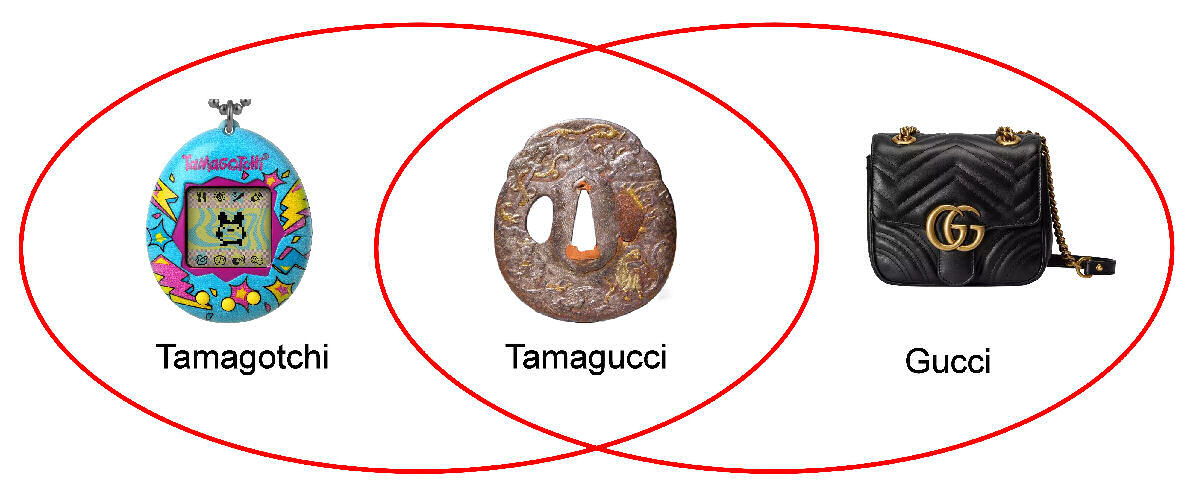
I have another hypothesis (explained with Venn diagrams)...

- 31 replies
-
- 16
-

-
-
Nanban and Hizen attributions overlap for a certain extent (though some tsuba are clearly Hizen and not Nanban). Jakushi could also be be a legit call, but usually Jakushi tsuba are signed and the vast majority of them represent dragons or Chinese landscapes. A non-toban shape of seppa-dai makes me lean towards a Nanban attribution (but don't take any attribution too seriously...).


-
The inlays look quite amatourish, possibly a Shōwa period tsuba?
-
Have space aliens ever landed on Earth? Who knows... Possible? Yes, of course! Likely? No, of course! Have iron tsuba been casted in Edo period? The same as above... that's all IMHO.
-
Markus Sesko's "Signatures of Japanese Sword Fittings Artists" lists 3 Nobukuni and 5 Masatoshi entrances, but never together...
-
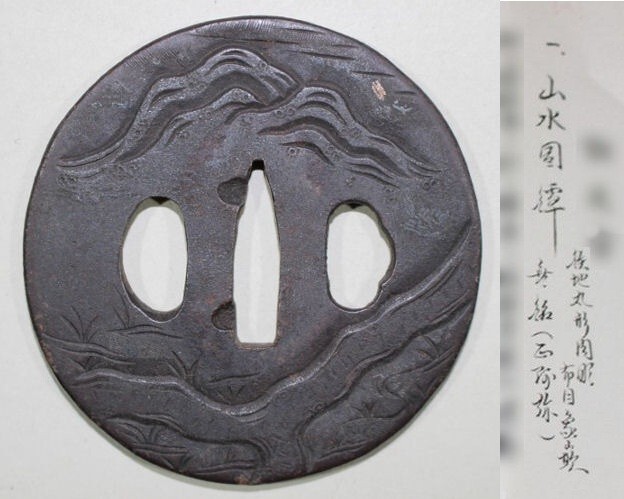
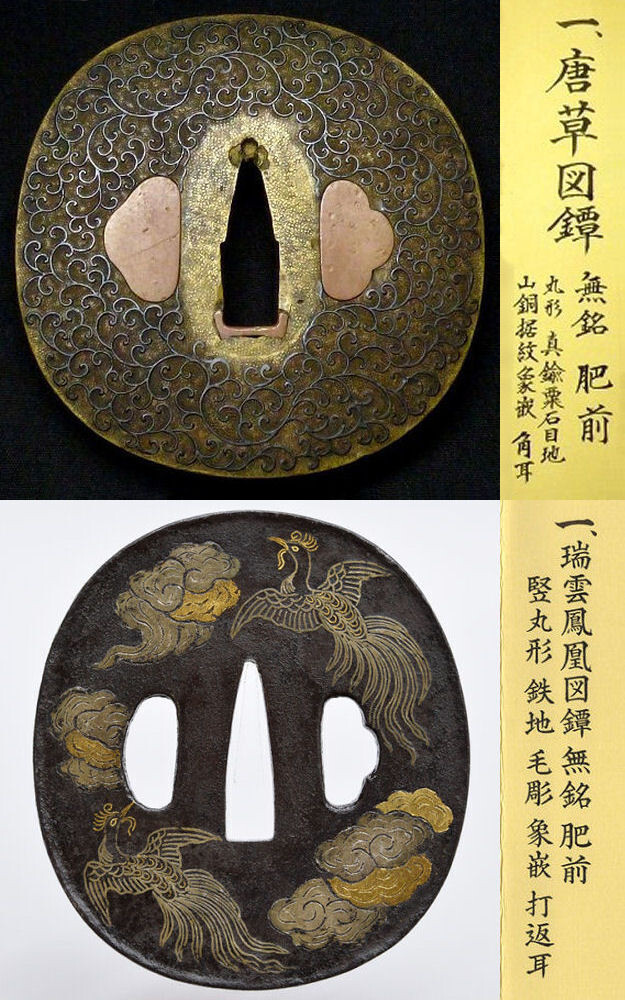
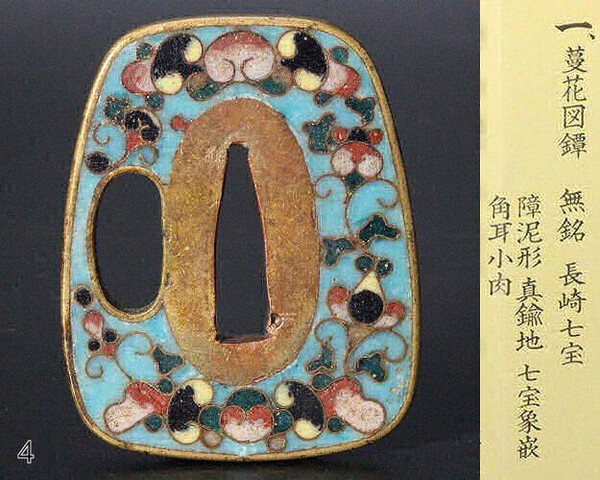
I was quite puzzled by the attribution of this tsuba to Hirata (平田), as in my understanding, the Hirata school is typically associated with suaka, yamagane, or shinchū-ji tsuba, often featuring shigure-yasuri or okina-yasuri file marks, and sometimes an odawara-fukurin. So, I did a bit of research and found that most "Hirata" attributions seem to originate from Bonhams auctions. None appear to be papered by the NBTHK, and only a few are signed by Hirata Harunari (8th generation, late Edo) or Hirata Haruaki (Meiji period). Perhaps there is some confusion with Hirado (平戸)? Here some images: 1. signed Narikazu (hard to believe he's the 2nd generation Hirata master) 2. a typical Hirata piece 3. a shippō-zōgan tsuba papered as Hirado 4. a similar piece papered as Nagasaki shippō


-
I wish to suggest Nagasaki shippō as a more likely attribution...
-
Dan, please go here and read all the stuff... https://www.openmovportal.ca/argus/final/Portal/Main.aspx?component=AAFG&record=a7450643-c397-4d2e-a9a6-0cea5b180791
-
Thanks God the Museum of Vancouver also states that the material is copper and/or silver alloy (?). So no iron casting involved (or clearly the museum curators don't know anything). https://www.openmovportal.ca/argus/final/Portal/Main.aspx?component=AAFG&record=a7450643-c397-4d2e-a9a6-0cea5b180791
-
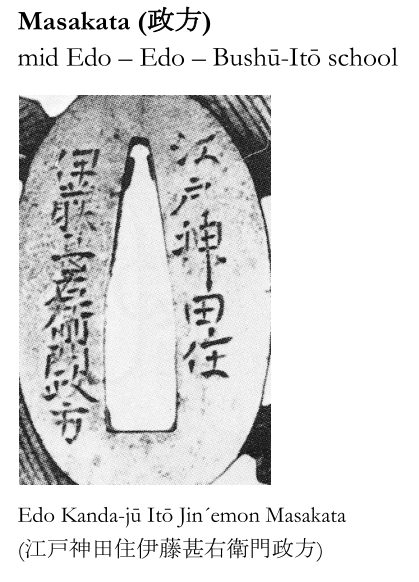
Actually the signature looks like 奈良重光 - Nara Shigemitsu, but I was unable to find this signature in my books.
-
The paper says the signature is Sashū jū Toshiuji (佐州住利姓).
-
Now I understand why Daruma shows such a sad face....
-
Here the genealogy of Hōan school according to "Genealogies of Japanese tsuba and tōsō-kinkō Artists" by Marcus Sesko. (the best I can do without a flatbed scanner)

-
Unfortunately zōgan means just "inlay", and does not describe the technique used to make it ...
-
Hi, I suggested Hizen relying on style alone, but of couse other schools/traditions can be considered. I assume the tsuba in made in iron, and the decoration is silver and gold nunome-zōgan (may be wrong). I'm unable to see true channels where inlay is missing, just minor wears in gin-nunome-zōgan could eventually result in that images. Finally, in my humble opinion the “anecdotal” example of what Alex consider to be representative of Kaga-zōgan is indeed a fair example of Kyō-kenjō (including the kin-zōgan kaō).
-
Could be a late Edo Hizen?