ROKUJURO
-
Posts
7,125 -
Joined
-
Last visited
-
Days Won
39
Content Type
Profiles
Forums
Events
Store
Downloads
Gallery
Everything posted by ROKUJURO
-
Grev, obviously a common theme in CHOSHU TSUBA!
-
Ray, I don't think that is a shark motive. The head and the fins are not shark-like..
-
This sword/NAKAGO does not look Japanese to me.
-
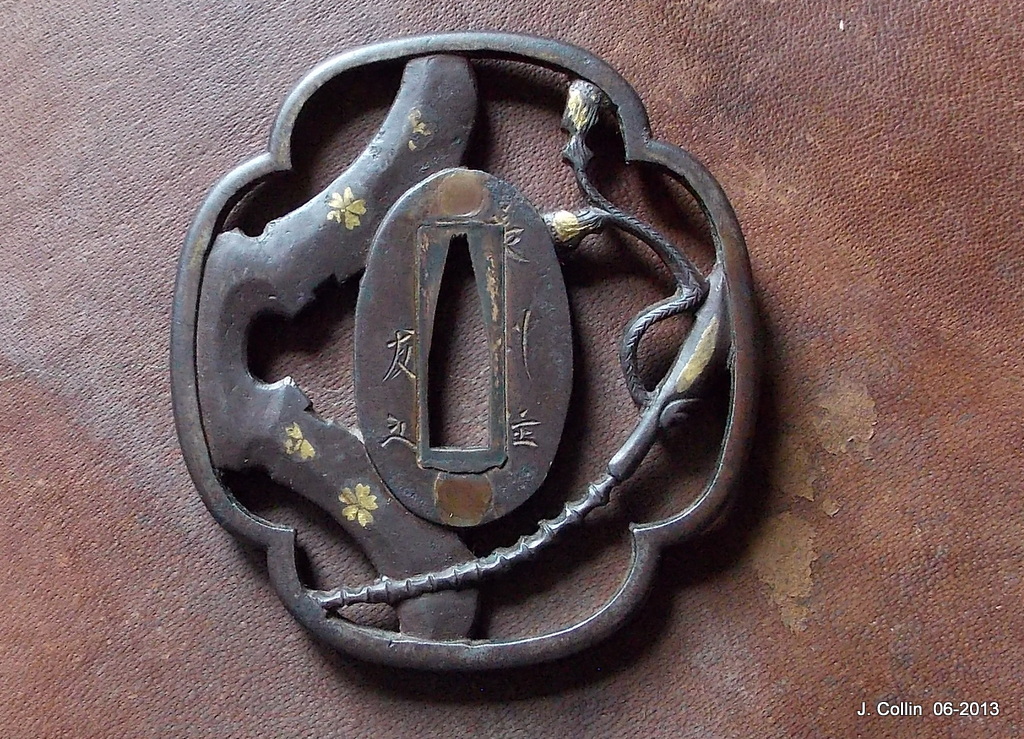
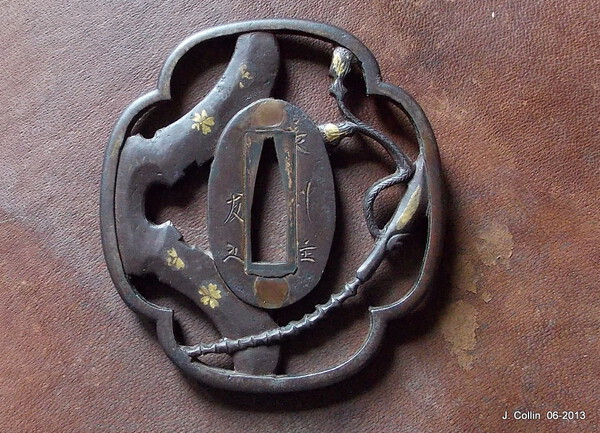
Jeremiah, a nice TSUBA, made with competent and fine chisel work! Condition is quite good, I think. Something you can be happy about!
-
Stan, maybe .....ZEN no JU KANE.....(KIYO?). Difficult to read, as the NAKAGO photo is upside down and shot at an angle, so I am unable to guess the first KANJI. I cannot open the second and third photo.
-
Advice On Cleaning Up A Blade And Koshirae
ROKUJURO replied to bigjohnshea's topic in General Nihonto Related Discussion
End of discussion. -
Advice On Cleaning Up A Blade And Koshirae
ROKUJURO replied to bigjohnshea's topic in General Nihonto Related Discussion
As Brian wrote: There are no products on the market that an amateur could use without damaging the blade. There are of course chemicals to transform rust into something less aggressive, but they are good for garden tools, cars, iron bridges and towers a.s.o.. Take a moment to think about what rust is: Rust is iron (element Fe) that has turned into a chemical compound (rust = Fe2O3) together with oxygen (element O). Rust is not something that covers the clean iron/steel like a layer of dirt - the iron surface itself has partly turned into something else. If you could remove the rust completely, the surface would be coarse and look probably like a natural stone, depending on how deep the rust has worked itself into the steel. Or you could say: How deep the oxygen had been allowed to attack the steel, chewing up Fe molecules and turning them into rust. Bringing a rusted blade back to a state where you could see the HATARAKI and HADA will always mean that you have to remove some of the steel surface until you have a clean, level and very even metal surface. THEN - and only then - you can start to restore the blade. Not easily done and nothing for non-trained people. -
Ww2 Sword Identification, Mei Translation Help Please?
ROKUJURO replied to Migsz's topic in Translation Assistance
Migsz, please sign all your posts with your first name plus an initial, so we may address you politely. -
Samurai Art Expo Utrecht
ROKUJURO replied to paulb's topic in Sword Shows, Events, Community News and Legislation Issues
I will be happy to meet you there! See you in an hour or so, local time 12°°! -
Rayhan, you are right that there is no SHINGANE to be found in the YAKIBA. I tried to explain that the whole blade would be submitted to massive changes in an attempt to remove a HAGIRE. In post 45, Denis gave a good explanation of what should be expected from a polish.
-
John, thank you, of course you are correct. The link should be to Markus Sesko's book on page 170 (https://books.google.de/books?id=46IYtI0nkiEC&pg=PA171&lpg=PA171&dq=SUE-SEKI+KANETOKI+swordsmith&source=bl&ots=BRDh25XSNt&sig=g35DCpGoecx1CaH0dg7tRICMLDo&hl=de&sa=X&ved=0ahUKEwiuuZjD1s7bAhULCcAKHegnBrYQ6AEIRzAJ#v=onepage&q=SUE-SEKI%20KANETOKI%20swordsmith&f=false). @ Ted: These SUE-SEKI KANETOKI smiths are a bit earlier, and my link to AOI for a sales price comparison was not correct. However, the real price is always what someone is willing to spend. The signature is very probably not KANENORI, I think John read it correctly. The real market value can only be estimated when a sword is in polished condition - and not polished hobbywise by someone who is mainly a dealer, but by a traditionally in Japan educated professional polisher! Yes, it is a genuine Japanese sword and the KOSHIRAE (complete set of mounting parts) as well, but please be aware that age is less important than quality, condition and a true signature! In this case, the condition of the NAKAGO is astonishingly good in relation to an age of 500 years, so one should be very careful with an assessment. Also, the edge of the blade has been slightly bent (not chipped as one would expect) near the KISSAKI (tip), so there might be something wrong with the steel. The whole subject of Japanese swords is quite difficult!
-
Ted, concerning value, a lot depends on condition. If your sword had a genuine signature, if it was really from that period of time (ca. 1600) and if it was in very good condition, it could have a nice value (see https://www.aoijapan.net/katana-noshu-seki-no-ju-kanetoki/). As it is now, someone may find it worth between $ 1.800.-- and $ 3.000.--. But you should consider that a polish will cost $ 2.500.-- or more plus a new HABAKI plus a new SHIRA-SAYA plus shipping and possibly papers (ORIGAMI). Without all that, it is just an old, damaged sword with a hidden potential.
-
Gentlemen, by discussing the possibility of 'polishing' out a HAGIRE, it should be considered that the respective blade will not only lose a good part of its width, but the overall appearance will change as well. The blade would have to be ground a lot thinner as well to keep the NIKU and the cross section angles close to that of the original. This may result in a significant loss of KAWAGANE, exposing the SHINGANE probably in most of the blade's surface, if it is a laminated construction. This will of course be a smaller problem with simple one-piece constructions as found in later TANTO. In my opinion, any repair attempt of a HAGIRE is a great risk and will not work out to be a true restoration of the blade.
-
I have seen attempts of 'repairing' HAGIRE without the latest technological means (like micro Laser welding). As the temperatures for welding are above 2.500°C, any original hardening effects in the HAMON are locally erased and cannot be restored. Depending on the heat source, the affected areas may differ in size, but even micro-welding will have obvious effects. If technically well done and with a perfect surface, a TOGISHI might be able to disguise the relevant spot with KESHO techniques to an extent, but for an expert the 'repair' will remain visible.
-
James, there is a seemingly old MEI and a MEKUGI-ANA close by. That is what you expect when only a part of the NAKAGO has been cut off. None of the pictures show the full NAKAGO so I don't know if there is a second MEKUGI-ANA further upwards as you would normally see in an O-SURIAGE blade.
-
James, punching a hole is the older technique; drilling was invented/introduced later in the EDO period, if I am correctly informed. If you have a drilled hole in the original location of the NAKAGO, you can assume that the blade is not KOTO.
-
I don't see the MITSU, but I think that the MEKUGI-ANA is drilled, not punched. This might be a key to an assessment of the age. Concerning the MEI: What about OSA (FUNE)?
-
I cannot read the MEI, but offering a "SHINKAI" for $ 330.-- is not too fraudulent in my eyes.
-
Even with modern LASER technology, heat is introduced into the area to fuse the metal sufficently to 'heal' the defect. This will be visible, but a good polisher may be able to hide this to an extent.
-
The NAKAGO of the 'widow-maker' NO-DACHI looks much older and the signature doesn't seem to be from the same hand.
-
Fifth Sword In Widow's Collection
ROKUJURO replied to dancingbear038's topic in General Nihonto Related Discussion
Thomas, is there a signature on the NAKAGO or a small stamp just below the HABAKI? Most blades of this era have some kind of signature. The blade is probably oil quenched. NAKAGO photos are upside-down and not sharp enough to see details. -
Or perhaps KANEMITSU, considering the distance between the KANJI.
-
Thomas, you could make reading the signature easier if you put the blade photos tip-up.
-
Third Sword In Widow's Collection
ROKUJURO replied to dancingbear038's topic in General Nihonto Related Discussion
Thomas, this is just a sword. Certainly not Japanese, but maybe the maker had one in mind without ever having seen one from close. Value: sub 50.--$ -
Michael, I thinks it reads as Steve wrote: ISHIHARA YOSHISADA. It is not a SAMURAI sword, but a military one. The signature has nothing to do with the age of the blade. To make reading MEI a little easier, it helps to have well focused photos of the NAKAGO (tang) with tip upwards.