


Grey Doffin
-
Posts
4,220 -
Joined
-
Last visited
-
Days Won
31
Content Type
Profiles
Forums
Events
Store
Downloads
Gallery
Everything posted by Grey Doffin
-
I can't really see the mei on the last tsuba. I gave it to Jakushi because the work is so typical of that group. Anyone have a better idea? Grey
-
IMHO, all are real. The Kinai is signed Echizen Ju Kinai Saku (made by Kinai (school) of Echizen Province). The last one with a dragon is signed Jakushi. The 1st tsuba is Choshu school but I can't make out the rest of the signature. Can't make any of the signature on the 2nd. The 4th tsuba is pretty low end. Grey
-
 One reason why I asked, Bryant, is that beginners are often very anxious to spend even more money on their new swords. They buy and then they want to polish and paper and have koshirae built and lord knows what then. Quite often this makes little artistic or financial sense. Go slow. Grey
 -
Hi Bryant, Why do you need a longer tsuka? Are you planning to use this for martial art? (Not a good idea). Replacing the tsuka replaces part of the sword's history; are you sure that makes sense? You could replace the habaki but, again, may not be a good idea. Why not enjoy it for what it is until you know more, and then you'll have a better idea what, if any, changes to make? Grey
-
The sword is not a fake, the paper is real, the price you paid was not unreasonable, I think you did quite well considering that you're new to Nihonto, you were buying on ebay, and you were buying a Japanese sword from Japan: a combination of factors that often leads to trouble. No idea why the seller could export so quickly but all else seems OK. Congrats. And now you need to commit some resources (time and money) to study. Without more knowledge your next purchase could just as easily be a disaster. Grey
-
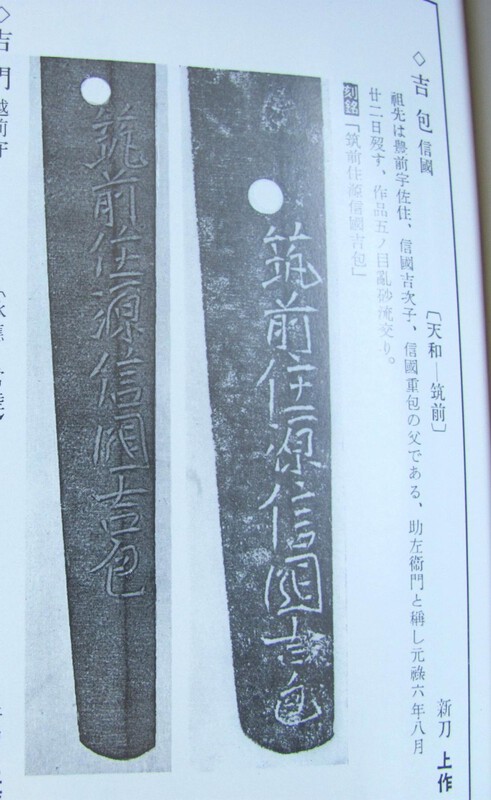
A photo of authentic signatures from Fujishiro's Nihon Toko Jiten: Shinto-hen. At 1st glance it looks good. Grey
-
Hi Jim, Looks like there is only one pin and what you see as the other is a large node in the same' (ray skin covering the handle). You may have to nudge the wrap to the side to get the pin out (depending on which side of the pin is the small end). If there is a 2nd pin and you can't see the other end it is below the wrap and another nudge may be in order. Looks like someone has been pushing on the pin already. If, when you get it out, you find that it is falling apart, whittle a new one from a chop stick to replace it. The pin is very important. Grey
-
Sorry but I have to disagree a bit. If the mei/attribution is a big name or if the sword is being sold by a dealer in Japan (where access to newer papers is relatively easy), no problem with what you've said Darcy. But I often come across swords and kodogu that were papered under the old system decades ago and have been in the west ever since. If the work is mid level (not important) there is no reason why we should suspect the authenticity and/or accuracy of the paper. If you have a tsuba with a Kicho paper to Shoami, no one in his right mind will spend $600 to send it to Tokyo for a newer paper. I understand that this paper doesn't add as much value as would a Hozon, but it does add value and I would sell the tsuba with the paper and make no apologies for having done so. And, unless I knew for a fact that the paper is bogus, I would never destroy it; it is part of the history of the piece. Grey
- 25 replies
-
- 10
-

-
A care & etiquette brochure that will help you get the handle off (and back on) and tell you how to handle the sword. http://www.nbthk-ab.org/Etiquette.htm Grey
-
I agree with Steven. Never Dull will make a rusty Showa-to look shiny and it will make a fine Nihonto look like a shiny Showa-to. Grey
-
Hi Darius, No idea what they are/what caused them; if they are masking tape residue they should have disappeared with the alcohol. You could try uchiko but make sure you have a good quality uchiko (Bob Benson in Hawaii sells this). Resist the urge to concentrate the uchiko in just this part of the blade; overuse in one area will make that area stand out. If a few applications of the uchiko don't succeed in removing the spots then I think you have 2 options: get the sword to a properly trained polisher or live with them. I would live with them. If I had to guess, I'd say that the uchiko won't fix the problem, but you never know. Grey
-
Katsumasa? Ww2 Era Hot Stamp Blade
Grey Doffin replied to The_ozzy_samurai's topic in Translation Assistance
Noshu Seki no Ju Kojima Katsumasa Saku Grey -
Doesn't look like shakudo at all (more like brass) and it does appear to be cast, which would make it a modern fake. Also sorry, Grey
-
I suspect Hama-mono or Dock Work: Meiji or early 20th century or even early post WWII and made to sell to western tourists. Grey
-
Flaw In Blade/polishing Issue...relocate Mune Machi?
Grey Doffin replied to Taz575's topic in Nihonto
Hi Tim, I suspect this will fall on deaf ears (since it has already). Don't spend any more money on this blade (never should have bought it in the first place). If you want to spend money restoring a sword find a better sword to restore. Anything spent on this sword will be lost when the sword is next sold (and it will get sold someday); it is too far gone. Grey -
Hi John, Never seen this before. The sword has been shortened; we know that because the horimono is partly under the habaki. But the nakago has been lengthened with the extra piece added on. This (the added piece) doesn't look like Japanese work (too crudely done). Maybe after the sword was surrendered to the occupying forces after WWII the original nakago broke at a mekugi-ana, or maybe there was a length limit imposed on war booty sent home and to comply the nakago was cut short. After the blade made it home the cut off piece or a piece from another sword's nakago was attached with the scarf joint. One explanation, maybe there are others. A shinsa could tell you what the panel thinks about who working when made the sword but it may get rejected because of the nakago. Beware of local appraisers; unless they have lots of experience with Nihonto they're often way off. Grey
-
The 1st character is a Bonji, a ritual Buddhist symbol if I have that right. The 2nd is a ken, an early style of edged weapon. I'm very curious about the cut across your nakago. What is happening there? Grey
-
Question About Shipping To Germany From The Us
Grey Doffin replied to Jiro49's topic in General Nihonto Related Discussion
Hi Matt, USPS has no problem shipping swords to anywhere they ship anything else. There are 2 possible snags, however. Germany may object to swords being imported (don't know if this is the case or not but I mention it) and US Customs may object to the export of animal products that may have originated with endangered species (ivory if present for sure and same' on the tsuka if your inspector wants to raise a fuss). Otherwise USPS is fine: they will insure swords up to the country of destination limit (I don't think US or Fedex will) and they are less expensive than the alternatives. Grey -
Noshu Osugi no Ju Ishihara Kanenao Saku. Can't read the date but he worked making Gunto for the war. Grey
-
I will be at the show and can take with me any book from my site you'd like to see (and buy). I will be buying books at the show; if you have any to sell and will be attending, let me know ahead of time and I'll tell you what I can do. Cheers, Grey
-
Thinking About Buying This Sword, Authentic? A Good Deal?
Grey Doffin replied to sounderites's topic in Nihonto
The paper is from the NTHK, I believe, not the NBTHK. Grey -
Evidence of retemper (most of which can be found on blades that haven't been retempered): dry, parched feeling nakago, exaggerated curvature, weak, inconsistent hamon, mune-yaki, open, exploded grain, mizu-kage, and a hamon that begins above the machi. With rare exceptions, retemper kills value. Grey
-
F&F payment sent. Grey
-
Gunto Fittings - Cleaning Vs Natural Patina
Grey Doffin replied to FletchSan's topic in Military Swords of Japan
Nothing harsher than water and not much of it; nothing more abrasive than a soft cloth. Looks pretty good already. Grey -
What To Do With Hawley #'s?
Grey Doffin replied to ggil's topic in General Nihonto Related Discussion
Hi Grant, A Hawley's number is the unique number given to a smith in one of Mr. Hawley's books. Masamune, for example, is MA 302 in the 1st edition blue books and MAS 590 in the later, expanded editions. The numbers serve only to keep track of the listings in Hawley's and tell you nothing about a smith. Knowing the number tells you where to look for the smith's listing in the book and nothing else. Grey
