Grey Doffin
-
Posts
4,174 -
Joined
-
Last visited
-
Days Won
31
Content Type
Profiles
Forums
Events
Store
Downloads
Gallery
Everything posted by Grey Doffin
-
Actually, it is possible for a perfectly hardened kissaki to bend at the tip. I've seen quite a few blades that had their original boshi and a bend in the tip. I've been told that Koto were more likely than Shinto or later to survive without cracking (don't know if that's true). And, as I mentioned before, if the boshi leaves sufficient room at the tip to allow for reshaping the kissaki behind a crack, once the repair is done the sword won't have suffered severe decrease in value. This could be more valuable than a mint NCO (or maybe not). It needs to be seen in hand by someone with experience. Grey
-
Some might say Boy's Day sword, but because of a strange curve in the nakago and lack of ornamentation on the kodogu, my guess is some sort of tourist trinket or out right fake. Doesn't look like Nihonto to me. Grey
-
Hi Bruno, If the kissaki is just bent it may be possible for a properly trained polisher to straighten it (don't dare try this yourself!). It looks in the picture like there might be a crack at the base of the bend. If there is a crack your only option is to have the kissaki reshaped, again by a proper polisher, and this can be done only if there is sufficient room in the boshi. You need to have a polisher look at this. Grey
-
 Hi Peter, I alerted Barry Hennick, our esteemed web guy, to your problem. I hope he can help. If not get back to me and I can help in a slightly more complicated manner. Grey
 -
Hi guys, The next issue of the JSS/US "Newsletter", our 4th of the year, will be special. I'm giving you a heads up in case you would like to receive a copy. Roger Bobertshaw, noted collector and authority of the swords of Hizen (Tadahiro/Tadayoshi lineage) was presented with a long forgotten document, which he has had translated into English and given to the JSS/US for publication. In Roger's words, "The document was written on 7 January 1884 by Hashimoto Kin’ichi, 10th Generation Tadayoshi, and it details the ancestry of the Tadayoshi and the Hizen Kaji itself, back some 700 years from the date it was written; that is back to 1184." We plan to do this right: nice paper, competent binding, each page of the original handwritten Japanese will be followed by that page's translation, all to be followed by extensive notes from Mr. Robertshaw, about 60 pages total. Anyone with an interest in Hizen-to should want a copy. You get one if you're a member of the JSS/US. Join now and you'll receive all of this year's issues. Your membership also helps us in our task of translating and publishing other Japanese sword references. You can join on our website: jssus.org Thanks, Grey
-
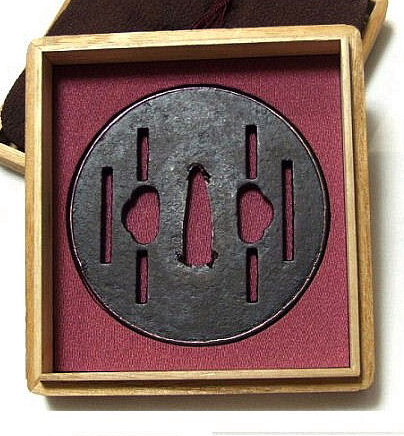
Interesting point, Rich; hadn't considered that. It brings to mind another question. There is a picture below of the tsuba in the box, from a recently completed ebay sale. I was wondering if the box and tsuba might have been combined, if maybe the hako-gaki was written about another round tsuba. Could this design be yatsuhashi (pastry) and iris? Grey
-
Sword laws in California
Grey Doffin replied to jeremy's topic in General Nihonto Related Discussion
Jeremy, I doubt there are any laws in California that would hang up the sword, but even if there were they wouldn't stop the sword at US Customs (a Federal, not State government agency). As long as you have been truthful about what this is and its value you should have no trouble. Grey -
Moriyama-san, Thank you. Grey
-
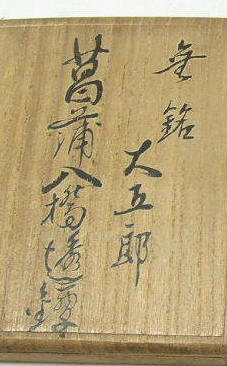
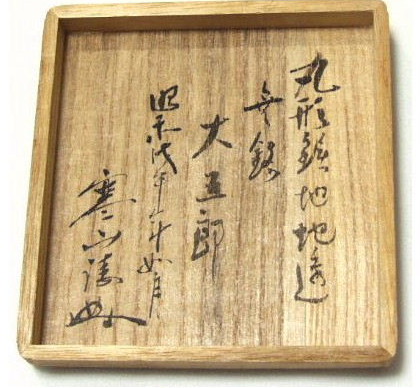
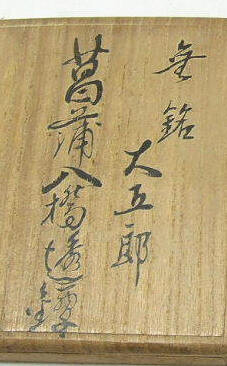
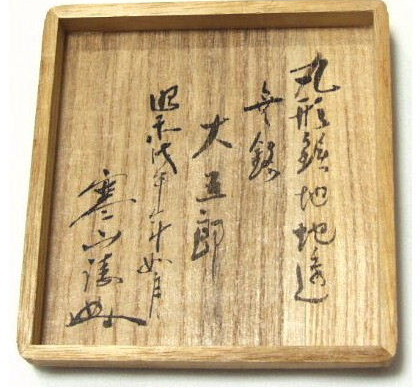
Hi guys, I would appreciate help with the hako-gaki below, supposedly by Kanzan. Thank you, Grey
-
Of course, the style of chisel. Thank you. Grey
-
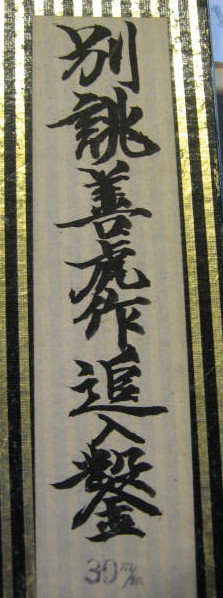
Hi guys, A set of woodworker's chisels (which might be for sale) comes in boxes with the label below. I can make out, "Betsu Atsurae Yoshitora Saku (special order made by Yoshitora), but the rest has me stumped (Shirizoku?....). I'd be most appreciative if someone can help. Thanks, Grey

-
I'm not aware of a cheap and easy copy of the Fuller & Gregory book. It is out of print and not likely to be reprinted. Copies do come available but tend to sell north of $300. Jim Dawson's new book, Swords of Imperial Japan 1868-1945: Cyclopedia Edition is as good and probably a more comprehensive reference, and it is in print at $125 plus postage Grey
-
Tliston, Definitely an older blade mounted in what might be a mix of WWII and other koshirae. The badly rusted nakago is a problem (a sign of neglect, not age). The blade also looks a bit tired (polished a few too many times) in some of the pictures. It also looks to be a bit longer than standard for WWII blades? I think the habaki is interesting. Make sure there is a pin through the hole in the handle and nakago. This is very important on a Japanese sword. Whittle a chopstick if the original one is missing. Don't know what else I can tell you from the photos. If someone knowledgeable and trustworthy could see it in hand he could tell you much more. Grey
-
One reason would be the large difference in the number of items involved. There have been 3 volumes of Yushu rated swords printed, with about 150 swords per volume. 450 swords total. The 1st Juyo shinsa was in about 1953 and there has been one a year since. In some years there were close to 450 items passing to Juyo-Token. I don't know the total number but it is likely between 5 and 10 thousand. Might it also be related to the natures of the 2 organizations? Correct me if mistaken but my impression of the NTHK during Yoshikawa Koen's life is of a smaller and more clubish group than the NBTHK. If this is so it seems that the good blades would be more likely to be traded among the members than on an open market. And lest anyone misunderstand, there is nothing bad about being smaller and clubish. Any case, that's my take on the matter. Interested to hear other's take. Grey
-
How about "Morisada Kore wo Tsukuru"? Whether this is worthy of remount and polish depends on a bunch of stuff. Is it a true signature or gimei, is it retempered, are there terrible kizu (defects), is it tired, and not the least, what do you hope to get out of it? By which I mean, does it have sentimental value, do you hope to learn about Nihonto from the experience and seeing the blade in polish, and do you hope to someday sell it at a profit? Grey
-
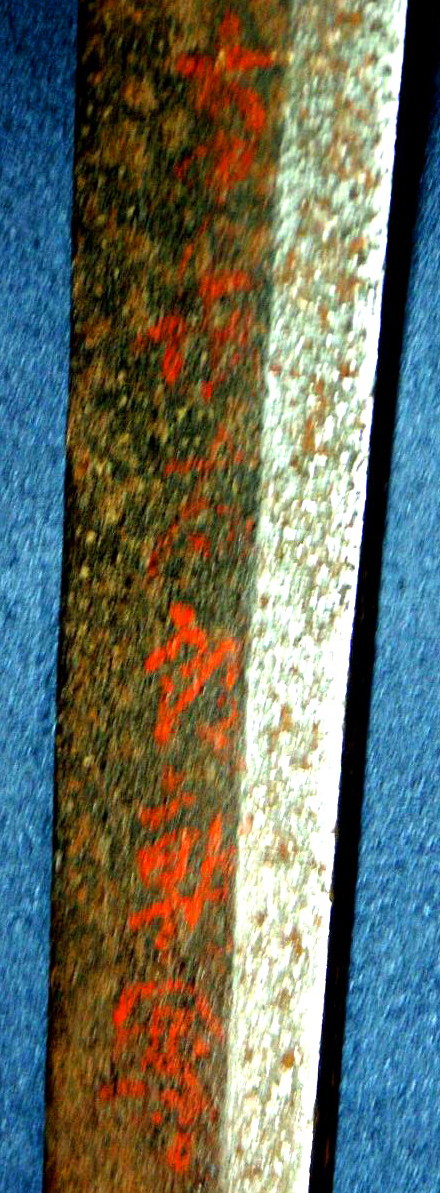
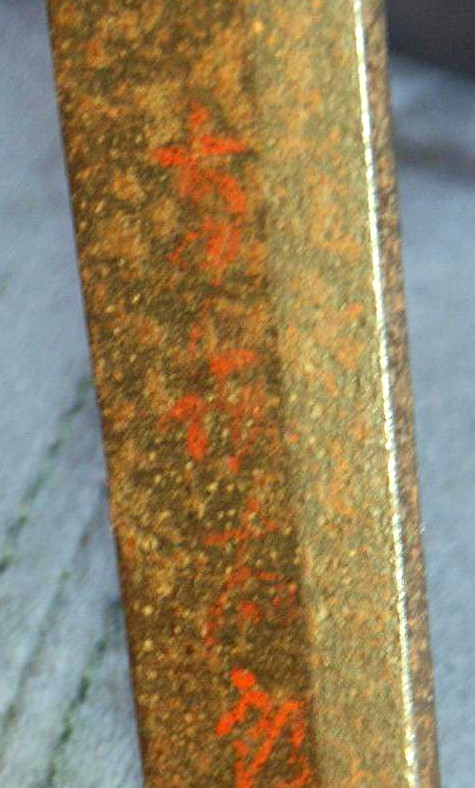
Jason, The signature reads, "Noshu Seki no Ju Kanehiro Saku", made by resident of Seki, Mino Province, Kanehiro. The red characters are the nimber 2005 followed by 4. The numbers are for inventory purposes. The Showa Arsenal stamp above the signature guarantees that the blade dates to the WWII era (late 30s to 1945). Grey
-
Hi Dave, The mei reads "Higashiyama Ju Yoshihira". If it is right the blade dates to about 1681. Bad kizu (defects) on the blade, which could mean: polished too many times and worn out, gimei of a good smith on a bum blade, or retempering. Proceed with caution. Grey
-
Correct me if mistaken, but I don't think there is any way to classify a sword as Mantetsu unless Mantetsu is signed on the nakago. The use of Manchurian iron doesn't give the blade any special attribute different from a blade made with other iron. Mantetsu blades fetch a higher price because of the label, not because of quality. If the sword doesn't have the label it shouldn't sell at a premium. Grey
-
Met Show
Grey Doffin replied to Pete Klein's topic in Sword Shows, Events, Community News and Legislation Issues
Thanks for the list, Pete; I've been wondering when it would be made public. It's my understanding that not all objects will be on view through the whole run, that some will be rotated in & out. Maybe the Met would know what/when if someone wanted to see a specific item. If you have an interest in Nihonto and you can possibly get to New York for the show, go. The importance and quality of the items included is exceptional. The O-Kanehira is one of the 5 great swords of Japan. The Bizen Saburo Kunimune Kokuho tachi is likely the one that Dr. Compton found and returned to Japan and is supposed to be spectacular. Once in a lifetime is a cliche but it wouldn't be out of place if used to describe this show. Grey -
Moriyama-san and Nakamura-san, Thank you for your help. Grey
-
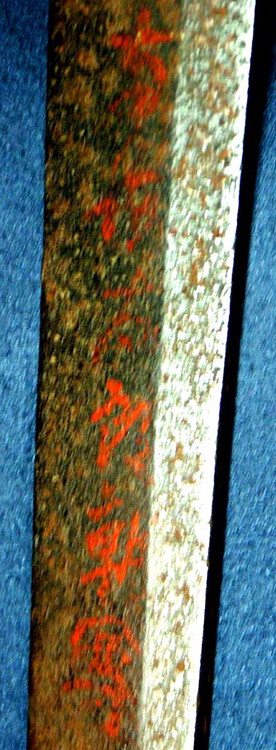
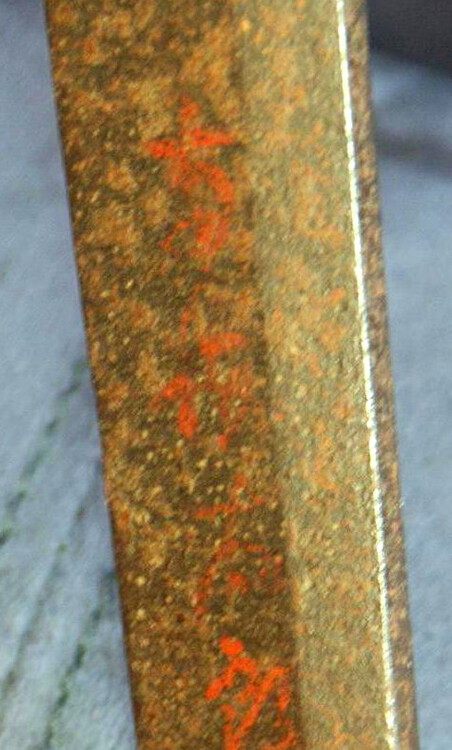
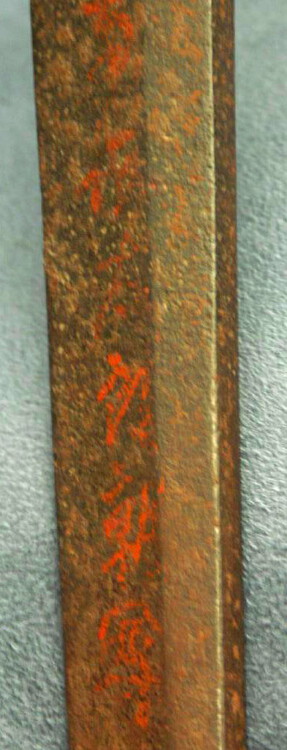
Hi guys, 6 Kanji I think, the 5th might be Kane. Can you tell me what this says? The 1st picture, which you may have to click to open, is probably the best. I've played with color and saturation to make it more readable; this isn't the real look of the nakago. And the sword will be for sale, if anyone cares about that. Thanks, Grey
-
Hi Charlie, The 1st Kanji in Idzumi is partially missing, but not so much that it is unreadable. With practice you'll recognize the Kanji; it's not that difficult. You need a set of my flashcards (if I may be so brazen). The Kanji were chosen to be relevant to sword signatures, they are written, not print, so they more closely match what you find on swords, and no other way I know of will teach you as quickly. Grey
-
Idzumi no Kami Kanesada. Grey
-
Kasumi do.....polishing question
Grey Doffin replied to undermilkwood's topic in General Nihonto Related Discussion
Hi Joe, I realized when I clicked on "Submit" that you might take offense with my posting, but the point I was trying to make called for clarity, not diplomacy. This is a forum about Nihonto; I assumed that was what you were getting at. Had you said upfront that you planned to polish blades you make I wouldn't have answered; you can do to them as you like. Any case, sorry for my share of the misunderstanding. Grey -
Kasumi do.....polishing question
Grey Doffin replied to undermilkwood's topic in General Nihonto Related Discussion
If someone has proper training to polish Nihonto he will know which stones to use and when to use them. If he doesn't have proper training he should leave polishing to those who do. Grey