Grey Doffin
-
Posts
4,235 -
Joined
-
Last visited
-
Days Won
31
Content Type
Profiles
Forums
Events
Store
Downloads
Gallery
Everything posted by Grey Doffin
-
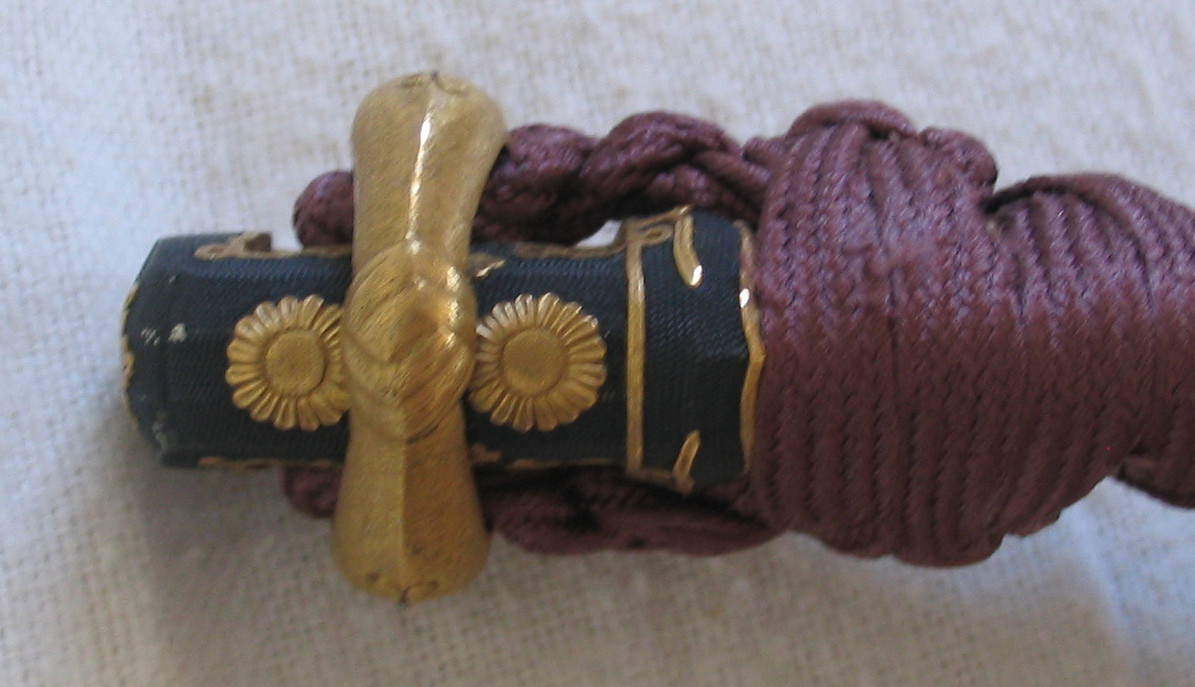
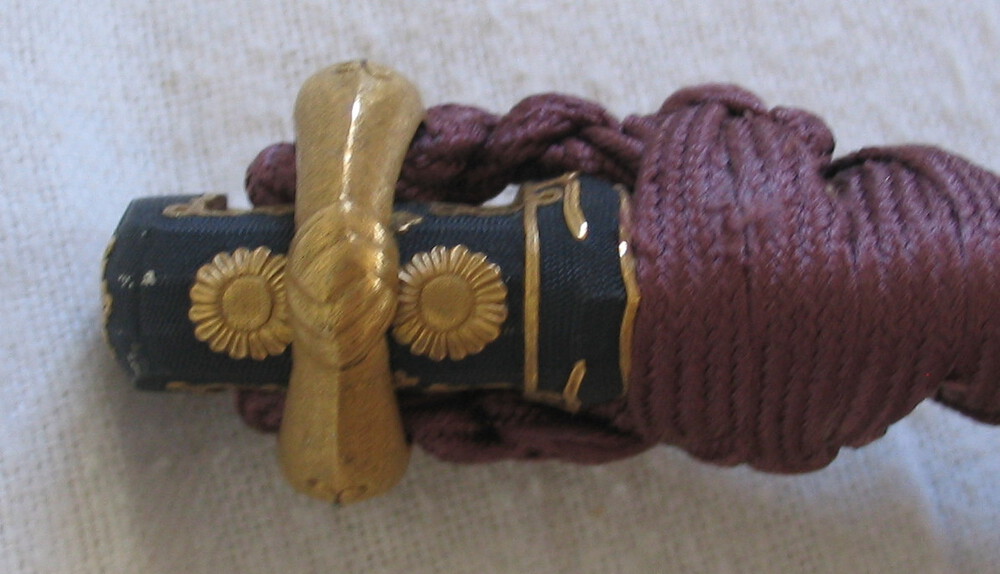
Here is a picture of a sarute from an itomaki no dachi koshirae, from Meiji or not much earlier I believe. This isn't clasping hands but something similar. Is it possible that the gunto sarute was developed from the earlier design? Grey
-

Emura vs. Nagamitsu (Ichihara)
Grey Doffin replied to SwordGuyJoe's topic in Military Swords of Japan
Hi guys, Before I get to what I have to say, I want you all to know I'm not trying to make enemies (I have enough already) or ruffle feathers, and I'm glad you all collect what you do because I don't need more competition for what I collect, but I don't get it. 25 years ago when I first discovered Nihonto I could sell a gunto for $300. If it was signed "Nagamitsu" or "Emura" (didn't matter which; they were considered to be the same guy) I could sell it for $400, because of the story about him being a prison warden with a smith at the prison training the prisoners. The $100 premium wasn't due to quality; a gunto was a gunto. It was only because of the story. Is the value really there? For $3,000. you can buy a papered, in polish wakizashi by a decent Shinto smith. You can buy a Sue-Koto katana. You're not even sure all of the blades signed Nagamitsu/Emura were made by one or 2 smiths; these things are so common (at least they used to be) that some of them might have been made by others. Is the quality really there? Well, if nothing else maybe I've brought some excitement to the site. I've put the target on my back; feel free to open fire. Grey -
Just learning, need some direction.
Grey Doffin replied to Spyrochiro's topic in General Nihonto Related Discussion
About restoration: A proper restoration (polishing of the blade) is expensive, at least $2,000. I would recommend against a polish unless and until you decide you're going to get serious about Japanese swords and learn proper care and handling. Every polish, which is done with stones, removes some of the steel and eventually, after one too many polishes, some of the core steel of the blade shows through the diminished skin steel (we call this tired; it decreases value and artistic merit). Beginners have a tendency to muck up new polishes with scratches, dings, and fingerprints, and when the blade passes on to its next owner he wants it in polish and the blade has to suffer through another one. A polish isn't necessary for preservation; a very light coating of oil is all that is needed. Here is a link to a sword care and etiquette brochure that explains all: http://www.nbthk-ab.org/Etiquette.htm Grey -
Here's a neat trick for determining the age of kin zogan (gold inlay). When the inlay is done the gold and surrounding steel will be at the same height. With time, the steel corrodes and expands a tiny bit; gold doesn't corrode so it stays the original height. If you can't feel a very slight difference in the 2 metal's heights, you can assume that the zogan was done relatively recently. Grey
-
Pawn Shop Find having hard time translating
Grey Doffin replied to Avolow's topic in Translation Assistance
Avolow, I can second what Reinhard said about study; there are no short cuts to understanding. That said, I do have a guide to fakes on my ebay ME page that should help a bit with the more flagrant fakes you're likely to come across. You'll find the guide here: http://members.ebay.com/ws/eBayISAPI.dll?ViewUserPage&userid=greyguy0 Grey -
Hi Rob, I'm sure also that way back a Samurai sword didn't come with shira-saya. The sword was bought as a weapon, to be used as a weapon, and mounted accordingly. Now, though, when you give a sword to a polisher you usually ask for shira-saya. Old, used sayas usually have dust, grit, or worse inside and reinserting the newly polished blade is asking for scratches. It is possible to split, clean, reglue and reuse an old saya (shira-saya for sure; not sure how easily this could be done to a lacquered saya). I've had this done when the old saya had an old and valuable saya-gaki. Another thread on NMB raised the question, "when did shira-saya first come into play?" I'd love to hear the answer. When high ranking Samurai of Edo time had more than one set of koshirae per blade, did they also have shira-saya for the blade? Any case, that's what I think I know. Anyone else think they know different? Grey
-
May I be so bold as to offer an even less expensive but just as genuine, communicative, and trustworthy source of tsuba: http://www.militaria.co.za/nmb/viewtopic.php?f=4&t=5336 which are the 30 tsuba I have listed on NMB's for sale group. Grey
-
Hirotoshi. Grey
-
Questions regarding nihonto
Grey Doffin replied to edzo's topic in General Nihonto Related Discussion
Hi Ed, The answer to all of your questions is to spend about 10 years in serious study; then you'll know how to do what you want. It won't be possible for someone at your level of expertise (judging by the questions you've asked; no offense meant) to properly catalog and appraise the collection. There are no short cuts to experience. You need help from someone both knowledgeable and honest. Best of luck. Grey -
"Papered" (Yeah right) Chinese Blade...
Grey Doffin replied to SwordGuyJoe's topic in Auctions and Online Sales or Sellers
Ian, it is proof of exceptional versatility. Should you be walking through the dark woods and you're attacked by a brigand or 2, you have the sword to protect you. What's more, on that same stroll through the dark woods, if nature calls, you have paper. Grey -
samurai sword 1450-1550 a.d.
Grey Doffin replied to snatch13's topic in General Nihonto Related Discussion
Here's a link to sword care and etiquette: http://www.nbthk-ab.org/Etiquette.htm Grey -
I don't think we want to tell anyone to give a nakago a good cleaning. Traditional ink stone and paper oshigata aren't difficult and don't require messing with the nakago. There is no reason to use soot. Grey
-
I agree with Kunitoshi for the 1st oshigata. I haven't translated the others but I notice that they appear to have been made with the soot and cellophane tape method. This isn't good practice, as the soot will change the patina of the blade's nakago. Ink stone and fine paper do a better job and they do no damage to the sword. Grey
-
To my eye, the seppa-dai isn't off. I think the kotsuka hitsu-ana is what's making the difference. Grey
-
Bonhams sale - San Francisco
Grey Doffin replied to Baka Gaijin's topic in Auctions and Online Sales or Sellers
They have the signature on the blade wrong also. Reads Kane something. I have no idea why the semi circle cut out of the nakago; can't even think of a slightly plausible explanation. Someone please enlighten us. Grey -
TAKEDO OTOJI - I don't think so...
Grey Doffin replied to SwordGuyJoe's topic in Translation Assistance
How about "Takeda Takatsugu Saku"? Might the seller be giving the Chinese reading of the Kanji? Grey -
No blade worth collecting was ever machi-okuried to fit into an existing shira-saya; never happened. This sword is nothing you want to spend any money on. Grey
-
Hi Justin, San Francisco every August, Tampa, FL every February, and Chicago every late April, early May. Grey
-
Long (62 cm) Ken in China
Grey Doffin replied to SwordGuyJoe's topic in Auctions and Online Sales or Sellers
Hi Joe, Appears to be a real Nihonto. Don't know anything about the smith; he might be the one in my index with a 1989 date. Picture 3 shows a close up of what might be a ha-giri (crack in edge) which would be a fatal flaw. Grey -
Please help me identify my newest sword.
Grey Doffin replied to Mcgee's topic in Translation Assistance
Showa Arsenal stamp, signed Yoshi something. and dated Showa Ni Ju ..... I'm sure others will fill in the blanks for you. I'll tell you that you should waste no time in making a new mekugi for this sword. Without a mekugi to lock the blade in its tsuka, the blade can move down inside the scabbard and shatter its point. Grey -
The nakago looks no earlier than Shin-Shinto, maybe even Meiji. The Bonji seems out of place to me. Sometimes horimono was placed to cover a defect in the blade. It looks like there is a patch of rough steel along side the Bonji; possibly there was a blister that needed to disappear. I could be wrong about this, and a nice looking piece regardless. Grey
-
Excuse me but this is getting nuts! We're supposed to be about preserving Japanese swords and we have this person with zero experience tapping on blocks of wood with rubber headed mallets and heating the habaki with a butane lighter? And towards what end? To get the habaki loose? And what good will that do anyone? Enough already! Leave the poor sword alone. All that is necessary to determine what Lori has is a good, in focus photo of the nakago. Grey
-
Yes. Grey
-
I agree, Joe. There are too many openings in some of the wrong places to justify the expense. What's more, no reason why the blade can't be enjoyed as is; the present polish is in good enough shape to show what there is to see. A common misconception is that polish is necessary to protect the blade; unless active rust is involved this isn't the case. Sometimes, and I believe this is one of them, well enough is best left alone. Grey (not too far from you, in Minnesota)
-
chinese are getting worse
Grey Doffin replied to raven2's topic in Auctions and Online Sales or Sellers
Ebay will tell you, and I agree with them, that they can't be checking each of the millions of auctions up at any given time to see which are legit and which are less so. And how would they know even if they were to try? I don't want some knucklehead at ebay deciding if my items are the real thing. What would be nice: if ebay let us search the world except for items located in specific countries. Wouldn't it be great to search "Japanese sword" located anywhere but China, Thailand, and Pakistan? Grey