


runagmc
-
Posts
1,198 -
Joined
-
Last visited
Content Type
Profiles
Forums
Events
Store
Downloads
Gallery
Everything posted by runagmc
-
The detail in the figure on the Omori piece is INSANE. I agree that technical skill and artistic vision are two seperate things, but for me, there's that much more to appreciate when the two come together. For instance, the figure on the Omori tsuba could have been just as much of a success as an artistic expression, with less detail, and without such a high level of difficulty... but the level of difficulty makes it all the more awe inspiring, in my opinion. Not only can you enjoy the artistic vision at first glance, but then you can look closer and marvel at the degree of skill and craftsmanship. Good thread :D
-
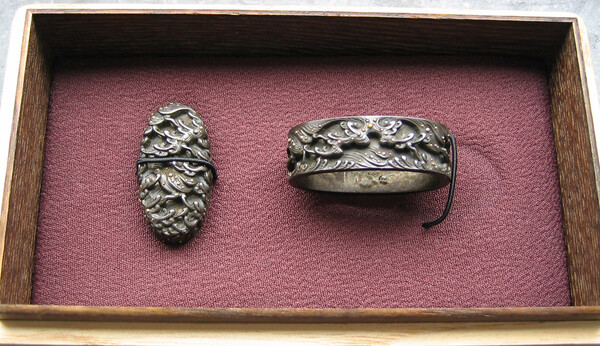
In my opinion it would be far easier to carve these deep recessed carvings in solid material rather than any mix of inlay (to build higher areas) and carving. That would just be adding even more difficulty and steps the way I see it... Mike_that's an amazing piece... Edit- If there's only a few high points that will stand well above the ground, obviously inlay will make the job easier... but when the whole piece is full of high and low points, like the fuchi kashira I posted, carving out of solid material would be the way the to go...
-
-
Christian, what do mean by (Think Tank!)-is the motto... and when you say don't shoot the messenger, I assume you are insinuating that some people are unwilling to give up the idea that these were made by mirror makers. Is this the case, or have I completely misunderstood? :?
-
I'm completely ignorant of this subject, so my first question would be... what COULD these have been originally, before being converted for use as tsuba? Any ideas? Could they have been used on polearms originally?

-
The first thing that came to mind is a famous tanto by Shintogo Kunimitsu done that way... Second, I found an Osafune Masmitsu done this way... Third, an Osafune Sukesada done the opposite way... I don't know if any of this will help you, but here it is anyway


-
The blade in the pics you posted looks like a typical Chinese fake to me...
-
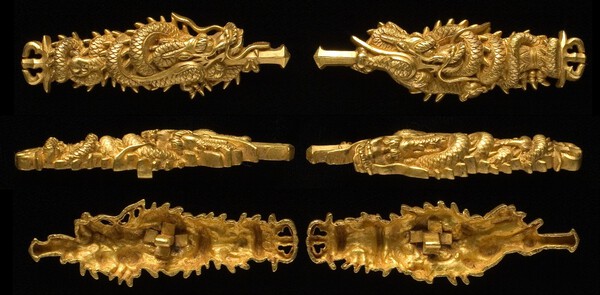
Here's some almost identical to yours...
-
Can a (hand made) military weapon have artistic value? This is the counter question you should ask yourself... Of course, as Chris says, this question cannot really be answered unless you have seen them in hand, for yourself, rather than relying on other people's (possibly uninformed) opinions...
-
Ford, just for my own interest, why would you not remove the patina completely on both fuchi and kashira and repatinate everything? I assume it's because you want the pieces to remain in their original state as much as possible... Or would doing it that way just be more work?
-
Ken, I would call that unokubi zukuri... and I agree with Veli, the second sword posted has been reshaped after the kissaki broke...
-
Maybe that's what they mean by "weak" and "poor" steel... the actual material (steel) may not be weak or poor, but the forging has left it weak...
-
Here's info on how to view the hamon... http://www.ksky.ne.jp/~sumie99/hamon.html
-
They don't say that it failed Hozon shinsa, only that they can't guarantee it will pass... at least that's the way it reads to me. There's no way to know if it was ever submited. If they thought it was shoshin mei, I would think they would have submited it, but who knows. And yes, I'm sure the lack of Hozon papers affected aoi-art's asking price...
-
I noticed that too, Chris. Since it's showing some ware, and the OP says it has thin kasane, I'm wondering if it has lost a lot of material from polishing... I think the look of funbari is due to the polishers trying to keep the hamachi... Also looking at the shinogiji, it looks like the faces of the sword have been shaped unevenly, maybe...
-
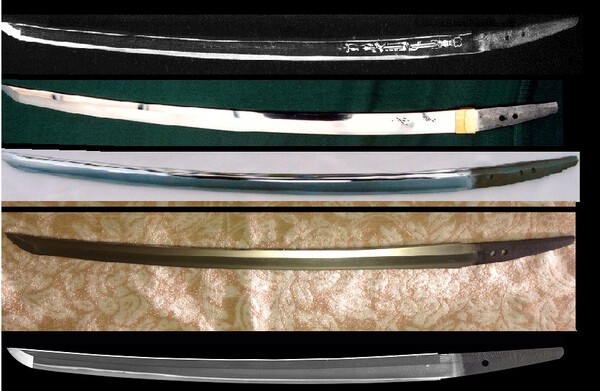
Here's a Shinto Bungo Takada wakizashi added to the comparison pic...
-
In the first pic of Henry's last post where you see the two kozuka, one on top of the other, I think I actually prefer the overall composition of the piece, and the style of waves, on the Mitsutaka. For me, the only negative is the apparent lack of control of the cuts. They almost look like they were done freehand, and in a hurry... or like the person who did the work had a good artistic vision, but his skills with the chisel were lacking...
-
Personally, I think the style of the waves, and the way they were layed out, is nice - it's just the rigidness of the chiseling, the lack of flow in the cuts, that aren't what I would expect from a master craftsman. I realize I'm not saying anything that hasn't been said already - I'm just agreeing that the craftmanship doesn't appear to be at the level you would expect, and that I don't think the critical opinions expressed are due to a lack of understanding or appreciation... Thanks to Mike for your posts. They are always appreciated... :D
-
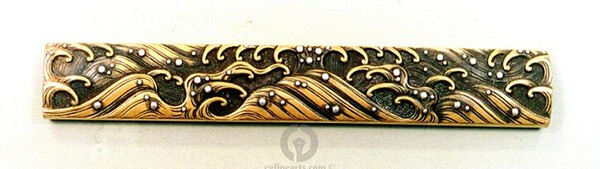
Here's a pic of a wave motif kozuka I like... :D
-
Ford, on the first pic you posted, they look like different styles of waves, which I wouldn't expect to see right next to each other... Is this a pic of a piece of tosogu, or a demonstration of different styles?
-
Not bad mounts and nice suguta...
-
An older sword would usually show less thickness in the mune, compared to the nakago mune, due to the number of polishes it would've likely received... In other words, you can tell this sword has seen very little polishing and is probably not so old...
-
You mean the mix-up between tight and small/ko... I assume... I don't think I've ever seen the term "loose" used to describe a ko-hada... I do understand your point though... And thanks for the good pics Paul...
-
Chris, anymore pics of the whole sword?


