


Justin Grant
-
Posts
663 -
Joined
-
Last visited
Content Type
Profiles
Forums
Events
Store
Downloads
Gallery
Everything posted by Justin Grant
-
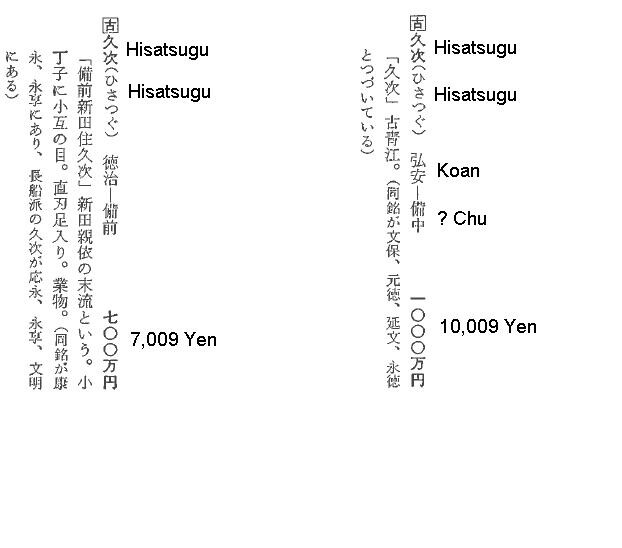
Hi all, I am looking for information on a Muromachi era smith Hisatsugu, two kanji mei. In my Toko Taikan book, I found the following page on 514. It lists two Hisatsugu, but I am unable to understand what is written. I have attached a scan of the page if someone can help me. I am not even sure if these two references are the same Hisatsugu. I attempted to translate what I could, but it too could be wrong... Thanks! Justin
-
Any one else get this?
Justin Grant replied to Stephen's topic in General Nihonto Related Discussion
Well, that did not work. I get an error message in Italian, and I assume it says we can't download more than 4 images and I got all of the blade pictures but not the inscription... The last photo... Sorry. -
Any one else get this?
Justin Grant replied to Stephen's topic in General Nihonto Related Discussion
I will grab them, resize them, and post here. Give me a few. -
Any one else get this?
Justin Grant replied to Stephen's topic in General Nihonto Related Discussion
Since I am at work, and have every AV tool known to mankind, I opened the link and the photos. They are "virus" free. I opened each of them except for the zip file. Each image is 3.5+ MB each, this may be why they used Jumbo Mail to post the pictures. The nakago has a large inscription, to which, I am not qualified to read. Justin -
It is my understanding (in reading) that this is not the case. The only NT's on register are in country, if an item is not accounted for, it is removed from the list of NT's. If it reappears, it is not "kept". It is somehow listed on a register as to its location. But I do not believe it is kept. I also read where if a NT is offered for sale from a private collection, the GVT gets first option at purchase, so these items are usually listed for sale at the end of the fiscal year so money is tight reducing the option of the GVT purchasing it. I could be wrong, but this is what I read on several sites that offer Shinsa services.
-
Could be a bad gas welding job, but not a "wire" welding job. I would lean more towards a hammer weld or forging. My guess is a thin or broken nakago at one point.
-
There is some truth to this. In the racing business, we use billet forged cranks. If you set/stand the crank on the flywheel flange, you can take a screwdriver and "whack" a through. It will ring like a bell. However, if it has a crack in it, it will thud. This is how we field check them. Also, there are a lot of Chinese fake cast cranks (yes racing too) that are machined to look like billet forged, and if you pull this test on them, they thud when you "whack" them. Not a perfect test, but it helps weed out most junk.
-
Please pardon the interruption, but I have been conversing with Cristian Laiber about a purchase and the e-mail now gets returned. If you know how to get in touch with him, let me know. Justin
-
A little help with a Kagemitsu
Justin Grant replied to Marked Hamon's topic in Translation Assistance
I don't have a dog in this fight, but let me say this. Moss and Dave / Simon, have issues. I don't understand the reason for the issues, but they are life. If they want to stand in front of each other measuring their members, so be it. I just don't want to be privy to it, and or the results. I enjoy the topics they both bring to the table. I enjoy the results of the actual conversation, just not the white noise. As for people using real names, I am using my real name... Justin -
As a "newbie" , let me put my 2 cents into this. Most new comers find this site or any informative site after the fact or in the last minutes of the final decision of a purchase. Most have "longed" for a purchase and have let the desire simmer on the back burner until some point in life when an opportunity presents its self and the purchase is made. I realize that the first thing any new comer will need to do is purchase a collection of reading material, and start the basic education. To someone that has never studied nihonto, the terms can be off-putting. Nakago, Tusba, Sori, Mei, etc. Lets face it, people jump off buildings and hope they sprout wings on the way down, few, if any, sprout wings first. The FAQ section is a great idea. When I purchased my blade, I did so without the benefit of advise before hand. If I had this information, would I have made my purchase, maybe.. But I did use the information after the fact to ensure I did not have a fake, but I was lucky.. I also would like to see a FAQ that is balanced and equal. Some collect for the pristine, some for the history, some the militaria aspect, so I would like to see all reasons to collect represented in a FAQ. Telling someone that a battle scared koto era blade is not worth collecting is passing your beliefs and style onto them. Allow enough information so they can decide what they want to collect. Make the information easy. The "Who, What, When, Where, Why, and How Come". A book listing is also a good thing, but realize, people usually find this place after a purchase in the course of researching what they already own. Be kind, be understanding, and be welcoming. There are a million ways of telling someone they purchased a fake, or "junk" that can be educational without making them feel bad. They will have that feeling by themselves, and need your support to keep them interested and moving forward. Telling people not to buy off Ebay when there is a sub-forum with Ebay in the title is also confusing. Maybe the FAQ about Ebay purchases should read, "Ebay Nihonto Purchases for Advanced Collectors". I have seen a lot of "don't do's" about Ebay, and then see where other "experienced" collectors talk of purchases and the one that go away. I guess this boils down to this, a lot of the new people find this site after a purchase is made, so make the FAQ easy to find, easy to navigate and informative. Justin
-
Hi Ray- I was raised Nichiren Shu, I understand Nichiren carried one for protection, and after his death it was in a shrine, but don't know much more. I was told by a priest that he doubted Nichiren would have carried one, he was not a man of voilence, even if to protect himself. So I don't know. I can't read the web page Morita-San referenced. My Japanese reading skills are not that good anymore except for prayer. I have also seen "warrior monk" "Samurai" armor with "Namu Myoho Range Kyo" inscribed on it, and wondered if this is somehow related to the Daishonin Interested to know more!
-
Various items...
Justin Grant replied to Justin Grant's topic in Auctions and Online Sales or Sellers
Thanks guys! I have no intention of purchasing, my other full-time hobbies (racing) has started and I am focused, financially and other wise on it. Just thought I would pass it along. I do appreciate the information. Justin -
I showed this picture to several master carpenters' who are remodeling my office. Once called it "ringed" and the other called it horizontally fluted. These seems to be rather simple but "westernized" description for a rather complex word. Just our Midwestern USA translation. Your mileage may very…..
-
If this is the wrong area, Mea Culpa, no harm intended... I found some Meiji era items for sale Uchiko "Tool Box" http://www.kurayaantiques.com/cgi-bin/w ... 30&I2.y=15 War Fan http://www.kurayaantiques.com/cgi-bin/w ... 43&I2.y=12 Just saw these on my browsing...
-
I realize this is not directly related to the translation of Mei, but I have a question in terms of translation or reading Kanji that I am hoping some of you can help me with. Is there a rule (grammar) when you use the Chinese Reading of a kanji (on'yomi) and when you use the Japanese Reading of a kanji (kun'yomi)? I know names are also a completely different thing all together, but I am stuck! Thanks Justin
-
150 year old samurai humor....
Justin Grant replied to jason_mazzy's topic in Auctions and Online Sales or Sellers
Ruefully shaking head….. -
Thanks guys. Memorizing Kanji is one thing, reading and applying is another!
-
So Showa starts in 25? I took 26 as the starting year and added 19. So, that is why the date did not look right to me.
-
Without giving it away, I have the date, but it does not fit, so I am going on the assumption that I have the start date off. If someone can PM me or post the starting date, I can add the rest and continue my studies! I love this section, it really helps my learning of Japanese!
-
Hi Colin- I have e-mailed, but no response yet. Just checking my facts before I have a detailed conversation. Thanks! me
-
John- Thank you for the link. Still leaves me to question the time issue on this one. I would gather from the article that most all were lost to time, so for this one to survive would be odd. HUMMMMM
-
I was browsing some links on this site and was taken to a site that had a collection of tsuba, one being a leather tachi style and very nice (in my opinion). The site referenced this as a Momoyama to early Edo piece, but the research I have been able to look up reference them as mid to late Edo. Being a novice, I am looking for opinions. I love the look, just not sure on the timeline. http://www.yamabushiantiques.com/BM_Ner ... 0Tsuba.htm
-
An Interesting 8 Monme Tanegashima
Justin Grant replied to watsonmil's topic in Tanegashima / Teppo / Hinawajū
Maybe I'm lost, not all that uncommon, but I have a question... Why would there be a Nichiren Shu mon on this Tokugawa supported weapon? The Tokugawa Shogunate persecuted the Nichiren Shu sect, up to and including, removing the noses and ears of the head priest and some of this followers, and putting many of them in exile. Makes it all the more strange for me. Maybe I am missing something. Justin -
An Interesting 8 Monme Tanegashima
Justin Grant replied to watsonmil's topic in Tanegashima / Teppo / Hinawajū
Edited my post with Google's version -
An Interesting 8 Monme Tanegashima
Justin Grant replied to watsonmil's topic in Tanegashima / Teppo / Hinawajū
Not perfect, but from: Babel fish http://babelfish.yahoo.com/translate_ur ... =Translate Parallel crosses/well curb crest It changed from the wooden uniting of the terrestrial part of the well, It is known as the crest of one person well Italy direct government of Tokugawa Ieyasu four Tenno. Small parallel crosses In circle well curb In parallel crosses chrysanthemum The part or the wooden uniting which has appeared in the ground of the well is called the well curb or the parallel crosses. The well was the important place which praises the water, polluting, was the place where is not good. In other words, it is thought that it reached the point where it is used from the fact that it is essential to life, as the house crest. In addition, also simple clear thing of the letter, “well” probably is suitable in the crest of the samurai. Natural shape of the letter of the well those which raise “the well curb” and corner are called “the parallel crosses”. In any case being something which translates into design the letter “of the well”, the Inoue Sakai Hanai scene well Ishii and the like houses have used. It is something which just displays the name letter. As an old record, the fact that “Bunsho description (Bunsho first year =1466 formation)” the worth normal Osamu's who is the Asakura heavily retainer child, the hardware of the gold and silver which inlays the parallel crosses of the house crest in the arms of thousand chrysanthemum circles is used, is something which is recorded. The crest of the worth person the parallel crosses has been visible even in the “knowledge house crests'. In addition the Ishii Nagai crest is recorded in the house crests, any Nagai things are the design which places the parallel crosses in Agemaki. Furthermore the well Italy of the river house crest shows spirit distantly with “the letter crest of the well” of the writing body. “The letter crest of the well Italy well” was changed into the geometric well curb crest afterwards. The well Italy house appeared distantly from the river national Inasa well group Italy 荘, but as for that ancestor/founder have the legend that it is it was born from the well. The well Italy 荘 it was close to the Hamana lake, there being a name well, the person utilized in many. Simply it was called “the well”, but because you call the good well, it became “[ii]” and you say that the well Italy letter was applied. At the time of a certain, the conversion person who holds a child appeared from in this well, put the orange on the side of a child and disappeared. The flamen of the well valley Yawata shrine was surprised to the tearful voice of the baby, raised carefully as a God giving. You say that this is the well Italy ancestor, the house crest is the origin which is made “the orange in the parallel crosses”. Dividing with the orange and the parallel crosses into two, it used afterwards as the respective house crest. Furthermore, the orange attaching the circle, has become “the orange in the circle”. The temple crest of the Nichiren sect as is known “in the parallel crosses the orange”, but you call the thing which is adopted from the legend, the person on Nichiren of the sect ancestor/founder well Italy tributary. As for having become the cause, the well Italy direct government which four Tenno of Ieyasu's Tokugawa is one person with the ancestor/founder of interest in the well Italy house has been converted to the Nichiren sect. What we assume that the person on Nichiren came out of well Italy, probably is attaching meeting of future. There was with a scene well person and Nagai in the samurai who uses the parallel crosses. These both houses had done at the adoption looking together with the worth Takeda's servant. In other words, the younger brother good fortune righteousness of scene well 昌 length, became Yosinari's Nagai adopted child. Commemorating this, piling up the letter “of the well” of both houses, as for the scene well person when “you piled up and parallel crosses” Nagai made the “group parallel crosses” it conveys. In addition, there is a crest which is called “to the parallel crosses the chrysanthemum”. It is known as the direct retainer of the shogun Natume's crest after that it is something which also Souseki Meiji master writer Natume uses with the 裔. But, as for the parallel crosses part of this crest originally being something which expresses the fence, “籬 ([magaki]) the chrysanthemum” is correct. The 籬 was simplified, being complicated, from the fact that it is difficult to draw, gradually finally became “the parallel crosses”. You probably can call the story which displays the phase where where the house crest keeps changing. Google's Version Curb / crest Izutsu 井戸の地上部分の木組みから転じた、 From the ground portion of the well turned wooden frame, 徳川家康四天王の一人井伊直政の紋として知られる。 Known as one of the Four crest of Tokugawa Ieyasu, Masashi Tadashi Ii. 細井桁 Hosoi digit 丸に井筒 Round Izutsu 井桁に菊 Chrysanthemum curb 井戸の地上に出ている部分、あるいはその木組みを井筒、あるいは井桁と呼んでいる。 Out of the ground portion of the well, the half-timbered or its Izutsu, are called or curb. 井戸は水をたたえた大切な場所であり、汚してはいけないところであった。 Well water is an important place tidy, but it was not dirty. つまり、生活に欠かせないことから、家紋として用いられるようになったと考えられる。 In other words, that can not live without, now considered to be used as a crest. また、「井」という字の単純明快なことも武家の紋にふさわしかったのであろう。 The "well" deserved to be the crest of the warrior character that is simple and clean also. 井の字の正体を「井筒」、隅を立てたものを「井桁」と呼んでいる。 The identity of the character well. "Izutsu", which set a corner to "curb" is called. いずれにしろ「井」の字を図案化したもので、井上・酒井・花井・駒井・石井などの諸家が用いている。 Anyway, "Well," which was a stylized character that used lesions by Inoue Sakai and Hanai, Komai Ishii. まさに名字を現わしたものである。 Which just showed up last name. 古い記録としては、朝倉氏の重臣であった甲斐常治の子、千菊丸の武具に家紋の井桁をちりばめた金銀の金物を用いるということが「文正記(文正元年=1466成立)」に記されたものである。 As the old record, was the son of Kai Tsuneharu Asakura's senior statesman, that the use of metal studded with gold and silver armor菊丸1000 to curb the crest, "Aya Masaki (Akira Aya-approved first year 1466)" The記which was. 甲斐氏の紋は「見聞諸家紋』にも井桁とみえている。また諸家紋には石井・長井氏の紋が記され、長井氏のものは総角のなかに井桁を据えた意匠である。さらに遠江の井伊氏の家紋は筆記体の「井の字紋」で勢いを見せている。 Kai's crest is "』 observation that various family crest to curb Apparently. The crest is also noted various Ishii Nagai's crest, which Mr Nagai is among the総角design and laid the curb. More Ii's crest of the cursive Toutoumi "well shaped crest," is showing momentum. 井伊氏の「井の字紋」はのちに幾何学的な井筒紋に替えられた。 Ii's "well shaped crest" was replacing the geometric Izutsu crest later. 井伊家は遠江国引佐郡井伊荘から発祥したが、その祖は井戸から生まれたという伝説をもている。 Ii family that originated from countries Inasachō Villa Ii Toutoumi county, the father is the face of a legend was born from a well. 井伊荘は浜名湖に近く、名井があって、多くに人が利用した。 Ii Villa is close to Lake Hamana, there was a name well, many people are using. たんに「井」とよばれていたが、良い井戸というので「イイ」となり井伊の字をあてたのだという。 Liked the "well" had been called, well I say good, "Ii" he said addressing the character Nearby Ii. あるとき、この井中より一子を抱いた化人が現われ、橘を一子のわきに置いて姿を消した。 At one time, holding a child of one person appears from this井中disappeared one child put aside Tachibana. 井谷八幡宮の神主は、赤ん坊の泣き声に驚き、神授として大切に育てた。 Itani Hachiman Shinto priest was surprised to hear a baby cry, grown in importance as a divine right. これが井伊氏の祖先であり、家紋を「井桁に橘」とした由来であるという。 Ii is said that this ancestor, the crest, "Tachibana to curb" and that it is derived. のちには、橘と井桁とを二つに分けてそれぞれ家紋として用いた。 Later, each divided into two for a family crest, and curb and Tachibana. さらに橘は丸を付けて「丸に橘」となっている。 With more Tachibana Maru, "Tachibana Maru" has become. 日蓮宗の寺紋は「井桁に橘」として知られるが、宗祖の日蓮上人が井伊氏の支流という伝説から取り入れられたものという。 Nichiren sect temple crest is "to curb Tachibana" As is known, are taken from a legend that a branch of the founder Nichiren Shonin's Ii. そのもととなったのは、井伊家中興の祖で徳川家康の四天王の一人であった井伊直政が日蓮宗に帰依したことにある。 The original was so, that devotion to Nichiren in the Masa Tadashi Ii Four of Tokugawa Ieyasu was one of the founder of家中興Ii. 日蓮上人が井伊氏から出たとするのは後世の付会であろう。 Ii he had gone out to Nichiren Shonin will add to posterity. 井桁を用いた武家に駒井氏と長井氏とがあった。 Mr. Nagai was a warrior for Mr. Komai curb. この両家はともに甲斐武田の家臣で養子縁組みをしていた。 These families had servants on adoption of both Kai Takeda. つまり、駒井昌長の弟吉正が、長井吉成の養子となったのである。 That is, the length Komai Masa Masa Yoshi brother, and was adopted by Nagai Yoshinari. これを記念して両家の「井」の字を重ねて、駒井氏は「重ね井桁」長井氏は「組井桁」にしたのだと伝える。 To celebrate this the two families, "Well," repeated the words of Mr. Komai the "curb repeated" Nagai said. "Curb sets," and he was telling. また、「井桁に菊」という紋がある。 The "curb chrysanthemum" There is a crest. 旗本夏目氏の紋として知られ、その後裔で明治の文豪夏目漱石も用いたものである。 Natsume's crest Hatamoto known, is also for the descendants of the Meiji writer Natsume Soseki. しかし、この紋の井桁部分は本来垣根を表現したもので「籬(マガキ)に菊」が正しい。 However, the portion of the curb This is a representation of a crest original fence "fence (Crassostrea gigas), chrysanthemum" is correct. 籬は複雑で描きにくかったことから、次第に簡略化され、とうとう「井桁」になってしまった。 Complex and difficult to draw from the fence, was gradually simplified, at last, "curb" became. 家紋が変化していく一面を現した話といえよう。 Appeared to one side and could say about the changing the crest.
