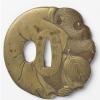
Kurikata Posted Saturday at 02:06 PM Report Posted Saturday at 02:06 PM Hi NMB experts, I think my new mumei tsuba might be classified as a Sendai Kiyosada school exemple (shakudo with gold inlays and specificlly gold around the hitsu ana). What are your views ? Thank you 2 1 Quote
Hokke Posted Saturday at 02:56 PM Report Posted Saturday at 02:56 PM Won’t hazard a guess on the school, but I don’t think there is any inlay there. Looks more like gilding to me. 2 Quote
Matsunoki Posted Saturday at 03:23 PM Report Posted Saturday at 03:23 PM Agree with Calabrese, this is not inlay work. I’m not totally certain that it is old. Apologies and I’m most likely wrong but I have seen modern pieces that are rather scary upon first glance. Also the nakago ana is similar to some “milk bottle” shapes found on modern items. I hope I’m wrong. No malicious intent. 2 1 Quote
Bugyotsuji Posted Saturday at 03:33 PM Report Posted Saturday at 03:33 PM It is giving me flashes of Nagoya-mono. 4 Quote
Spartancrest Posted Saturday at 10:45 PM Report Posted Saturday at 10:45 PM https://www.metmuseum.org/art/collection/search/27603 Ko-kinko ? 2 Quote
Jesta Posted Sunday at 01:10 AM Report Posted Sunday at 01:10 AM I don’t get modern vibes from this one. I would agree that it is not inlay, but gilding. You can see places where the gilding has not quite gone to the edge of the pattern, and other places where the gilding has worn through. My first thought on seeing the nanako was Nagoya-mono, but the colour is better than you normally get with that, so I am not sure. 1 Quote
Infinite_Wisdumb Posted Sunday at 02:10 AM Report Posted Sunday at 02:10 AM 10 hours ago, Matsunoki said: Agree with Calabrese, this is not inlay work. I’m not totally certain that it is old. Apologies and I’m most likely wrong but I have seen modern pieces that are rather scary upon first glance. Also the nakago ana is similar to some “milk bottle” shapes found on modern items. I hope I’m wrong. No malicious intent. Agreed many Kantei to Nagoya-mono, but the nakago Ana colors and punch marks dont align with historical MN examples poor Gilding and the size of the nanako suggest Nagoya however 1 Quote
Matsunoki Posted Sunday at 07:53 AM Report Posted Sunday at 07:53 AM 6 hours ago, Jesta said: but the colour is better than you normally get with that, so I am not sure. 5 hours ago, Infinite_Wisdumb said: many Kantei to Nagoya-mono, but the nakago Ana colors and punch marks dont align with historical MN examples poor Gilding and the size of the nanako suggest Nagoya however Have a look at the image below and the link to another topic. I don’t think the tsuba in question is a Nagoya-mono, I think it most likely brand new. It is really amazing the level of detail and the colouration that can be achieved now with silicone moulding etc. Perfect nanako isn’t a problem for these guys! Quote
MauroP Posted Sunday at 09:57 AM Report Posted Sunday at 09:57 AM Gents, there is a lot in between from Kiyosada school to Nagoyamono. The subject is very Japanese (shōgatsu-kazari straw rope and tachibana fruits). The material, from the images, looks fine shakudō. The nanako-ji, thought not outstanding, is far better than usually seen in Kyō-kanagushi. The gold gilding shows minor wears as expected from a piece 200 years old or so. So, why not an honest middle/late Edo Owari-kinkō or Kyō-kinkō? 6 Quote
Jesta Posted Sunday at 10:04 AM Report Posted Sunday at 10:04 AM 2 minutes ago, MauroP said: Gents, there is a lot in between from Kiyosada school to Nagoyamono. The subject is very Japanese (shōgatsu-kazari straw rope and tachibana fruits). The material, from the images, looks fine shakudō. The nanako-ji, thought not outstanding, is far better than usually seen in Kyō-kanagushi. The gold gilding shows minor wears as expected from a piece 200 years old or so. So, why not an honest middle/late Edo Owari-kinkō or Kyō-kinkō? I would agree on the wear pattern making it likely that this is old. A reverse image search doesn’t throw up any other identical pieces, so with that and the wear pattern, I am not convinced that it is new. If it is a fake, then I would expect to see more of them, and no wear on the gilding. IMHO: Edo period (probably late), and of reasonable quality. 3 1 1 Quote
ROKUJURO Posted Sunday at 10:32 AM Report Posted Sunday at 10:32 AM Could we discuss at all if this is a fake when it is MUMEI? Quote
Kurikata Posted Sunday at 11:47 AM Author Report Posted Sunday at 11:47 AM Thank you all of you for the time spent to analyse the pictures of my tsuba. I have to admit that providing an opinion with two pictures is quite a difficult exercise. As a summury (and because I have the tsuba in hands): - late edo [end of 19th century) - dark shakudo with an average nanako patern - light signs of usage around the sepadai - design is not common (tachinaba and strow ropes) Please let see herewith more pictures as all opinion are warmly welcome [even if I do not avoid the fact that a modern tsuba is not excluded) 2 1 Quote
Iekatsu Posted Sunday at 11:50 AM Report Posted Sunday at 11:50 AM (edited) You guys need to stop feaking people out. It is a legitiamate Tsuba, Edo period. It is a carved design with applied gilding. Gilding in not perfect, sometimes it is worn away and sometimes it goes outside of the lines. I would say clear Mino influence with this one. Edited Sunday at 11:52 AM by Iekatsu 4 3 Quote
MauroP Posted Sunday at 12:00 PM Report Posted Sunday at 12:00 PM 10 minutes ago, Iekatsu said: You guys need to stop feaking people out. It is a legitiamate Tsuba, Edo period. It is a carved design with applied gilding. Gilding in not perfect, sometimes it is worn away and sometimes it goes outside of the lines. I would say clear Mino influence with this one. I don't agree on Mino style, but consent on the general approach. 1 1 1 Quote
Iekatsu Posted Sunday at 12:18 PM Report Posted Sunday at 12:18 PM (edited) To be clear I don't think it is Mino, but I can see the influence in the general layout of elements, the shape of the Seppa-dai and the Hitsu-ana etc. Edited Sunday at 12:19 PM by Iekatsu 1 Quote
Jesta Posted Monday at 01:04 AM Report Posted Monday at 01:04 AM 13 hours ago, Iekatsu said: You guys need to stop feaking people out. It is a legitiamate Tsuba, Edo period. It is a carved design with applied gilding. Gilding in not perfect, sometimes it is worn away and sometimes it goes outside of the lines. I would say clear Mino influence with this one. Agreed on this. 1 Quote
Matsunoki Posted Monday at 12:58 PM Report Posted Monday at 12:58 PM No-one is trying to freak anyone out but with this type of kinko tsuba it is now worth looking twice. Also images can mislead in both directions. Using modern materials it is now possible to make a virtually perfect cast of any tsuba, no matter how detailed or fine the nanako or inlay is. Silicone moulding is now being used by some very clever and talented people (see the thread I linked to). That can include Sekigane and Tagane-ato reproduced exactly together with just about any other feature including scratches or other imperfections. Patination can be used to make sekigane look correctly inlaid in copper and usually needing a mag glass to detect. Also now it is possible to create a patina that scarily mimics shakudo but on plain copper or cheaper copper alloys and modern gold plating fluids create the impression of rich gilding when used with masking fluids that are able to work to minuscule tolerances depending on the skill of the “artist”. The things that made me hesitant (but I am pleased to be wrong) ….some of you mention/talk about wear pattern. I cannot see a wear pattern. Wear occurs on the high points. Not on small features hidden deep in the design. I see no wear to the high points. ….the plate itself is rippled …..the patina looks the same inside the Tagane-ato …..for a tsuba apparently mounted (more than once?) there is little wear to the seppa-dai or the rim ….some of the gilding looks flat and dull Having said all that I am very happy to accept that my doubts were unfounded and I bow to the more knowledgeable tsuba guys on here but can you please enlarge on…. 1. How is the plate made given there is no inlay? Simply cast as a thicker plate with the detail then carved down into it or a rough cast including the raised detail and then hand finished? 2. What type of “gilding” are we looking at given that it’s not inlay and it’s not foil? (And it doesn’t look mercurial) 3. why is the plate rippled? (To my eyes anyway) 2 Quote
Infinite_Wisdumb Posted Monday at 01:05 PM Report Posted Monday at 01:05 PM Send it to Shinsa for a definitive answer 😅😅😅😅 Quote
Hokke Posted Monday at 02:45 PM Report Posted Monday at 02:45 PM @Kurikatathe second set of pictures are definitely more crisp in close up.......if you get a chance id be curious to see the section I have boxed in red here in more focus. Quote
Kurikata Posted Monday at 03:21 PM Author Report Posted Monday at 03:21 PM Dear Calabrese [@Hokke], I have done my best ! Quote
Infinite_Wisdumb Posted Monday at 03:23 PM Report Posted Monday at 03:23 PM I stand by Nagoya-Mono assessment after more detailed pics 1 Quote
Matsunoki Posted Monday at 04:57 PM Report Posted Monday at 04:57 PM 1 hour ago, Infinite_Wisdumb said: I stand by Nagoya-Mono assessment after more detailed pics I’m veering in that direction also……but I hope someone can answer my questions above. Also, can you Bruno get a clear shot of the inside of the nakago ana…..looking for signs of wear from mounting? Quote
Kurikata Posted Monday at 06:32 PM Author Report Posted Monday at 06:32 PM Hi Colin [@Matsunoki], Here it is..(in my opinion, this tsuba has been mounted). Quote
Matsunoki Posted Monday at 06:47 PM Report Posted Monday at 06:47 PM The file marks in the nakago ana and the kozuka ana look exactly the same and rather rough and unfinished. Agreed there seems to be some slight wear inside the nakago ana but to my eyes this still looks doubtful. The light reflection makes it look like iron is showing through the patina in nakago ana but I know that it cannot be. Thank you for the images Bruno. I am sorry to be sceptical. 1 Quote
ROKUJURO Posted Monday at 06:53 PM Report Posted Monday at 06:53 PM 3 hours ago, Infinite_Wisdumb said: I stand by Nagoya-Mono assessment after more detailed pics NAGOYA-MONO TSUBA were mainly made in MEIJI and TAISHO eras, but I get the impression that this TSUBA might be younger than that. Quote
Hokke Posted Monday at 08:10 PM Report Posted Monday at 08:10 PM 4 hours ago, Kurikata said: Dear Calabrese [@Hokke], I have done my best ! Thanks for the attempt......so difficult to make out....trust me, I get how crazy hard it is to get the trifecta in photography - angle, lighting and focus. That nanako is poking me in the brain.....just something off....some of the spots where it looks like gold is missing, to me look like the opposite and the black is over the gold. All that said, im a novice in tsuba, so admittedly my opinion caries zero weight. 1 Quote
Jesta Posted yesterday at 01:20 AM Report Posted yesterday at 01:20 AM Wear points… (see below) I have seen rippled nanako like this before. I was wondering if it might be an applied layer. It is not great nanako, but looks like it was applied by hand. Quote
ROKUJURO Posted yesterday at 08:04 AM Report Posted yesterday at 08:04 AM Damage is not necessarily a sign of wear, and slightly irregular NANAKO is not a typical sign of hand-work. Quote
Matsunoki Posted yesterday at 08:08 AM Report Posted yesterday at 08:08 AM 6 hours ago, Jesta said: Wear points… (see below) That looks much more like damage than a wear pattern. Or manufacturing flaw? The rim is deformed, maybe it has been dropped. Or maybe someone decided to try and lever it upwards for unknown reasons. The more I look (closely) the more doubtful I become. Edo tsuba artists working in shakudo and gold/gilt/foil worked accurately and crisply. This tsuba has a lot of what I would call “sloppy” work. Again, apologies for negativity, just calling it how I see it. 6 hours ago, Jesta said: was wondering if it might be an applied layer ….as in San-mei construction (which I only encountered about a year ago)…..no evidence in the ana which is where it usually shows? 2 Quote

Recommended Posts
Join the conversation
You can post now and register later. If you have an account, sign in now to post with your account.