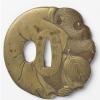
Kurikata Posted yesterday at 02:06 PM Report Posted yesterday at 02:06 PM Hi NMB experts, I think my new mumei tsuba might be classified as a Sendai Kiyosada school exemple (shakudo with gold inlays and specificlly gold around the hitsu ana). What are your views ? Thank you 2 1 Quote
Hokke Posted yesterday at 02:56 PM Report Posted yesterday at 02:56 PM Won’t hazard a guess on the school, but I don’t think there is any inlay there. Looks more like gilding to me. 2 Quote
Matsunoki Posted yesterday at 03:23 PM Report Posted yesterday at 03:23 PM Agree with Calabrese, this is not inlay work. I’m not totally certain that it is old. Apologies and I’m most likely wrong but I have seen modern pieces that are rather scary upon first glance. Also the nakago ana is similar to some “milk bottle” shapes found on modern items. I hope I’m wrong. No malicious intent. 1 1 Quote
Bugyotsuji Posted yesterday at 03:33 PM Report Posted yesterday at 03:33 PM It is giving me flashes of Nagoya-mono. 4 Quote
Spartancrest Posted 22 hours ago Report Posted 22 hours ago https://www.metmuseum.org/art/collection/search/27603 Ko-kinko ? 2 Quote
Jesta Posted 20 hours ago Report Posted 20 hours ago I don’t get modern vibes from this one. I would agree that it is not inlay, but gilding. You can see places where the gilding has not quite gone to the edge of the pattern, and other places where the gilding has worn through. My first thought on seeing the nanako was Nagoya-mono, but the colour is better than you normally get with that, so I am not sure. 1 Quote
Infinite_Wisdumb Posted 19 hours ago Report Posted 19 hours ago 10 hours ago, Matsunoki said: Agree with Calabrese, this is not inlay work. I’m not totally certain that it is old. Apologies and I’m most likely wrong but I have seen modern pieces that are rather scary upon first glance. Also the nakago ana is similar to some “milk bottle” shapes found on modern items. I hope I’m wrong. No malicious intent. Agreed many Kantei to Nagoya-mono, but the nakago Ana colors and punch marks dont align with historical MN examples poor Gilding and the size of the nanako suggest Nagoya however 1 Quote
Matsunoki Posted 13 hours ago Report Posted 13 hours ago 6 hours ago, Jesta said: but the colour is better than you normally get with that, so I am not sure. 5 hours ago, Infinite_Wisdumb said: many Kantei to Nagoya-mono, but the nakago Ana colors and punch marks dont align with historical MN examples poor Gilding and the size of the nanako suggest Nagoya however Have a look at the image below and the link to another topic. I don’t think the tsuba in question is a Nagoya-mono, I think it most likely brand new. It is really amazing the level of detail and the colouration that can be achieved now with silicone moulding etc. Perfect nanako isn’t a problem for these guys! Quote
MauroP Posted 11 hours ago Report Posted 11 hours ago Gents, there is a lot in between from Kiyosada school to Nagoyamono. The subject is very Japanese (shōgatsu-kazari straw rope and tachibana fruits). The material, from the images, looks fine shakudō. The nanako-ji, thought not outstanding, is far better than usually seen in Kyō-kanagushi. The gold gilding shows minor wears as expected from a piece 200 years old or so. So, why not an honest middle/late Edo Owari-kinkō or Kyō-kinkō? 4 Quote
Jesta Posted 11 hours ago Report Posted 11 hours ago 2 minutes ago, MauroP said: Gents, there is a lot in between from Kiyosada school to Nagoyamono. The subject is very Japanese (shōgatsu-kazari straw rope and tachibana fruits). The material, from the images, looks fine shakudō. The nanako-ji, thought not outstanding, is far better than usually seen in Kyō-kanagushi. The gold gilding shows minor wears as expected from a piece 200 years old or so. So, why not an honest middle/late Edo Owari-kinkō or Kyō-kinkō? I would agree on the wear pattern making it likely that this is old. A reverse image search doesn’t throw up any other identical pieces, so with that and the wear pattern, I am not convinced that it is new. If it is a fake, then I would expect to see more of them, and no wear on the gilding. IMHO: Edo period (probably late), and of reasonable quality. 2 1 1 Quote
ROKUJURO Posted 11 hours ago Report Posted 11 hours ago Could we talk at all if this is a fake when it is MUMEI? Quote
Kurikata Posted 9 hours ago Author Report Posted 9 hours ago Thank you all of you for the time spent to analyse the pictures of my tsuba. I have to admit that providing an opinion with two pictures is quite a difficult exercise. As a summury (and because I have the tsuba in hands): - late edo [end of 19th century) - dark shakudo with an average nanako patern - light signs of usage around the sepadai - design is not common (tachinaba and strow ropes) Please let see herewith more pictures as all opinion are warmly welcome [even if I do not avoid the fact that a modern tsuba is not excluded) 1 1 Quote
Iekatsu Posted 9 hours ago Report Posted 9 hours ago (edited) You guys need to stop feaking people out. It is a legitiamate Tsuba, Edo period. It is a carved design with applied gilding. Gilding in not perfect, sometimes it is worn away and sometimes it goes outside of the lines. I would say clear Mino influence with this one. Edited 9 hours ago by Iekatsu 2 1 Quote
MauroP Posted 9 hours ago Report Posted 9 hours ago 10 minutes ago, Iekatsu said: You guys need to stop feaking people out. It is a legitiamate Tsuba, Edo period. It is a carved design with applied gilding. Gilding in not perfect, sometimes it is worn away and sometimes it goes outside of the lines. I would say clear Mino influence with this one. I don't agree on Mino style, but consent on the general approach. 1 1 Quote
Iekatsu Posted 9 hours ago Report Posted 9 hours ago (edited) To be clear I don't think it is Mino, but I can see the influence in the general layout of elements, the shape of the Seppa-dai and the Hitsu-ana etc. Edited 9 hours ago by Iekatsu Quote

Recommended Posts
Join the conversation
You can post now and register later. If you have an account, sign in now to post with your account.