flemming
-
Posts
36 -
Joined
-
Last visited
-
Days Won
1
Content Type
Profiles
Forums
Events
Store
Downloads
Gallery
Everything posted by flemming
-
With respect to Mr. Robertshaw's post, it is quite perplexing with respect to Tadayoshi's activities, since it would appear that almost all of the "Omi dai Jo Tadahiro" works of Tadayoshi are either by Yoshinobu or the "real" Omi dai Jo" Tadahiro nidai I have noticed. I actually have a theory that every sword after the bestowing of Omi dai Jo to the first Tadayoshi, were daisaku-daimei based on workmanship and signature...
-
If you look through the Tadayoshi school Meikan, you see that everything under 2 shaku was considered a wakizashi, and is signed "katana mei". I hope this answers the question. Lloyd
-
Strange 'shrimp' tanto on Yahoo
flemming replied to Hector's topic in General Nihonto Related Discussion
I see on ebay that another of these is being offered. It is apparently in a Toad Theme. I find it peculiar that I have not seen one of these type ever before now. The toad theme item appears to be Japanese, since the level of workmanship to produce it seems above the Chinese offerings, similar to the blade of this discussion. As a long time collector, I am puzzled by these, since they must be some sort of reproduction!? https://www.ebay.ca/itm/365786805403?_skw=sword+morikuni+kongohyoe+moritaka+tanto&itmmeta=01KDG5VV8WXXQ94F1Z8QV8K5KB&hash=item552a97b49b:g:hZsAAOSwNydn64VV&itmprp=enc%3AAQAKAAAA4FkggFvd1GGDu0w3yXCmi1d9zCpwjtNWHlFamxbvJ4G%2BoczlU%2BTLLEJCUuIgKELTYZDJxxGEVBe8uPaKR4OQtETKQc7X6jYlLbWYk6g0BK8fTuXRVJYZ5BYsKXC72v1aCc0%2BBOZNpuVZiP0%2FY%2FbhAgt7SVnucUv%2FiUOomn6ESIcs%2F%2BQZzVJSQEjCXT0qpD6w4qLgyxD5BNtSr3hN8I5G64d7g%2B5YOoB0SDbPnp51IqYxfeUc60NDa%2B2KTJr%2BGSpylYj0%2Bz%2B%2FLCMy872ivEMhJNl4e11UPkYqR9f0WZ68LkmG|tkp%3ABk9SR86074XsZg -
After looking at the photos, I agree that the original machi was around the top ana. The koshi sori can be seen in the horimono. Now, the habaki is just ahead of the koshi sori, originally it would be just behind the curve. That makes the middle mekugi ana the original, making the blade about 76cm. originally? since it does look a little machi-okuri. Based on the measurements, especially mihaba taper and kasane I agree that this is an early Muromachi blade, and around this time the double shallow horimono was used by a few Kongohyoe smiths replacing the bo-hi style used during Nambukcho. The kasane had become thicker than late Kamakura blades for the most part, so they do feel quite heavy as a rule. There was a Moritaka from around 1375, the 5th generation, whose signature does appear in Fujishiro given a jidai of 1390. That may be who made your big tachi. The first Muromachi Moritaka is the 6th generation, 1409-1429 who I believe made your signed blade. It is a nice piece of work with plenty of remaining hada, and the signature makes it quite rare as most katana have lost the signatures or were not signed. Lloyd
-
That is my finding as well. It may be because there are only 2 generations listed in Fujishiros with signatures, and being suriage in most cases, it may be difficult to pin down the jidai with full confidence. The Juyo blade I mentioned has comments with the papers, attributing it to Nambokucho due to shape, length and nakago. I have seen few NBTHK papers with a jidai mentioned for Kongohyoe, but I do have one, ko-Kongobyoe with jidai of Bun-Ei 1264 in Tokubetsu Hozon papers. I will study the photos that you posted and possibly tomorrow will have more info. Lloyd
-
By the way, that is a magnificent tachi, of the Nambokucho period. I recently examined similar mumei tachi which had achieved Juyo Token papers. Lloyd
-
Yes! That is exactly right. It is easier to see in the oshigata. Lloyd
-
I am glad that you have seen the Kongohyoe book. I have written a very different and more comprehensive book about the school which I hope to publish in the new year. In my opinion the kissaki is just fine; it was originally an extended-ko and still has its shape. If you push the ko-shinogi back, it may not look proper. It is typical to find the hakikake in the boshi nearing the tip on some Moritaka blades. Because all Kongohyoe blades were made with compound sori, this enables one to figure out where the original machi and habaki were located. There is around 2 inches of koshi-sori at the base, which is not exposed in most samples, from suriage. If you can locate in the nakago this curvature, which is usually still there, originally it began abruptly, coming forward out of the habaki. If you can locate this spot you know which ana is original and where the machi was. The picture you have posted is not clear enough to be sure. Perhaps you can place a ruler beside the mune side to make it more obvious. Also, you might include some measurements to aid in kantei of period, like moto-haba, saki-haba, moto-kasane, and come to think of it, a top down photo of the kasane might be handy. Lloyd
-
If you could post a picture of the whole nakago plus an inch or two past the machi, it would be easier to see where the original machi was. The picture should be taken straight on if possible. It would also be nice to see a picture of the kissaki. Lloyd Flemming
-
As a Mitsumori the signature is not good, as it is signed Morimitsu, of which there are many generations. This one probably selling as the highly ranked 2nd generation from around Oei. Lloyd
-
To address the original question; hitachi metals details the 5 kinds of iron sand regionally found in Japan. See section on iron sand... http://www.hitachi-metals.co.jp/e/tatara/index.htm Lloyd Flemming
-
I would like to just make some observations; it has consistencies with Ko-Aoe, like the visible utsuri, and significant original koshi-sori. It also seems to have notable saki-sori however. Of most interest is the first photo, as it shows the mokume grain crossing through the hamon into the yakiba, also found with Ko-Aoe. Regarding the first picture, it may be a reflection or something else, but along the yakiba edge, there appears to be an old nioi-line quite faded, but running in a Hoso-Suguha fashion above the edge. The hada in the yakiba seems to stop at that point, and below the dim suguha line appears a different steel, like a yakiba insert that has been cut back to re-harden the blade. The nie in the hamon looks dull, and seems to be sporadically above the habuchi, sometimes a sign of saiha. Of course, it may be some reflection, should have it in hand to really see what is going on. Lloyd
-
Barry, I thought your ko-Naminohira blade was outstanding, it was an excellent opportunity to study it, even for a short time. The members provided some remarkable swords for this event which were a joy to see. Lloyd Flemming
-
Thanks Ewe, that particular size of hada seems limited to one or two moritakas, with finer chikei and less prominence than Sadamori. That could be a Sadamori. Lloyd
-
And by the way, if that happens to be the or a Moritaka, then it is likely a convoluted 5 piece construction, in which the interface of the compicated yakiba piece with the ji is above the hamon, related to Hawleys #29 sub-assembly diagram. Lloyd Flemming
-
Nice photo Ewe; that seems to look like a Juyo Token Moritaka I had in hand yesterday, attributed to the third generation. Is that a possibility? Or is that a different sword? Lloyd Flemming
-
Hi There all I find hada to never appear fully as original in terms of chikei thickness, intensity and "realism". The pattern is the same, however unless every detail of the original yakiire is known, bake time, bake temp, quench temp etc, the hada will be altered from its original appearance. Here is another yaki-naoshi (saiha) by another big name, but since it is common in Hizen swords many of you will have seen this hada in hand, or reasonable photos. This was konuka hada of Omi-dai-jo Tadahiro ca 1640 or thereabouts. This is not the same quality of the konuka usually seen in the Hizen swords, the saiha is apparent, at least in my opinion. You can also see a ghost of the original hamon, this blade was originally suguha. The mizukage was moved behind the habaki with a machi-okuri operation, then nakago repatinated to hide it, something probably reserved for expensive swords. It would be interesting to know who did this work to the Tadahiro, it is not a terrible job by any means. Lloyd Flemming

-
Calling Kongobei school sword owners!
flemming replied to flemming's topic in General Nihonto Related Discussion
Thanks Adrian, we have had some Sadamori blades in hand for photos, so those we already have. I hope people note the date of my first post in this thread, it is about 2 years old, and the book has been published. We may publish an addendum based on Ko-Kongobyoe samples being studied, so are only looking for very early Moritaka and Morikuni samples, around early to mid-Kamakura. Thank you for responding, the Sadamori swords I have seen are quite beautiful works. Lloyd F -
Calling Kongobei school sword owners!
flemming replied to flemming's topic in General Nihonto Related Discussion
I did use one image, you will see it hopefully by the end of next week. I believe your name is included, as is another member who I should contact. Yours was the only image I have seen that had the qualities of the sword photo you have posted above. In fact, I wish you could have photographed all of the book material, since you have obviously mastered this process. To get that kind of lateral focus I have to shoot at f32 for about 15 seconds, using a telephoto with close up tubes at a distance. It never looks as good as your results. I am going to feed your above large image into a pro-1printer when I have time, and I will bet the output is outstanding. In case there is a second printing, we have been adding slowly some of the missing Moritaka generations. Lloyd F. -
Calling Kongobei school sword owners!
flemming replied to flemming's topic in General Nihonto Related Discussion
That is a spectacular photo there, in hi res you can zoom into the hada nicely, and I notice your width (depth) of focus across the blade is amazing. Did you take that photo Ewe? I can see some hada in the ha, it almost looks like a Sadamori. Lloyd -
Calling Kongobei school sword owners!
flemming replied to flemming's topic in General Nihonto Related Discussion
Hi There I noticed this post today, and first to Jeff: The Morisadas were two groups at least, from Hyuga and also Hirado in Hizen. They are all after Ei-sho, working around 1530 or so, one in early shinto. There are 2 different types of kanji for "Sada" differentiating these smiths. I have not seen a sample in hand, they are not particularly common. Shame about the saiha re-hardening, but it is possible for the curvature to change on a re-hardened blade, so they do not make good representative samples of sugata, or hamon or hada. The signature is of interest if it is signed. We have been slowly collecting Moritaka generations to finally represent each generation and reconcile the signatures, some still eluding us. Hello to Ewe, that is a nice sample, a quick look at the sugata reminds me of an O-suriage Nambokucho sword, some of the koshi-sori has been lost I think, since the koshi-sori was nearly at the machi originally, like some earlier Bizen blades that now have a bit of a tori-sori look from shortening. In any event, the whole thing is nice and healthy looking and the hada is captured well in the photo. Lloyd Flemming -
Hi There, You might consider Sukehiro. Lloyd Flemming
-
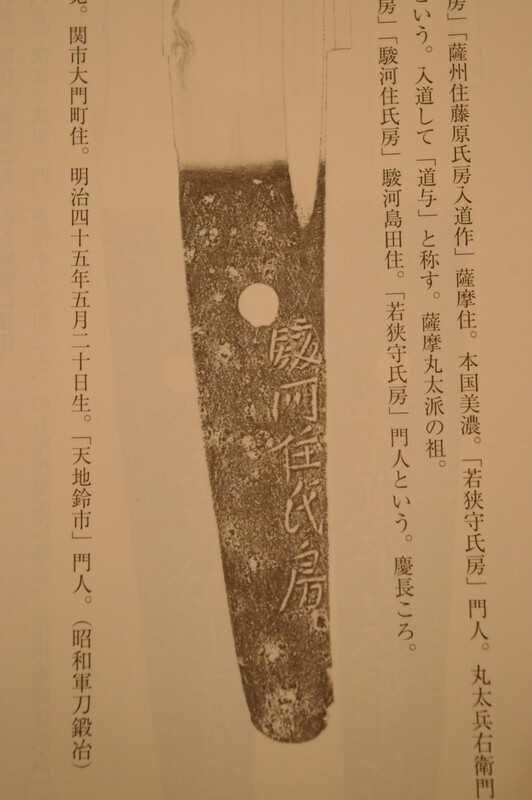
Hi Stephen Happened to have this on my desk, somewhere off the picture there is a date around Ei-Sho... Hope this confirms your fusa determination. Lloyd Flemming
-
Hitatsura Versus Abundant (Large) Jinie
flemming replied to hxv's topic in General Nihonto Related Discussion
I Just read the previous post erected while I was concocting mine....Kudos to you Sir, I think that sums it up. Lloyd Flemming JSSC -
Hitatsura Versus Abundant (Large) Jinie
flemming replied to hxv's topic in General Nihonto Related Discussion
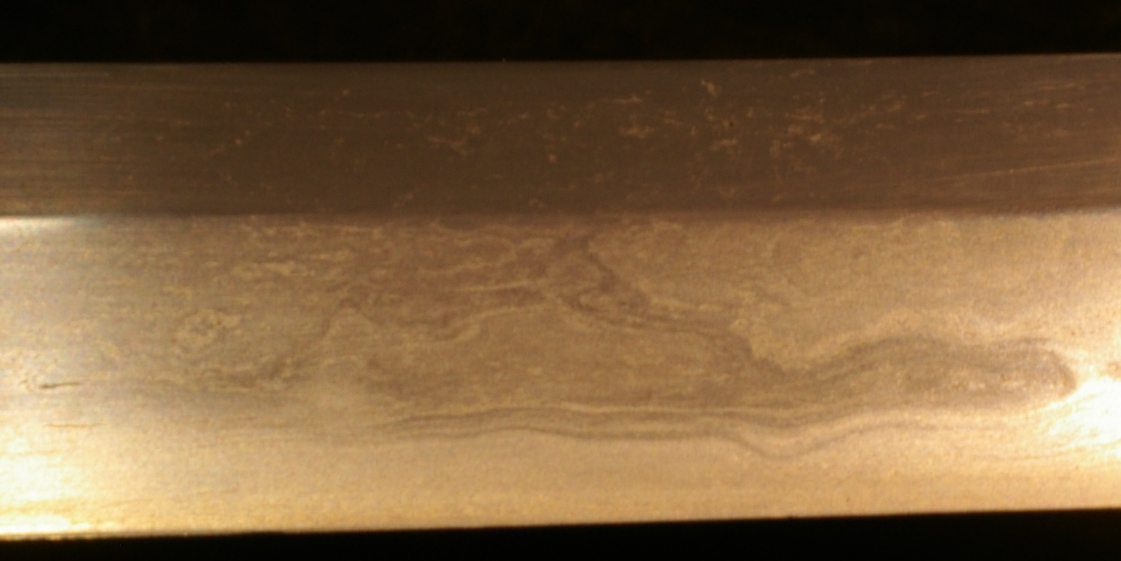
Hi there, if i may I would like to expand Jeans explanation a bit from my experience with Hitatsura; I think Nobuo Nakahara agrees with his definition as he does mention Tobiyaki. The difference between Shintetsu or perhaps Rai hada patches,Sumigane etc., is that a Hitatsura spot or patch is surrounded by a "nioi line". In some cases you can see habuchi activity, but I think to qualify as Hitatsura, you need a stand-alone patch, whether tobiyaki, Muneyaki, Tamayaki, Uchinoke etc, they are all seen with a surrounding of nioi. This is how Hitatsura is shown in some old Oshigata, like Hawleys Koto book. In hand, works like Soshu Akihiro do show the nioi border distincly at least in the 2 samples I have examined. I snapped a photo of such an extended patch of Hitatsura, whether by design or accident it was made, and I have tried to highlight the nioi border. This blade has a dim nioi-guchi to begin with... Lloyd Flemming JSSC