


Bruno
-
Posts
1,195 -
Joined
-
Last visited
Content Type
Profiles
Forums
Events
Store
Downloads
Gallery
Everything posted by Bruno
-
Interesting John, i did not know some ito were suede made. Do you have an example?
-
Not sure yet.
-
The most difficult is to find the perfect matching Gunto scabbard. Once it is done, you can find all the missing Gunto fittings here on the NMB or elsewhere, and have the whole koshirae mounted by a craftman like David McDonald or others of the same level. http://www.montanairon.com/swords.html As said the most important is to do nothing by yourself.
-
Hello, I am trying to gather close up photos of star stamp gendaito TYPE 3 tsuka. I am in a double project of Type 3 koshirae restoration for 2 RJT blades, and would like to have a better idea of what was done at the time. I know there are slight variations in terms of wrappings, final knots , ito colors, wood core shapes (more or less curved, flared or very straight). It will help me quite a lot if you guys could post clear photos of yours, indicating also : - the name of the smith/provenance : Tokyo, Seki smith...) and year of made. - the exact kind of Type 3 koshirae it belongs (lacquered wood scabbard, light brown scabbard, one or two chuha button(s)). Thanks and best regards
-
Hey Stephen, As far as I know he is still working on it. I think it will deal mainly about Tokyo smiths, not all gendaito smiths (too much work). I agree, I too want to read it!
-
Here are the sources : 2 books 1) 真説戦う日本刀 2) 軍刀組合始末
-
Hey Bruce, I have got these infos during the numerous correspondences I had with Chris Bowen, sorry I don't know or remember the written sources. What I can tell, and if I am not wrong is that the sho/seki stamps was a marketing technique created by some really smart business men in Seki to indicate the swords passed a quality control inspection for non-traditionally made blades so they are in actuality showato. Nothing decreed by the government, and the absence of a stamp isn't proof of anything except the blade didn't pass through the seki inspection. The star stamp is also an inspection stamp which was used to verify that the blade met the specifications for the RJT program, which included the requirement that the blade be traditionally made with tamahagane, etc. So since we know that smiths were required to make swords with tamahagane and that the smiths received tamahagane, a star stamp is a de facto indication that the blades are traditionally made. The RJT program was a stable and good source of income for smiths- doubtful they would try to dodge the requirements and risk being removed. So to summarize, the sho/seki stamp was a quality control for non traditionnal blades but the purpose was not indicate the blade was non traditionnal. I hope I am clearer, sorry I can't explain better with my limited english.
-
Indeed he is Bruce! Thanks for the reminder. I think Seki Mitsunobu had Niwa kanenobu as master, plus, to me, there are similarities in some of their respective mei. Mitsunobu's later work mei are very similar to Kanenobu's mei. I admit though I base this analysis only on the very few exemples I have seen. It seems smiths who entered the RJT prog late in 1944/45 are very little if not documented.
-
Thanks Thomas. Yes I think there are at least 2 WW2 era Mitsunobu smiths. Not sure who exactly was the other one though.
-
Seki stamp never meant the sword is a non traditional showa-to. The seki (and sho) stamps originated with a sword making guild in Seki as a marketing/quality control technique after lots of cheap swords were breaking in combat. They starting a quality control program that anyone could submit their blades for an inspection and receive the stamp. Once stamped, it was a sign that the blades were good for combat, so it became popular as a way to insure buyers that the sword was good.
-
PM sent. Bruce
-
Hi, I am looking for an "approved" jishin mei by RJT smith SEKI MITSUNOBU. On Dr STEIN's oshigata page, there are 3 different mei (attached pics) wich leads me to think some are nakirishi mei, or maybe he just changed his mei style? I would guess jishin mei are more likely found on his earlier blades. I only saw blades dated 1944 so maybe he just worked one year? If you have oshigata or own a gendaito by this smith, it would be great to share a close up of the mei and indicate the year too. from Markus book: MITSUNOBU (光信), Shōwa (昭和, 1926-1989), Gifu – “Mitsunobu” (光信), real name Kaneda Mitsuhiro (金田光弘), born February 27th 1924, student of Kanenobu (兼延), he worked as rikugun-jumei-tōshō and died June 25th 1974 Finally, I would like to find from when to when he worked as a RJT and if he had students. Thanks for your help
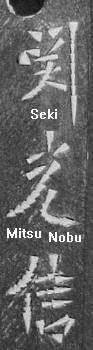
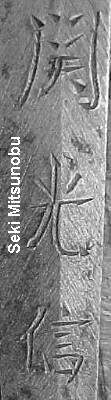

-
yes a bit confusing indeed!
-
On the contrary Stephen, I think he is a great smith. It is another member who wrote he was not good, not me!
-
David, The other two Teruhide smiths from Saitama never signed "Ishido" Teruhide so no, it can't be anyone but Ishido Teruhide from Tokyo. They were all 3 good smiths but often mixed up.
-
Yes one and only one Ishido Teruhide in Tokyo and in whole Japan as a Showa era swordsmith. I don't even understand the "infamous Ishido Teruhide"
-
There was only 1 Ishido Teruhide in Tokyo. Most Ishido Teruhide blades we see are kind of mass produced for the army, not custom made, without a date. This particular ishido Teruhide in the above photos looks like a rare long Ishido Teruhide signature. Probably a custom made to order blade.
-
Thanks Gareth. The Ishido Teruhide is mounted in the Type 98 but which blade is mounted in the Kai Gunto?
-
Gareth, what is the nagasa please?
-
in the USA only Jimmy Hayashi is traditionally trained otherwise you can contact Chris Bowen for advices
-
self trainedpolisher, run away!
-
Who is polishing it?
-

Help With Miyaguchi/ikkansai Kunimori Please
Bruno replied to Navymate's topic in Military Swords of Japan
Also from Chris: The book is titled: Shizuoka Ken no Gendai Tosho to sono Saku To ni Tsuite (Shizuoka Prefecture's Modern Sword smiths and the Swords They Made) published in Showa 44 by Kawaguchi Hiroshi, a university professor and resident of Shizuoka Prefecture. An oshigata of one of Mizukoshi tosho's swords which was made in Showa 19; compare the workmanship to the Kunimori blades. Also, a photo of text which lists Miyaguchi's 3 mei: Toshihiro (used for top class, special order blades), Yasuhiro (2nd class blades), and Kunimori (used for blades made of Western steel). -
Help With Miyaguchi/ikkansai Kunimori Please
Bruno replied to Navymate's topic in Military Swords of Japan
"the Kunimori tachi shows no nie" to Chris so oil quenched, western steel. -
Help With Miyaguchi/ikkansai Kunimori Please
Bruno replied to Navymate's topic in Military Swords of Japan
I was discussing recently about Ikkansai Kunimori with Chris Bowen. Here is what he believes: "Well, here is my take on this matter... 1. It is well known that Miyaguchi's Kunimori signed blades are made of Western steel. This is noted in period literature such as in Fujishiro's Shinto Hen, a long respected reference. 2. I have been told directly by Miyaguchi's son, who became a respected smith, that Mizukoshi Mitsuhiro, a former student of Miyaguchi, produced these Kunimori (Protect the Country) blades as part of a business venture to meet the demand for swords at the time as well as a way to help his student establish himself financially. The son was explict- Mizukoshi made the blades, Miyaguchi received them in bundles and he signed them one after another while his son held them down, as is customary. You can't get more compelling evidence. 3. As for the NBTHK, their focus has always been on older swords. They would rarely if ever paper WWII era blades until rather recently. When I first moved to Japan, I would ask them all sorts of questions about WWII smiths and sword making and they almost always referred me elsewhere because they did not know the answers to my questions. I have spoken with several NBTHK shinsa team members over the years and they freely admitted that these swords are, in their words, a "blind spot". People who haven't been behind the curtain live with this fantasy that the NBTHK is some sort of sword omniscient monolith that knows everything and is never in error. The truth is it's just a group of people doing their jobs as best they can as in any quasi-governmental agency. They don't know everything and they are not always right. In the later years before I left Japan, when WWII swords started to become a thing, they would actually refer questions about WWII swords to me! 4. As always, refer to the blades themselves. I have seen dozens of the these Kunimori mei blades. Well made they are, but they have all looked oil quenched. Many years ago I stated that star stamped blades were traditionally made. People who have never been to Japan, can't speak or read the language, have never spent as much as a single minute talking with WWII smiths and people with direct first hand knowledge, who wouldn't know an oil quenched blade from one quenched in water, came out and challenged my statements. Oh, the NBTHK would never paper a stamped blade, regardless they claimed, until l submitted a star stamped blade and it passed as Hozon. They wouldn't accept the WWII army documents, the literature citing, etc. This looks and smells like the same thing: people with little to no knowledge who have done zero real research blindly claiming that if the NBTHK papered something, it must be the real deal. This is what is known as an "appeal to authority" (argumentum ad verecundiam), It's a fallacious argument used to support an opinion when one has no real evidence. Bruno, I have done my homework, I am very comfortable with the results of the thousands of hours I have spent with WWII smiths, period Japanese literature, etc. I really don't put any stock at all in what people with nothing but blind faith believe. Everyone is entitled to their opinions and you can't always convince everyone. There are still people who believe the Earth is flat, after all.... Edit : mistake corrected - the smith who made these blades was Mizukoshi Hiromitsu. I typed it backwards. Maybe you can edit your post. These blades were made by Mizukoshi, not at the Okura Tanrenjo, but in Mishima, Shizuoka, were I lived for 13 years! They are, at best, daisaku regardless of construction and for that reason alone aren't considered on the same level as Miyaguchi's own work. Western steel is normally not water hardening- it cracks too easily. When quenched in oil, it does not produce significant, if any, nie. This is usually the giveaway. If forged/folded, they can certainly have hada, and oil quenching produces a nioiguchi specifically. These are not dis qualifiers in any sense! Western steel was used because it was easier to get than tamahagane, cheaper, and easier to work with. It was quenched in oil which results in less cracking than tamahagane in water. It allowed smiths to make swords faster, easier, and more cheaply. Exactly what the war effort demanded. And by the way, one shouldn't take the term "Western steel" literally- it simply means steel made using western, not traditional Japanese (tatara) methods.

