


Bruno
-
Posts
1,184 -
Joined
-
Last visited
Content Type
Profiles
Forums
Events
Store
Downloads
Gallery
Everything posted by Bruno
-
The wrap is an amateur job done post war. I have only seen 1 star stamped blade in these mounts but late war anything is possible. Blade looks forged- I think it is a genuine, late, star stamped blade.
-
Star stamp looks ok to me. It looks like a showa-to though, but I think it is more due to the the fact it is a "RJT last ditch" sword. Let's wait for better photos of the blade and nakago.
-

Need recommendations for Tsuka repair and wraps
Bruno replied to Kolekt-To's topic in Military Swords of Japan
David McDonalds all the way. http://www.montanairon.com/swords.html -
Andy,, Very late blade, which coudl explain the pretty rough finish for a star stamped gendaito. I don't see any photos that show the complete mei: one shows the top Seki ju and the other the bottom, tomo saku, without any showing the kanji in the middle which is the first kanji in the maker's name. Can you post better photos showing entire mei (signature) and of the other side (date)? Thank you
-
I woul guess one is just more faded/discolored than the other one. They were identical at some point.
-
Much appreciated Mal, thanks!
-
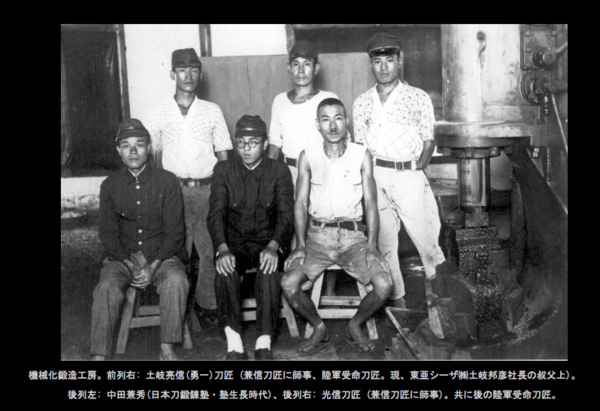
Thank you George, you are very helpful as always! So to be sure, Mistunobu is this guy on the smaller attached photo or the guy on the larger one (right and left depends if you are facing the photo or if you are turning your back)


-
Thanks Mal! What surprises me is that I have been told by a knowledgable person that Mitsunobu is back row middle and Nakata Kanehide back row right. On the translation p.28 it says Mitsunobu is back row right and Nakata Kanehide is back row left. So one version is not correct.
-
I may have found on Ohmura website ,a photo with Seki Mitsunobu. He is back row middle, back row right is Nakata Kanehide. Can anyone can read the name and place of the other smiths? Thanks
-
Late war Shin Gunto sword signature
Bruno replied to PeterCollector's topic in Translation Assistance
Peter, There is a page on SLOUGH oshigata book for the 3 smiths if I am not wrong. You can buy the book or ask for scans pages here. NB: there should by a small Gifu stamp on the nakago -
Late war Shin Gunto sword signature
Bruno replied to PeterCollector's topic in Translation Assistance
Peter, Fukumoto Kanemune worked in Gifu in a family workshop with his father Fukumoto Amahide and Ido idetoshi. You can do a research with his name on the forum and find more infos, or even Google him. -
Late war Shin Gunto sword signature
Bruno replied to PeterCollector's topic in Translation Assistance
NENGO : SHO WA JYU KU NEN JYU NI GATSU ( December 1944 maybe) -
Late war Shin Gunto sword signature
Bruno replied to PeterCollector's topic in Translation Assistance
MEI : KANEMUNE -
Help with Shin Gunto sword signature
Bruno replied to PeterCollector's topic in Translation Assistance
Maybe SHOWA JYU KU NEN ICHI GATSU -
Interesting John, i did not know some ito were suede made. Do you have an example?
-
Not sure yet.
-
The most difficult is to find the perfect matching Gunto scabbard. Once it is done, you can find all the missing Gunto fittings here on the NMB or elsewhere, and have the whole koshirae mounted by a craftman like David McDonald or others of the same level. http://www.montanairon.com/swords.html As said the most important is to do nothing by yourself.
-
Hello, I am trying to gather close up photos of star stamp gendaito TYPE 3 tsuka. I am in a double project of Type 3 koshirae restoration for 2 RJT blades, and would like to have a better idea of what was done at the time. I know there are slight variations in terms of wrappings, final knots , ito colors, wood core shapes (more or less curved, flared or very straight). It will help me quite a lot if you guys could post clear photos of yours, indicating also : - the name of the smith/provenance : Tokyo, Seki smith...) and year of made. - the exact kind of Type 3 koshirae it belongs (lacquered wood scabbard, light brown scabbard, one or two chuha button(s)). Thanks and best regards
-
Hey Stephen, As far as I know he is still working on it. I think it will deal mainly about Tokyo smiths, not all gendaito smiths (too much work). I agree, I too want to read it!
-
Here are the sources : 2 books 1) 真説戦う日本刀 2) 軍刀組合始末
-
Hey Bruce, I have got these infos during the numerous correspondences I had with Chris Bowen, sorry I don't know or remember the written sources. What I can tell, and if I am not wrong is that the sho/seki stamps was a marketing technique created by some really smart business men in Seki to indicate the swords passed a quality control inspection for non-traditionally made blades so they are in actuality showato. Nothing decreed by the government, and the absence of a stamp isn't proof of anything except the blade didn't pass through the seki inspection. The star stamp is also an inspection stamp which was used to verify that the blade met the specifications for the RJT program, which included the requirement that the blade be traditionally made with tamahagane, etc. So since we know that smiths were required to make swords with tamahagane and that the smiths received tamahagane, a star stamp is a de facto indication that the blades are traditionally made. The RJT program was a stable and good source of income for smiths- doubtful they would try to dodge the requirements and risk being removed. So to summarize, the sho/seki stamp was a quality control for non traditionnal blades but the purpose was not indicate the blade was non traditionnal. I hope I am clearer, sorry I can't explain better with my limited english.
-
Indeed he is Bruce! Thanks for the reminder. I think Seki Mitsunobu had Niwa kanenobu as master, plus, to me, there are similarities in some of their respective mei. Mitsunobu's later work mei are very similar to Kanenobu's mei. I admit though I base this analysis only on the very few exemples I have seen. It seems smiths who entered the RJT prog late in 1944/45 are very little if not documented.
-
Thanks Thomas. Yes I think there are at least 2 WW2 era Mitsunobu smiths. Not sure who exactly was the other one though.
-
Seki stamp never meant the sword is a non traditional showa-to. The seki (and sho) stamps originated with a sword making guild in Seki as a marketing/quality control technique after lots of cheap swords were breaking in combat. They starting a quality control program that anyone could submit their blades for an inspection and receive the stamp. Once stamped, it was a sign that the blades were good for combat, so it became popular as a way to insure buyers that the sword was good.
-
PM sent. Bruce


