eternal_newbie
-
Posts
1,003 -
Joined
-
Last visited
-
Days Won
6
Content Type
Profiles
Forums
Events
Store
Downloads
Gallery
Everything posted by eternal_newbie
-
Masahiro is another representative smith of Ko-Mihara, check out this particularly impressive example (ubu, zaimei and with yubashiri that resembles nijuba and sanjuba): https://www.toukentakarado.com/item-tk019-juyo-token-mihara
-
There's no harm in knowing the worth of what you have. I know many of us don't like thinking about it, but accidents (or not-so-accidents) and sickness, old age etc. come for all of us in the end, and having valuations of your belongings will help your loved ones after your passing. It also helps with home & contents insurance.
-
Agreed; this is a spectacular, extremely tight and bright nioiguchi that demands to be front and center, not obscured behind a gunome or suguha interpretation.
-

The power of a good polish...
eternal_newbie replied to MassiveMoonHeh's topic in General Nihonto Related Discussion
If you zoom out on the image it kinda makes it easier to see them snaking across the hada. -
The power of a good polish...
eternal_newbie replied to MassiveMoonHeh's topic in General Nihonto Related Discussion
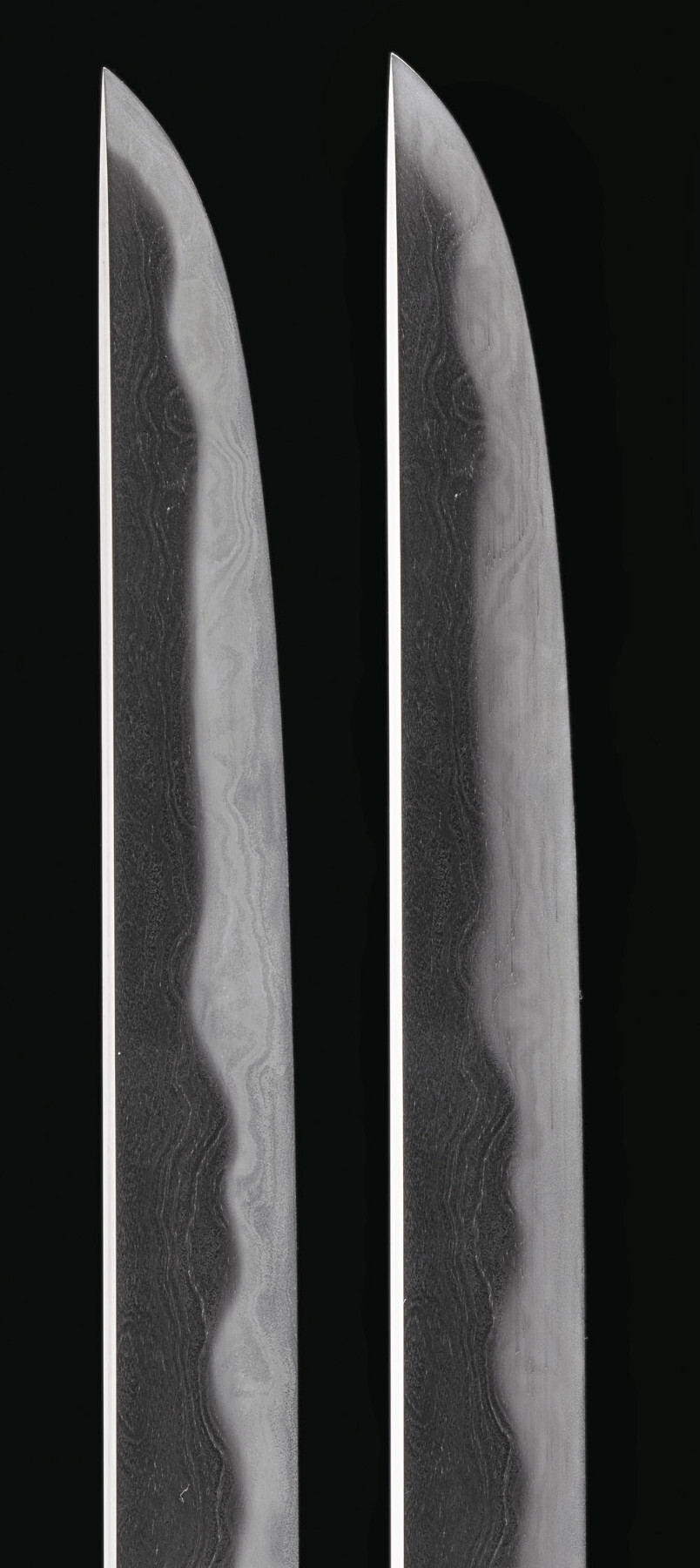
When they say that Sadamune's jigane was superior to Masamune's, this is what they're talking about. No doubt this was a major factor in attributing this to Sadamune despite the atypical sugata (Sadamune tended to work more in the Nanbokuchu style, with extended kissaki) -
Novel ‘oddity’ or painful to the eyes?
eternal_newbie replied to Mark S.'s topic in General Nihonto Related Discussion
It'd pair nicely with a Hocho Masamune for all your kitchen needs -
I'm more leaning towards a display mogito, mainly from the low quality of the tsuba carving.
-
The power of a good polish...
eternal_newbie replied to MassiveMoonHeh's topic in General Nihonto Related Discussion
Yep. Based on the somewhat slender profile and relatively small kissaki (2.7cm according to https://www.tsuruginoya.net/stories/kikkousadamune/) likely the earlier part of that working range. -
The power of a good polish...
eternal_newbie replied to MassiveMoonHeh's topic in General Nihonto Related Discussion
@Rivkin You can also get a good view of the entire blade (unfortunately, only in its current state, not pre-1967) here: https://emuseum.nich.go.jp/detail?langId=en&webView=&content_base_id=100193&content_part_id=0&content_pict_id=0 -
The power of a good polish...
eternal_newbie replied to MassiveMoonHeh's topic in General Nihonto Related Discussion
I suspect things are much more even on this site, perhaps even tilted in favour of the original. And as @MassiveMoonHeh pointed out, the calmer look of the original polish is more in keeping with Sadamune, whereas the increased contrast of the notare hadori with the darkened steel makes it seem more like a Go or Shizu from a distance. That said, I do perhaps wonder if the 1961 version of the blade would look perhaps a bit too subdued or washed out in typical exhibition lighting compared to the post-1967 hadori (which is, as we know, a modern polishing style that came into vogue with the introduction of electric lighting). The post-1967 photography isn't quite as good as the 1961 images that @Brano posted, so it's hard to do a like-for-like comparison. -
The power of a good polish...
eternal_newbie replied to MassiveMoonHeh's topic in General Nihonto Related Discussion
Much, much better, thanks for that. -
The power of a good polish...
eternal_newbie replied to MassiveMoonHeh's topic in General Nihonto Related Discussion
Unfortunately this is complicated by having many modern sources (mostly non-Japanese) of inferior uchiko; instead of powdered deer horn or burnt rice husks or whatever, most of it is both too hard and either too fine (builds up in openings or horimono and then gets inadvertently dragged out in clumps, causing those big gouges you see in the Norishige), or too coarse (creates a grid of hairline scratches that eventually obscures hada and activity, especially when viewing with an angled light source). Uchiko as the default was, if not ideal, at least workable when it was always produced by togishi and curated by dealers; now, if you're not buying from a reputable shop in Japan, you're probably going to get some mystery powder that might just leave your TokuJu blade looking like you took a buffing wheel to it. -
The power of a good polish...
eternal_newbie replied to MassiveMoonHeh's topic in General Nihonto Related Discussion
I managed to find this picture on the Wayback Machine from Darcy's old blog, showcasing the damage even a little bit of improper uchiko use can do to a polish – in this case a Norishige tanto (view the full-sized image for maximum effect):
-
The power of a good polish...
eternal_newbie replied to MassiveMoonHeh's topic in General Nihonto Related Discussion
That is indeed a mon - the kikkō (tortoise-shell) mon, from which its name derives. -
The power of a good polish...
eternal_newbie replied to MassiveMoonHeh's topic in General Nihonto Related Discussion
While you are absolutely correct on the dangers of uchiko overuse, I do think a couple of other factors played a part here. For starters, improvements in technology and technique in photography - take a look at how much more well-defined and sharp the nakago (which was not re-polished) looks in the second picture, as well as how much more visibility the steel texture has. In addition, the polishing style appears to have changed; the original appears to have been interpreted by the polisher as a slightly undulating suguha-based hamon, while the new polisher has interpreted it as a somewhat dynamic but shallow notare. -
Thank you, I think this will be a good compromise allowing users to easily summarize the auction site playing field without burying known and trusted dealers under mountains of low-quality/unreliable listings.
-
I've noticed recently that swords from Yahoo Auctions are starting to show up. This is making me wonder if auction sites need their own category or filter, because: a) the vast majority of these are going to be gimei big names (and indeed that seems to be the case for the ones added so far) b) the scraper appears to be picking up books and catalogs as actual swords, presumably because at least one of the swordsmiths exhibited is listed in the description
-
I believe he means that both blades are now no longer available (the yoroidoshi having been sold and the gimei having been withdrawn). If so, the moderators can remove/archive the thread.
-
Update: Yamanaka Newsletters Volume 4 Issue #10 available: Yamanaka V4 NL10
-
Noted and observed. Sorry to hear that; I'll add it to my list of stolen blades to look out for. I wonder if it would be worthwhile to have a pinned thread, or even a new forum area, for stolen/lost blades that folks can easily consult whenever they're buying a sword...
-
Agreed; earlier Gassan work tends to have a more naturalistic ayasugi pattern (similar to how the Kanemoto sanbonsugi gets less even and regimented as you work backwards through the generations to the shodai). Edit: some examples of early ko-Gassan ayasugi - https://web.archive.org/web/20071213011622/http://www.nihonto.ca/ko-gassan/jigane-l.jpg https://nihontoantiques.com/project/name-sword-fss-693/ https://www.aoijapan.net/tanto-gassan/ https://www.aoijapan.net/katana-gassan/ https://www.militaria.co.za/nmb/topic/45265-nbthk-papered-ko-gassan-katana-with-kijimono-nakago/
-
I believe this is what you're after: https://www.militaria.co.za/articles/Examining_the_Origin_of_Soshu-den.pdf It's actually an updated version of this article - you can compare the two links to see what information was added in the newer version. And this is the thread in which it was discussed (and the aforementioned controversy arose):
-
Delayed loading
eternal_newbie replied to Matsunoki's topic in Forum Technical Details and Maintenance
If it matters, I just had an extended period of extremely slow loading, sometimes not loading at all. From about ~20m ago up until the time of this post. Different browsers didn't seem to make a difference. -
katana mei pheasant leg
eternal_newbie replied to JeanEB's topic in Auctions and Online Sales or Sellers
Yes, kijimomo (雉子股) translates to "pheasant's leg/thigh". Although personally, I mentally translate it as "drumstick" -
Rarely seen 'possibly' pre Nanbokucho period koshirae and fittings.
eternal_newbie replied to Lewis B's topic in Tosogu
Thanks Lewis. It's always a treat to see koshirae/tosogu that predate the Edo period as so many blades were remounted to suit the Tokugawas' preferred aesthetics –– plus wood, cloth and leather just generally have a much shorter lifespan than steel.