eternal_newbie
-
Posts
561 -
Joined
-
Last visited
-
Days Won
2
Content Type
Profiles
Forums
Events
Store
Downloads
Gallery
Everything posted by eternal_newbie
-

Phrase on sayagaki - please help.
eternal_newbie replied to Hector's topic in Translation Assistance
皆焼き, mina-yaki - lit. "fired (i.e. hardened) all over" It's generally another way of saying hitatsura, or occasionally to describe a blade that has spots of hardening all over the surface but not enough to be considered fully hitatsura. Examples: https://www.nipponto.co.jp/swords4/WK327917.htm https://www.seiyudo.com/wa-021111.htm -
If you're just getting usable koshirae for a shinsakuto / iai sword, you could probably get it cheaper (100-200k yen) going with one of the outfits in Gifu, e.g. Tozando as they'd basically just be using the generic iaito parts and labor with a premium for adapting it to your blade instead of the standard sizes of iaito casts. But you'd definitely want something more premium for a beloved antique blade.
-
The Kashima sisters have a good breakdown of the costs on their website (as well as some past examples of more interesting requests): http://www.ksky.ne.jp./~sumie99/costs.html
-
WHO LOVES TO GAMBLE
eternal_newbie replied to lonely panet's topic in General Nihonto Related Discussion
Good luck to you, always an exciting time sending a newly restored sword to shinsa -
Semi hitatsura or a failed yakiire?
eternal_newbie replied to Hector's topic in General Nihonto Related Discussion
Either a smith doing some experimentation in hitatsura style, or an overzealous amateur polisher highlighting stray bits of yubashiri with hadori instead of sticking to the overall hamon pattern. I will say that generally smiths wouldn't sign a blade they're not happy with, so either what you're seeing is the intent or someone added it after the blade was forged. That said, it's not unheard of for blades to have isolated sections where the hamon flares up and then settles down again, for example: (from this listing) -
Aoi Art Sa Sadayoshi Katana # 25604
eternal_newbie replied to Barrett Hiebert's topic in Wanted to Buy
There was some discussion on the board about that blade earlier (they liked it too): -
Help with koshirae identification
eternal_newbie replied to Ricardo Artesao's topic in General Nihonto Related Discussion
It's described here as "lacquerwork" which implies the lacquer is either carved or applied to give it that texture. https://www.mandarinmansion.com/item/aikuchi-snakes-and-centipedes You can see other types of texture/patterns created with lacquer, some of them quite striking, in this thread: -
Decoration, mostly sold at souvenir and craft shops for tourists
-
Sunnobi tanto, yes. Wakizashi size by modern torokusho categorisation, but clearly made to be used as tanto based on the era and shape. Oversize tanto are a kantei point for certain smiths, including Soshu Sadamune. Given that this has a tanto sugata but is over 30.3cm and mounted like a wakizashi, either term is appropriate.
-
Please help/advise. What can you tell me about this sword?
eternal_newbie replied to 2devnul's topic in Nihonto
I believe they're referring to an acid etch that's done on a sword to make certain elements of it stand out more (this can be hamon or jigane, depending on how the etch is applied). Needless to say that's heavily frowned upon by Nihonto connoisseurs. -
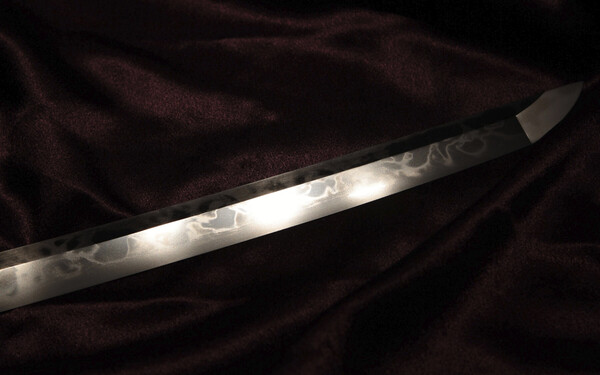
Also, I was doing some research in the Wayback Machine and this reminded me of something I saw there recently that I thought you might enjoy: https://web.archive.org/web/20161025013333/http://nihonto.ca/yosozaemon-sukesada-3/ I was able to track down some images of it that are a higher resolution than what the WBM managed to archive:



-
Must be something in the water, because here's another https://eirakudo.shop/648659
-
Seeking ID and additional info help for Tachi sword
eternal_newbie replied to Corsairisen's topic in Nihonto
Most of them have the telltale long fold line along the hamon, yes. But at the prestige end you have stuff like these: https://www.swordjp.com/product/crab-koshirae-tamahagene-katana https://www.reddit.com/r/Katanas/comments/1mope74/possibly_the_nicest_chinese_tamahagane_made_katana/ https://www.militaria.co.za/nmb/topic/50084-chinese-katanas/#comment-522004 I'm not saying 95% of the regulars here wouldn't figure it out, but for someone newer to the field who's only ever seen monosteel/tool steel swords before it could definitely be tricky. The only saving grace is that at this point, blades of that quality are still only made on a custom basis, so they end up not being much cheaper than an actual shinsakuto once you take customisation into consideration. They're even starting to get ambitious and copying big name smiths now! Sukehiro: https://www.swordjp.com/product/toranba-tamahagane-katana-sword Inoue Shinkai: https://www.swordjp.com/product/wing-tamahagane-katana And now that I think about it, that crab koshirae one in the first link looks like it might have been an attempt at Gassan ayasugi-hada. -
Seeking ID and additional info help for Tachi sword
eternal_newbie replied to Corsairisen's topic in Nihonto
Some of the more high-end forges in China can now do custom blades that look more or less identical in terms of steel grain and tempering patterns to a martial-arts grade modern Nihonto. I've heard stories of one or two of these actually managing to get temporary registration permits issued when coming in to Japan for a grading / demonstration. -
That, or it's an O-O-O-suriage blade that used to be a massive nodachi, and that was part of the mune earlier in its life.
-
Please help me identify this sword
eternal_newbie replied to TheTinkerBard's topic in Military Swords of Japan
Keep in mind that this was hundreds of years ago and a great many folks were effectively illiterate. It's entirely possible that chiseling a mei was the first time he'd ever had to write something... -
Or made solely for foreigners to buy in a souvenir shop.
-
Unfortunately it looks like the auction link has been removed too. Interesting... Anyway, check your inbox, I've sent you a message with the contents of the listing.
-
If you can't get it on wayback send me a PM, I did a quick search and found the files in my browser cache.
-
I think this is one case where the quality of the blade (very obviously top-level Soshu if Kanzan, Tanzan, the NBTHK *and* whichever appraisers the Date family had on the case all agreed with Go/den Go) trumps any concerns about attribution and level of certificate. If it gets reattributed to Hasebe Kunishige or Shizu then it's a Hasebe Kunishige or Shizu that's good enough to stand with Go and Masamune, and was treasured by the Date clan, and with TH you've got the NBTHK's double stamp of approval for school, quality and condition. Going to Juyo (or TokuJu) would just be adding a third stamp of approval to something that already has the thumbs up from some of the headiest authorities on what makes a blade good. And really, what can any given Juyo panel tell you that you won't find on an extensive sayagaki by Kanzan and Tanzan? One other possible reason for not sending it to shinsa is to keep alive the hope - for prospective buyers - that the "Den" attribution means it might go Juyo to Masamune instead, as he is also (obviously) in the same tier of mastery as Go and does have some work with tobiyaki and togari. But this is a long shot and realistically, the best-case outcome of a Juyo shinsa will be just telling you what you already know - lovely sword, probably Go, somewhat atypical. There's much more potential downside, and you can save yourself a few hundred thousand extra yen in shinsa and handling fees (and another two years of waiting, including when - not if - it passes next year's session) by just selling it as-is.
-
Remember that "den" doesn't necessarily mean "missing", it can mean "has something extra" too. The islands of tobiyaki and the little togari-like protrusions from the ha, for example, are things more commonly associated with Hasebe Kunishige and Shizu Saburo Kaneuji respectively.
-
Help With Mei (two smith sword)
eternal_newbie replied to cookiemonstah47's topic in Translation Assistance
Correct. The "old-style" hiro kanji is 廣, the "new" kanji is 広. An honorary title given to a Sagami smith. For more information on how these worked, Markus Sesko has an excellent writeup: https://markussesko.com/2013/02/19/how-honorary-titles-were-conferred/ -
Please help me identify this sword
eternal_newbie replied to TheTinkerBard's topic in Military Swords of Japan
I've seen at least one smith (the name eludes me, sadly) for whom an amateurish, inconsistent mei is a kantei point! -
Regarding your other question - fake mei were indeed added quite early on. This would allow you to present your lord with a big-named blade to preserve your honour and raise yourself in his esteem, even if you didn't have the resources or influence to actually acquire one. And the lord, probably having at least one or two good sword appraisers on hand, if not being one himself, would tacitly accept this and exchange this "treasure" with another less prosperous vassal as a reward for some minor deed.
-
Not in that style. Dai-mei or dai-saku, a work either made by Shintogo's pupil or signed by Shintogo would have been in his style (silky Awataguchi jigane with chikei, thin suguha hamon rich with activity). Ask yourself why the inside of the strokes are filled with the same lighter coloured rust as some of the surface staining while the rest of the nakago is covered in black patina. Edit: Uwe provides a good example above. The mei there is much more recent than Shintogo's time, being from the Edo period. Yet it has the same dark patina as the rest of the nakago.