Pete Klein
-
Posts
2,984 -
Joined
-
Last visited
-
Days Won
27
Content Type
Profiles
Forums
Events
Store
Downloads
Gallery
Everything posted by Pete Klein
-
Is it like this one? http://www.aoijapan.com/img/sword/2012/12577koshirae.jpg I would imagine that silver might be easier to work into complicated forms but of course Ford would be the one to comment on that due to experience. Silver can be quite beautiful when left to develop it's patina over time as it is a complex of blues and grays as opposed to 'black' shakudo which of course can be beautiful in it's own right. I have the feeling I would like the silver for myself.
-
Ebay Hozons, Are They Legitimate
Pete Klein replied to Henry's topic in Auctions and Online Sales or Sellers
This is a great article on the evolution of the NBTHK shinsa origami: http://www.nihontocraft.com/japanese_sword_papers.html -
Those punch marks are exactly that - punch marks, just nicer ones. They aren't tagane mei or specific to any school. Just a nicer way of moving metal to fit the tsuba. You will see them more often on kinko as opposed to tetsu tsuba. You can see there are two on top superimposed and the nakago ana has been further widened which cut into them.
-
Has a bit of a Shonai vibe to it.
-
Brian - I like everything, as long as it's the most!
-
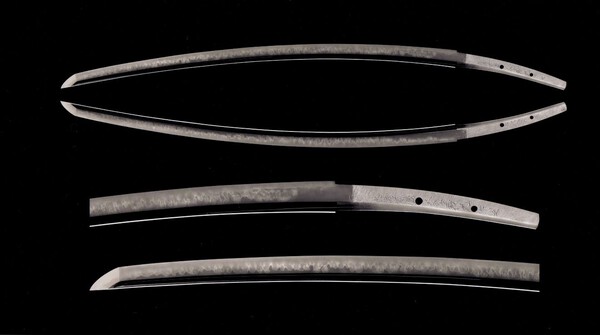
I WANT THIS ONE!
-
-
I have to wonder if a fail could be considered as an income tax deduction as a chaitable contribution? ROFLMAO!!! Good luck Bud!
-
OK - thanks! Pete
-
BTW - Val. just curious. Where did you find the Tanyu Kai first volume? 'Very rare' item! Pete
-
HI Val - having a bit of sport, are we? LOL! OK then, I'll bite. This kozuka has very good craftsmanship and could very well be early work. The mei, Goto Mitsutaka is '最初期銘' earliest signature - but has only two examples in, 'Toso Kodogu Meiji Taikei and only one of the two is in this writing form (the other from menuki is more cursive). The one found in, 'Shinsen Kinko Meikan' is the cursive form from Wakayama and none found in, 'Studies in Kyo Goto'. The problem I find is that the kozuka mei does not match the one in Wakayama. Ichijo's mei were very fine line where this one is a bit blunt and, shall we say, 'uncertain' in it's execution. If we compare it to the next Ichijo mei which is Mitsuyuki there is more similarity but still lacks the refinement of the recorded mei. My feeling is that it may not pass shinsa but if it is recognized as shoshin then it would be a 'very' important addition to canon as a transition mei between Mitsutake and Mitsuyuki, which of course I would applaud. Pete From Wakayama:
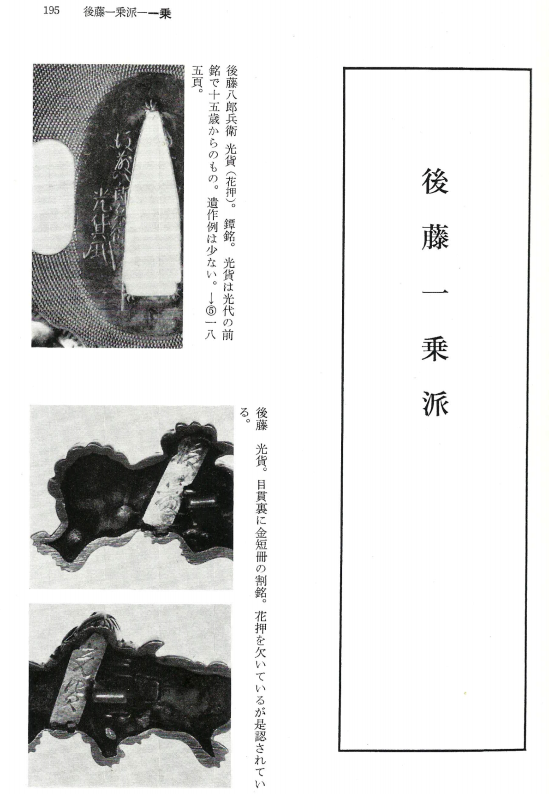
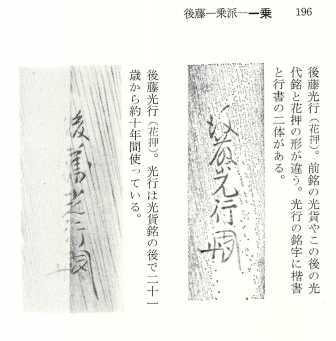
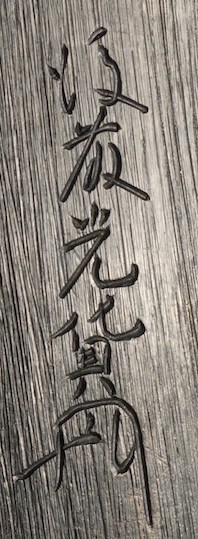
-
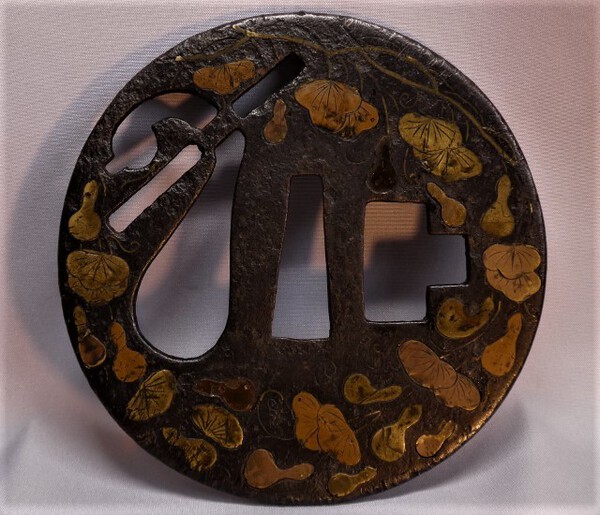
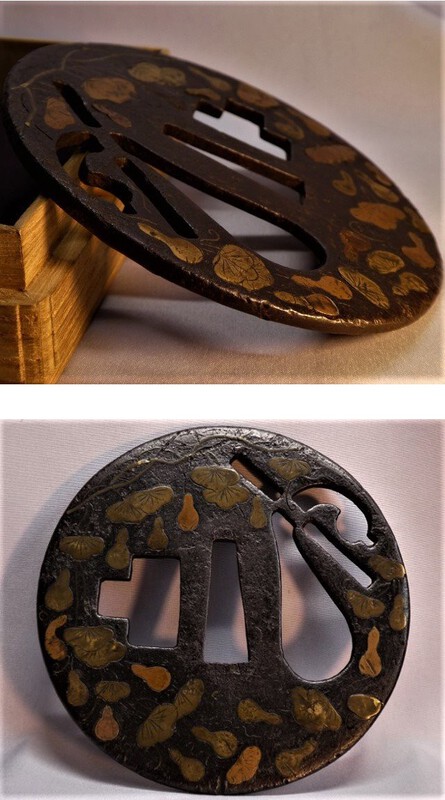
Recently in from Japan. I've been waiting to find a Heianjou Zogan tsuba for some time now which was a bit out of the ordinary. I hope you find it interesting: 9.7 cm x 4mm, 185 g. To me the use of different colors is intriguing. There are two rather old lacquer fills on the omote where gourd inlays had been lost. I've not come across this before.
-
References For Ko-Nara And Early Tetsunin/saga Kaneie?
Pete Klein replied to lotus's topic in Tosogu
http://www.japaneseswordbooksandtsuba.com/store/Books Why not write Grey and see if he has anything there? -
References For Ko-Nara And Early Tetsunin/saga Kaneie?
Pete Klein replied to lotus's topic in Tosogu
http://www.shibuiswords.com/kaneiyeAcademy.htm Interesting write up on Kaneiye / schools. -
-
The Shirobei Goto were the main line family starting with Yujo and did no iron work that I have ever seen or heard of. The mainline masters (usually) the first born son would inherit the family name. Other sons would sometimes start their own side line, 'waki' Goto schools which is where you will find examples of iron works and of pieces more akin to Machibori work from time to time. The first Goto Seijo was the son of Goto Ryujo, second generation of the Shichirobei line founded by his father Goto Chojo, who was second son of Goto Kojo, fourth mainline master. Going to Haynes Index there are almost two pages of Seijo's lineage with varying amounts of information. When the NBTHK writes 'Goto Seijo' on an origami that is not to infer it is the first or any specific generation. It is simply saying the mei is a correct example of Goto Seijo work but could be by any generation. If they are confident of a generation they will list it or of a time frame also but of late they seem rarely so inclined. From what I could find in Wakayama, 'Toso Kodogu Meiji Taikei' this is work of a later generation and I would think someone from around ~1800. By this time the mainline had lost most of it's power and I would imagine whoever this was didn't care much for 'norms' about signatures on iron but that is of course speculation on my part. FYI Ichijo was also waki Goto which is why he made iron works. Texts to have: Haynes Index Toso Kodogu Meiji Taikei by Wakayama Studies in Kyo Goto (waki Goto schools) by Kasahara and Akimoto 'Shinsen' Kinko Meikan (very difficult to find of late) by Kenichi Kokubo
-
That tsuba is pictured in 'Toso Kodogu Meijei Taikei' by Wkakyama as an example of the mei so although it did not have a paper it would be pretty much guaranteed. 'Wei bother' bought it, of course which probably has something to do with the price but I could see it selling on Ginza for that price anyway. It is a smallish but very nice piece, IMHO.
-
-
Which Of Your Tsubas Best Embodies The Wabi-Sabi Aesthetic?
Pete Klein replied to lotus's topic in Tosogu
I am going to take a bit of a liberty as this of course is not a tsuba but to me it has a definite 'mono no aware' quality to it: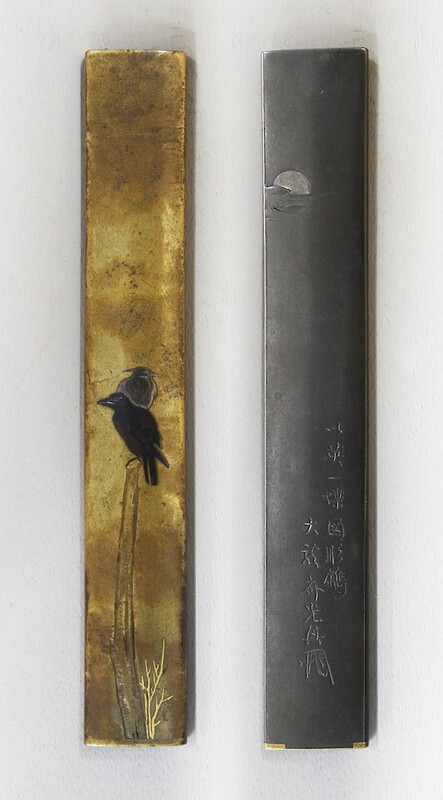
-
Which Of Your Tsubas Best Embodies The Wabi-Sabi Aesthetic?
Pete Klein replied to lotus's topic in Tosogu
Michael - any time you get tired of that Shimizu you've got my address (methinks it will be a very - long - wait...)! LOL -
Nbthk Eb Members In Gräfrath
Pete Klein replied to BIG's topic in Sword Shows, Events, Community News and Legislation Issues
I would be amazed if all existing true Nihonto numbered in excess of 100,000. -
Heianjo Zogan PS: to study Higo these will be most helpful: http://www.japaneseswordbooksandtsuba.com/store/books/b521-kanshiro-nishigaki-hirata-%26-shimizu-hayashi-%26-kamiyoshi-3-books-ito


-
Nbthk Eb Members In Gräfrath
Pete Klein replied to BIG's topic in Sword Shows, Events, Community News and Legislation Issues
When you bend to the bokken, what carpenter does it belong to ? Hmm... -
Nbthk Eb Members In Gräfrath
Pete Klein replied to BIG's topic in Sword Shows, Events, Community News and Legislation Issues
International group of experts met at the Deutsches Klingenmuseum in Gräfrath. By Manuel Böhnke They are wearing white cloth gloves. Some hold a handkerchief in front of their nose - others even bite it carefully. Because under no circumstances may saliva or sweat come into contact with the blade - risk of rusting. After bowing to respect the blacksmith, they carefully pick up the swords and carefully examine them. The layman soon realizes that these men and women are from the field. They are members of the European spin-off of the Society for the Preservation of the Japanese Art Sword (NBTHK). On Saturday, the private collectors met at the Blades Museum in Gräfrath. The members want to preserve the centuries-old art and pass on their knowledge. "We are not concerned with everyday objects, but with collectibles," explained Professor Eckhard Kremers. He is president of the European NBTHK. The martial aspect of the weapons does not matter. It's about the beauty of the material, the art of forging. It is estimated that there are more than 20 million Japanese swords. 10 to 15 percent stand out from the crowd. They were made artistically and have probably never seen the battlefield for the most part. "Forging technology is not so different from European ones," explained Dieter Kraft. The NBTHK member led the meeting on Saturday and presented parts of his collection. According to him, the real difference lies in how "so finely" the blades are handled, ground and polished. Further cooperation between Klingenmuseum and NBTHK conceivable The king's discipline for the collectors is to recognize the origin of a sword with a bare look. This happens in three steps. First, they hold the blade vertically and look at it at a 90-degree angle. Shape and bend allow conclusions to be drawn to the era in which the sword was forged. Keeping it level allows statements about the material. Used is Tamahagane steel, which is made in special ovens made of iron sand. In the final step, the experts look up at close range, which patterns have arisen during curing. These are characteristic for the respective manufacturer. SOCIETY NBTHK The headquarters of the Society for the Preservation of Japanese Art Sword is located in Japan's capital Tokyo. The European offshoot currently has about 100 members. They come from Germany, Belgium, the Netherlands, Austria, Switzerland or Great Britain, among others. www.nbthk.net Ideally, they even reveal the name of the blacksmith. "This knowledge can be read. You have to practice on examples, "explained Kraft. The art swords are a costly passion. Starting at just under € 1,000, selected models can cost well over € 100,000. According to Kraft, the decisive factor is not just age. "Were there 500 years of war, many simple swords were made." Their value is limited. In fact, it's about subtleties that initially remain hidden from inexperienced viewers. "For us it is very special that this meeting takes place here for the first time," said museum director Dr. Isabell Immel. Upstairs there are some Japanese blades to see. However, this department requires special knowledge. They do not exist in their house so far. That's why Immel hopes to be able to cooperate with the NBTHK again in the future: "This is where this place of the blade culture lives." According to Dieter Kraft this is well conceivable: "The conditions are great. Communicating knowledge is our mission. " via Google Translate