John C
-
Posts
2,857 -
Joined
-
Last visited
-
Days Won
18
Content Type
Profiles
Forums
Events
Store
Downloads
Gallery
Everything posted by John C
-
Moriyama-san Speaking of yanone, I've post this before but was unable to have it translated or deciphered. Not sure if you saw it, however are you able to make this out? I really appreciate you taking a look. John C.

-
Correct, Jean. The term bokuto, more commonly used in Japan, is generally used to describe "Doctor's swords" while bokken, particularly here in the US, is used to described the wooden training swords. John C.
-
Photographs Illustrating the Wearing of Japanese Guntō
John C replied to saemonjonosuke's topic in Military Swords of Japan
Warrant officer in Manchuria with type 19. John C.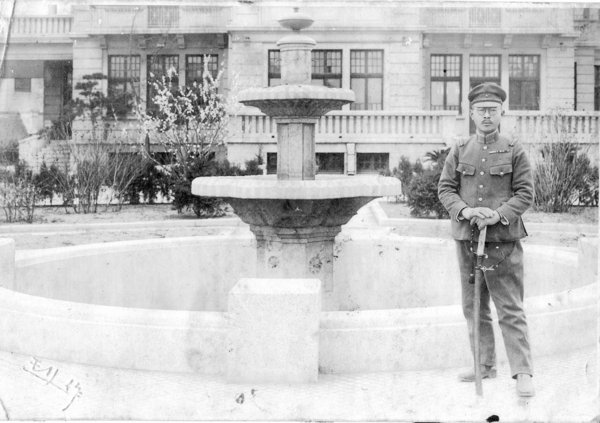
-
Photographs Illustrating the Wearing of Japanese Guntō
John C replied to saemonjonosuke's topic in Military Swords of Japan
Guess I'll add some of my photos: Two police officers with patrolman swords and Sgt. Tekehira Ogawa with type 32. John C.


-
Thanks, Jean. I was asking because hyudo does have a meaning - usually Ice house, but can mean things associated with the military. John C.
-
Photographs Illustrating the Wearing of Japanese Guntō
John C replied to saemonjonosuke's topic in Military Swords of Japan
Matt: What I really like about your pics is that several show ordinary soldiers with wakizashi sized swords as well as a pilot with a regular sized sword. Helps to dispell the myth that a shorter sword is necessarily a "tanker or pilot" sword, as proffered by so many sellers. John C. -
Grev: Is one of the circled words a typo or is it this way in the original (the kanji appear to be the same)? John C.

-
Translation Assistance: Battle Damaged Blade
John C replied to chgruener's topic in Translation Assistance
Hello Mindy: I can't read the smith name, however the date is Nov 1943. In addition, it looks like a showato, meaning a decent sword but not of great value. For Japanese sword collectors, I would assume 300-500 euro in that condition. For military collectors, maybe a bit more as a war relic. John C. -
My latest crossover piece - a tabako-ire with tsuba, seppa, and kashira as the kanagu. John C.

-
Mine is a traditional tanto style (foreground). John C.

-
Scott: I was looking through Daruma Magazine issue 7 and found a similar bokuto "shrimp". So maybe? John C.

-
Scott: As a bokuto enthusiast (though I do not own many) my guess would be chato or something else. Bokuto could be ornate, however were designed to be at least somewhat protective and possibly fool a potential criminal. I do not think a light fish stuffed in the obi fits those criteria. But really, a bokuto is anything, usually made of wood, that could be used defensively so who knows. John C.
-
Moriyama-san Is he using one of these two forms of masa? John C.


-
Steve: The first kanji looks a bit like tsuru, or crane. Are there carved cranes on the piece? John C.
-
Ron: For what it's worth, I'm also seeing Kanekage. John C.
- 1 reply
-
- 1
-

-
Indeed. I looked in the "Japanese Art Names" book under metalworkers for Kaneame and he wasn't listed, unfortunately. John C.
-
Hello Detlev: The longer writing is the date: Showa 17 (1942). The side with just two kanji is the swordsmith Kane + sumi. This would be his art name. Markus Sesko has two listed for the Showa era. I'm guessing that yours is the second one, since your sword is not traditionally made (the first Kanesumi listed was an RJT smith who made traditionally made swords.) John C.

-
98 Shin Gunto from Grandpa
John C replied to Basic_Platypuss4039's topic in Military Swords of Japan
BP: Is the blade signed/can we see the nakago? The mounts looks as if they are either late war or have been reconditioned at some point. The metal fittings are somewhat rough cast, the ito wrap has been put through the tsuka (like a traditional samurai sword, though not military), and the tsuka skin seems to be celluloid. In addition, the leather is in decent condition. If untouched, this was probably carried very late in the war as it uses parts typically seen on late war swords. The tassel seems to be all brown, which are typically navy. Other possibilities are that is is after market or is the type used on Gunzoku swords. This may also explain the fittings. In any case, a look at the nakago will tell us more. John C. -
Johan: Frome those pics, it looks like a legit type 98. You might look at the area marked in the pic for a mekugi. It would ba an unusual place, but could be. You could also try peeking under some of the wrap to see if it is hidden. John C.

-
Identification of this sword markings please
John C replied to Great-Dane's topic in Military Swords of Japan
Kanesumi 1942. The black numbers are 495 something. The stamp is the Seki inspection stamp. John C. -
Steve: I had originally come up with ame (rain) as well, however I didn't think it made sense. Could the two words mune (chest, heart, or spine in the context of swords) and ame (rain) have something to do with the sword itself? John C.
-
I think satomura kiyoyoshi is correct, however it may be pronounced Kiyoshi. 里村 (Satomura): Surname (Village/Home + Village) John C.
-
Les: Sorry it's not much help, however the first kanji below the ana is Mune and the third is a kao but I can't get the second. John C.
-
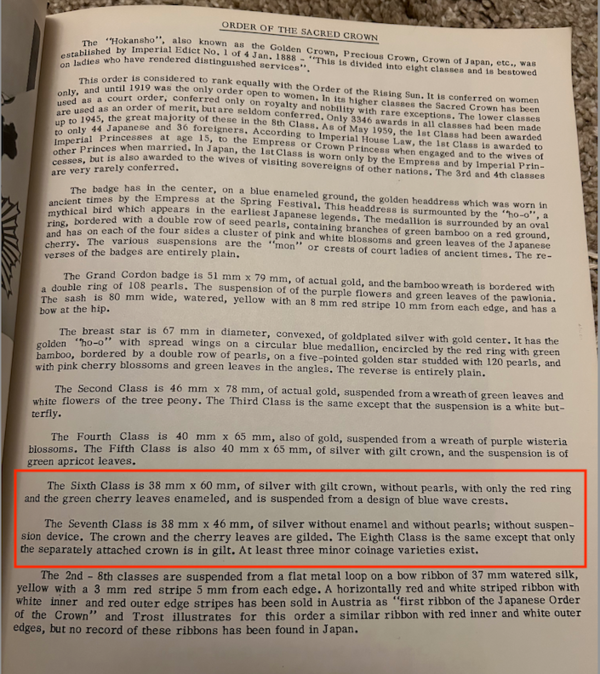
According to the "Orders and Medals of Japan" (Peterson), they appear to be the 6th and 7th class Order of the Sacred Crown (see boxed area of pic). They were bestowed on ladies who exhibited distinguished service. John C.

-
Google has it as Satomura Kiyoyoshi. John C.