


John C
-
Posts
3,410 -
Joined
-
Last visited
-
Days Won
21
Content Type
Profiles
Forums
Events
Store
Downloads
Gallery
Everything posted by John C
-
Russ: Yes. The habaki is softer material, however that area is so thin it doesn't take much to start to round over that small edge. Think about how we caution against even softer materials like saw dust scratching the blade. The material in conjunction with a bit of rust can cause weakness where it is thin. Another issue, albeit WAY beyond my level of expertise, is the incompatibility of metals when moisture is introduced. I know some metals can react with others causing corrosion and weakness (think galvanized pipes and copper pipes in plumbing). Just another thought as to why that area could wear like that. John C.
-
POST ORLANDO SHOW ?
John C replied to stackinnutts's topic in Sword Shows, Events, Community News and Legislation Issues
Glad to see there was at least one kid (blue shirt, shaggy hair) getting interested. Except for Sam and a few others, it looked like my high school reunion in some of the pics. John C. -
POST ORLANDO SHOW ?
John C replied to stackinnutts's topic in Sword Shows, Events, Community News and Legislation Issues
Was that you in the obligatory north west beanie cap...in Florida? John C. -
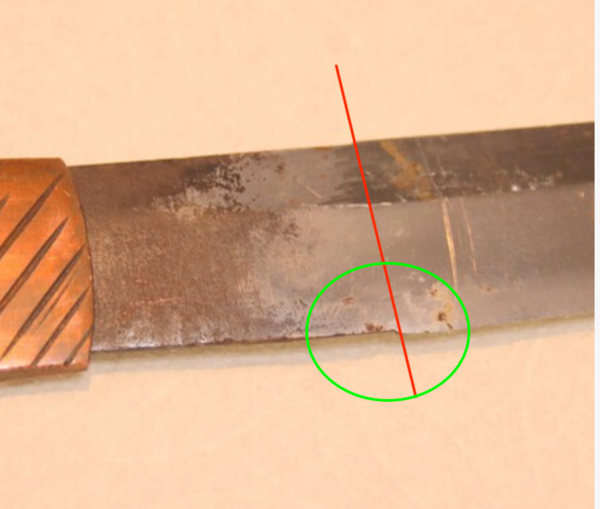
Lance: Same assessment. An older blade in need of some love, however it is legit. The red line in the pic is the munemachi-hamachi line I was referenceing. Looks fine. The green circle shows a lot of wear where the habaki contacts the edge. This is a result of age (removing and reinstalling the habaki). So in all, a good sign for legitimacy. John C.
-
No paint in the numbers suggests it was done post-paint, at any rate. John C.
-
The detail on the sakura menuki is not there...yet. Hope they don't get there. John C.
-
Identifying a swordsmith/history
John C replied to janimal's topic in General Nihonto Related Discussion
Just by the color of the steel, it looks shin-shinto. So I would start with smiths who are fairly modern. John C. -
Bushu ju?? John C.
-
Thanks, Nazar. As a proof of concept, it worked well. John C.
-
Bruce: Is that same celluloid? If so, I was thinking late war with the wire sarute, however it also has pierced tsuba...what do you think date-wise? John C.
-
This thread (the part from Steve Waszak) talks a bit about acids and forging techiniques to reach the effect.
-
Should be no problem, however two cautions: First, it will be a harder wood so If carving by hand, be prepared to sharpen the gouges often. Second, if the tree is still whole, you will need to cut the planks and let them finish drying to avoid movement, shrinkage, and tension release after it is carved to final shape. John C.
-
Google is incorrect. The tannic acid dissipates over time through off-gassing. While this happens faster with kiln dried wood due to 6% moisture content, the concentration is higher and therefore more deleterious to metal. Personally, I don't worry too much about it. Unless the sword is never cleaned or maintained, it should not be a problem. John C.
-
The word 'nie' means seeth or boil. If you look at the circled area of the picture I posted, you will see what appears to be something that looks like boiling water. That's nie. And it is a sign of water quenching. The thinner, whiter, cloudy areas are called ko-nie. That means 'small nie'. Technically, they are too small to see with the naked eye, which is why it just looks like a cloudy line. All of the above is created by the martensite crystals as they differentially cool in water. John C.
-
As others have said, honoki is most common in Japan as it is readily available, light weight, straight grain, and easy to carve. Any wood can be used, as long as it is either low acidic (never use oak, for example) or has been air dried for a few years. Kiln dried wood, which is popular in big-box stores, concentrates the tannic acid and could lead to rust production as it reacts with metal. I tend to use poplar or cherry that has been air dried for 5 years because honoki is virtually impossible to get here. John C.
-
Lance: Seems legit to me. Not ww2 but older blade. If you could take off the habaki (brass collar) and show that area where the tang meets the blade, it may tell us more (the imaginary line drawn between the edge and back should be perpendicular to the center line of the tang. Chinese copies are usually off-center). John C.
-
All of the clues are in the pictures, Steve. You can see nie and activity in the hada. The hamon has some life and activity in it. John C.

-
I mentioned in a previous post it is the word Lan (orchid). I wonder if it has anything to do with the Japanese occupation of the Dutch east indies or just an abbreviation for a company name? John C.
-
Not sure what you have there. Note also that the cuts on the tassel strings are straight and not jagged. I would guess it is not from another gunto. Does F&G have anything on it? John C.
-
The one next to the 32 could be an artillery sword. The scabbards are similar to some of the ones laying there. John C.
-
Michael: Looks like a legit type 98 to me. It also looks like the peg (mekugi) should come right out. Remember they are tapered, so when holding the sword in the right hand, the peg comes out from left to right (as if against the palm). A chopstick or thing awl should pop it right out with a few light taps. The information on the tang is what we really need to see. May have once had a leather cover on the scabbard (saya) given it is bare and there is a hole in the tsuba. John C.
-
Site Trouble Yesterday?
John C replied to Bruce Pennington's topic in Forum Technical Details and Maintenance
No problems loading, however drop down menu on forums is now missing. Not sure if that's a local problem or not. John C. -
@Iaido dude Steve: Any insight on these? John C.
-
Very common for baggage handlers to steal. It has been an issue for a long time. Indeed, roughly 10 percent, depending on the business, of employees steal from businesses of all types. Opportunity + Incentive (pressure) + rationalization = Employee theft triangle (Cressey). John C.
-
Restoration possible??
John C replied to Ronald Aguirre's topic in General Nihonto Related Discussion
Ron: Here is a diagram of what Grey was talking about. Getting a picture of the boshi will be important. John C.






