
Soshin
-
Posts
2,918 -
Joined
-
Last visited
-
Days Won
3
Content Type
Profiles
Forums
Events
Store
Downloads
Gallery
Everything posted by Soshin
-
After reading the topic a few times I have came to the conclusion that at fundamental conservation point should be restated just so that this thread does not create some confusion. This was originally stated in the original post by Keith G. Lacquer of different types original to many very old (circa Early Edo, Momoyama, Muromachi Periods) tsuba should not be removed. My pubic service announcement has ended. Yours truly, David S.
-
Also wanted to post this scan of a Nanban tsuba with all of the typical characteristics of Nanban tsuba (stylized seppa-dai design, dote-mimi, and no signature) but with a motif of many monkeys setting in trees all in different positions. The intermeshed arms, legs, and tree branches create a familiar Nanban-bori arabesque pattern frequently made of vines in more typical Nanban tsuba. This tsuba could have been made by a Nanban tsubashi trying to imitate the monkey designs seen in the Yagami school. Yours truly, David S.

-
I just wanted to post some scans of this month NBTHK magazine (Issue #648, pg. 21) that like last month was featuring the Nanban group in the tosogu section. Here are two tsuba by the Yagami school that show even more of a Nanban influence then the classic school motif of the two thousand monkeys. Right now I am a little "on the fence" about if Yagami school should or should not be included the large Nanban group. These two tsuba have many design elements seen in the large Nanban group. Yours truly, David S.

-
Well technically speaking Hirado and Nagazaki are both port cities located near each other in what was once Hizen Province. They both had a degree of European and Chinese influence that affect a tsuba produced there. Therefore using the Torigoye and Haynes classification system I would think the first tsuba would be classified as Namban as I think there is a bit stronger European influence with the use of the stylized Roman letters. I was thinking the second linked tsuba was a Kagonami but I am not really sure as I have not seen many tsuba of this type described as Kagonami. The two thousand-monkeys-designs is another design that comes like John L. says from artists of Hizen Province that shows a great degree of non-Japanese influence and also by their location near Hirado and Nagazaki cities in Hizen are often given the Namban label. Thanks John L., Jim, and others for the discussion. Yours truly, David Stiles
-
Hi Bernad, The Heianjo Shinchu Zogan school does but Mr. Holbrook was referring to the old name for the Kyo Sukashi school which is Heianjo Sukashi. Hi Andrey E., Having also purchase some tsuba from the same collection and I love each tsuba very much (thanks Grey) but I have revised about a little more then half of Mr. Holbrook original attributions. Your tsuba here I don't think is Kyo Sukashi school but maybe a nice Shoami work done with sukashi. I collect and like Shoami tsuba and have many in my collection. Thanks for sharing and discussing the nice tsuba. Yours truly, David S.
-
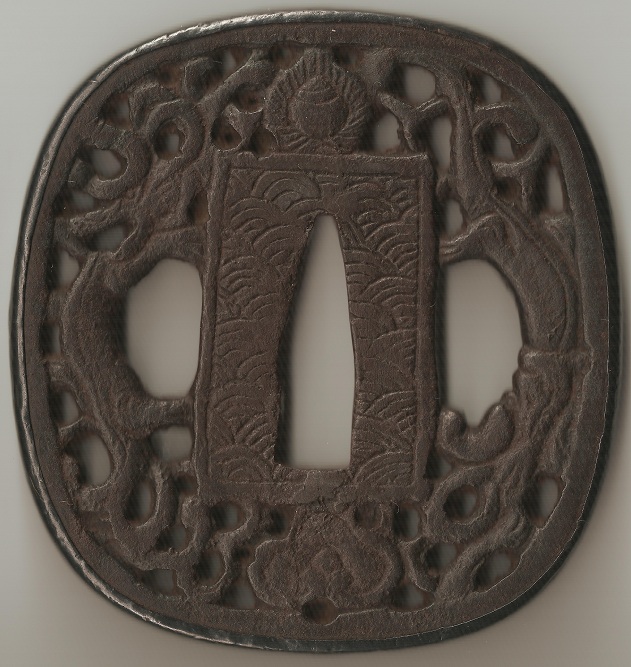
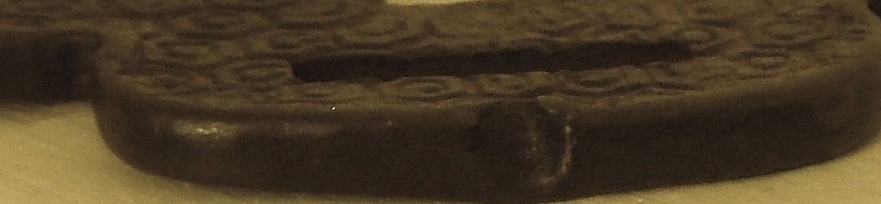
The first Namban tsuba you linked to has a strong European influence. This is apparent characters at the bottom of the tsuba which has stylized Roman letters. Most of the information I have about Namban tsuba is from Tsuba An Aesthetic Study where Torigoye and Haynes spends some three pages on the subject. They divide the very wide group of Namban into three subgroups: Namban, Kanton, and Kagonami. The original Namban style had has strong European influences like the first tsuba you linked to were made in the southern port cities of Hirado and Nagasaki. The very early Muromatchi Period tsuba made in Chinese for export to Japan are also classified as Namban. The Kanton were those tsuba that had a kaku or dote mimi with engraved designs showing a strong southern Chinese style influence with Chinese dragons and a very symetrical design. These were copies of the earlier Chinese style Namban export from China during the Muromatchi Period. The Kagonami also had the Chinese style dragon and other mythical animals but with a asymetrical design that are very complex in detail. You see that in the second tsuba you linked to. By the end of the Edo period there were production places all over Japan including the original places in Kyushu and Edo, Kyoto, Aizu, and Yokohama. Mostly only copies of the Kanton style of Namban were being produced of varying quality. Here are some quick scans I have of my tsuba. I think it is a classical Kanto (Namban) tsuba that shows the characteristic symmetric design with Chinese style dragons casing a diamond. This type of craving techique in the surface of the tsuba is called Namban bori. The overall size of the tsuba is a little bit on the small side at 6.9 ✕6.5✕ 0.5 cm. The scans show the very dark sakudo fukurin very well. I am not sure when the sakudo fukurin was added to mine but I have assigned a middle Edo Period age to the tsuba based up on accumulation of dust and oxidation in the sukashi; and the deep color to the patina. Yours truly, David S.


-
Just my two cents on the topic. I really like your large nanban tsuba and I am a lover of the school as well. I would generally consider it a part of the Kanton subgroup of Nanban as I do see Chinese and not European influences in the motifs and design layout. The undercutting that others are talking about are common in Nanban but I don't think are a requirement for inclusion into a very board school. I have a Kanton (Nanban) tsuba that has a Skakudo fukurin of a very dark color as well that I did not notice at first look while purchasing the tsuba on a vacation in Japan. I think the fukurin covers the undercutting of the mimi normally observed in Nanban tsuba. Yours truly, David S.
-
I would agree with Henry's analysis of the tsuba. The relief craving isn't very good and the tsuba also look badly hammered. I would venter to say that the tsuba looks as old as its Nihonto (i.e. Shin-Shinto era or Late Edo Period). Yours truly, David S.
-
I would agree with Henry I think the design is a kamon. I have seen similar designs in a iron piece in Gai So Shi by Robert E. Hayes specifically item #12. The tsuba date to the Muromachi Period. Go to the following link and look up the item in detail as there are high resolution photos on the web: http://www.nihonart.de/index_en.php. Yours truly, David S.
-

Florida show
Soshin replied to Grey Doffin's topic in Sword Shows, Events, Community News and Legislation Issues
I have some beanie babys with wonderful painta and fine tekkotsu on their rim and the inside of the sukashi. I will bring them to the Tampa Show! Just kidding... I will be attending the show for the first time and can't wait as I have booked my flights and my hotel room. Just the idea of going to Florida in Feburary for a weekend sounds like a good idea given how cold it has been in Maryland. I am of course focused on what I am interested studying and collecting tosogu but I will still take some time to look around a bit at the Nihonto and other Japanese associated forms of art. Any advice to a show newbie is welcome. Yours truly, David S. -
Hi Bernard, Even though one of the photos is a bit out of focus. It looks like the sakudo-nanako is of hight quality. Keep in mind that I am not a expert by any means on this subject. Also of the tiger along bamboo design is well done as well in takabori (high relief carving). Some wear to the gold inlay which is to be expected on a Edo period piece. There also also appears some minor damage to the backside which is also common wear spots of a kinko kozuka like this. Having a photos of both sides of the kogatana blade would also be nice as it looks like it has a mei. Thanks for sharing photos of your kozuka. Some of the more experienced people on the forum might be able to help. Yours truly, David S.
-
Happy New Year Everyone Yours truly, David S.
-
I am really not a kinko person so I really can't tell if it is Goto or not. I buy tosogu books with Kinko works in them but really don't collect them. Could you provide additional photos of good quality and detail that show the sakudo nanako body of the kozuka? Having a photo the other side of the kozuka would also be helpful. Yours truly, David S.
-
I must agree with Mark G. and Peter D. the tsuba looks like a modern cast iron tsuba. Not unlike a tsuba in terms of casting flaws I purchased off of eBay when I just started collection tsuba. Yours truly, David S.
-
Thanks for the comparison between the Owari Nobuie and a original Nobuie from the late Muromachi or Momoyama periods Steve. Having similar motifs in all three tsuba is very helpful. I would say that while my tsuba is not to the level of craftsmanship (specifically the mokko-gata form) of the original Nobuie I would say that my tsuba is closer then the Owari Nobuie example provided. I am drawing this conclusion based upon comparing the turtle shell kokuin design found in all three tsuba. My tsuba turtle shell kokuin on the Ji (surface) of the tsuba has a similar delicate melted appearance similar to the original Nobuie more so then the Owari Nobuie example. Yours truly, David S.
-
No I am not upset as I did not purchasing tsuba for the reason that I was thinking it dated from the Momoyama period. I was simply using the information provided by the tsuba former owner as a starting point to do my own academic research. I would consider all tsuba in my collection as study pieces per se. I have started to focus my collection on iron tsuba from the following school/groups Yagyu, Owari Sukashi, Nobuie and copies, Yamakichibei and copies, Tempo, Satome, Katchushi, Tosho , and Shoami. This tsuba I would consider it in the style of Nobuie likely made by one of the two generations of Norisuke tsubako of Owari. This tsuba is well within the context of what I collect. Does anyone know what works of the Owari Nobuie school look like and were they ever signed differently other then Nobuie? The Kaneko (金子) may be the signature of a early owner of the tsuba if made by either generation of Norisuke or the mei of someone working in the Owari Nobuie school during the late Edo period. Just wanted to edit the post and add some more ideas and questions relating to Japanese to English transliteration. I was thinking that there is more then one way to transliterate the Kanji 金子. Wouldn't it be equally correct to use Kinko as Kaneko? Does standardized Romaji have a specific conversion to address this? Having someone more experienced with tranliteration of Japanese signatures would be great. Thanks again for everyone taking the time to reply to my thread. Yours truly, David S.
-
Hi Steve, Here are some new photos of the tsuba that I hope are a little better and more helpful for identification. The mei is also clearest in the photo of the Omote side. Two photos are along different parts of the mimi. Thank you for clarifying what I think Christian had in mind. The tsuba has the following measurements: 7.0 ✕ 6.8 ✕ 0.30 cm (mimi = 0.40 cm). The Owari Sukashi school only lasted until the middle Edo period but both generations of Norisuke based in Owari produced tsuba during the late Edo that were high quality for the time period. I know that at the 小道具の世界 – Kodôgu no Sekai blog http://kodogunosekai.com/ Rich highlighted a tsuba by the second generation Norisuke that is wonderful. Let me know if anyone needs any more information. Thanks again. Yours truly, David S.


-
Thanks Reinhard for the additional information. I was simply listing ideas in the thread as I was doing some searching on the internet. I would consider the quality of the iron (steel) and patina to be good but not to the level of a real Momoyama period Nobuie. I did do some checking and the kanji (子) has the literal meaning of child or offspring. A literal translation of kaneko (金子) could be "golden child". According to Christian the implied meaning for the kanji (子) given the context is reminiscent. I find this very interesting. The fact that Kaneko (金子) is a common family name may indicate that the signature is not the mei of the maker of the tsuba but possible one of the early owners of the tsuba. I was already ruling out Nobuie before I purchased the tsuba as it is clear the signature is not Nobuie (信家) and the color of the patina is not the blackish purple in color even though ko-sukashi and turtle shell kukuin are common designs in Nobuie (信家) tsuba. I was still thinking that in terms of placement of ko-sukashi, overall thickness, and other signs of wearing associated with use and age that the tsuba dated to either the Momoyama or early Edo period. The presence of a iron insert indicates the tsuba has been mounted on a few different swords during its functional life and there is what looks like a sword strike to the rim on the ura side of the tsuba. These are the signs of wear I am referring to. Tekkotsu are also very pronounced in the rim as well. Here is the photo of the rim showing the damage and some tekkotsu as well highlighted in the photo by arrows. At the site of the strike the lamination folds can also be seen very clearly. Bob raises a good question what is the context and evidence are you using Christian that would indicate this is a later Owari tsuba? I was also under the general idea that tsuba production ended in Owari by the middle Edo period. Yours truly, David S.

-
Thanks John. I did a quick Google search using the terms "Kaneko" and "Choshu" and came up with these tsuba from a Christies auction lot. Here is the URL: http://www.christies.com/LotFinder/lot_details.aspx?intObjectID=4004105. I would say that the tsuba pictured in the lot are classic Choshu Kinko and likely belong to the Choshu line Reinhard found. They look very different then the current tsuba in question. Does anyone think the mei could have been altered when the iron insert on kozuka hitsu-ana was added? I noticed that the insert is a little bit ticker then the remainder of the tsuba in that area. Yours truly, David S.
-
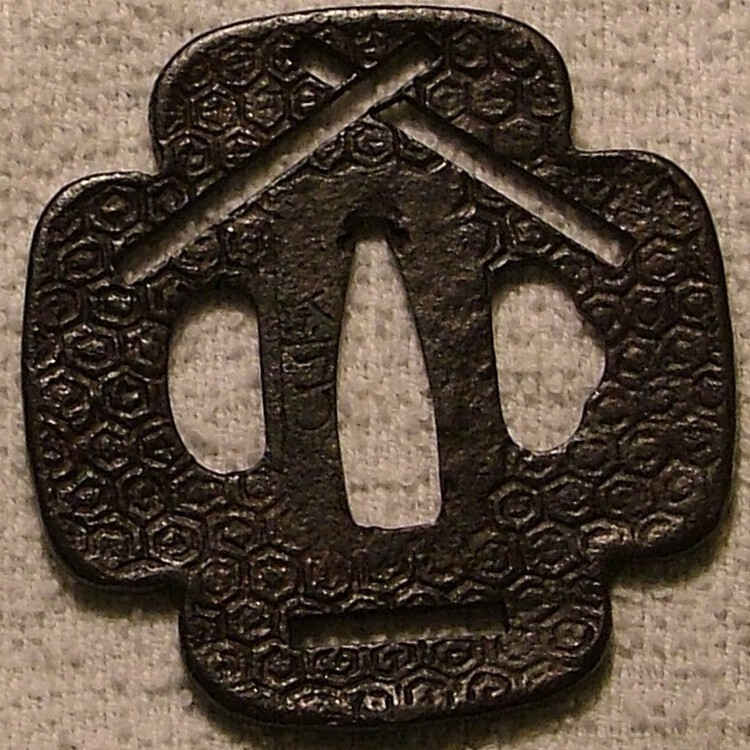
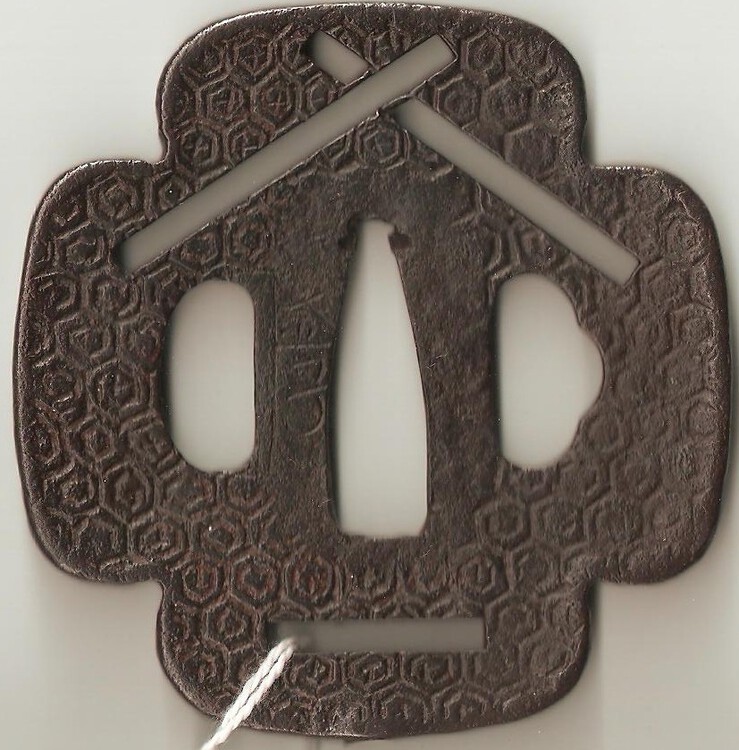
Hi Reinhard, Thanks for the information. Here is a higher resolution photograph of the tsuba under normal light. The mei is I think a little easier to read in the photograph. I was generally agreeing with Skip's attribution to the Myochin school based upon the kokuin, placement of ko-sukashi above and below the seppa-dai, the very dark blackish brown color of the patina, and the shape of the mimi. The thickness is also characteristic of a earlier Myochin at 0.3 cm at the seppa-dai and 0.4 cm at mimi. Later Myochin tsuba of the middle to late Edo period would be much thicker. I wouldn't describe this tsuba as being Choshu like. Does anyone know of a Myochin armor maker using the Kaneko (金子) name around the Momoyama or early Edo periods who also made tsuba? Or any Myochin armor makers that would use the Kane (金) as the first kanji in their name? Thanks again for all the help. Yours truly, David S.
-
Hello Translation Assistance Forum, This is my first post of this forum on the Nihonto Message Board. I have what I think is a Momoyama period Myochin tsuba that that has a mei that is difficult to read. This I find is often the case with Momoyama tsuba that are signed. The tsuba was once owned by Skip Holbrook that I purchased on the message board. Skip's notes state the following: Well I agree about the school and time period comparing it to other works with shinsa papers but as for the mei I don't think it is signed Nobuiye (信家). From what I can determine as I often help people with translations is that the first Kanji is Kane (金) the second Kanji I am not sure on. This second Kanji character might be stylized in some way making it hard to read. This is why I am posting scans of the tsuba which clearly displays the mei. If you need me to post some higher resolution scans or photos of mei please let me know. I would just like the translation for my own research notes as I really like the tsuba and will not be selling anytime soon. Thank you so much for you help. Yours truly, David S.

-
I think all of the tsuba are real, antique, and dating to the Edo period. I also agree that the tsuba are a pit pricey given the current exchange between the US Dollor and the Japanese Yen and the current market. I have of recently shifted my purchases from Japan were I started to the USA. Next year I am also going to try to make it to more show in the USA as well as deepen my research of tosogu. Thanks for sharing photos of the tsuba for sale in Japan. Yours truly, David S.
-
Dote tsuba Auction ends 28th November
Soshin replied to Henry Wilson's topic in Auctions and Online Sales or Sellers
My impression of this piece is that it likely a Edo period Katchushi tsuba. I come to this conclusion based up it thickness, overall size, and style of rim. The dote mimi and overall thickness and small size is commonly seen in Edo period Katchushi tsuba. Just my opinion. Overall I like the tsuba. Thanks for sharing Henry :D Yours truly, David Stiles -
Merry Christmas Henry! I am more of a iron tsuba person but what a wonderful early Kagamishi tsuba. Thanks for posting detail information about it. Yours truly, David S.
-
I would also agree with James. Both tsuba are cast copies one is iron and the other is copper and likely date to the Showa period and are therefore vintage and not antique. There are frequent motifs and themes copied in antique tsuba as well. I have a Owari Sukashi tsuba from the Momoyama period that is of a sun family crest motif that I think is a antique copy of a similar sun family crest motif done in a Muromachi period Ko-Katchushi tsuba. I have also seen real antique tsuba that have the same motif done in different school styles as well. Just my two cents. Thanks for the interesting topic of buyer beware eBay (aka. crime-bay). Yours truly, David S.