
Soshin
-
Posts
2,935 -
Joined
-
Last visited
-
Days Won
3
Content Type
Profiles
Forums
Events
Store
Downloads
Gallery
Everything posted by Soshin
-
Thanks for sharing the nice collection of tsuba with the Tosogu message board. I really like the Choshu and Miboku tsuba(s). Something about thoese type of kinko tsuba I really like and the Miboku is a really good example. Yours truly, David S. (Soshin)
-
Would Bakumatsu era (1856 - 1867) or early Meji period (1868 – 1890) be a better estimation of the tsuba's age? Thanks Reinhard for providing additional information about my tsuba I will update my records. If anyone else can provide information about school of the tsuba which worked in or came from Echizen that would be great as well. Yours truly, David S. (Soshin)
-
Thanks John for providing some assistance and additional information to the discussion. I would agree with everything you said after taking sometime to look back at the tsuba in question and the website of on the Echizen Kinai tsuba school. The tsuba are different and only share the same design motif of a dragon. I am fairy new to tsuba and just wanted to help facilitate discussion of Amon's tsuba to improve both of our level of understanding. Yours truly, David S. (Soshin)
-
I fully agree with Ted opinion on the subject. I would keep the tsuka as is and look for a matching kashira. There are a number of orphan kashira at different Nihonto shows for sale. Yours truly, David S. (Soshin)
-
The dragon design reminds me of the Echizen Kinai school of tsuba http://www.shibuiswords.com/BITsuba3.htm but the detail on your tsuba isn't that clear compared to the ones discussed on the website sited above. The observed lack of detail of your tsuba might be an artifact of photographs being taken on a dark background that you have provided. I once had a old iaito that had a similar dragon design to what is seen in the Echizen Kinai school but the detail and qaulity of the workmenship was very poor as the tsuba was cast copy. Due to the current quality of your direct photograph of your tsuba it hard to make any conclusions one way or another. Have additional information about the Nihonto might also be helpful. Hope you find my information helpful. Yours truly, Daivd S. (Soshin)
-
Could you please provide a detail photographs of the kashira? It make it easier for people to make suggestions as to what you should do with the set of menuki, kashira, and the tsuka. Yours truly, David S. (Soshin)
-
Could you retake the photographs of the tsuba using a lighter background? Using a dark back background with such a dark colored tsuba makes it hard to see any detail. An alternative would be to scan the tsuba with a document scanner. Any information you can offer about how you obtained the tsuba might be helpful as well in obtaining more information about the tsuba. Thanks. Yours truly, David S. (Soshin)
-
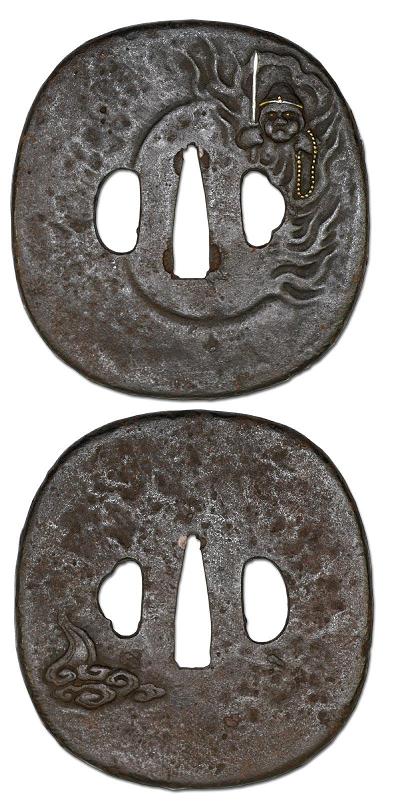
Dear Tosogu Form; As I have often posted many questions about some of my poor quality tsuba that I have little information about from my collection and likely almost caused blindness in some of the connoisseurs of tosogu on this form I have decided to post a new tsuba I obtained as a birthday gift to myself a few weeks ago. The piece was purchased at Tokugawa Art in Nagoya, Japan. Here is the link to the website. http://www.sanmei.com/ The tsuba is still listed in the sold item section of the website. Here is a short write up I did about the tsuba as well. The dealer said that he was thinking the tsuba likely dates to the early to middle Edo period from Echizen province. Does anyone have any information about different schools of tsuba maker active in Echizen around the early to middle Edo period? Thanks again for the additional information and enjoy the view. Item Name: Fudo Myo-ō Tsuba Item Number: T14 Purchase Date: 07/15/2009 Product: Tsuba for Katana Material: Iron (tetsu) Age: early Edo (17c) to mid Edo (18c) Size: 8.4 X 7.9X 0.4 cm Weight: 300 grams Shape: Maru-gata Misc: Kozuka-hitsu & Kogai-hitsu ana, Sekigane Attachment: Wooden Display Box DESCRIPTION: This iron (tetsu 鉄) tsuba have a Immovable Wisdom King Buddhist (Fudo Myo-ō 不動明王) motif done in high relief (taka bori 高彫). There are silver (gin zogan 銀嵌) and brass (shinchu zogan 真鍮嵌) inlays that are also in high relief (suemon zogan象嵌). The border of the tsuba is round in shape and higher in relief then to the middle of the tusba (maru mimi 丸耳). The tusba surface has a wonderful hammered pattern (Tsuchime Ji 槌目地). I purchased this tsuba via the Internet at Tokugawa Art located in Higashi-ku, Nagoya, Japan. The dealer said that the tsuba was likely made in Echizen province during the early to mid Edo period.

-
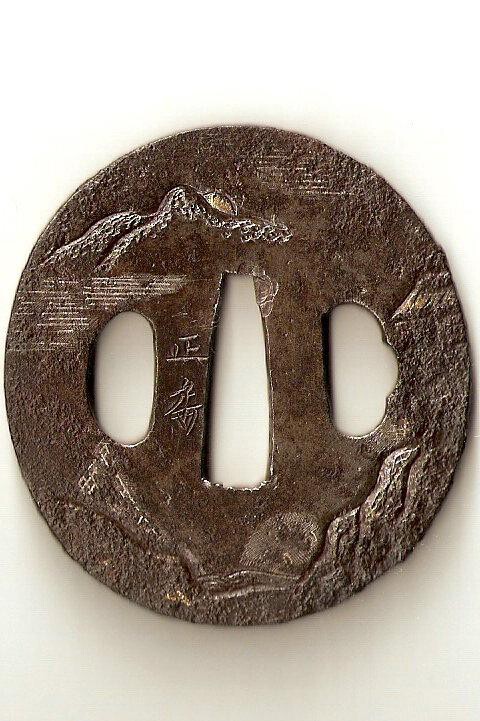
I'm replaying to this post I made to add some additional information I was able to uncover in a book that I own. In Lethal Elegance "The Art of Samurai Sword Fittings" by Joe Earle on page 74 I uncovered some information about the Ito or Bushu school of tsuba makers. "The Museum owns nearly one hundred Bushu tsuba. While all of them are (at least) competently manufactured, many are essentially mass-produced goods of low-quality iron and of little aesthetic interest today, either to Japaneses or Western connoisseurs." I had a few people look at my tsuba at the local Nihonto club and they said it likely belongs to Bushu-Ito school as Masafusa is a common name in that school. I would say that my tsuba likely falls in to the generalization talked about by Mr. Earle in regards to the Bushu-ito school. Just providing additional information I was able to come up with. Yours truly, David S. (Soshin)
-
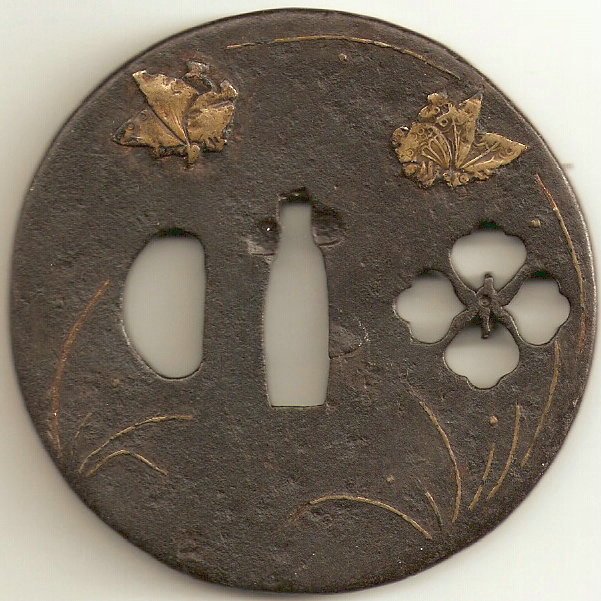
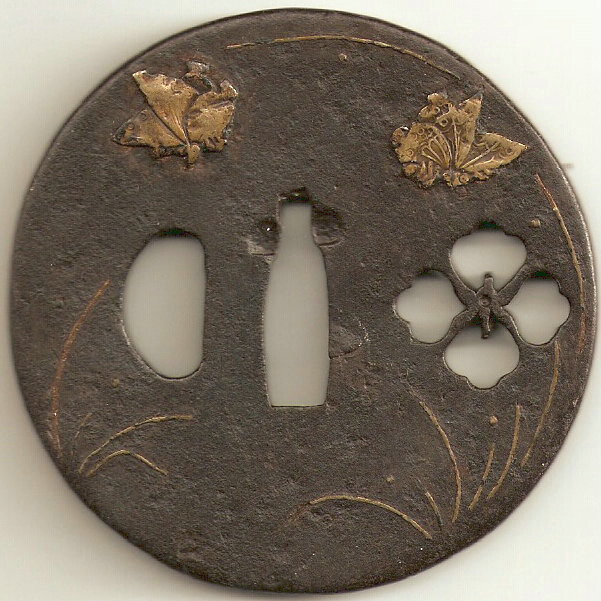
Dear Gary, I don't have much information to offer except I have a katana sized tsuba with a very similar butterfly design on it as your set of menuki. The butterflies are among grass that is drawn in lines. I think my butterflies are made of copper. The butterflies are inlay-ed in high relief (taka-bori) and are some how stamped on to the surface of the iron tsuba. I don't know much about the tsuba other then it likely dates to the late Edo period. Here is a scan of the omote side of my tsuba. Hope you find my little information helpful in your research. Yours truly, David S. (Soshin)
-
I am not familiar with the subject of the tanto tsuba the Chinese Buddhist monk, Kazan. The menuki appear to show a classical Hotei (large Zen Buddhist Monk holding a bag) design. Who is Jittoku is he related to Hotei and how is he related to Kazan? The person on the menuki(s) appear to me to be the same person at two slightly different perspectives. I common design seen in menuki sets. Thanks for sharing the menuki(s) and tsuba I really like the design and craftsmanship of the pieces. If you could post photographs of the whole tanto koshirae that would be great. If the menuki and tsuba are any indication then the koshirase should be really nice. Thank you. Yours David S.(Soshin)
-
In regards of Tsuchimeji tsuba be used by country Samurai (i.e. Goshi) I am not sure. I currently have two tsuba(s) that both belong to the Tembo school and also have Tsuchimeji. The type of surface is very common in Tembo school but it is not excluive to the school. I have another tsuba that belongs to the Shoami school of the late Edo period that also has a Tsuchimeji surface. I hope you find this information helpful. Check out Dr. S. website he has much information on tsuba of the Tembo school. Here is another website with additional information and many photos of Yamashiro Tembo tsuba(s). http://www.shibuiswords.com/BITsuba2.htm Yours truly, David (Soshin)
-
In terms of the comparison of the mei between John's and Ford's I can tell that John's mei in the second kanji has some major balance issues in terms of the different sizes of the composite radicals. It really reminds me of my own Shodo work that my sensei would dislike in terms of its poor balance of the different composite radicals. The person writing the John's mei was likely not writing their own name which they likely would have practiced many times and would have had better redical balance. Just my impressions and observations of the different mei of the same name. Yours truly, David (Soshin)
-
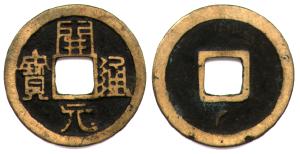
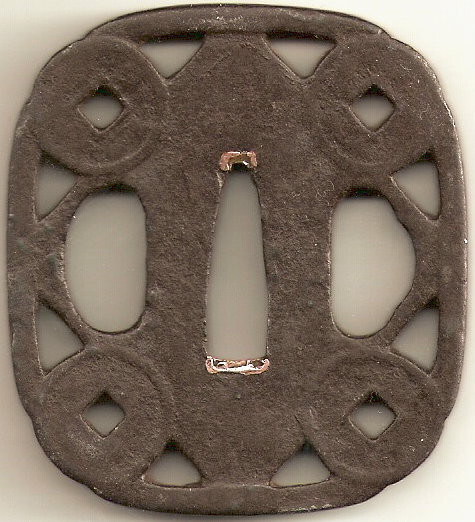
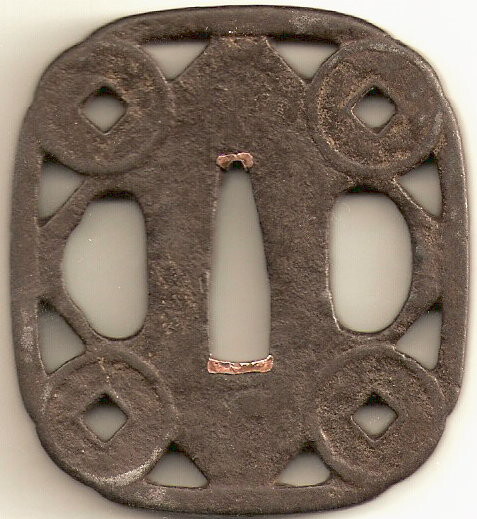
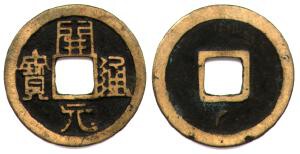
I have a Edo period wakazashi tsuba with a coin designs on it done in a thick ji-sukashi style. The central diamond shaped silk spool is also done in ji-sukashi. The Edo period coins were pattern after Chinese Tan'g Dynasty coin designs. I hope you find this information helpful. Here are some scans of my tsuba for reference and a small photograph of a Chinese Tan'g Dynasty coin. Yours truly, David (Soshin)
-

little naginata with edo koshira
Soshin replied to drbvac's topic in Auctions and Online Sales or Sellers
I once purchased a mumei tanto with a good hamon and hada from eBay. Once I received it and examined it in more detail it turned out that the nakago was polished removing almost all of the rust. I estimated the age of the tanto with the polished nakago to be shinshinto. This naginata look much like my tanto. When people do this it very much removes almost all value of the Nihonto as antique art. Just my "two-cents". Thanks for reading. Yours truly, David (Soshin) -
Hi Fred, I have bookmarked your website because you have some really nice tsuba for sale and study. Your Nanban tsuba are all really great. Thanks for sharing the link to your website. Yours truly, David (Soshin)
-
I like the tsuba as well. I would agree that the tsuba posted here is very similar to the first two tsuba listed at Japanesesword.com website. Yours truly, David (Soshin)
-
Thank you Brian for posting the whole set of tosogu. They are wonderful even if they are gimei. Yours truly, David (Soshin)
-
I have a iron tsuba simply signed Masfusa. The over condition of the gold and silver inlays are not great but the quality of the iron of this tsuba is much better then other iron tsuba in my collection. I did some research and found out that there were two schools of tsubako in the Edo period that had members that used that name the Bushu Ito and the Shoami Schools. From a stylistic analysis of the tsuba I would say it is likely Shoami school and not Bushu Ito but I know from this forum that stylistic analysis should be the last thing to consider when preforming a kanei on a Tsuba. I have posted a scan of the omote (面) side of the tsuba for reference. If anyone can provide additional information that would be a big help. Yours truly, David (Shoshin)
-
Thank you Peter for taking the time to address the larger issue with me trying to kantei my tsuba. Looking at the photograh you provided the type and quality of the forging of my tsuba would not fit with the Owari school classification of the Momoyama to early Edo periods. Yours truly, David (Soshin)
-
I am just posting a reply to my own thread as a reminder and to help facilitate recall for fellow forum members about my post. I came across the same stylistic sukashi bird patterns in a Tusba posted on this forum that was listed for sale as a Momoyama period Tsuba from the Heianjo School. I am fairly sure my tsuba is Edo period but could have been a copy made from this type of Tsuba of the Momoyama period or early Edo period. Here is the link to the post I am referring to. http://www.militaria.co.za/nmb/viewtopic.php?f=4&t=5336 The Tsuba is near the bottom of the for sale listing. Thank you for taking the time to read my post. Yours truly, David S. (Soshin)
-
Dear Gunome, I am not sure of the school of the tsuba but the design looks interesting thanks for sharing. The patina on the tsuba looks like it is in really bad condition. Did you get the tsuba in that condition? I have heard of people fixing patina on altered and damage tsuba but I have never seen any and I am not sure if it works. Yours truly, David
-
Dear Raven2, Nice tsuba, I have been meaning to go to the Chicago and San Fransisco shows sometime in the future. Lately I have been spending to much money on trips to Japan. Thanks for posting photos of your new tsuba. I really like the kiku (Chrysanthemums) design in Kyo Sukashi form. The tsuba('s) sabi also looks great. Yours truly, David
-
In terms of the design of the tsuba being the sun surrounded by rays of light that is also a strong possibility because the symbol of the sun has very strong connections to a few different aspects of Japanese Buddhism. The presence of the numbers 4 and 8 in the design is also unmistakable in my opinion. The specific aspect I am refereeing to is the Buddha named Dainichi Nyori in Japanese. A quick translation in English of the name of the Buddha would be "Great Sun Buddha". As for the age of the tsuba I likely say it is Momoyama or early Edo and the design copied from early Muromachi period (ca. 1400) works. Still I really like the tsuba even though it's geometry is a little off. Yours truly, David
-
Dear Peter, It could be a sun but after counting the number of sukashi openings in the tsuba I would likely say that the sukashi tsuba is in the form of a styled Buddhist Dharma wheel (Skt. Dharma Chakra) in Japanese called a Rinbo. I remember reading about a Tsuba that had similar design in a issue of the NBTHK monthly magazine. In the article it provided a fine example of a sukashi tsuba done in the design of a Rinbo. The tsuba had eight spokes in positive form in the wheel shape. Water wheels are also common but often have more then 4 or 8 spokes to the wheel design. Your sukashi tsuba has four positive form (ji-sukashi) shape and eight negative form sukashi openings. Both numbers 4 and 8 are very important in Buddhism. I hope you find this information helpful and thanks for sharing the photos on the forum. I am not sure what the school of sukashi tsuba belongs to. Yours truly, David