Surfson
-
Posts
2,965 -
Joined
-
Last visited
-
Days Won
18
Content Type
Profiles
Forums
Events
Store
Downloads
Gallery
Everything posted by Surfson
-
I have gotten some wonderful koshirae on Buyee/Yahoo. Although years ago, I was able to buy great, mounted swords straight out of the woodwork on ebay, the last few years, the good ones are very rare.
-
Sometimes Buyee is worse than customs, since they appoint themselves as arbiters of the process. Many times, they just wouldn't advance the koshirae without explanation. Once they started giving me the option of destruction or payment of storage, I had to play hardball. I have a friend who has had this happen to him many times.
-
George, there was consensus you should submit it to shinsa. You could have had it back by now and we could have a better informed conversation about your interesting sword.
-
 Did you buy it? Looks like it has been sold.
 -
I have had problems with several koshirae getting stuck (no pun intended) with Buyee for various reasons, or no reason at all. They will sometimes give you the choice of paying storage or to have them destroy the item. Their communications are often either bad or non existent. My solution to this problem was fairly direct. I have canceled payment (through Paypal or the credit card company) on more than one occasion, which puts them in a bind. They don't mind holding a "stuck" item if you own it, but once they own it, they suddenly get motivated to solve the problem. I hope this helps.
-
If that habaki is solid gold, I agree with the others - it will be noticeably heavier than a typical habaki. If you don't want to take it to a jeweler, you can get a simple acid based test kit. You would rub it on an abrasive stone, and then treat it with the different grades of acid. I have never used one of these, but they seem fairly simple, and as long as you are careful to choose an unobrusive part of the habaki, the rubbing part won't be overly destructive. https://www.amazon.com/Silver-Platinum-Testing-Stone-Jewelers/dp/B000OVHWLK/ref=asc_df_B000OVHWLK/?tag=hyprod-20&linkCode=df0&hvadid=312270791747&hvpos=&hvnetw=g&hvrand=7381579657912300181&hvpone=&hvptwo=&hvqmt=&hvdev=c&hvdvcmdl=&hvlocint=&hvlocphy=9021715&hvtargid=pla-569657247504&psc=1&tag=&ref=&adgrpid=62213987215&hvpone=&hvptwo=&hvadid=312270791747&hvpos=&hvnetw=g&hvrand=7381579657912300181&hvqmt=&hvdev=c&hvdvcmdl=&hvlocint=&hvlocphy=9021715&hvtargid=pla-569657247504
-
Translation assistance and identification
Surfson replied to Dconekin's topic in Translation Assistance
Thanks, didn't know that. b -
Translation assistance and identification
Surfson replied to Dconekin's topic in Translation Assistance
Dirk, two of those are Naomichi -
That is a very fine piece.
-
My read is: The water service cat looks like a mountain flower. Hilarious!
-
Hard to answer your question. Even if we assume it is gimei. Does it have mounts? is that an unwrapped handle in the background? Are all the other mounts there? What condition is the blade in? Any fatal chips, hagire or bad pitting rust? Probably worth less than $1500 if gimei.
-
Translation assistance and identification
Surfson replied to Dconekin's topic in Translation Assistance
He is a well regarded smith from the Mishina group. Like Yoshimichi, they often use sudareba, kikusui, Fujisan and other artistic motifs. Here are a couple shots of one in my collection. Also, here is a nice article about the school. http://www.nihontocraft.com/Mishina.html

-
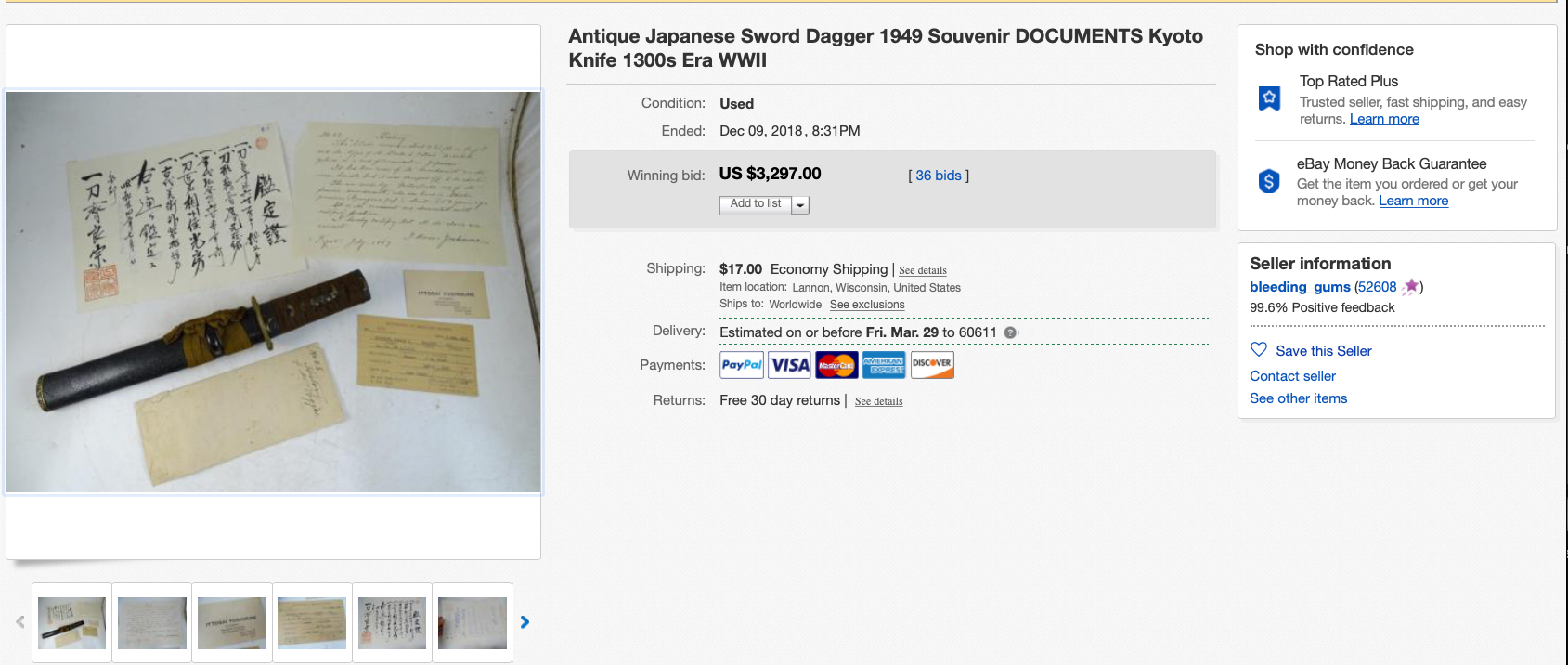
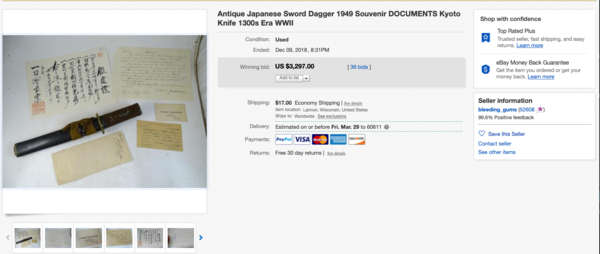
Here is a screenshot from the sales result of the other tanto that went through Yoshimune's shop and appraisal service.
-
Wow, thanks for posting that Bob. I had forgotten about this little study that I had done of Ittosai Yoshimune. I do love those tsuba - still have them. Interestingly, I found one in shakudo that was very similar but was pear or plum blossoms instead of cherry.
-
Marugata suemon?
-
Importance of a "Ubu" Nakago and Blade Length
Surfson replied to Cookie_Monstah's topic in General Nihonto Related Discussion
Paz, many are bitten by the "koto bug", including myself. However, I have kept most of my great shinto and shinshinto blades (mostly signed, ubu, polished, papered and obtained in need of restoration from ebay over the last two plus decades), and just been adding koto blades to the collection. My frustration with koto blades is the huge emphasis on kantei, since so many of these swords are osuriage. That puts collectors often in the position of buying, for high prices, mumei (osuriage) blades with high level papers to makers that the shinsa team chose. In many cases, we are paying huge prices just for the papers on swords lacking a signature. Since I have bought many of my koto blades on ebay or at shows and had them restored, I have to say that I have several that have gotten two, three or even four different attributions. I don't share your sense of koto superiority - shinto and shinshinto blades are wonderful, are often great examples of the pinnacle of Edo period sword making and can be found in perfect, near-mint condition, as they were when new. Also, the imagination of swords as art fluorished during the shinto period and later, and there are many schools that produced magnificent pieces of sword art. Many of these, e.g. Kiyomaro, command prices at or exceeding the prices brought by many of the koto masters. The path you have taken is very common and perfectly normal, though it need not be accompanied by a loss of affection for shinto swords. I have found some very nice koto blades and love owning and restoring them, but I love my Edo period swords as well. -
JD, Sharpness and durability were very important to a samurai when he was using the sword he was carrying in battles. Call it worthless if you must, but it was a valid and accepted method of testing the sharpness and durability of blades, and the nomenclature is still used today. These testers, and experience in battle, were also attuned to the tendency of certain swords with excessive tempering to break, another feature that had life or death consequences.
-
Kirill, my first guess is that it is a sword that you will have at the San Francisco show! I also thought Norishige, based on some sections with what looks like matsukawa hada (plus you liked the Ko-Uda call). Beyond that I thought it might be a shin shinto utsushi of a Yamato blade, but that seems out of the question.
-
Aoi has arranged and covered shipping for the blades that I have bought from them, but it has been many years since I purchased one from them.
-
It also says shakudo nanako ji maru bori...(tetsubun?)
-
Tameshigiri using human bodies is fortunately not done these days. However, having the results of decades of study using this primeval method has resulted in the ranking system that has been passed along. Although it is nice to own a sword by a maker designated as wazamono or better, I find that the Fujishiro rankings, which you use as well, are a better guide toward sword quality. The two ranking systems seem to be correlated to some extent. It's my understanding that Fujishiro made his rankings based on his personal experience from polishing thousands of swords.
-
Importance of a "Ubu" Nakago and Blade Length
Surfson replied to Cookie_Monstah's topic in General Nihonto Related Discussion
As a general rule, most collectors prefer blades to be at least "josun" or 70cm, which is just over 27.5". An ubu nakago is always preferred, regardless of era or age. Signed is preferred to not signed. In terms of length, after the Edo period, the standard length for gunto (military swords) was closer to the range of 66-68 cm, so the view of the above mostly applies to swords from Edo period or earlier. -
I hope to be self aware enough that I can start to distribute my collection at least a few years before I shuffle off this mortal coil. The problem is that we really can't plan for surprises (e.g. getting hit by a bus), and parting with my collection, especially my most favorite items, will be traumatic. I am trying to do what you have done Chris; that way, I will have the memories of my pieces secured in text and photos after I have found them new homes.
-
How long is the cutting edge on the unsigned blade?
-
I'm planning to take mine with me.