GRC
-
Posts
759 -
Joined
-
Last visited
-
Days Won
14
Content Type
Profiles
Forums
Events
Store
Downloads
Gallery
Everything posted by GRC
-
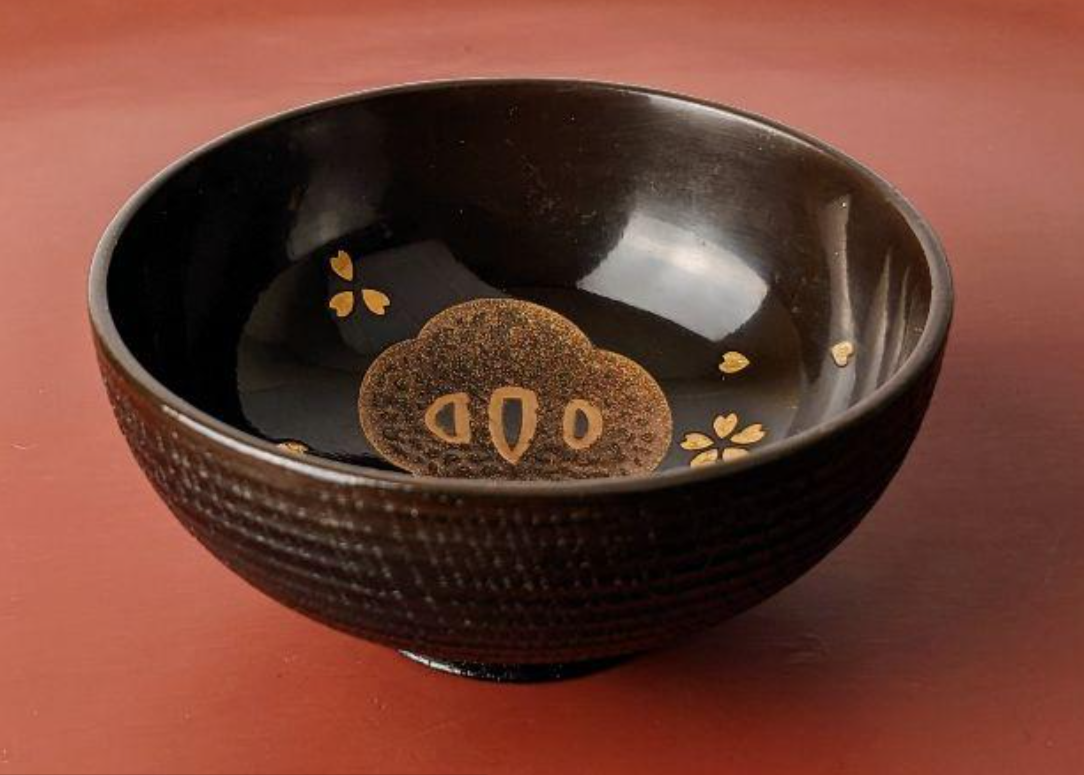
lacquer bowl:


-
Some thoughts on shinsa and high end prices for tsuba: Shinsa gets so many papers wrong so often, that it really shouldn't matter what they say in many cases. The obvious pieces shouldn't need papers anyway... and even then shinsa still makes mistakes (eg. an obvious, signed Yamakichibei tsuba was given a Saotome attribution... it's been posted on this message board in the past). But then again, people will always want/need "confirmation" from some sort of perceived authority before dropping the big bucks on something that is "museum class". Sadly, all this just reaffirms the idea that all too often, the high end prices are less about the piece itself and more about trophy hunting and the bragging rights that go along with it. But that seems to require the "papers" to wave around as justification. So when papers are present for high end pieces, the price gets driven up. I have read in several recent-ish posts that It seems that NBTHK shinsa is trending toward a much more cautious approach in assigning a lot more "den" attributions, rather than to give an attribution to a master smith. just some thoughts and observations... I know there's lots of opinions on this topic
-
flea market price for that one... could have/should have been much higher. It's special because it's Hirata Hikozo... THE GUY. Ground breaking innovator at a very special time in Japanese history. My question is why did the museum let this one go?
-
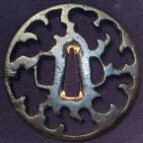
Piers summed that one up pretty neatly It's always those "crossover" pieces that are the toughest. I wish we could find some sort of period document that states the smith's intent on any of these not-so-clearly-defined motifs, and whether or not they intended their design to be a cross-over, or if it was just coincidence. I'm sure each scenario will be correct for different tsuba, but most likely, we'll always be left wondering... Damon, personally, I would place yours in the tokei "clock gear" category. If you look up images of Jesuit art, the rays tend to be more irregularly spaced with different lengths and thicknesses. and they sometimes use these more curvy flame-like rays: Here's one up for sale now that is listed as "gear", but I would say this one definitely isn't a gear (good luck running anything mechanical with a gear shaped like that). I would lean toward "rays of enlightenment" from the Christian Jesuit's iconography.


-
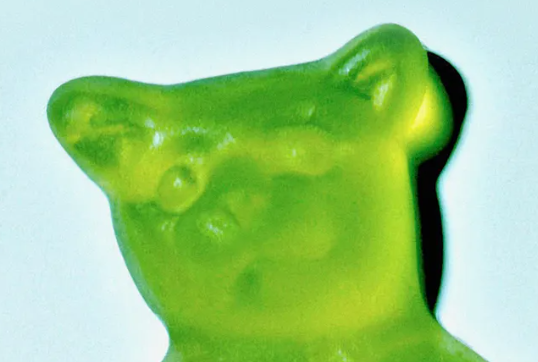
Thanks Curran, glad I'm not the only one Piers, did the Japanese description actually say "probably"? That's an important detail because it would show that even Kanemaru & Shibata couldn't say for certain that it was a guruma (wheel) motif. Thanks for that addition And Dale, Fozzie Bear was going to be my alternate explanation Before the connection clicked, these hitsu-ana always made me think of gummy bears... You know, I wouldn't be surprised if someone saw one of their guruma motif tsuba, where the straight sukashi lines were a little more distorted than usual, pointed out the similarity to a slice of lotus root... then the smiths started to play with the idea. Kind of like this one (from Varshavsky's bibliography): http://varshavskycollection.com/wp-content/uploads/2018/04/IMG_5965-372x400.jpg I guess it's all "food for thought" Dale's pun, not mine, so he gets credit for that one
-
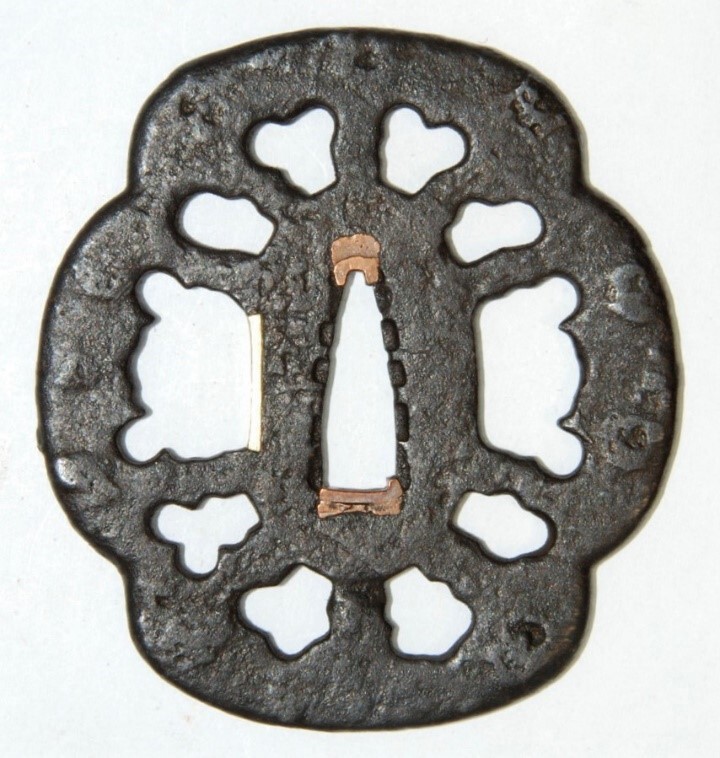
OK here’s another… I’m sure most people who start looking into Momoyama period tsuba, will quickly realize how common the “wagon wheel” motif was. It was employed in all sorts of variations, ranging from faithful realism, to abstractions where only a partial section of the wagon wheel is shown, to varying degrees of “expressionism” where the motif gets increasingly distorted or obscured. The wheel motif was one that was refined and explored by the Yamakichibei smiths. However, in sorting through images of the many variations of Yamakichibei “wheels”, it became clear that certain forms were quite consistent and could possibly be alternative motifs that the smiths adopted into use simply because they have an inherent “wheel-like” characteristic. In effect these artisans could have been “double dipping” with their choice of motifs. MOTIF 3 – Lotus root (perhaps with some type of vessel/cookpot hitsu-ana) According to Varshavsky’s bibliography, the one at bottom left was once part of the A.H.Church Collection where it was described as: “Iron, mokko form. Irregular surface with 8 irregular piercings. Signed: Yamakichi.” If you look at the four examples, the general outlines of the 8 sukashi are remarkably similar from one tsuba to the next, even though the individual sukashi openings appear to be “irregularly” shaped. So, this is clearly a predetermined pattern that is being repeated on multiple tsuba shapes and sizes (although the Yamakichibei do love their mokko-shaped tsuba!). None were done with any “randomness” on the part of the smith. This deliberateness, along with the fact that the motif takes on a more “organic” looking, almost vegetable-like form, is what got me thinking that this pattern must be alluding to something other than just a distorted wheel motif. Recently, I was looking up something about Japanese cooking traditions and accidentally came across a food item that jumped out immediately as being a solid representative for this tsuba motif. Call me crazy for suggesting it, but I can’t help but notice how similar it is to slices of cooked lotus roots! When sliced raw, the outlines of the holes are quite smooth (bottom image), but then they get much more irregular after they are cooked (top two images) Knowing that the Yamakichibei used other food items in their tsuba motifs, like the edamame beans I posted earlier, and their already known “sticks of dumplings”, I started thinking that cooked lotus roots wouldn’t be “off the table” as a possibility. I decided to look into it more, and it turns out that eating cooked lotus root is particular to Japan (and China and Korea …and perhaps some other countries as well). I also looked up areas where lotus root is cultivated in Japan: https://japancrops.com/en/crops/lotus-root/ In 2020, Aichi prefecture was ranked #4 in Japan’s lotus root agricultural production. Aichi prefecture was formerly included in an area that was known as the Owari province, which is where the Yamakichibei smiths were established. So, it wouldn’t be unreasonable to assume that this area was engaged in lotus root cultivation at the time of the Yamakichibei, and this was a dish that the Owari samurai were familiar with. I suspect it might be very difficult to find some sort of accounting record of the lotus root production in Owari during the Momoyama period, but it would be a fantastic bit of “confirmation”. Back to the motif itself: 1- The number of sukashi openings Interestingly, it turns out that most of the time, lotus roots grow with 9 holes arranged in a ring-like pattern around the center. However, a Google image search revealed that can also form with anywhere from 8-10 holes (maybe even more or less?). So, if this really is a lotus root motif, it makes me wonder why the Yamkichibei would consistently choose 8 sukashi openings when 9 was far more common… I wonder if they deliberately chose this for reasons of general aesthetics, or perhaps to represent the Buddhist “eight paths to enlightenment”. And just as a bit of musing, maybe they picked the rarer 8 because it would be akin to something like the Western idea of finding a “lucky four-leaf clover”. Maybe finding that occasional 8-hole root slice in your bowl held some sort of “good luck” aspect to it. Unfortunately, I have no way of finding out if this is true. 2- What are those unusual hitsu-ana supposed to be? This one most clearly shows the core elements that are common to all of them: As far as I know, these are only found in the Yamakichibei tsuba. I’ve never seen anyone attribute a meaning to these bizarrely unique hitsu-ana with any confidence or certainty… it always seems to start with a smile and “oh, you mean the bear’s head?” , then it eventually ends with a shrug of the shoulders and a “who knows?”. Looking at the four tsuba above, the hitsu-ana shapes are once again, quite consistent in their basic design elements, therefore must be deliberate in their design. While looking at the one of these tsuba turned on its side, some possibilities came to mind: 1- Maybe some sort of suhama motif? (a topic already discussed by others in this thread) 2- Maybe it’s some type of container with two handles? a) a basket filled with a few uncut lotus roots? b) a lidded cookpot? Like a traditional Japanese clay cookpot called a donabe that is used for stewing and brazing (like what you’d cook the lotus roots with) I was almost certain it was a donabe, but the tsuba with the fancy hitsu-ana inserts has some pretty exaggerated features… particularly the two “protrusions” at the sides. So, this steers me back toward the idea of a basket with several uncut lotus roots jutting out To sum up: The cooked lotus root, along with some type of vessel/cookpot does seem to fit from a visual perspective, and could possibly have the following reasons for its use: · A motif that references an agricultural product and meal type that has cultural significance to the Owari province. · Perhaps a reference to the Buddhist 8 paths to enlightenment. · Perhaps some element of luck or good fortune because 8 holes in a lotus root is less common (again, purely a hypothetical on my part). · And as a bonus, it simultaneously alludes to the “wheel motif” and whatever significances that had to the samurai of the time.


- 97 replies
-
- 10
-

-

-
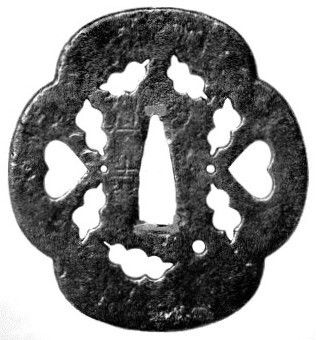
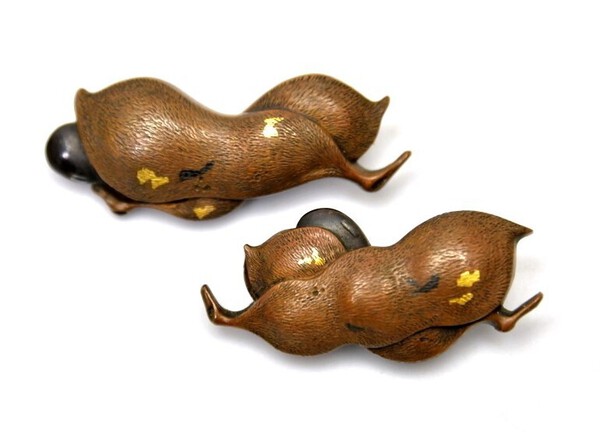
MOTIF 2 – Edamame (soybean) pods, with Sun, moon and star, and Inome (boar’s eye) hitsu-ana The many sukashi elements positioned between the two inome-shaped hitsu-ana, seem irregular at first, but they are actually repeated patterns. They have either 2 or three round bulges, with narrower “protrusions” at either end, where one is end is more squared off, while the other end has a more pointed tip. Edamame typically has 2 to 3 beans inside a bean pod: https://specialtyproduce.com/produce/Edamame_Shelling_Beans_17810.php Bottom left image: two sword hilt menuki shaped as one double- and one triple-bean edamame Bottom right image: a bowl of cooked edamame from: https://www.kobejones.com.au/everything-you-need-to-know-about-the-humble-edamame-bean/ Note: there’s a remarkable consistency in the sukashi designs of both these tsuba: 2 inome-shaped hitsu-ana 6 double bean pods (arranged in a ring) 1 triple bean pod (located at the bottom of the design) 3 circles (2 small and one large) Here is another variant of the same theme, but the tsuba does not have the mokko shape o fthe previous two. Interestingly, the entire pattern has been inverted, such that the triple-bean pod and the largest circle are positioned near the top of the tsuba. It was described in the fourth issue of the KTK as “Obscure sukashi motif. Oban form”. So what are the three small circles? I found this example and quote from Sergei Varshavsky’s site: In a different tsuba design from Yamikichibei, published in the 1992 Lundgren collection, the “three circles” are presented as a single motif in a much larger scale, and the design is described as: “Sword guard with design of sankô (Three Lights: the sun, the moon and the star) in openwork. Signed Yamakichibei.” *note: all black and white images and blue quotes are from Sergei Varshavsky's site



-
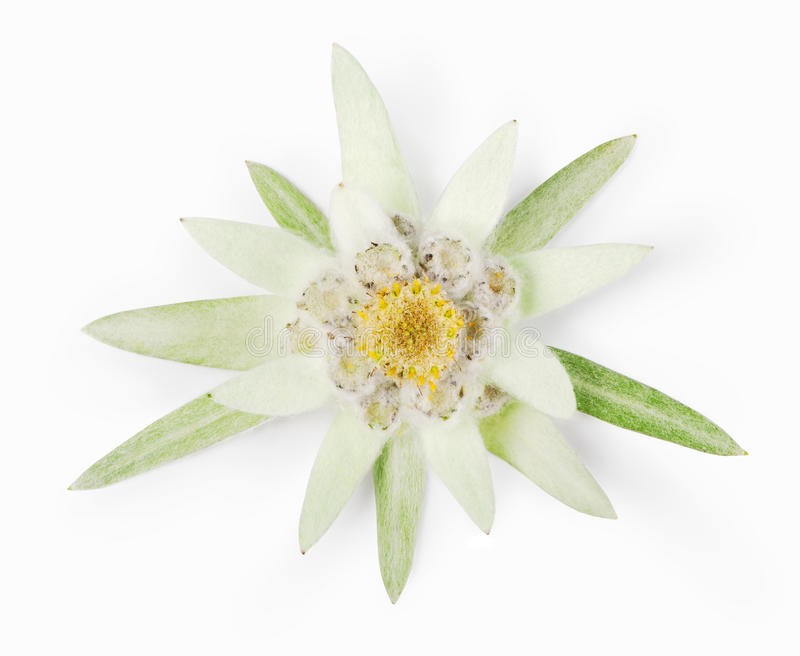
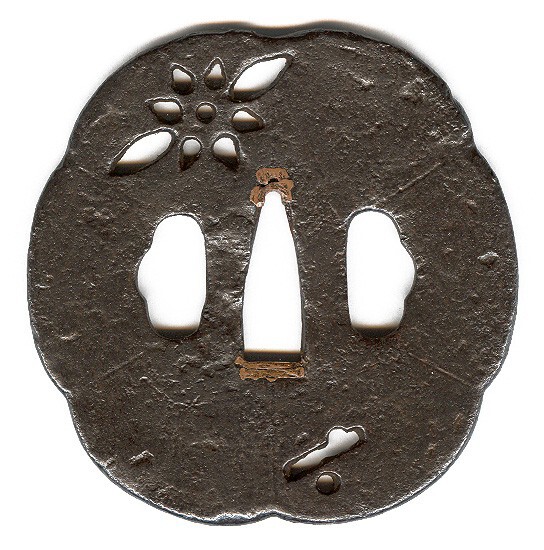
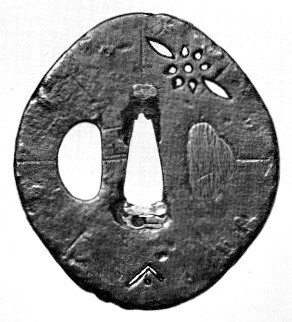
MOTIF 1 – Japanese Edelweiss Flower The motif that appears to be a flower with what appears to be: 2 oppositely positioned, oblong, pointed “leaves”, with 6 smaller “petals” with a similar yet shorter shape to the leaves, positioned around a circle in the center. After searching for native Japanese flowers with similar characteristics, I narrowed it down to a single candidate. I believe that this motif represents Japanese edelweiss. There are 11 species of this flower which grow in Japan, China and Korea. Scientific article: The establishment history of alpine Leontopodium japonicum (Asteraceae) resembles that of warm-temperate plants on the Korean Peninsula (Lee et. Al, 2016) The following information was obtained from: www7a.biglobe.ne.jp/~flower_world/Asteraceae/Leontopodium%20japonicum.htm In Japan, there are two main “types” (however according to Lee et al, there appears to be 7 distinct genetic variants within Japan). One is common from the lowlands up to the sub-alpine areas all over Japan, and the other grows specifically in the higher mountainous regions of Japan. It’s interesting to note that the author wrote that from visual cues alone, he can’t tell the difference between the lowland and alpine types. Scientific name: Leontopodium japonicum Japanese common name: 1- usu-yuki-sou [pale snow weed] 2- mine usu-yuki-sou [mountain pale snow weed] The flowers bloom from July to October Potential significance of the motif: This particular flower motif is seen on many Yamakichibei tsuba, and from a variety of their smiths. For those who may not know, the three kanji of Yamakichibei (山吉兵) translate to something like “lucky mountain soldier”. From Google translate: 山 - mountain 吉 - luck (or fortune) 兵 – soldier (or warrior) So, a flower motif that specifically calls to mind the idea of “mountains”, might have made one of these tsuba recognizable as one of the “Yama” tsuba. So, it could have partially served as a sort of “calling card” for the Yamakichibei. Given the established lore that the Yamakichibei smiths were retained by Oda Nobunaga, having a recognizable “Yama” motif may have also helped identity the wearer as one of Oda Nobunaga’s warriors. Many of the Japanese tsuba motifs have associated “inferred meanings” that would have been most culturally relevant and significant at the time of their production and use. I looked for culturally associated meanings for Japanese edelweiss. Interestingly, in today’s Japan, this flower is viewed as representing “power and/or courage”. This sentiment would have surely been appreciated by the samurai who was rewarded with a tsuba carrying this motif, especially during the peak of the warring era of Japan. However, before solidifying this connection, it would be important to determine whether the edelweiss flower had this same association during the Momoyama period…a daunting prospect that may be very difficult to confirm.



-
I see you all have been exploring some of the abstract motifs of the Yamakichibei tsuba… lots of fun I’ve been collecting and sorting images of Yamakichibei tsuba for quite some time now. Recently, a bunch of things “clicked” and I feel like I made some progress on a few of their motifs, so I thought I’d share 😊 I’m curious to see what you all think. Sergei Varshavsky’s “Yamakichibei Tsuba. A Limited Bibliography.” has been an indispensable source for many of the images and descriptions quoted directly from the authors of the books they were published in. All the black and white images I will use come directly from Sergei’s site. Here’s the link if you don’t have it: https://varshavskycollection.com/yamakichibei-tsuba/ It was interesting how often words like: obscure; unknown; and “may be…”, appear in the quotes. Some authors have even been deliberately evasive about the motifs by using descriptions like “with small sukashi”.
-
Brian, I completely agree with you that it makes no sense to make an individual tatara to produce a singular cast iron product, unless it was a very special item with a very large price tag for the effort. My point is that cast iron foundries were on a much larger scale than that during the Edo period, and they were clearly producing items in quantity. Here's an image from the archives of the Okamoto corporation that has been making cast iron products in Japan for 460 years. It's Edo period, but the exact date of the image is unknown: More quotes from Isogawa, specifically referring to the evolution of foundries in time period preceding the Edo period: "in the Eastern Japan, pot C was the main form of boiling throughout the Middle Ages, and in the Western Japan, Buddhist utensils made of bronze were sometimes made of cast iron, such as iron Buddhas and iron bowls." I'd like to point out that bowls, Buddhas and "Buddhist utensils" are not kettles... and I would suggest that it alludes to at least some smaller objects for a more utilitarian household usage, or with some decorative motifs to serve as "Buddhist utensils" (what those are specifically is not clear unfortunately). And again, this goes back to pre-Edo times. So, it seems there's a much longer history to the production of smaller or more common objects. continuing from Isogawa: "These cast iron castings were produced by workers who were called "foundrymen" in the Middle Ages. From the results of the survey of the casting ruins, it can be assumed that many of them adopted the production form of copper and iron side by side. In ancient times, production workshops parasitized ironworks, but in the Middle Ages they were often located around casting sand production areas. In the late Middle Ages, some were located on the periphery of cities." So, casting foundries were first set up next to the ironworks that were producing steel and cast iron in "ancient times", but were moved away from the sources of "sand iron" in order to be closer to the necessary "casting sand" for making molds. Then lastly, moved to the outskirts of cities. I would assume the only logical explanation for the move would be to get closer to the growing consumer demand from the people living in cities. So it seems obvious that the only way casting foundries could be moved away from the source of the cast iron itself (sand iron), was if they were being supplied with cast iron ingots from the steel production sites. There's no way they were moving unprocessed sand iron to the foundry locations. The cast iron would have to have been sent in an already prepared, ingot form for it to make economic sense.

-
Darrel, Point #1: I am fully aware that the majority of sukashi tsuba were cut with chisels. I'm only pointing out that the technological advance of gaining the tools to saw a sukashi cut, was omitted in the posted statement. My point in bringing it up, was that in both cases (sukahsi cuts & casting iron), certain significant technological advances were being omitted. Hence the idea of being "stuck" with a certain mindset: like the idea that cast iron products would have been made in small field tatara throughout the Edo period. This would have severely limited their potential for producing items in quantity. Point 2: I never suggested it would be easy to work regular cast iron. I simply asked if it was possible to do nunome crosscutting with a file on regular cast iron. Ford kindly responded that it would not work. I did explore the idea of malleable cast iron at various points in this thread, but the use of that type of cast iron during the Edo period is still not confirmed. Nailing down that date of usage, could be important in sorting certain "types"/"styles" of cast iron tsuba into relative production dates. eg. "Type "X" could only have been produced after the use of malleable cast iron, therefore must have been produced after date "Y". Also, tatara can produce both sword steel and cast iron. This was all discussed much earlier in this thread. It was pretty clear from the Akita university paper that they produced grey cast iron right off the bat in their tatara. Sorry, I don't see where you're going with the soft vs hard steel comment. As for the need for breaking the tatara... that's definitely necessary for the small field tatara. As far as I can tell, that does not appear to be necessary for the larger tatara furnaces with fixed structures that were operated by many workers. These fixed structure furnaces would have facilitated in scaling up the production of many cast items from a single melt.
-
Brian, my point about the tatara, was that even the simplest version of these was able to reach the required temperature to melt cast iron. I wasn't at all trying to infer that someone would go to the trouble of building, then tearing down a field tatara to produce some cast iron products. That wouldn't make any sense at all. I was simply pointing out that if a small tatara can reach the 1200 C, then a larger, dedicated foundry furnace for casting (as described by Shinya Isogawa) would easily reach the necessary temperature for casting. So, getting up to temperature was not even remotely an issue. The longer Shinya Isogawa article points to a necessarily cooperative nature in the running of a larger furnace to produce many small items or single large item, and in this section of text, he's stating that this type of production dates as far back as the "ancient", pre-Edo times: "Since a large furnace with a treadle sheath can melt a large amount of metal, it is certain that this is premised on the mass production of small castings or the production of large castings. In addition, in both the mass production of small products and the production of large castings, cooperation is necessary in the production and casting of molds." This trend continued and became more structured and organized in the "early modern period" (early Edo period): "In many cases, it is said that management and technology and labor were separated from each other in the early modern period, and the character of the handicraft elder became clearer. However, some local foundries did not take this path and retained the medieval form of production and management." So it seems clear that the Japanese were already casting small cast iron items "in mass quantity" since before the Edo period. Now that obviously doesn't necessitate the inclusion of tsuba at such an early date. It makes more sense (to me) that cast iron tsuba production would have kicked in when shiiremono were being consumed by the masses. But the important point here is, that according to the Japanese archeology summarized by Isogawa, the production of many small cast iron products in mass quantity was just a matter of fact.
-
On the issue of “opinion-based” thinking. As for my knowledge base, I will freely acknowledge that before getting into this thread, I knew virtually nothing about casting iron. Over the months of reading and researching the topic from both Western and Japanese sources, the more I learn, the more I realize how little Ford knows about this specific topic in relation to Edo period Japan. One major issue, is that Ford appears to be stuck on the idea that only the small-sized tatara was available to the Japanese throughout the Edo period. These are often referred to as “field tatara” in the literature. His understanding of what these basic tatara were capable of is overly simplistic and deeply flawed, as pointed out in my previous post. It is also clear that Ford seems unaware of the degree of “industrialization” that the Japanese employed in their steel and cast iron production capabilities as they switched to increasingly advanced, larger scale tatara with fixed buildings and whole communities of workers dedicated to running these facilities. There were many posts on this topic earlier in this thread. I really don’t want to harp on it, but a similar bias was demonstrated recently in this thread, where he asserted that sukashi tsuba were exclusively chiseled and never sawn. This was also demonstrated to be a false statement in the resulting spin-off thread: One more thing- the use of saws in tsuba making? - Tosogu - Nihonto Message Board (militaria.co.za). It does seem to be presenting as a “pattern” of behavior. However, I certainly could be wrong about linking these events… it’s just an observation. My apologies if I’m off base on this one, but this is how it comes across to me.
-
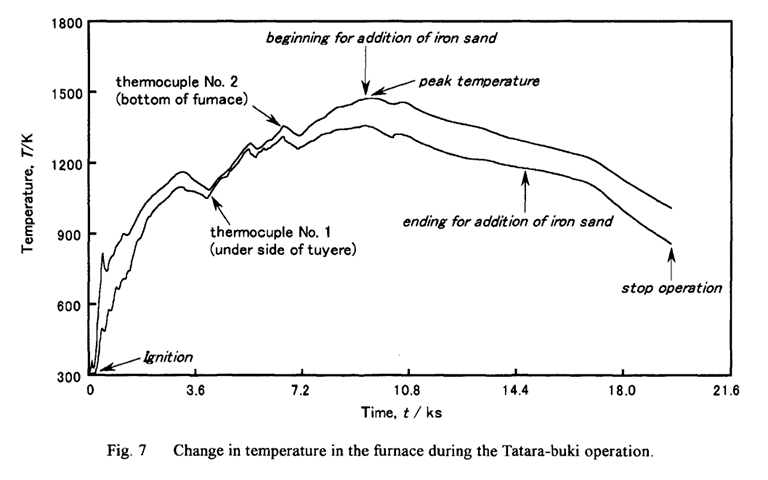
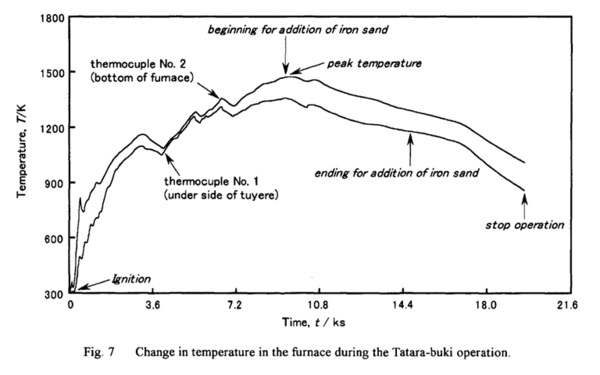
OK, I finally had a bit of time to dig in to Ford’s list of comments and opinions. My apologies for the length of this post, but as I mentioned previously, it takes time and effort to go through a series of articles and put it all together. Let’s address these points from Ford: “the way Glen presented the matter is could be inferred that casting iron is simple and only requires a 'relatively low temperature'. This is, as I described, far from the truth.” “he's making statements as though fact when he is unclear regarding the technical issues involved.” “I'd also add that melting cast iron is impossible "at a relatively low temperature". “ Look up any information on the temperature range of Tatara, and 1200 Celsius is well within that range… no great leap at all. Just about any tatara should be able to melt cast iron… plain and simple. Here’s an excerpt from the abstract of a published Japanese article about the production of sword steel using small tatara: “The steelmaking operations using a small "Tatara" furnace have been performed to investigate the effects of furnace size on the characteristics of "Kera" (steel bloom).” “It is important for Tatara steelmaking operation to arrange the furnace size with which iron sand is reduced and carburized at temperatures around 1350 degrees C without being blown out.” https://www.researchgate.net/publication/262767375_Effect_of_Size_for_Small_Tatara_Steelmaking_Furnace So, if 1350 C is the ideal temperature for making sword steel in a tatara, then reaching 1200 C to melt some cast iron would be a comparatively simple task. Here is another published Japanese research paper, where even an improperly functioning tatara reached the 1200 C temperature. たたら製鉄法に基づく向浜砂鉄の製錬と鋳造--創造工房実習より得られた二三の知見 | CiNii Research In the publication from the Faculty of Engineering Sciences of Akita Univeristy, by Yoshinari Komatsu, Shoji Goto and Setsuo Aso, they were able to smelt their own cast iron from Japanese sandiron, using a small tatara. Using metallurgical analysis, they verified the product to be grey cast iron with a carbon content of 4.12%. From the paper’s abstract: “A small-sized "Tatara-buki" furnace was made for laboratory working. Iron sand was mined from Mukaihama beach in the city of Akita and applied to iron making based on the "Tatara-buki" process.” They managed to reach temperatures of 1470 Kelvin (1197 degrees Celsius) in their tatara, DESPITE the fact that one of their air sources was misaligned, so they didn’t even have the proper air flow in their tatara. They reported that the improper airflow also led to slag buildup which exacerbated the issue, so their tatara’s temperature declined after reaching the initial ~1200 Celsius peak, but it was still enough for them to produce cast iron from their collected iron sand. Here's the graph of their measured temperature values, using two different temperature sensors (the temperatures are expressed in units of “Kelvin”) In their evaluation as to whether or not this type of activity would be valuable as an educational tool for use with materials science students at the university, the authors stated: “it is easy to make iron and cast using materials that are readily available” So, Ford’s statements of “I'd also add that melting cast iron is impossible "at a relatively low temperature". Typically 1200 degrees C is needed to do the job, this is really at about the limits of a bellows fed charcoal fire” and “The point being that casting iron is not a quick nor simple process. ", are clearly NOT SUPPORTED by the Japanese who specialize in materials science and have actively researched traditional small sized tatara. These opinion-based assertions by Ford, again completely unsupported by any evidence or citations from Ford, are COMPLETELY FALSE. More later with information about casting methods from Japanese sources (including the Yoshinari Komatsu paper cited above, and the longer Shinya Isogawa paper cited in recent posts). I see Dan already got started on it...
-
In not addressing some earlier points: Some us do have a day job, so I personally don't have an infinite amount of time to address each point in one go. I'll do my best to get there in due time. No need to be so judgmental as to suppose that myself or anyone else on the "Edo cast-iron side" is attempting to skirt an issue that is being presented... I think everyone trying to explore that possibility is doing their best to dig up information to address each point. These things take time to research from a variety of sources, so they aren't as easy to put into writing as quickly as an objection. So let's address one point now: I don't know how else to interpret this phrasing from Shinya Isogawa, which was backed up by the statement of observation by a Jesuit missionary: Isogawa's statement, specifically referred to the mid-16th Century. The missionary's writings (by Luis Frois), were done during the Momoyama period, specifically from 1578-1593. So technically, that is still pre-Edo. The title of this section of writing is: In the author's writings, he refers to the Edo period as the "modern period". You could clearly make the case that ceramic bowls were largely replaced by cast-iron bowls just prior to the Edo period's beginning. So we can chalk that one up to me conflating the section title's reference to "modern times" as "Edo period and I blended the two together. However, do you really think that the Japanese suddenly switched back to the use ceramics and stopped producing/consuming cast-iron goods in mass quantities at the beginning of the Edo period? Additionally, this does not negate the phrasing by the author that is written as a statement of fact. From this, it is a perfectly reasonable conclusion to state that the Japanese were clearly producing and consuming cast-iron goods for household use since the mid-1600s. Bowls are a common everyday household item, are they not? Feel free to share an alternate interpretation of the author's statements. More on some of Ford's other interpretations later...
-
By the way, I realize now, that I erred when I originally stated the source of the article. After I stumbled across the article using searches with Japanese kanji, I tried looking up the author using English, and the only thing that came up was that 2014 article that Ford provided. I wrongly assumed they were the same because they were by the same author and dealt with a similar subject. My apologies for the confusion, and that it led people to a different article.
-
Here are just a few of the relevant translated quotes from that paper: "Establishment of medieval casting production Medieval casting workshops in the 12th century, pot A appeared in addition to the feather pot in the western Japan, and pot C appeared in the eastern Japan. The results of the survey of the casting ruins have revealed the place of production, and it has become possible to confirm the existence of many self-sustaining casting groups that produced medieval pot kettles Japan generally. In addition, unlike the ancient times, where casting production was carried out in a form that was parasitic in workshops related to ironmaking and refining, casting workshops based on mold making, melting process, and casting process have become common. This is characterized by the fact that it takes a form of production on the premise that cast metal will be distributed as a commodity, and this was used in the Middle Ages" "From the Middle Ages to the Early Modern Period The decline of earthen cooking utensils Regarding the prevalence of cast iron castings in different regions, the relationship with earthen cookers must be discussed. Although the disappearance of earthen cookers became prominent in the middle of the 16th century in Western Japan. This is nothing more than an indication of the spread of cast iron castings and pots. Yaso-kai missionary Le (12) A passage in chapter 6 of Iss Frois' Comparison of Japanese and European Cultures Japan How People Eat and Drink, says, "We use ceramic pots and bowls when we cook our meals, and Japan people use cast-iron pots and bowls." From this 58 cast iron castings in ancient and medieval times, it can be inferred that in the western Japan where he carried out his missionary work, the spread of boiling tools made of cast iron castings was remarkable. Behind this was an explosive rise in casting production. In addition, during this period, there was a nationwide popularity of pot B, and the word "hot pot" came to refer to pot B. It can be presumed that in the Edo period, even in the eastern Japan, pot C declined, and a change occurred in which Nabe B took over it." "unlike bronze castings, cast iron castings repeat the cycle of recovering damaged material and regenerating them as ingots many times, so conclusions must be drawn by considering the analysis values from both the production area of the raw material and the distribution area that is premised on the recovery of the ingot."
-
This is the article I was referencing: 古代・中世の鋳鉄鋳物 五十川 伸矢 I believe this is the journal: 国立歴史民俗博物館研究報告 第46集 (1992) The microsoft translation for those comes up as: Cast iron castings in ancient and medieval times. Shinya Isogawa Bulletin of the National Museum of Japanese History Vol. 46 (1992) It is 79 pages, written in Japanese, with a single page of English writing on the last page. I had to copy everything from the pdf to a word document, then translate it one page at a time using Microsoft's translate function. When I tried doing more text than that, the translation kept getting cut off for some reason... definitely tedious.
-
It's got fins on the body and tail, so shachi it is Looks like it's also cast like so many (but not all) of the others.
-
Ford does this also apply to the very fine lined sukashi of the Ito schools (Odawara and Bushu Ito)? I genuinely don't mean to be contrary here, but I don't know how to reconcile what you are proposing, with the information and examples that are available on this topic. I've also seen refences like the one Dale posted, citing an entire style of sukashi made by saw cuts, like this one: "The original style, Itozukashi, or Odawara Sukashi consists in designs cut through in fine lines with a fine saw. The style of sawcuts thus called Itozukashi was not altogether the monopoly of the Ito family. We find example of it in the work of the Shoami of Akita, also in Inaba, Owari, in Mito, and many other places besides such men as Seisai, and Shosai who worked in Yedo. We may mention as a tour de force, a tsuba by Munenori pierced with an extremely elongated Svastika, once in the Burty collection, of which the sawcuts were about 0.25 mm, without the slightest defect in the cut being visible, even under the microscope." Here are three examples that I got with a google search for "itosukashi". I can't see any deformations along the sukashi edges that would indicate the use of chisels, in 1- the pine needles, 2- the birds, or 3- the wave lines & bird wings. Even the chisel work of the mei on #1 shows edge deformations, and some of the strokes of the mei are even about the same width as the sukashi. The tips of the finest sukashi lines are pointed. And if you look at the tips of the three tiny little birds in #2, you can see that they aren't cut clean through, they sort of gradually rise up from the center like an "onramp" to get onto a highway/freeway. Also, the curves of #1 and #3 are remarkably smooth. I could envision all these features being formed by dragging a thin abrasive wire up and down through a tiny drilled hole. Are you certain that these were produced by chiseling and filing rather than "sawing" with an abrasive wire?
-
Some other points of interest about casting from Isogawa's anthropology article: The article outlined that the foundrymen were using widely available, distributed cast-iron ingots, so all they had to do was do a quick melt at a relatively low temperature, and would have poured this into multiple pre-made sand molds. Cast iron goods were commonplace during the Edo period, and foundrymen were supplying all sorts of small sized consumer goods in large quantities. They even pointed out that a certain point in the Edo period, household ceramic bowls had been largely replaced by cast iron bowls. As an aside, although not a scholarly source, this site on traditional Japanese kettle production states that sand molds could be reused multiple times until their quality deteriorated, whereas high end pieces were made in single use molds made of sand or clay. https://japanobjects.com/features/tetsubin/#how Back to Isogawa: He also pointed out the rarity of finding extant molds in in the archeological dig sites and that in many cases, the structure of the molds had to be inferred from the details in the cast-iron objects themselves. He also concluded that the rarity of extant examples of older cast-iron products strongly suggested that older items would have been "cannibalized" and remelted to make new items once they were damaged through use, transport, or fire damage. So looking at it from a reverse perspective, we can perhaps infer that newer items will have had a greater chance of surviving, and older items will be harder to come by.
-
Hi Darrel, I never intended to suggest that at all, my apologies if it came across that way. That part of the work would almost certainly be equally laborious for both of those types of alloys (steel vs cast-iron). My point was that by casting, you'd be able to skip all of these steps: -forging your own plate, -scribing a pattern on the plate to outline the pattern to be cut, -drilling the plate -straight chiseling to create a basic straight-walled outline (resulting in a roughly vertical sukashi wall) -rough chiseling the remaining flat surfaces to try to carve it into a more 3D shape (including doing some of the detail work like carving in the scales of a dragon for example) Then you are basically at the same point for both cast and forged sukashi tsuba for putting in the finishing details like cleaning up some of the detail work, or adding nunome, or maybe a simple inlay like a dragon eye. You'd also have to remove the "web remnants" in the cast tsuba, but those will be quite thin and much easier to remove compared to removing the full thickness from a solid forged plate. So, a massive time savings, and savings in charcoal resources since you only have to do a "single heat" to melt the cast-iron and pour it, vs the "multiple heats" required for the hand forging of your plate into whatever shape you are aiming for. If a smith was making their own tamagahane, then add in a lot more labor and many more heats. I've actually been looking into Japanese sources to find out, in an attempt to narrow that down. That's a critical piece of information to support or refute that idea. So for now that's, that's just a suggestion that was originally offered up in Lissenden's dissertation. I've been trying to explore that idea to see if I could find out more about it and whether or not it was a possibility. I just got a Japanese source from 1936 on the specific topic of malleable cast-iron that I need to get translated. I'm hoping that it is a historical summary of its use in Japan and will shed some light on when its use began. I just read a translated, peer-reviewed Japanese anthropology article about the history of Japanese cast-iron kettle, bell and bowl production (by Shinya Isogawa), that during the pre-Edo and early Edo periods, the rare examples of signed pieces showed that the mei was cut into the mold before casting, and these items were more brittle. So, we can assume those ones were not malleable cast-iron. Unfortunately though, this doesn't help us with the period in question: mid to late Edo. Regardless, I think the use of malleable cast-iron is now much less relevant for our current endeavour. I think the availability/use of malleable cast iron is most relevant to the nanban tsuba specifically, which often have lots of nunome and finer details compared to a straight-walled sukashi. And even then, may not be necessary... I suppose you could just file in the cross-hatching for nunome, rather than chisel in the cross-hatching. So it may not be a necessity at all. Why I think malleable cast iron is now less relevant: Earlier, I was thinking that the softness of malleable cast iron would make it perfectly functional for use in battle, and allow it to serve the "defensive" aspect in its long list of functions. The irrelevance of the defensive aspect "clicked" for me when I read the comment by Joly, that stated shiiremono were being produced in large quantities during the 18th and 19th centuries, and were being "made for the masses", and served a "decorative" function. Given the mid to late Edo time period, and the fact that these were not intended for use by the samurai, there was absolutely no expectation that these would ever be required for use in any kind of battle. Even the samurai were not seeing any battles during this time period, so the defensive aspect of any tsuba made in that time period would be almost entirely irrelevant. The only exception being, when people were gearing up for the Satsuma rebellion and the perceived fear of some sort of impending European invasion once Japan opened its borders once more. But this was just at the very end of the Edo period.
-
Not to drag this out any further, as the thread is already moving along, but I feel I should explain the rationale for my last few "heated" posts. Much earlier in this thread, one of the posters was chided and mocked. I felt compelled to say something then, just as I felt compelled to say something now about the repeated attempts to discredit or mock others. My last few posts were a response to what I was witnessing, and found distasteful and potentially hurtful to others (and I know through conversations with others, I was not the only one who saw them that way). The posts were carefully scripted to use some of these same strategies and tactics in such a way as to “mirror” them back to the sender. In that way, I was hoping to show that the same destructive tactics could be used against anyone. Normally, I would not choose to do that in any form of academic discussion, and I sincerely hope to never see the need to do so again. In terms of this being “my theory”, that is an interesting perspective, but one that I do not share. My approach is to always be open to new sources of researched information and will gladly pivot my thinking as soon as new evidence arises. Having “perfectly respectful criticisms of specific points” is an essential tool to the refinement of any theory, however it is only helpful when being “respectful” is the norm, rather than the exception. There are better ways to introduce a counter point, or offer up another avenue to consider, that will actually generate discussion, rather than to shut it down. Many contributors to this thread have done exactly that and it’s been a wonderful discussion that offers up opportunities to research new areas and continue to learn. I am looking forward to seeing whatever evidence turns up from either position in this discussion, so that we can hopefully get to some sort of agreeable conclusion.
-
Um, definitely contact the company first to find out whether they used regular cast iron or malleable cast iron before you try taking a chisel to it. And by the way Darrel, it was every reference on malleable cast iron that I had read that says that it can be worked with hand tools. So "I" didn't say it, I merely passed the information along. I don't see any reason to distrust what was written by the metallurgists.
-
The inherent problem there is that you are talking about samurai again, not the target market for cast fittings... refocus your attention on the general populous who would have had a far more varied buying potential. It is well documented that during the peaceful Edo period, some merchants had exceeded the wealth of many samurai, while the masses were still much less affluent. Yet the samurai were still the "cultural elite", and the general masses were not as "cultivated" or as educated as the samurai themselves. So, it doesn't take much of a leap to envision the general populous admiring the cast tsuba copies that have a lot more "obvious" designs with 3D depth to them, like "the frog" and "the rat", or any of the heavily carved "Choshu and Bushu" tsuba, as noted by Joly. Now throw into the mix, many of the lower quality nanban tsuba that were so popular among the masses during the mid to late Edo period, as well as the multitude of cast copies of the Kinai dragon tsuba, or the myriad of examples in the Shachi tsuba thread. These surely would have appealed to those who were NOT the exalted aesthetes that Ford seems to think were the only people who were purchasing tsuba during the Edo period. People also need to stop viewing these things as defensive tools during the Edo period. The idea is absolute folly and is completely irrelevant in terms of determining whether or not cast-iron tsuba were produced in the Edo period. Yet it remains one of cornerstones of the "post-Edo believers". What war, what battle was anyone getting into? And that goes for both the samurai and the general populous. The defensive potential or function of the tsuba, during the Edo period, is completely irrelevant to this whole topic. This was a period of peace and prosperity where people were using tsuba more like jewelry, and adornments. Granted in the late Edo period, there was an aesthetic movement that shifted back toward the more austere iron guards, with the tsubako drawing inspiration from the tsuba of old (from the likes of Kaneiye, Nobuiye, Ymakichibei etc...). But, there was still an enormous variety of aesthetic styles being produced in that period, ranging from serene and austere, to heavily carved machi-bori, or the extreme opulence of some of the kinko tsuba, or some highly visible reference to various cultural motifs (like some type of 3D dragon, frog, phoenix, or horse-riding gear ...etc). The cast-iron tsuba were more likely used as simple "adornments" to "accessorize" an outfit for a night out on the town. The found examples listed by Haynes and Joly seem to favour tsuba with 3D carved motifs. For a 3D-carved tsuba, there would be an enormous savings of time, energy and resources if it was first formed from a casting. You wouldn't have to try forging out your own plate, or do any of the rough chiseling... you could very quickly get to the "finishing" of an already mostly formed object: clean up most of the webs, or address some possible faults, or add an inlayed eye on a dragon, or scratch in some crosshatching to add some nunome etc. People who can't see how much time and effort this would save, have clearly never tried to cut out even a basic straight-walled iron sukashi tsuba by hand... otherwise they would know how much time and effort that takes. Then imagine having to do all the chiseling to produce a true 3D effect like the curving body of a dragon with all of its scales...another monumental task. Again, go have a look at some of the shachi tsuba in the shachi tsuba thread, then imagine trying to produce that by hand, from start to finish...