Ludolf Richter
-
Posts
491 -
Joined
-
Last visited
Content Type
Profiles
Forums
Events
Store
Downloads
Gallery
Everything posted by Ludolf Richter
-
Not a bat?!Ludolf
-
Hi John,if Haynes was a member of our board,we could ask him,why he used a name/reading different from the Kinko Jiten,when Wakayama and Iida e.g.read the 1st Kanji as "hide" and he as "teru" (following Joly and Hara!).In the Nihonto Meikan the reading is added to the Go's Kanji in Hiragana-characters!Ludolf
-
Hi,there was a nice Tsuba at Ebay with Mei plus Kao.The Japanese owner made it "Tokujyu".When I didn't find that name in the various index books I looked into my Nelson for the different meanings of the 1st Kanji and there he was: Noritoshi (Haynes H 07416 from Seki).When I informed the owner that the artist is only known as Noritoshi,his answer was,that Noritoshi is only the other reading of the characters.He didn't change or expand his Ebay-entry. When I created my private Tosogu-Mei-database (ca.5000 pics) there had been several (but not to many) artists,where the reading of the Go was different between western and Japanese authors.How did the various authors know how an artist and his contemporaries spoke his go or name!?Ludolf
-
Hi!My Tsuba once was part of a pre-WW2-collection,when there were no Hongkong/Chinese fakes.Ludolf
-
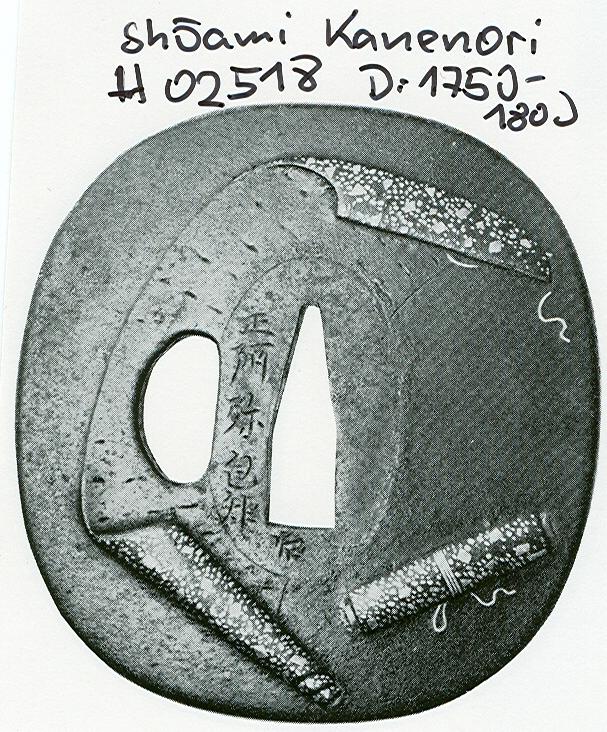
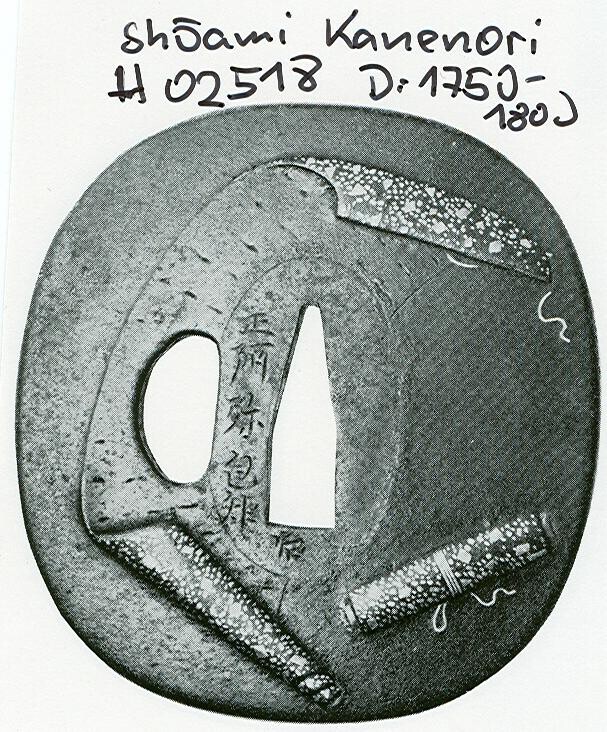
Here is my Tsuba (6.3 x 5.7 cm).Ludolf

-
Mark is right:it is Shoami Kanenori.Ludolf
-
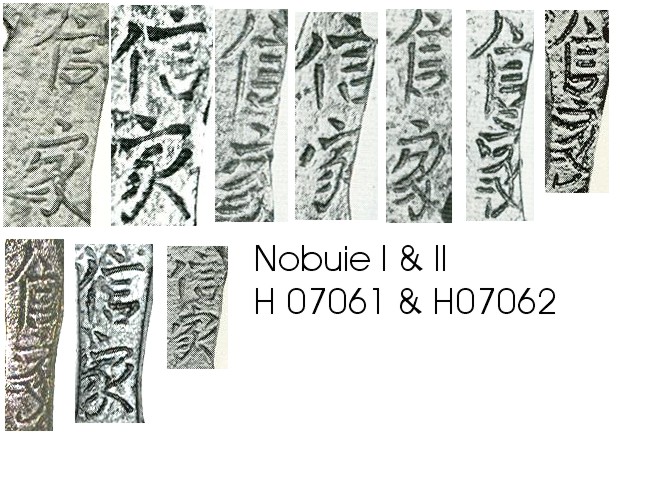
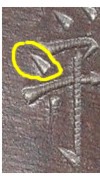
Hi James,I have checked all the Mei of the 4 gen.Kawaji no Kami Kunisuke (Shinto Taikan,Fujishiro,Iida,YTZ,REI,Compton):the Mei on your sword is clearly Gimei!I have added a pic of "Kami" from your Mei,where an "arrow" is pointing in the opposite direction.Ludolf
-
Hi Jean, I found 4 papered Motoshige blades in my books; 1.NBTHK 7.Tokubetsu Juyo T. Nr.38 2.Compton part I -249 with NBTHK paper from 1968 3.NTHK Yushu to zu Roku vol.I-29 4.NTHK Yushu to zu Roku vol.II-44 Ludolf
-
Hi Brian,the results of my search recommendation are your 3 entries,but Henry Wilsons much older entries from Aug./Sept.2004 (my quotation was from his entry "September 18,2004,8:17" are not covered!Ludolf
-
I recommend to use our search mode with "Hosokawa Masachika" and author "Henry Wilson".There had been 2 more entries by Henry Wilson from August/September 2004,which have probably been lost: "...He is listed in Hawleys under MAS 59.He also used a different kanji for chika during his career so it is very possible that he is also listed under MAS 49,too...".There may have been replies to these queries which I don't have.Ludolf
-
Hi all.On Dec.13 a nice,well polished Katana with limit Euro 2.000 is to be found at the Lempertz/Cologne Asian Art Auction as Nr.835.The Mei reads as follows "Tairyusai Munechika tsukuru kore" with a dating of 1868.There is no Shinshinto Munechika!When I had gotten 2 extra pics of Mei+dating,it was evident that the 2nd name's Kanji was "hiro" and not "chika",i.e.the Mei of Sokan (can be read Munehiro),SOK 1,one of the most prominent Shinshinto swordsmiths!.The Mei could have been made by him (or as a Daimei by his son),but he never made a sword with Masame and Suguha: always with Ko-Itame and Ko-Gunome-Midare (with Nioi)!The sword owner (and not a Lempertz expert) had read all the Kanji,even from the rare "Tairyusai",correct and he should not have recogniced a well chiselled "hiro"?I believe,he new the real name and the Gimei!It's quite evident that he did so on purpose.Ludolf
-
Hi!Here are some examples.Ludolf

-
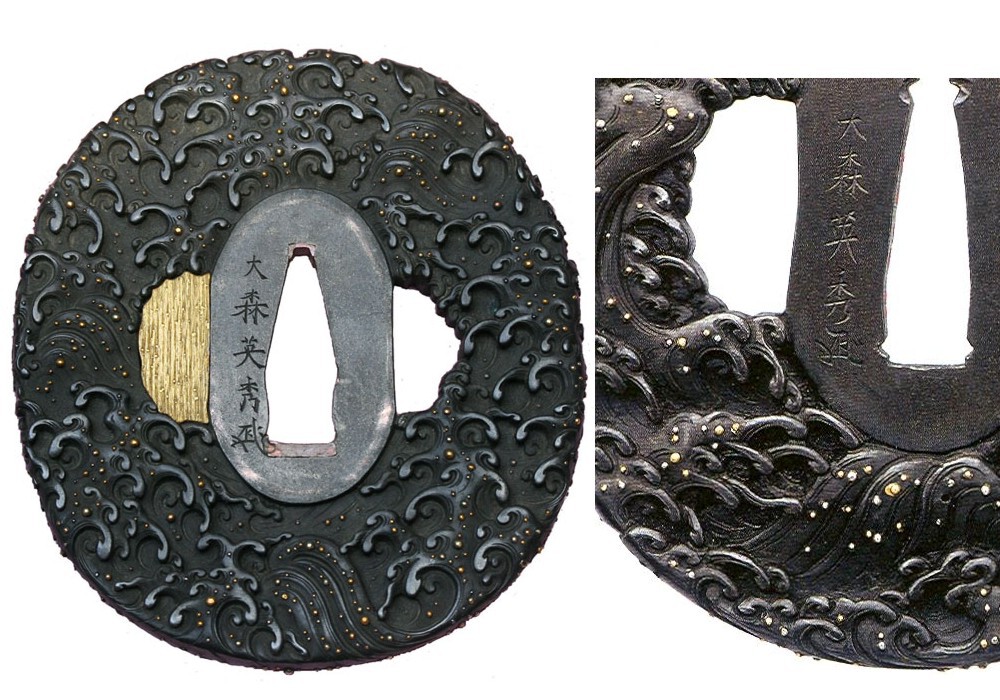
Here comes a new pic with "your" and "my" Tsuba.I don't remember from which book I have it.When I was creating my private Tosogo-mei.database,now with around 5000 entries,I had copied only the part with the Mei as seen in my pic.As I had already remarked:very similar to "your" Tsuba.Ludolf
-
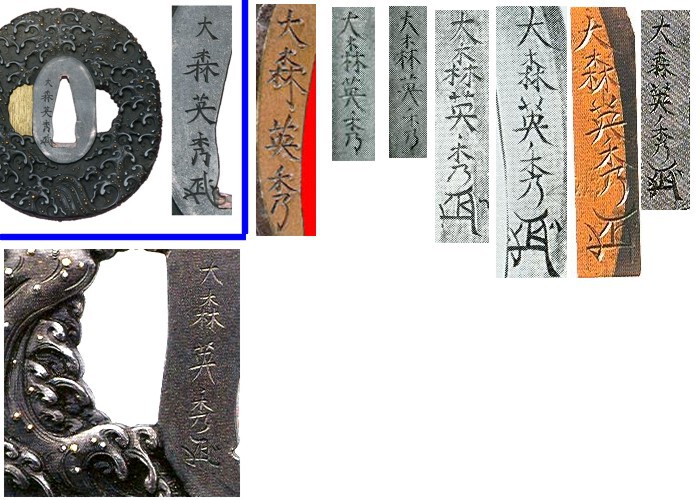
Hi Brian,here are some mei pics of Omori Teruhide.Look at the workmanship of the example below yours:very similar!I had it papered.Ludolf
-
Hi, here are some Mei examples.Ludolf

-
Hi John,here are some examples of his Mei.Ludolf

-
Your Tsuba was made by a very good artist.Besides Gimei (a slightly different Kao,nearly identical names characters) there is an other possibility:made by a top-student,like with other Tosogu-school examples?!Ludolf
-
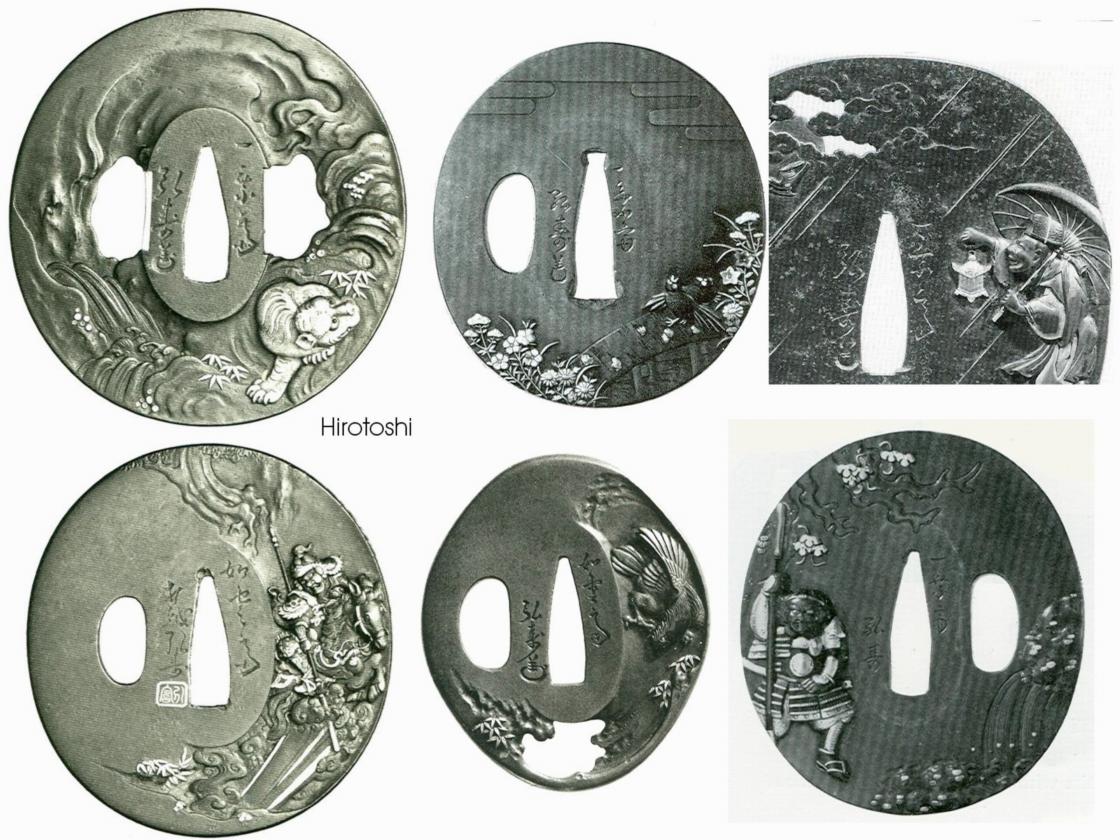
Hi John,here comes a pic with signatures+Kao of your artist:Juso/Ikkanshi/Kiyotoshi.Ludolf

-
Your examle on the left and right side of the original one is not from Goto Denjo but Goto Kanjo!I have put together some authentic Mei pics from Denjo and one from Kanjo.Ludolf

-
Hi Shan,the Mei reads Goto Denjo.He was the fourth master of the Kibei Goto line.He lived and worked at Kyoto and died in 1712.Haynes H 00391.Mei and Kao differ from my examples:Gimei?Ludolf
-
Hi!It reads Seiryuken Eiju.Look at Naofusa H06602.Ludolf
-
Hi!A nice Tsuba!The Mei reads Sakushu ju Inoue Masakuni Masakuni was a shinshinto swordsmith (Hawley MAS 387) who also made Tsuba.He was from Awaji and worked in the pre-meiji era.Other than swordsmiths who also made Tsuba he used the same Go for his sword and tsuba mei.Ludolf
-
Hi,for me it looks more as swordsmith's work,like with Terushige (TER 40).Ludolf

-
Did Anyone see the auction on this sword ?
Ludolf Richter replied to a topic in Auctions and Online Sales or Sellers
Hi,I once bought a fine sword which had a wrong description in the catalogue:I had payed for an extra photo of the Mei.Maybe the Mei of that sword reads Tsunamune instead of Tsunemune!Ludolf -
Hi,it's Goto Keijo (H 03082,1739-1804),aka Mitsumori:see Shin-san Kinko Meikan page 406 with the same Kao (not recorded in Haynes and Joly)!The 1st character on the right side is a typical one-kanji "Goto".I cannot decipher the next 2 Kanji.Ludolf