Ludolf Richter
-
Posts
491 -
Joined
-
Last visited
Content Type
Profiles
Forums
Events
Store
Downloads
Gallery
Everything posted by Ludolf Richter
-
Hi all,there is no Go "Kozaemon" but only "Kizaemon".The Sosho-writing of Kizaemon can be seen in the pics of the Kinko Meikan and the shin-san Kinko Meikan.I tried to find the right side part of the Mei of the Daisho Tsuba in my Sosho dictionary:I resigned after two hours!I hope ,one of our Japanese members will solve the problem.Ludolf PS.There is no Jakushi-Kao listed in the books.
-
Hi John,I agree with Michel that your Tsuba was not made by the "Nidai".The knowledge about the Jakushi family with 5-6 generations seems to be very unsatisfied.I have a Jakushi Tsuba too,but am unable (with all my many books!) to find the originator.There is even a dispute among the various authors about the "Shodai"(probably a Samurai of the Ryuzoji clan of Saga,definitely a man who studied painting,with works still in existance,he became a priest of the Shukafuji temple at Nagasaki); he may never have made a Tsuba or Fuchi/Kashira at all!Haynes made the "Nidai" his son,but others believe him to be his brother,while the sons used different Go's.The "Nidai" is said to have been a harbour official at Nagasaki,who learned the etching technique ("Kusarakashi") from foreigners.The use of Nunome Zogan in the higher parts of the low relief modeling is said to be characteristic for the "Nidai",but there is no proof,that later generation didn't use that feature too.In the newer edition (shin-san) of the Kinko Meikan are 6 examples with Jakushi-Mei on page 508,but not 2 alike!Ludolf
-
Next attempt:I have resized my pic to 50%,although the original size was in match with Brian's conditions.Ludolf
-
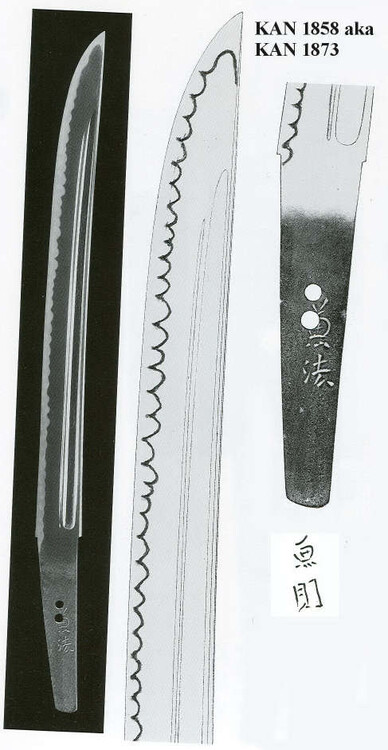
Hi Marius,here comes your Kanenori!According to Cox's book,it could also be the Kanenori from the "Echizen Seki Ha of Echizen",who worked in the first quarter of the 17th century:KAN 1859 (pics in Fijishiro-Shinto hen on p.48 or Tokuno on p.115,in Cox's Mino-book on p.218).Ludolf
-
Hi all,I was just looking through my old Christie's and Southeby's auction catalogues to find examples with a certain Mei.What a nice feature,that the auctioneers published the results with the name of the one who purchased the item!A pity that this is not longer possible nowadays!Dr.Torigoe made his money at that time with a lot of Origami.Some-now famous-collectors bought nearly all the could get,even when the Mei was doubtful (catalogue:"ascribed to ..." and not "signed").Ludolf
-
The Mei reads "Koshuken Matsuoka Mototsugu" plus Kao Mototsugu (name Koshuken,family Matsuoka) worked at Edo in the first half of the 19th century.Haynes index-number H 05965. There is a pic in The Baur Collection...:D258 ("Matsuoka Mototsugu" plus seal instead of your Kao).Ludolf
-
Hi Rich,it's not The Haynes cat.#2 but cat. #1.The 1914 book about the Mosle Collection (in German;item 427 on page 80) does not contain pics.Besides the poor quality pic from the Haynes cat #1 nr.25 there may be a better one.The Mosle Collection was sold by Parke-Bernet in the fifties.I tried to get the respective 2 auction catalogues via Ebay,but was not successful.The seller was a NMB member (I forgot the name) from Florida.Maybe he or another member does have these auction catalogues and there is a pic of that Tsuba.Cheers.Ludolf
-
Hi Johannes,it wasn't easy to find this artist (a very rare "yoshi" Kanji!),but here is the result: Hashizume Tomoyoshi plus Kao Hashizume is the family name,Tomoyoshi the Go.He is listed in the Haynes index with H 10222.It's not much known about Tomoyoshi.He lived in the 2nd half of the 18th century and was born at Mito in Hitachi,but went to Edo later and became a member of the Omori school.No Tsuba made by him is recorded in the books,only Fuchi/Kashira.Ludolf
-
I have checked several Kunihiro Mei in my Tsuba books:no result.It might have been made by a swordsmith,e.g.Hawley's KUN 209 from Musashi,who lived around Enpo era.Ludolf
-
The swords with Gimei have been sold.The auction results: -(Gimei Muneshige) Euro 2800 -(Gimei Uda Kunihisa) Euro 4600 To these results a premium of 23% is to be added! The poor collectors/victims!Ludolf
-
According to our Mantis-friend Kenneth Wilson,whom I sent the below Ebay.ge site,the Chinese are now going to fake whole sets:Tsuba,Menuki and Fuchi-Kashira!Ludolf http://cgi.ebay.de/Tosogu-Set-Tsuba-Fuc ... dZViewItem
-
Hi John, the Mei reads Bishu Okayama ju Fujiwara Kuni--- the missing part mune (and probably saku) Its Hawley's Kunimune KUN 642 Bizen 1659 20x The "Oka" Kanji is strange but typical for him.Look at page 237 of Fujishiro's Shinto hen on the left side. Ludolf
-
Hi John,unfortunately there are a lot of Yoshitoshi,even with different 1st Kanji.It would be helpful if you will post the 2 Kanji from the Kanji page of NMB or -better- post pics of Mei and blade.Ludolf
-
Although he is not to be found in the index books (Kawaguchi/1928,Sato/Nihonto Meikan,Fujishiro,Iida,Tokuno and "Keicho Irai Shinto Bengi"/1851/reprint),he may yet exist!Robert Cole does have one on his homepage (see below): IZUMI-no-KAMI ... KANEHISA TEN-SHO 1573 MINO KOTO Where did he get that information from?!Mino swordsmith normally have the standard Kanji for "Kane" and not this one:there is one from Tensho-era in the index-plus Cox's Mino-book,but without a title!Ludolf http://www.sho-shin.com/titles.htm
-
The first kanji seems to be "Yoshi" (the Xmas-tree-type-Kanji!):no idea about the 2nd one.The "Kao" is no Kao but a seal:maybe one of our members can decypher the seal-script.Ludolf
-
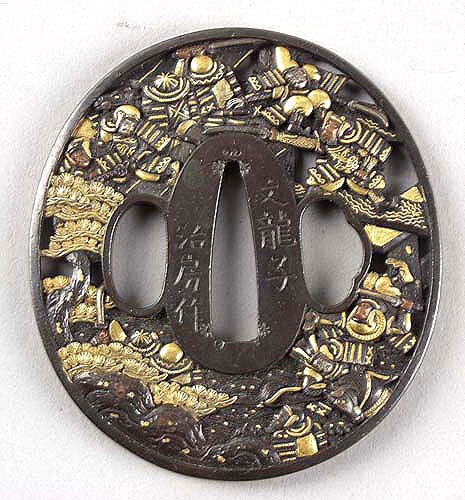
I found this Tsuba on a German auction.Although the artist is recorded (H 00783),he seems to be nearly unknown.Mei "Bunryushi Harufusa saku".They have a Euro 800 limit for that piece,which is to high for me!Ludolf
-
There are two nice swords on a German auction to come: 1 Mei "Uda Kunihisa" 2 Mei "Hitachi no Kami Muneshige" From my researches both are Gimei!Ludolf

-
I got the following answer from the Swiss auction house "Galerie Koller".By the way it's the first positive answer,when telling an auction house,that their Swords/Tsuba were Gimei!Ludolf Sehr geehrter Herr Richter, vielen Dank für die Informationen. Da werde ich wohl Konsequenzen ziehen müssen. Mit freundlichen Grüssen Regi Preiswerk ________________________________________ G A L E R I E K O L L E R A G
-
From the books (Nihonto Meikan and others) the statement "Nihon Kaji Sosho" is known only to have been added by later Generations in the 19th century (probably because nobody wanted their swords?!).By the way,Hawley gives "1660" to Shodai Kinmichi (KIN 43) instead of ca.1580-1615.The dating for the Nidai (KIN 46) is also not correct.Ludolf
-
Probably a poem.At a first glance "Myochin---3 hitherto for me unknown Kanji---Muneyoshi saku".There is only one possibility in the Haynes index: H 06351 from Tosa province,who worked around 1800,with a lack of personal data.Haynes has used a different 2nd Kanji for Myochin,but yours is in the Mei dictionaries.Let our Japanese friends do the rest!Ludolf
-
Congratulation to both of you:You got it! Neither is this the Mei from one of the most prominent Tosogu artists of the 18th century, nor is this the Tsuba fom the Red Cross Exhibition (catalogue plate CXXXVIII),as they claim it, at all! It would be pure speculation that the Tsuba may have been made by a student of the Iwamoto school (like with other schools,esp.the Soten one) or is the work of an unknown faker.Ludolf
-
There is the Nr.748 from the Red Cross Exhibition ("shunshodo Konkwan") at a Swiss auction.Ludolf http://www.galeriekoller.ch/en/asp/full ... &saletype=
-
Here are the 2 Oshigata:yours and the one from Art and the Sword.Ludolf

-
There is an example to be found in ART AND THE SWORD The Bulletin of the Japanese Sword Society of the United States edited by Bruce Kowalski 1991-Volume Four page 20/21 The Mei is nearly identical with yours (genuine!) and has a dating:"A day in August of the 4th year of Bunka" (1807).According to the author,Kentaro Yoshikawa,"The Yoshitsugu who made this blade is a swordsmith of the Yoshimasa school and a student of Suishinshi Masahide,who moved from Chikuzen to Kuruma around Kyowa (1801)".Ludolf
-
Hi John,there is no such artist to be found in the index and some other books.Not even the "Bible" (Iida/Wakayama-"Kinko Jiten") does have one with these Kanji.3 possibilities: 1.He is an artist of the 2nd half of the 20th century 2.He ia a hitherto not known artist 3.It is a known artist but this Go is not known hizerto I have checked the other meanings besides "Yoshi"(zen,taru and sa):no match. Ludolf