Baka Gaijin
-
Posts
575 -
Joined
-
Last visited
-
Days Won
33
Content Type
Profiles
Forums
Events
Store
Downloads
Gallery
Everything posted by Baka Gaijin
-
Good morning Kunitaro san and Justin Here's another blade with that name: http://www.metmuseum.org/Collections/se ... s/40003096 Somewhere in the back of my mind I recall the one in the link may have belonged to Sir Francis Festing thence to Basil (B.W.) Robinson at one time in the 1950's, but I could be wrong. Here is a link to "Sasa no Tsuyu" from Col Hartley's website, an exhibition in Los Angeles in 1964 (Tachi no 26) http://home.comcast.net/~colhartley/Ori ... dArmor.htm Cheers
-
Good evening Jan and Kunitaro san. Here's a link to the Shiwa Jou (Old man or Elder) mask and the type of Noh plays it would feature in: http://www.the-noh.com/sub/jp/index.php ... class_id=1 Cheers
-
Hi David, What is the design? It looks like a stylised Saihai or Haraegushi to me. Cheers
-

Do you use your nihonto for tameshigiri?
Baka Gaijin replied to Hans Kondor's topic in General Nihonto Related Discussion
Good morning Kunitaro san, Try this link: http://www.ninecircles.co.uk/Swords_and ... tting.aspx I would recommend them as a reputable company. Cheers -
Thanks Ed, George, Steve & Markus Makes sense now Cheers
-
Hi Ed Can you explain the term "peend" as it relates to this nakago in a bit more detail please. Cheers
-
Hi Denis, "Puzzled at the title "Very rare prototype NCO sword" If you look at the first post in this thread and follow the link, you will see why this really is a rare prototype and quite different to the normal NCO sword in the following ways: The blade does not have a Habaki, nor was one intended by the look of the fit at the Koiguchi, and the officer type saya with Ishizuki with Cherry blossoms and a leaf, Semegane with Kashiwaba, Haikan with Cherry blossoms & Kuchigane with Cherry blossoms. I've never seen one like it. Cheers
-
Morning all Check out Kunitaro san's posting with a nakago on a sword by Izumi no Kami Kanesada (Nosada) Late Muromachi period bearing the 臨兵闘者皆陣列在前 viewtopic.php?f=9&t=13872&start=90 Cheers
-
Good morning all, If this helps, there was a 1970 2 volume publication by Fukunaga Suiken called "Kubikiri Asaemon Token Oshigata". An example of the two volume set sold recently on eBay: http://www.ebay.ca/itm/KUBIKIRI-ASAEMON ... 0429038626 Cheers
-
Edo Period Corner Part II
Baka Gaijin replied to estcrh's topic in General Nihonto Related Discussion
Afternoon Jan This is an interesting, if long drawn out book about Oei - Hokusai's daughter: http://www.amazon.co.uk/The-Printmakers ... =1-1-fkmr0 Cheers -
Ann and Gabriel Barbier-Mueller collection in Quebec City
Baka Gaijin replied to b.hennick's topic in Katchu
Thanks for posting Barry, I really like the Fukurokuju hachi (Images 94 & 95). Cheers -
Edo Period Corner Part II
Baka Gaijin replied to estcrh's topic in General Nihonto Related Discussion
Good evening Jan, From the right top, Title of the series: Honchō Meishō Kagami Second right in (Red Background) "Takeda Daizen Daibu Shingen” The Artist: Utagawa Yoshikazu - signed lower left with the red seal underneath and Kiwame censor's seal in circular cartouche above and below. He was also known as: Ichijusai, Issen, Isshunsai, Ichikawa Yoshikazu As an Ukiyo-e printmaker he was active 1850-1870. Pupil of Utagawa Kuniyoshi. One of the major early printmakers of the Yokohama school. His subject matter included foreigners and foreign customs and manners, as well as landscapes and warriors. Also a book illustrator. (Edited to add the following 05.47 local 21/10/12) The red seal is called Yoshi Kiri and is a stylised working on the theme of a Kiri Kamon (Paulownia Imperialis). It was first used by Yoshikawa's master Kuniyoshi in 1845. And here is a really exciting piece of info I just discovered...The master Kuniyoshi had a daughter called Yoshi (1842 - 1885) She was a woodblock artist also (working in the beginning on the small vignette images on her father's prints). She signed as "Yoshijo" - The daughter Yoshi. I include this because it is interesting that a woman in this period was allowed to have "a voice" through her Art. Cheers -
"What a beautiful poem. Well done and thanks Morita san." I'll second that Brian. Rennyo details: http://en.wikipedia.org/wiki/Rennyo Cheers
-
Again thank you Henry and Ford......... Cheers
-
Give the man a cigar!!!! Thanks Ford for the reply and Henry for the Link. Might the Noh play be Hagoromo? (Here's a bit of trivia....though Matsu can mean "pine tree" (松), it can also mean "to wait" or "to pine" (待つ). ) Veering off at a wild tangent, the axe shape looks very much like the one that Kurosawa uses for the woodcutter in Rashomon. Cheers
-
Good morning Grev, The design under the axe edge is stylised Pine Bark - Matsu Kawa Bishi. You will see it as a Kamon in its own right or as a surround to another. Here's a speculation for Ford, who I believe thrives upon such piquant Fayre... Does the Tadamasa original contain a message regarding a clan who bore the Matsukawa Bishi Kamon, or is it just about chopping wood....... Cheers
-
Excellent Cheers
-
Good morning Tobias, Do you know this resource? http://www.nichibun.ac.jp/graphicversio ... zou_e.html It has some extremely interesting imagery such as an army of Obakemono storming a Castle. It's in Japanese, but navigation is really easy once you get the hang of it. Cheers
-
Elegant script on a military theme
Baka Gaijin replied to Baka Gaijin's topic in Translation Assistance
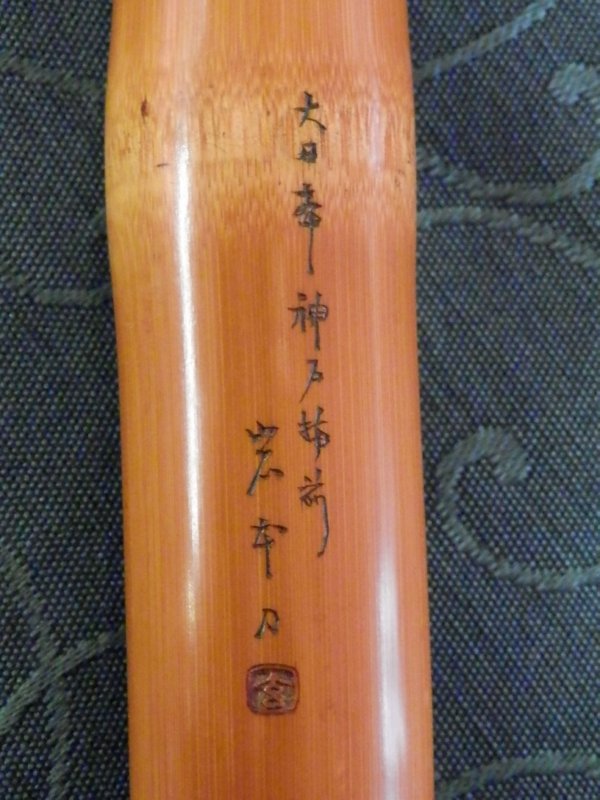
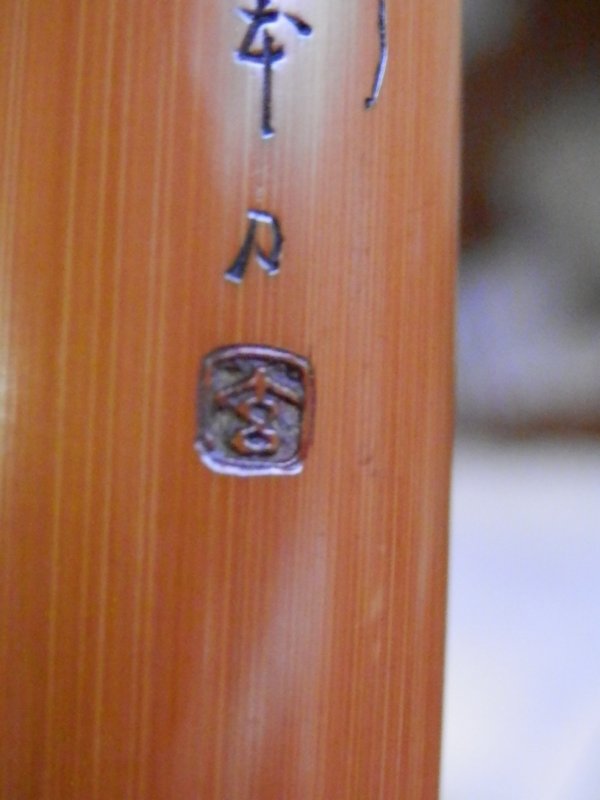
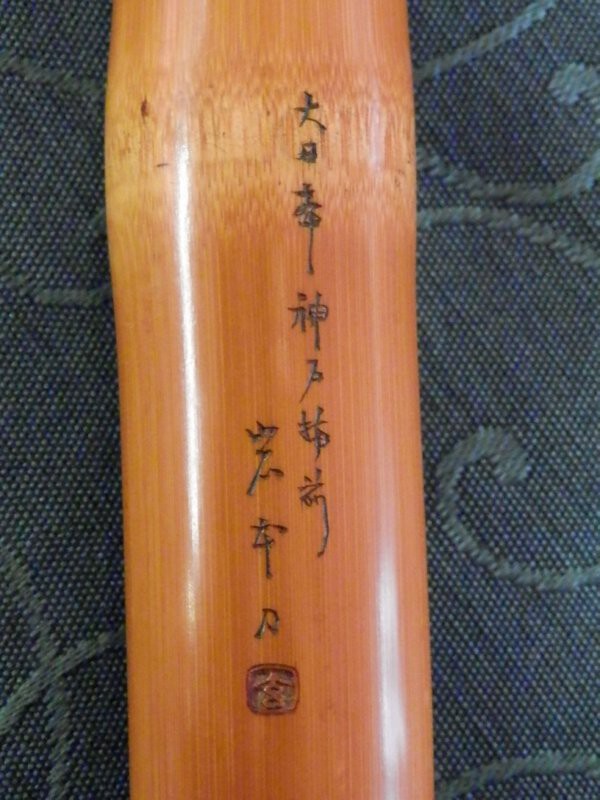
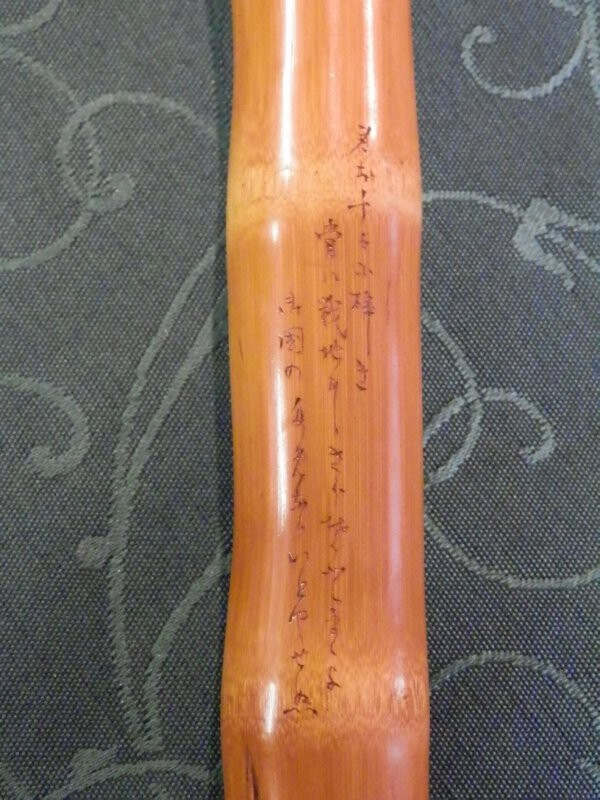
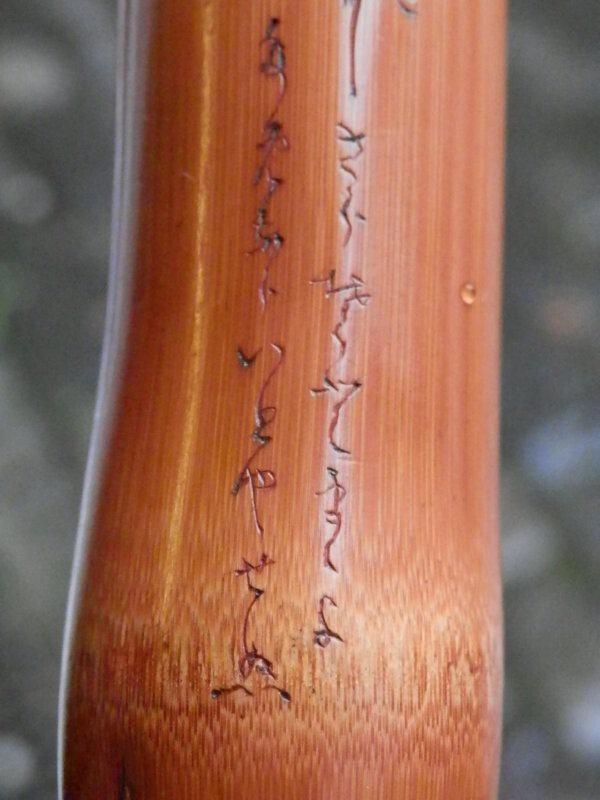
Morita san どうもありがとうございます。 I'll get to work on this and post my attempt later. Edited at 08.13 Local Here is my very poor attempt: 大日本神戸(or 石 )坊前 Great Japan Patriotic Truth (Fund?) 岩本刀 Iwamoto (carved) 身を千々に砕き、 骨は戦地にさら(晒)そと、ゆく(征/行)よ 御国のためなら、いと(厭)やせぬ。 Should I die, I leave only my bleached bones on the Battlefield for the Nation. Cheers -
Good morning Ed, What an unusual image, my first thought was that it may be a pun on the Basho Haiku: 夏草や 兵どもが 夢の跡 Then the thought of the skull being a victim of the Hag on Adachi Moor came to mind. Or a perspective upon the fleeting nature of Beauty. There is something O.C.D. about the way the script is written which reminds me of similar obsessive compulsive traits found in many artists' work. Bellmer, Van Gogh and to an extent, the work of a 20th Century British "outsider artist" called Scottie Wilson being brief examples. I put the image at maximum magnification and tried to find repeat patterns in the script. I wonder if the script is contemporary with the rest of the painting? After all that Artsy waffle, I haven't a clue what it's about, but it was fun to speculate..... Thanks for posting it Ed
-
Elegant script on a military theme
Baka Gaijin replied to Baka Gaijin's topic in Translation Assistance
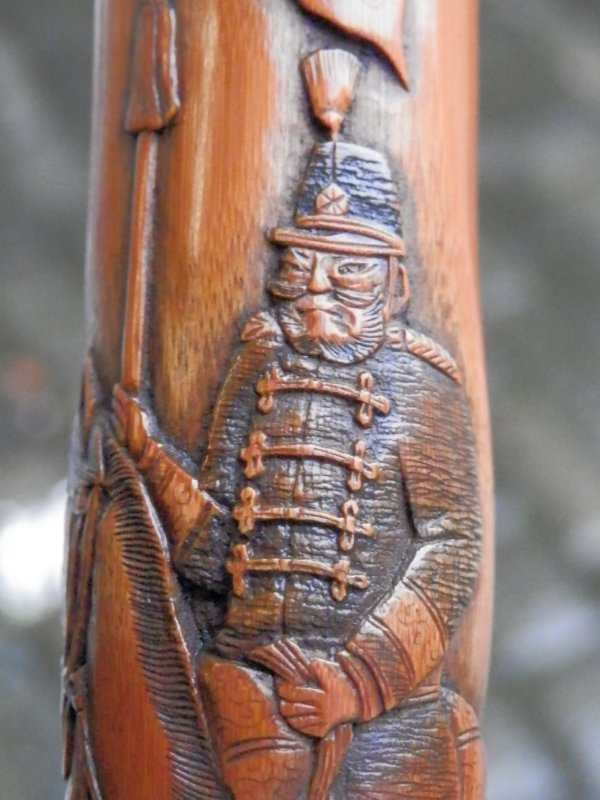
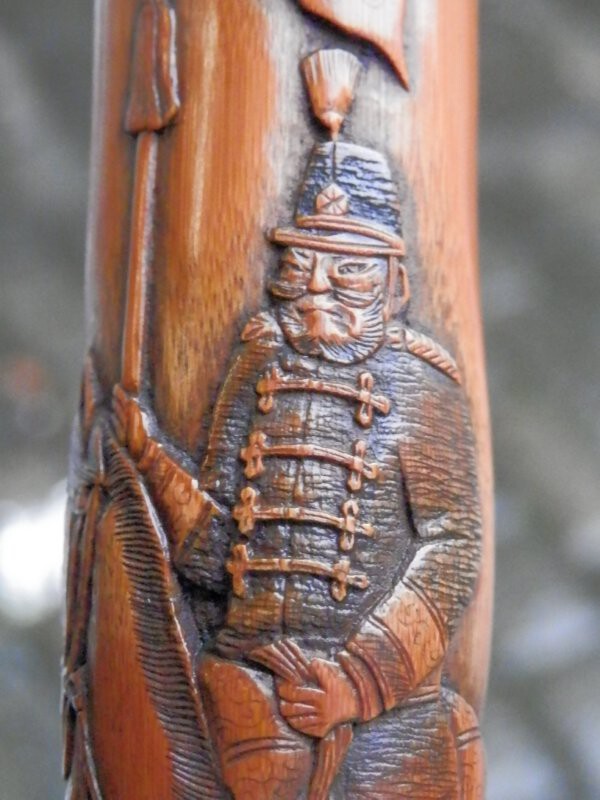
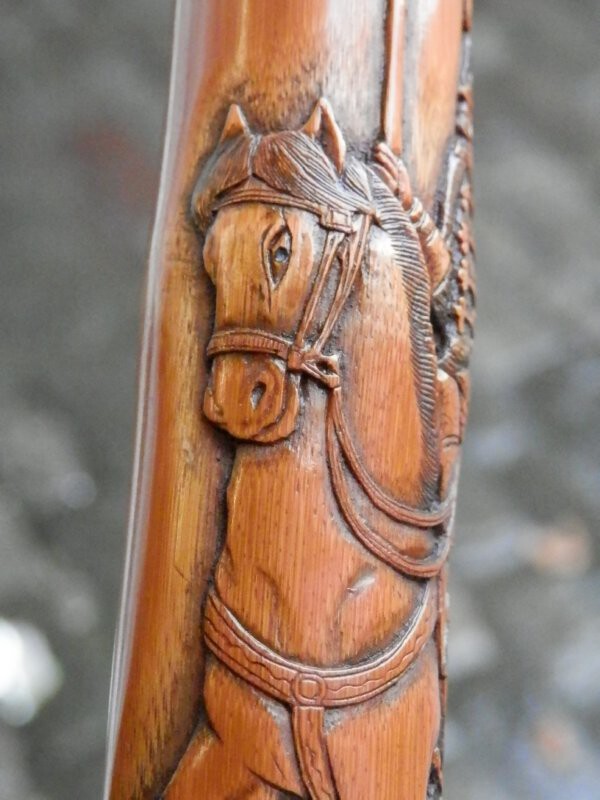
Good afternoon all, Here is the Main carving: I am guessing a celebration of one of the generals commanding in one of the Sino Japanese Wars? Cheers


-
Good afternoon all, With Brian's permission I would ask for some help. The following script and signature is cut into a military themed Bamboo root end walking stick (90cms). Cheers


-
Do you use your nihonto for tameshigiri?
Baka Gaijin replied to Hans Kondor's topic in General Nihonto Related Discussion
Again Kunitaro san どうもありがとうございます For extending the knowledge base. -
Muromachi Period Dates Confusion
Baka Gaijin replied to Tcat's topic in General Nihonto Related Discussion
Hi Tom "after being beat up by an Anthropologist" I'd pay good money to see footage of that on You Tube.... Could go viral.... Excellent and well considered points BTW. Cheers -
Muromachi Period Dates Confusion
Baka Gaijin replied to Tcat's topic in General Nihonto Related Discussion
Good morning Alex "Can someone please tell me the correct dates for the Muromachi (and/or all) period(s)?" The simple answer to that is no...... So many academics over the hundred and fifty or so years have written their magnum opus from a particular viewpoint or agenda, hence the historic rubble of dates falling over each other. To quote Diane Skoss of Koryu Books: "Some historians date the Muromachi period also known as the Ashikaga period from 1333 to 1568; others divide this era into several shorter periods, while sword collectors usually divide it into two parts with the Nanbokuchō running from 1333 - 1392 and the Muromachi from 1392 - 1573." She further advises the dating in The Connoisseur's Book of Japanese Swords, which runs: Yamato 645 - 710 A.D. Nara 710 -794 Heian 794 - 1185 Kamakura 1185 - 1333 Nanbokuchō 1333 - 1392 Muromachi 1392 - 1573 Azuchi - Momoyama 1573 - 1600 Edo 1600 - 1867 Meiji 1868 - 1912 Hope this helps Cheers PS here is a link to Diane and Meik Skoss's site: http://www.koryu.com/