Kiipu
-
Posts
2,450 -
Joined
-
Last visited
-
Days Won
11
Content Type
Profiles
Forums
Events
Store
Downloads
Gallery
Everything posted by Kiipu
-

Questions about possible purchase of small Seki stamped sword.
Kiipu replied to Rictus's topic in Military Swords of Japan
And his new forum name is Darth Vajo of Bavaria! @Xander Chia there are some really good articles that you should take a look at via the link below. You will find several that discuss the shortcomings of the traditional made sword, especially in regards to cold weather. Japanese Sword and Tosogu Related Articles This article in particular shows that even back then the shortcomings were known and workarounds were developed to address the problem. Ura Nihon no Toko By Yoshikawa Kentaro -
Cross-References to Observed Tanegashimas
Kiipu replied to Kiipu's topic in Tanegashima / Teppo / Hinawajū
Via GBF. Tanegashima/Teppo Wanzl Conversion -
A little infographic just for Bruce! Amahide, Post #14
-
Hi Ed, best to just leave the habaki alone for the time being. Below is a link to get you started on the handle rewrap question. However, I would wait until others have chimed in with more recent experience. Type 98 Japanese Officer's Sword In addition, on the menu tab at the top of NMB, click on Nihonto Info. From the drop down menu, hover over Links and then click on Restoration. This will display several individuals who do sword work.
-
The same character, just old versus new style. 亞 = 亜 https://en.wiktionary.org/wiki/亞 https://en.wiktionary.org/wiki/亜
-
興亞 = 興亜 = kōa = development of Asia. https://en.wiktionary.org/wiki/興亜
-
Identification Help With Shore Patrol or Police Wakizashi
Kiipu replied to DTM72's topic in Military Swords of Japan
Hi Dan, the hilt markings consist of a kanji character followed by some numbers. Will need a closeup of the kanji character so as to identify it. 一七六 = 176. -
WWII (as far as I can tell) Nihonto Blade Identification
Kiipu replied to Patinamax's topic in Military Swords of Japan
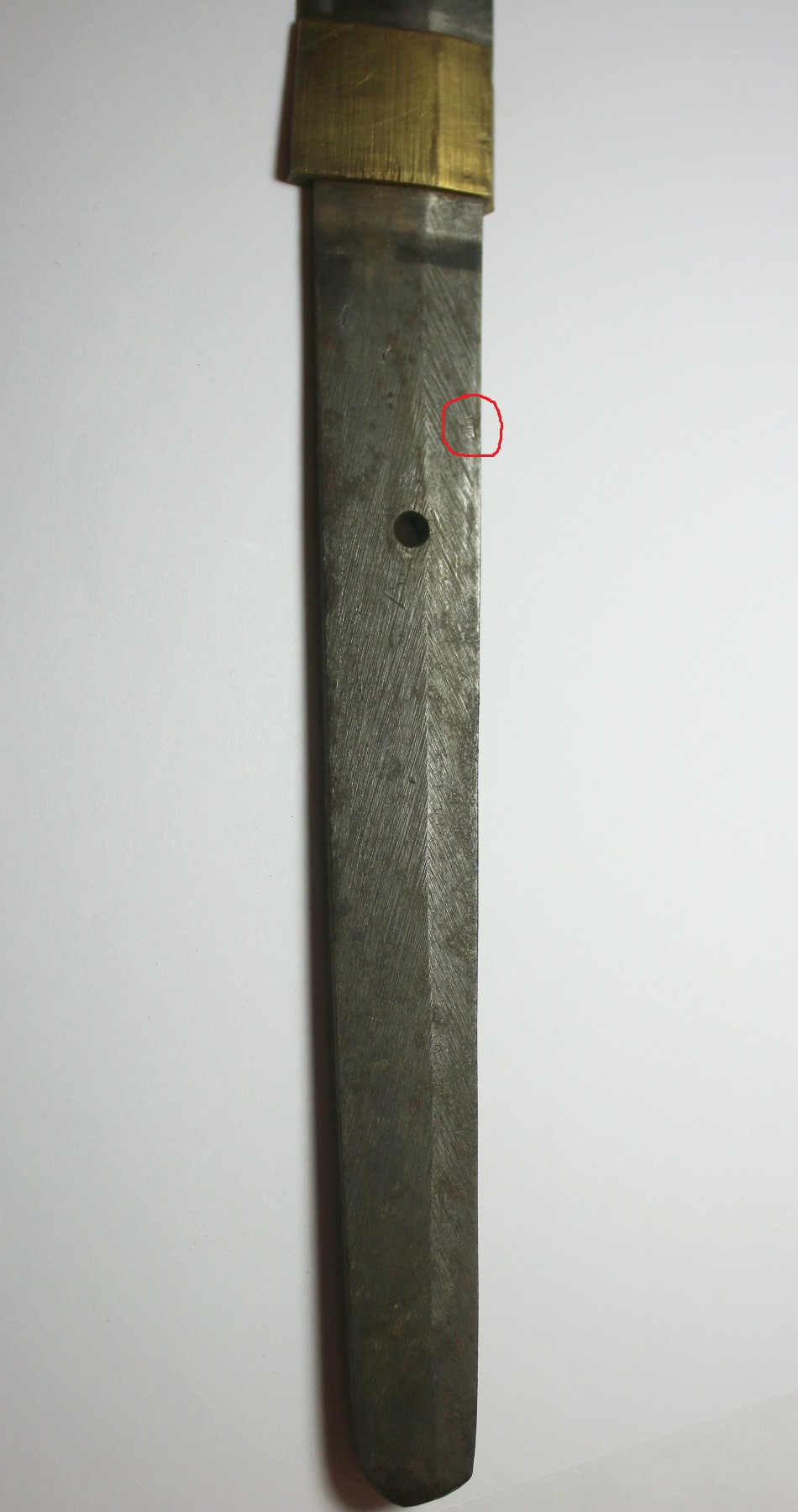
I have circled the Seki 関 stamp on the picture below. Only the left side of the stamp is still visible as this side of the nakago was sanitized for reasons unknown. To see the stamp clearly, one needs to download the picture and then zoom in on the location. FYI, I did not notice it until Brian & Bruce mentioned it. This got me curious as to where it was at.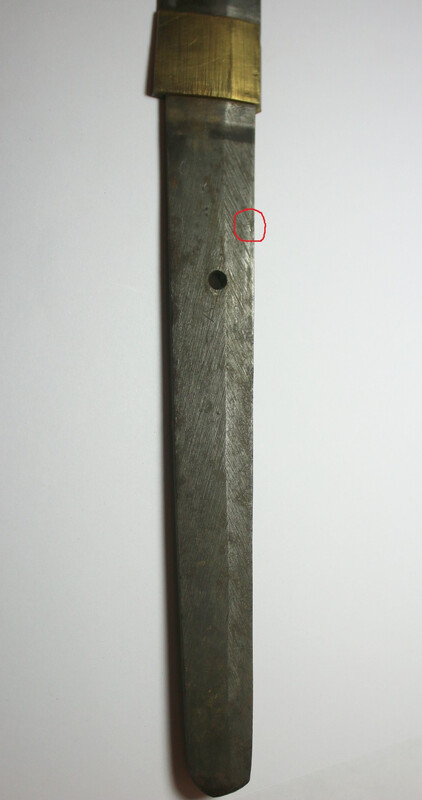
-
Looks like someone took a wire brush to the habaki or maybe were trying to pry the habaki off? Are there any markings on the nakago mune [the spine of the tang]? 兼定 = Kanesada. 昭和十八年十二月 = 1943 December.
-
Cross-reference to another Kawamura Tadatsuna 河村忠綱. Japanese Officer sword - Nakago help (2 of 2)
-
Tony, your sword is the last one made in 1943 so far. 44th Series ヒ五九一 昭和癸未春 1943 Spring. 44th Series ヒ六二四 昭和癸未春 1943 Spring <-- Your sword. 44th Series ヒ一一五五 昭和甲申春 1944 Spring.
-
The sword is Chinese and @BANGBANGSAN is the person to ask. With that said, I think the flags represent the Beiyang Government 北洋政府 and army 北洋军. And if I am wrong, Trystan will be more than glad to correct me!
-
Are organizations obsolete
Kiipu replied to Peter Bleed's topic in General Nihonto Related Discussion
This is the new entry point for collectors and also allows for the crossover of collectors of Japanese militaria. In might come as a surprise, but almost all Japanese militaria collectors own a few military swords. The future of sword collecting organizations is bringing together the religious order (Nihontō or swords as pieces of art); the warrior class such as martial artists, law enforcement, or military (the sword as a weapon), and working class (blue collar guntō & militaria collecting and the endless debates over what original paint was used on scabbards!). With this combination, sword organizations will survive. Oddly enough, this very forum does not have a subforum for the warrior class; yet, there are many with a martial arts background and would probably love to talk about it. What is to become of them? Apologies to Peter for the sidestep. -
Mantetsu , Translation, date,appreciated
Kiipu replied to paul carruthers's topic in Military Swords of Japan
昭和辛巳春 = 1941 Spring. 興亜一心 満鐵作之 = Kōa Isshin South Manchuria Railway Company (SMR) made this. ソ 二三一 = So-231 [serial number]. Paul, can you post an overall picture of the sword with the scabbard placed below the blade? The purpose is just to see the style of fittings used. And finally, there is a little article written by@Bruce Penningtonabout these swords that you can read in the "Downloads" section. Mantetsu - South Manchurian Railway -
Zach, I forgot to mention the following link about Type 95s. IJA Type 95 NCO Sword Info As for your concerns about the color of the scabbard, I would recommend reading the thread below. The thread introduces several colors besides the dreaded black. Type 95 Black Saya
-
Hi Zach, that is a nice looking Type 95 Military Sword made by Suya. @Shamsy & @Stegel will need to look at the scabbard color though. How would you describe the scabbard color when using the "Mark 1" eyeball?
-
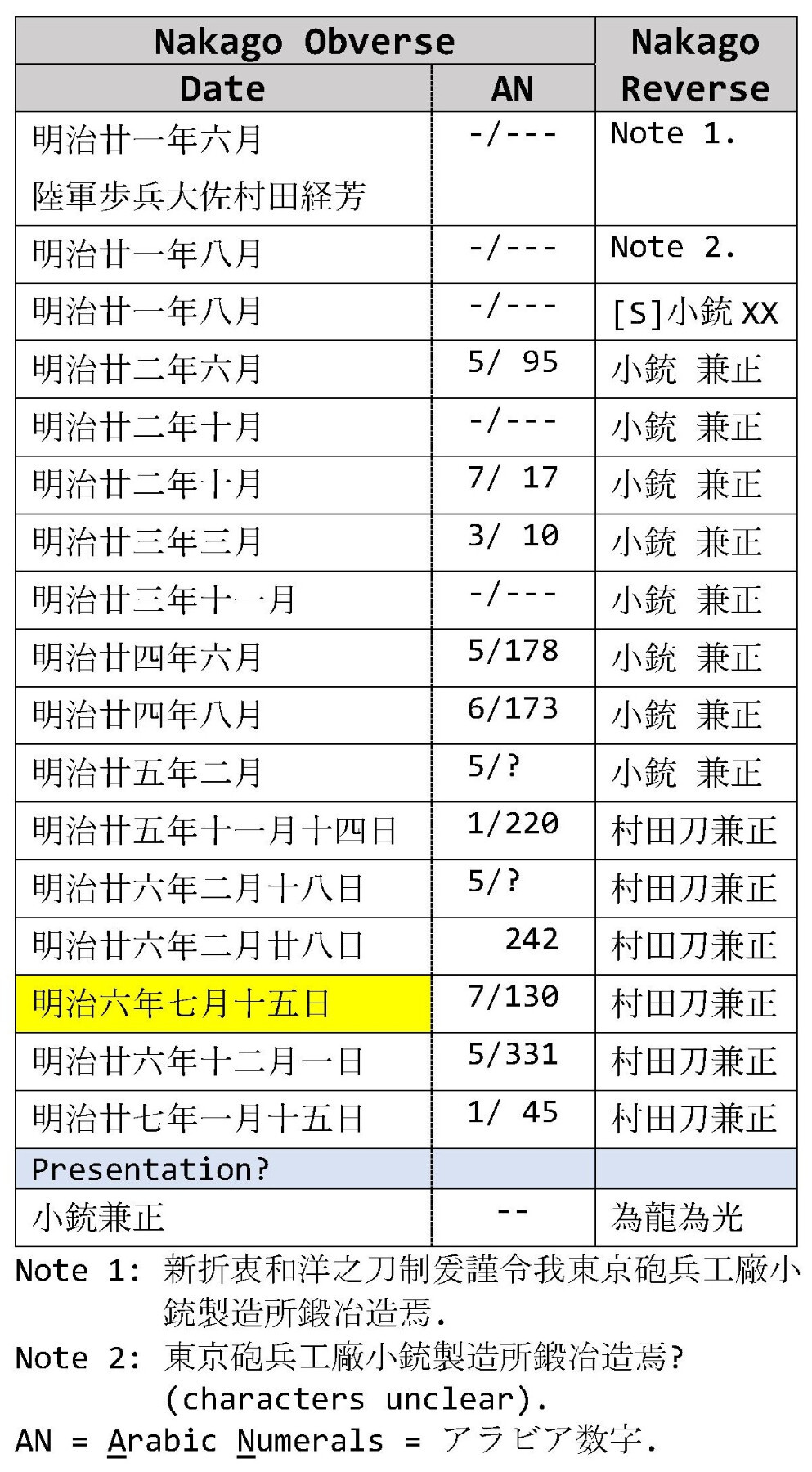
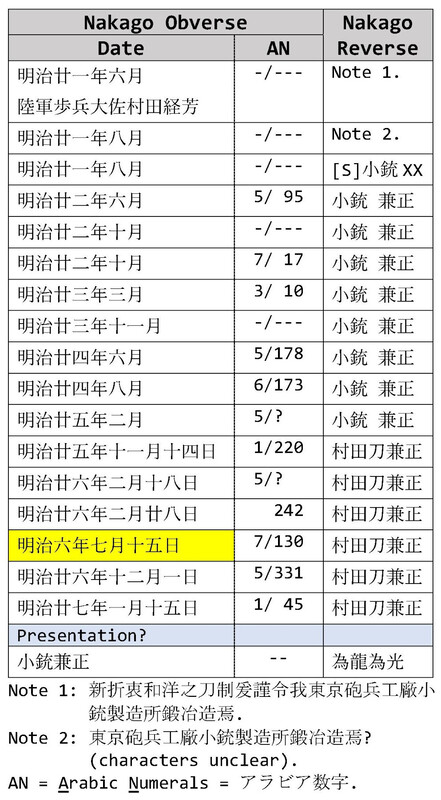
The prefix rifle 小銃 used by Kanemasa 兼正 is most likely the location where the blade was made. In this case, the Rifle Factory of Tōkyō Artillery Arsenal 東京砲兵工廠小銃製造所. The first two blades are actually marked with the full name.
-
This is an update of Post #27 of 2020-11-27.
-
Katana: Shoju Kanemasa (Kogarasumaru shape) 小銃兼正 = Shōjū Kanemasa = Rifle Kanemasa. 明治二十四年六月 = June 1891. Courtesy of @MarcoUdin.
-
Hard to tell exactly what these markings are. Some look like katakana characters such as タ and ヘ.
-
Another oldie but goodie from 2017 about Type 95 Military Swords dressed in white. Hope Shamsy does not mind a link about white in a thread about black! Winter Is Coming...
-
Another one for @mecox to add to Japanese Naval Swords and for @Bruce Pennington to ponder a large Seki stamp on a 1944 dated blade. Good luck to you both! 関 = Seki (stamp). 大道 =Daidō. Red paint: 二八六七 = 2867. 昭和一九年 = 1944. Green paint: イ四二 = I 42 (I as in the letter i). @Eds, does any of the parts have a stamped number on them that match the above two numbers?
-
Translation help on Additional Kanji on Masanaga Gendaito
Kiipu replied to matthewbrice's topic in Translation Assistance
Never heard of the guy! All of the 七生刀鍛錬道場 swords with the exception of one have been made by Masanaga. The sole exception is a Masakatsu 正勝. Masanaga = 正永. (Or Masunaga if your name is Trystan!) Masakatsu = 正勝. It is actually dated March 1944 and not March 1943. It is the only Seven Lives Type 100 with the 阪 final inspection mark instead of a "star" stamp. The 阪 final inspection mark is between the characters 生 and 刀. The 阪 final inspection mark is lightly struck and is large in size. The link below says Masakatsu's 正勝 real name is 中村・勝. Katana[Nakamura_Masakatsu] -
@Jon MB If still at hand, does your Masanaga 正永 have any markings on the nakago mune? This matter of serialization has just recently come to the forefront. Translation help on Additional Kanji on Masanaga Gendaito 爲小泉氏 = Tame Koizumi-shi = Made for Mister Koizumi. 七生刀鍛錬道場 正永作之 = Masanaga made this. 昭和廿年二月吉日 = A lucky day in February 1945.
-
Translation help on Additional Kanji on Masanaga Gendaito
Kiipu replied to matthewbrice's topic in Translation Assistance
After looking at all the others, I think the serial number could be 41. Can you double check that for me? The other serials that I have are 21, 60, and 94 ranging from September 1943 to March 1944. Production at the dōjō would have stopped either in March 1945 or June 1945 because of bombing.