PietroParis
-
Posts
796 -
Joined
-
Last visited
-
Days Won
4
Content Type
Profiles
Forums
Events
Store
Downloads
Gallery
Everything posted by PietroParis
-

Okimono Construction Material Identification Sought
PietroParis replied to hddennis's topic in Other Japanese Arts
Not necessarily. On this kind of tourist/export carvings a random signature can be added just to enhance the perceived value of the item, with no connection to the identity of the carver. Indeed, most such carvings carry simple signatures from a limited set, e.g. famous signatures from the past such as 正直 Masanao or 正之 Masayuki. Other much-recurring signatures are 石川 Ishigawa and 玉石 Gyokuseki, the latter probably intended as a pun because it can be read as "dodgy". Your pictures are not clear enough to read the signatures, but it seems to me that the one on the left belongs in the broad class mentioned above, while the one on the right (cursive, upside down) is harder to read and might or might not mean anything at all in Japanese. -
Okimono Construction Material Identification Sought
PietroParis replied to hddennis's topic in Other Japanese Arts
Thank you, you are correct that they are not great old works. The one on the right might be Japanese, the one on the left most likely not, but they both are relatively recent products aimed at the tourist/export market. No problem with that, as long as you know what they are, like them, and did not pay a fortune for them. P.S. leaving aside the ethical (and legal) implications of buying/selling recent ivory, of course. That is a matter on which sensitivities vary, but many netsuke collectors feel strongly about it because it kind of ruins the game also for harmless antique ivory. P.P.S. On this kind of carvings the signature does not matter, since it will not point to a recorded artist anyway. -
Okimono Construction Material Identification Sought
PietroParis replied to hddennis's topic in Other Japanese Arts
You are of course correct in pointing out that, differently from the eBay example, your okimono shows detail also on the bottom. However, there is still at least one flat, messy area that looks suspicious to me: For the rest, I don't know what kind of plastics would resist the hot pin, but let me stress the obvious fact that the hot pin test works only in one direction: if it melts, it is not ivory. If it does not melt, it could be ivory as well as any other material that does not melt. I recall a discussion in the FB group of a museum replica (the cat in robe from the Peabody Museum) that had fooled its buyer because it had passed the hot pin test.
-
Okimono Construction Material Identification Sought
PietroParis replied to hddennis's topic in Other Japanese Arts
It does not look like ivory, especially the bottom view. Moreover, as you were told in the FB group, it is a model that is quite commonly faked, see e.g. this recent sale: https://www.ebay.fr/itm/115468859653 My own guess would still be some kind of plastic. Just out of curiosity, would you care to show the netsuke? -
A series of fittings ( or how not to build a collection )
PietroParis replied to Bob M.'s topic in Tosogu
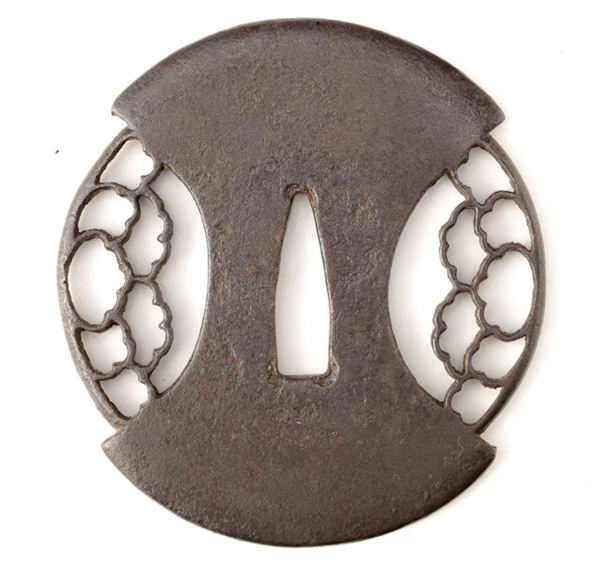
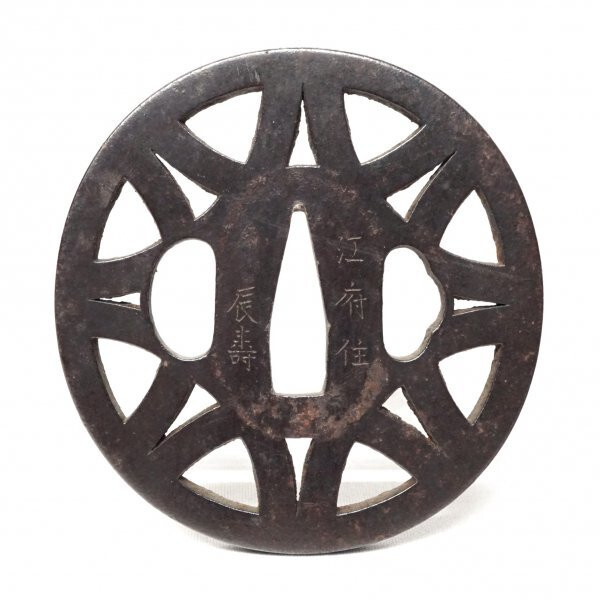
Very nice, would you please post it also in the "Tatsutoshi & Students" thread? For the record, a similar tsuba signed 並寿 Namitoshi (one of Tatsutoshi's students) has been on sale for ages on Yahoo! Japan: https://buyee.jp/item/yahoo/auction/l657634473 -
One more from Yahoo! Japan. The seppa dai is heavily corroded, but the Hozon certificate attributes it to Tatsutoshi:
-
Tatsutoshi on Yahoo Japan, with rust issues:
-
A series of fittings ( or how not to build a collection )
PietroParis replied to Bob M.'s topic in Tosogu
Last one and then I swear I’ll stop: this is identified as a Kaichi by a well known Japanese scholar/dealer of netsuke: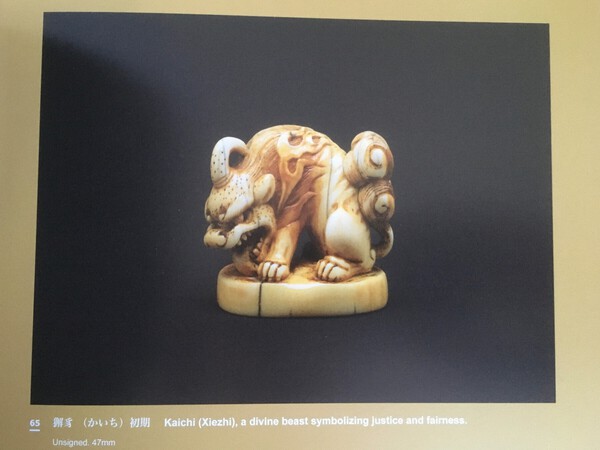
-
A series of fittings ( or how not to build a collection )
PietroParis replied to Bob M.'s topic in Tosogu
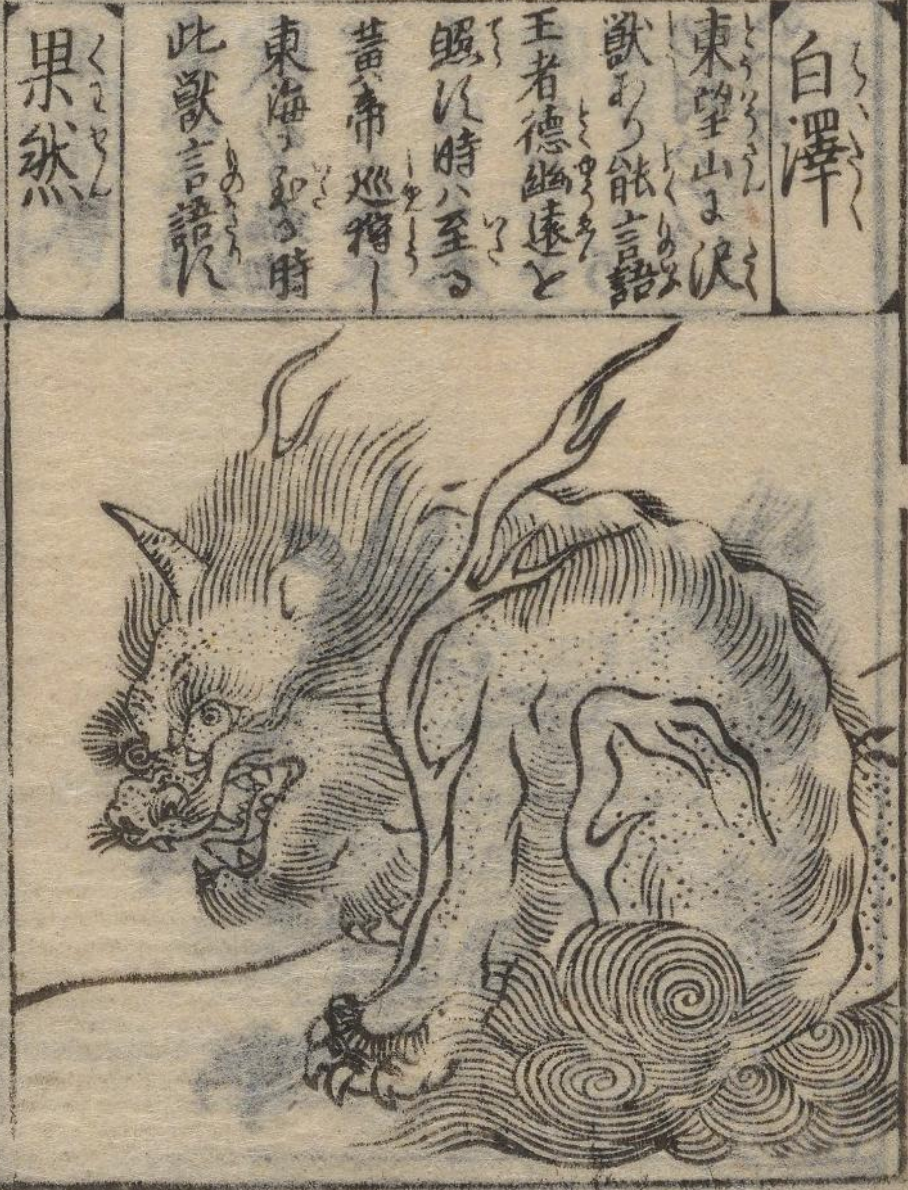
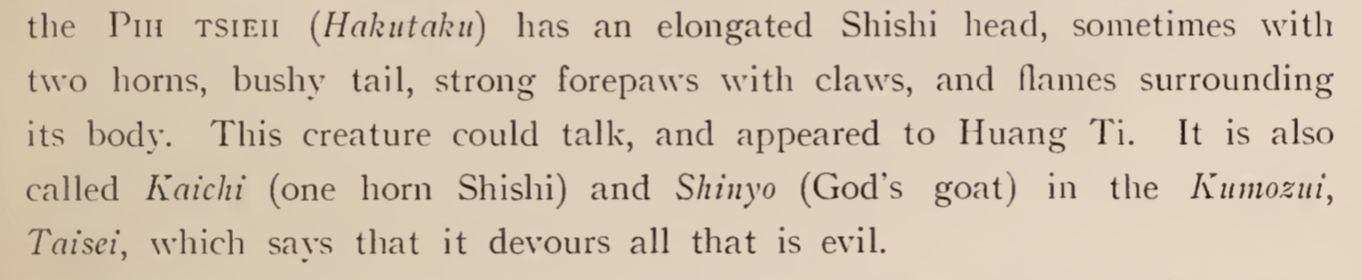
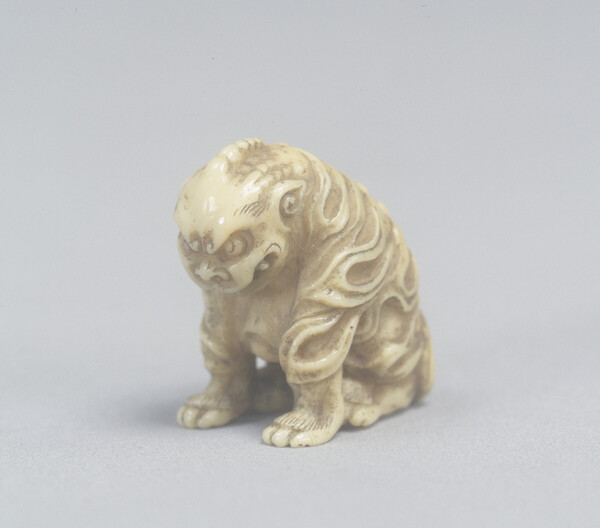
For those who remember the sprawling discussion a few months ago on the Japanese representations of the mythical beast 白澤 BaiZe/Hakutaku, I would like to share two more examples of the "flaming horned lion" version that I stumbled onto later. I tried to add them directly to my old summary (see this link) but I can no longer edit it. The first is again by Tachibana Morikuni, in an encyclopedia of Chinese things named "Morokoshi kinmo zui" (see this link): The second is a netsuke in the Go collection at Tokyo National Museum (see this link). This one attests that the shishi-like representation, alternative to the extra-eyed, cow/goat-like representation, is still recognized by Japanese curators as Baize/Hakutaku: Cheers, Pietro
-
Just in case anyone didn't know: https://archive.org/details/japaneseswordmou00joly/mode/2up
-
Another tsuba on eBay whose style looks familiar even if the signature 宜壽 Yoshitoshi is not in Markus Sesko's lineage for the Akao & Ito school:

-
Help to identify these swords Tokyo national museum
PietroParis replied to Paz's topic in General Nihonto Related Discussion
You could try to match them with these pictures from the museum's website: https://colbase.nich.go.jp/organizations/1/collection_items?locale=en&limit=100&organization_id=1&with_image_file=1&only_parent=0&free_word=katana https://colbase.nich.go.jp/organizations/1/collection_items?locale=en&limit=100&organization_id=1&with_image_file=1&only_parent=0&free_word=tachi https://colbase.nich.go.jp/organizations/1/collection_items?locale=en&limit=100&organization_id=1&with_image_file=1&only_parent=0&free_word=wakizashi -
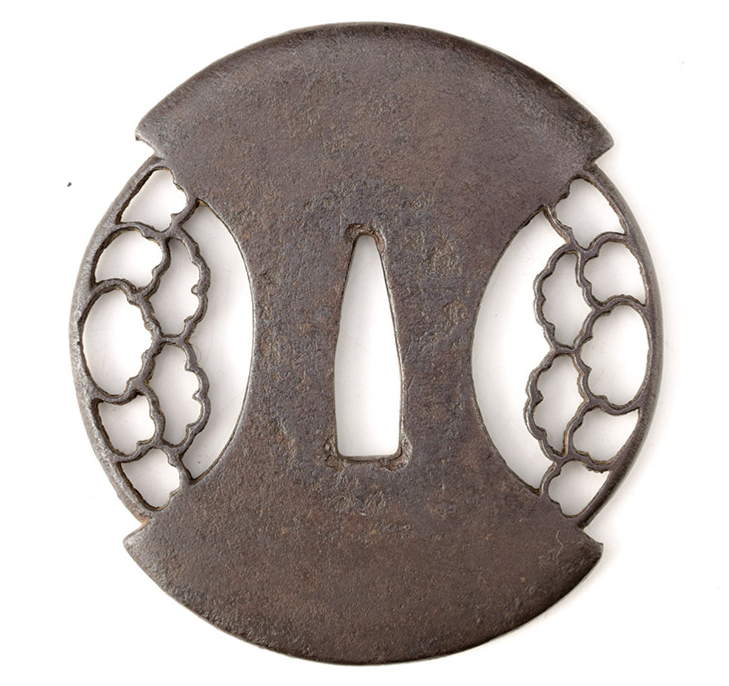
I have this cross(?) shaped, unsigned tsuba, papered Shoami: It was discussed earlier in this thread.

-
Murphy is a dirty bastard!!
PietroParis replied to Bigsgtg's topic in Auctions and Online Sales or Sellers
Just out of curiosity, who's Murphy?
-
A series of fittings ( or how not to build a collection )
PietroParis replied to Bob M.'s topic in Tosogu
Yep:
-
A series of fittings ( or how not to build a collection )
PietroParis replied to Bob M.'s topic in Tosogu
Like the weirdly asymmetric hitsu ana? [EDIT: no, that's like the original - sorry] [2nd EDIT: a Tadamasa reproduction was discussed long ago in the forum, but the picture alas has disappeared] -
Indeed, he is not in Markus Sesko's genealogy but the theme and the "toshi" suggest some relation.
-
I'd guess stuff he found while poking around with a metal detector?
-
Tatsunao on Yahoo Japan:
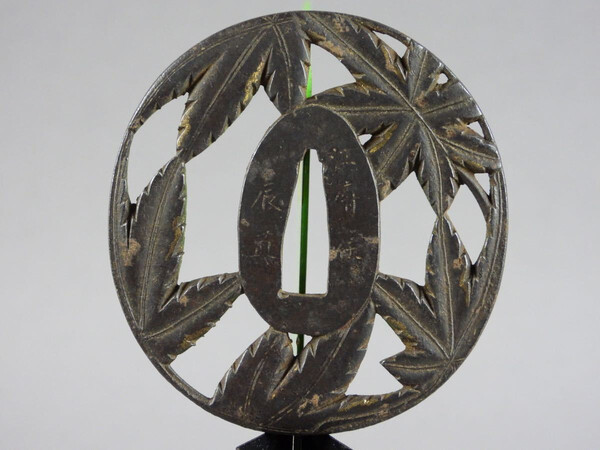
-
Mythical animal from a pictures book
PietroParis replied to PietroParis's topic in Translation Assistance
Hi Thomas, all of these pictures are discussed at length in the last two pages of this other thread: https://www.militaria.co.za/nmb/topic/34920-a-series-of-fittings-or-how-not-to-build-a-collection/ see in particular this summary: https://www.militaria.co.za/nmb/topic/34920-a-series-of-fittings-or-how-not-to-build-a-collection/page/20/#comment-398868 The picture that you posted is not a Kirin, unless you use the term in the very wide sense of "mythical horned creature". In particular, Kirin are supposed to have hooves. Based on what transpired from the discussion in the other thread, it appears that yours is rather a 獬豸 (Xiezhi/ Kaichi). -
A series of fittings ( or how not to build a collection )
PietroParis replied to Bob M.'s topic in Tosogu
P.S. Do what you want with this additional piece of information: going back to the early posts of this discussion, I noticed that for Joly Kaichi is another name of the Hakutaku. Clearly he was sticking to the tradition of the Hakutaku as a flaming horned lion, which I would not consider "wrong" but just alternative to (and co-existing with) the cow-like, multi-eyed tradition.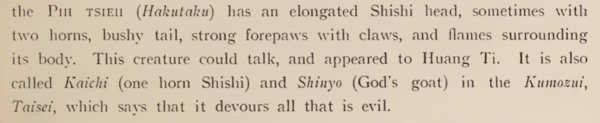
-
A series of fittings ( or how not to build a collection )
PietroParis replied to Bob M.'s topic in Tosogu
I was trying to get to the bottom of the matter while following only the historical sources available. I'm glad that the subject of the tsuba is identified beyond doubt now, I feel less bad about hogging all these pages. As I am also a netsuke collector, I was mainly interested in the Hakutaku business. Thanks to Piers' input, I have now added a point 3bis to the writeup above concerning another possible occurrence of the flaming-horned-lion version in Japanese literature. I am constantly reminded of the fact that being unable to read Japanese is a big handicap in this endeavor, which makes the results inevitably amateurish... -
Mythical animal from a pictures book
PietroParis replied to PietroParis's topic in Translation Assistance
Thanks Piers! that's very valuable for the Hakutaku discussion in the other thread, as it reinforces the idea that even in the Japanese literature there are two "parallel" versions of the beast (a lion-like one with just two eyes and a cow-like one with extra eyes on the sides). -
Mythical animal from a pictures book
PietroParis replied to PietroParis's topic in Translation Assistance
Sorry if I drag this on, I am just curious to tie a loose end. Could anybody please read for me the name of this other beast? Again, it should be the two boldface characters on the top right corner.
-
A series of fittings ( or how not to build a collection )
PietroParis replied to Bob M.'s topic in Tosogu
And will you admit that it is absurd to claim that early 17th-century depictions of an imaginary animal are "mistaken"? And most importantly, why do you have to turn this into a pissing contest? After finding the picture that the maker of the tsuba was inspired by – which does not seem related to the legend in the "Yunji Qiqian", although I cannot read the text – it is clear that the animal on Bob's tsuba is not a Hakutaku. So?