
Dan tsuba
-
Posts
857 -
Joined
Content Type
Profiles
Forums
Events
Store
Downloads
Gallery
Everything posted by Dan tsuba
-
Hello all! So, I have a question. I have been collecting tsuba for about 6 years. I have about 140 tsuba. When I receive my tsuba, I open the package and (while standing) bow to the tsuba (I guess it is part of my martial arts training thing!). I “heft” it in my hands to get a tactile “feel” for the tsuba and its weight and shape. I also know that sometimes the forging of tsuba had religious rituals attached to it (as in the making of sword blades). Now this may seem “weird” to some. But with only a few of my tsuba I have felt what can only be interpreted as definite “vibes”. Most (of the few tsuba that I have felt "vibes" from) are “positive vibes”. But with one tanto size tsuba I received what can only be interpreted as a “negative vibe”. I am getting along in years and have learned that the “universe works in mysterious ways”. I am wondering if any other members have experienced something similar, or do I just have an overactive imagination! Just an interesting experience I wanted to share with members. With respect, Dan
-
Moriyama san- Thank you so much for your assistance on the translation. Much appreciated. With respect, Dan
-
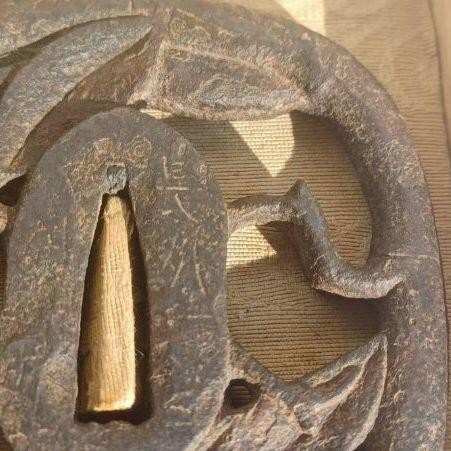
Hello Thomas, I have posted a picture of the tsuba (2 tsuba) that came in the box. They will take a lot of work to clean! One tsuba has a mei. Thanks, With respect, Dan

-
Can someone give me a translation of what appears on the tsuba box lid? Maybe it can help me identify the tsuba that came in the box. Thanks! With respect, Dan

-
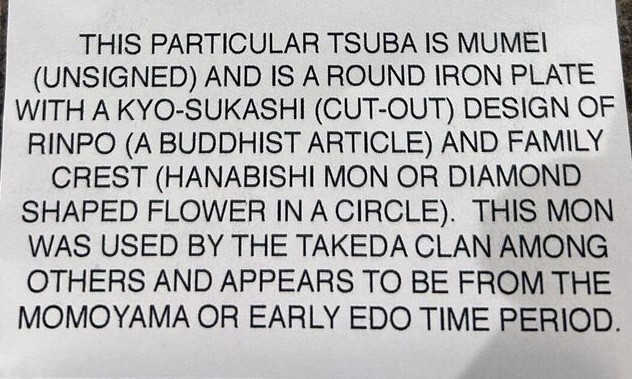
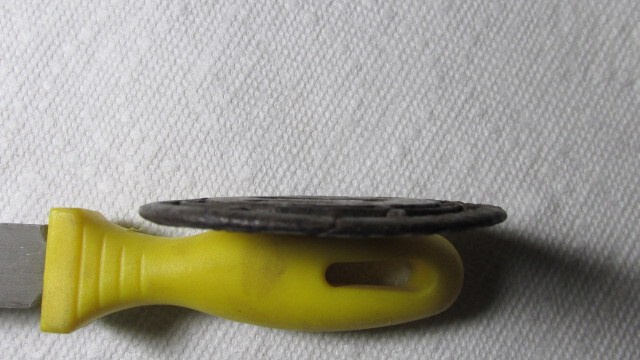
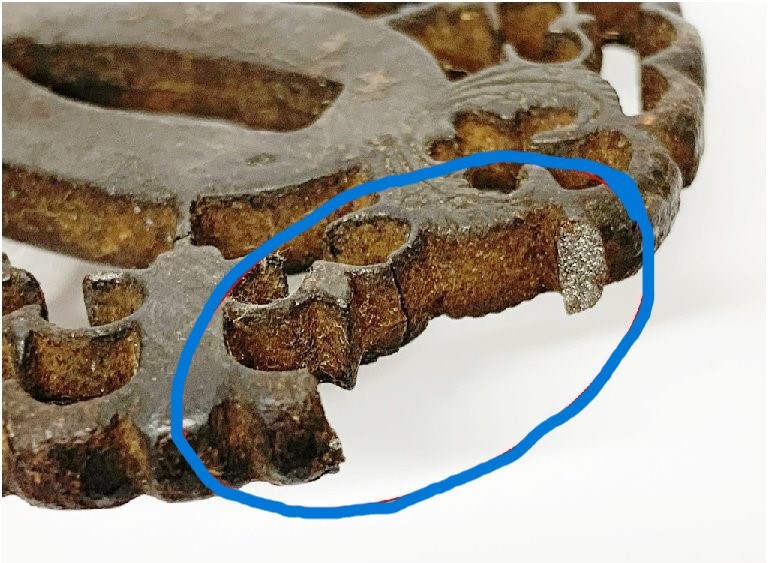
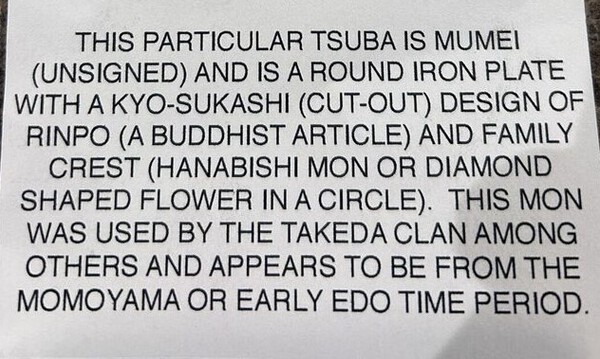
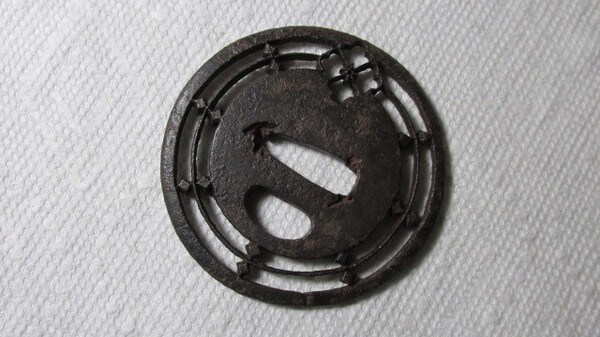
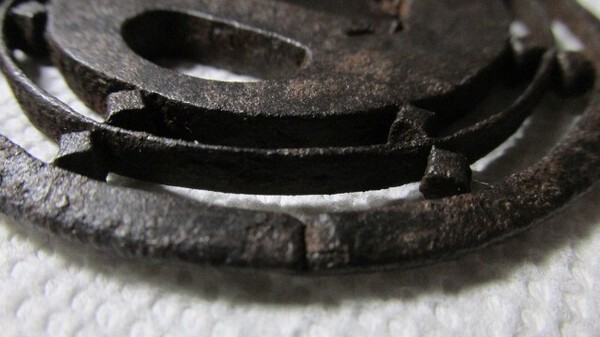
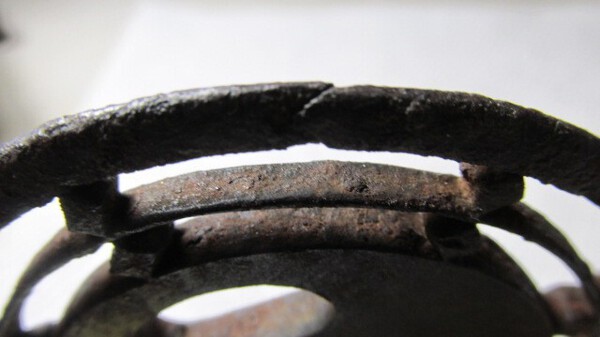
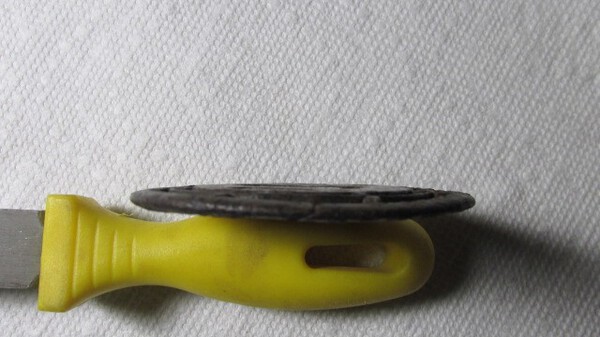
Hello all! So, my latest tsuba (bought for $50.00 U.S. dollars with a wood box- hurrah!) is interesting (written description of tsuba shown below). The mimi is bent and split in one area (pictures also shown below). It looks to me like it could have been struck hard (maybe with a sword?). Any opinions and thoughts on the split (or cracked) mimi?? With respect, Dan
-
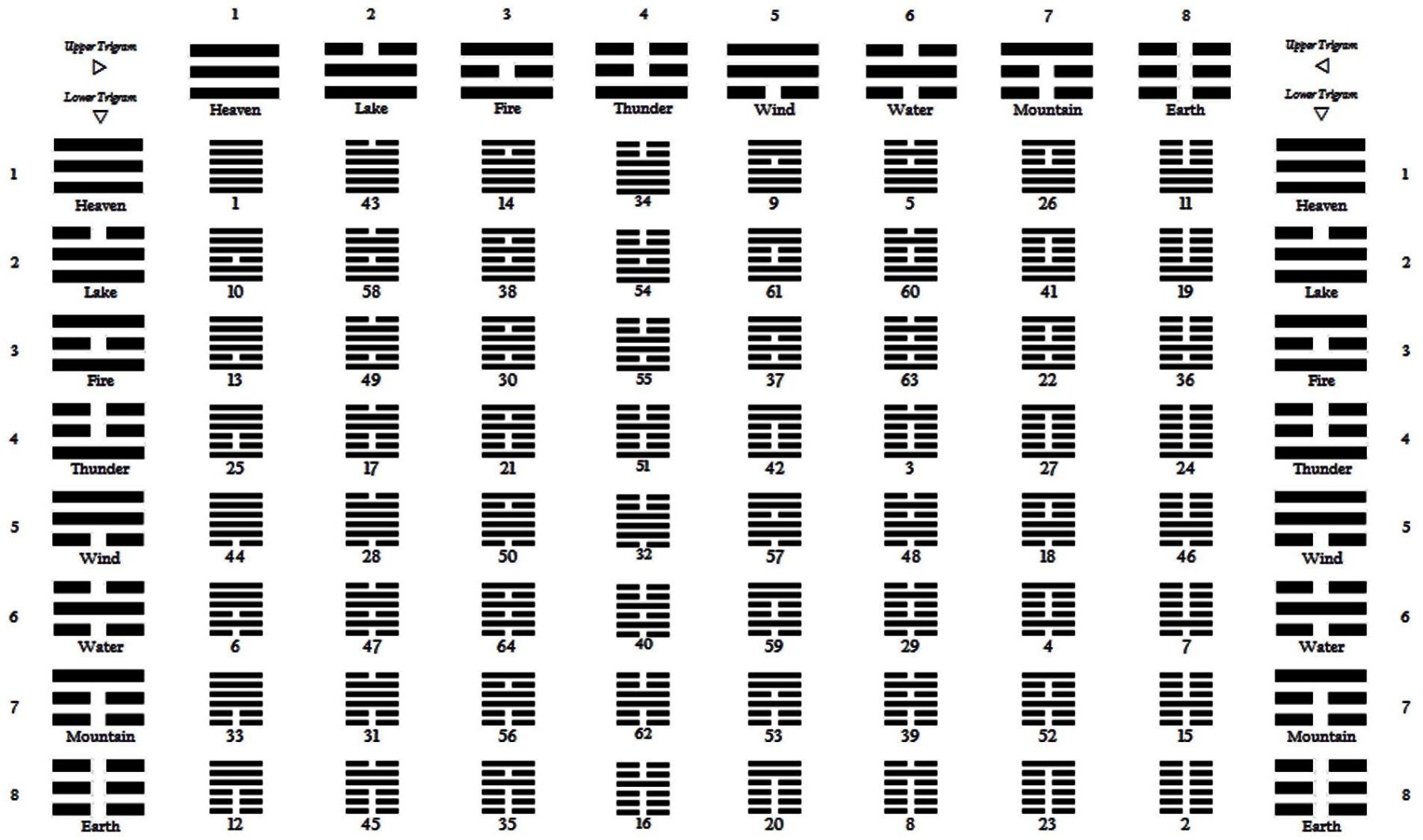
Wow DirkO, that's it!! Fantastic! Thanks! I found some more information here- Taixuanjing - Wikipedia Now I have to work on translating what the square inlays in my tsuba mean! With respect, Dan
-
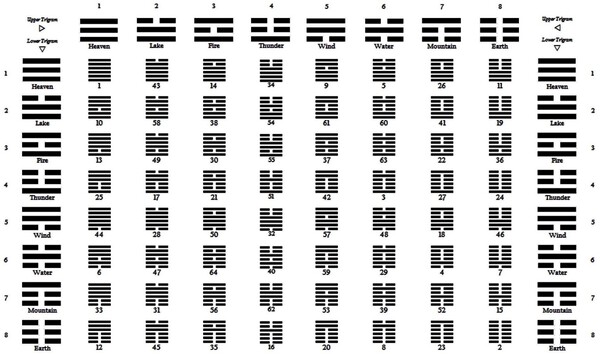
I wonder if those "scattered lattices" characters represent hexagrams (or something like them) from the I Ching? They look very similar. List of hexagrams of the I Ching - Wikipedia With respect, Dan
-
This is a square inlay type tsuba I have in my collection. I am also interested in the school or technique name! With respect, Dan

-
Hi Ford, Thanks for your expertise on explaining the process. Much appreciated! With respect, Dan
-
Thanks, Ford, for the information. So, these Yanigane were probably used as examples or models to make the same designs on tsuba (and other pieces) or used by apprentices for training purposes to learn the technique of a particular studio (or school). Which brings up another interesting question. How were these Yanigane made? Was the completed metal piece pressed into soft clay (or casting sand) and then the matsu-yani (pine pitch) was poured into the clay (or sand)? Or could the matsu-yani itself be used to make a mold when slightly hardened and then a more liquid state matsu-yani poured into that? Not important, but just interesting! With respect, Dan
-
Hello all! So, like I stated “I am out of here” on that “Tsuba casting molds” thread. But I still look at it and there has been an interesting question raised (before and recently) on that thread (I refer to pages 7 and 13 of that thread). That question has to do with tsuba Yanigata. The resin or pitch type casts made of tsuba (and other objects). Pitch is a type of plastic. It is a “viscoelastic polymer”. Maybe these tsuba Yanigata were used by the Japanese craftsman as a sort of visual 3-dimensional aid and example to use when they were carving the same design on another piece? They probably would not make another metal tsuba to keep as an example of their work. Why would they do that when they could sell their duplicate piece? A website dealing with Yanigata can be found here (although nothing is stated about using them as visual aids or examples to use when making a tsuba or other objects)- https://tsubakansho....2020/06/26/yanigata/ I have also included some pictures of these “plastic type” Yanigata (previously shown on that “Tsuba casting molds?” thread). Just another interesting question! With respect, Dan


-
Well, my friends, I agree with Spartancrest and his statement quoted here- “This thread was about evidence and proof - what has been presented is dismissed, but we have enjoyed plenty of dickering and bickering. Personal insults and showmanship abound, but have we got anywhere?” No, we have not got anywhere because (in my opinion) “what has been presented is dismissed” because the question of cast iron tsuba being made in the Edo period comes down to the “dollar bill” in today’s tsuba market (I am certain that you know what I am referring to). As Spartancrest also stated “Personal insults and showmanship abound….” If at any time during the period that this thread has been on this forum (Janurary 2022), if anybody feels that I “insulted them” or was just showing “showmanship”- I do apologize for that. But as we all know too well, sometimes these threads can get "a little heated"! So, my friends, I am “out of here” for now. Don’t all cheer! Ha, ha, ha, etc! With respect, Dan
-
Hello Luca! I understand and appreciate what you have stated in your post. And I agree with you that Ford “has probably seen more extremely high end tsuba in his life than all of us put together”. Although it is my understanding that cast iron tsuba were never considered “high end” tsuba. Could anyone actually differentiate between an extremely well-made cast iron tsuba and a well-made hand forged tsuba? As I have stated previously (several times in this thread) I feel the only way that a determination could be made is to subject the piece to non-invasive metallurgical testing (I refer you to Dr. Lissenden's thesis paper and quotes stated in one of my previous posts - to be found on page 12 of this thread - his entire thesis can be found on line). Until that can be done (or someone is willing to take a hammer to a possible cast iron tsuba!) I think that it would be extremely difficult to make an accurate determination. With respect, Dan
-
Ford my friend, Blah, blah, blah- There you go again! And I quote "Dan, to let you know that, despite your complete ignorance of my qualifications or academic standing in this field, I take my work seriously and apparently so do serious people, who matter. No I am not "ignorant", I read your bio! So, I do not "matter"! You always have to "put people down"! What is up with that! With your ego you probably need a chainsaw to get your overinflated "big ego head" through a doorway! I have a Masters degree. That is at least 5 years of formal academic training at a University. How many years do you have? Anyway, this is off topic. When you want to get back to "reality" we can do that.
-
My friends, as an addendum to my above post (since there are only "the sounds of crickets" here)- Let me try to explain to you how “scholarly research” works. I have an opinion or thought that is backed up with my “stated reference” (or references). Specifically stating the reference referred to and the page number (or numbers). If you disagree with my “stated reference”, then you need to state your own “stated reference” (or references) that contradicts mine. Otherwise, you are just stating “opinions” that are not “backed up” by “stated references”. Similar to several times where a “jeweler” by trade (who now makes tsuba – and placed a “beating a dead horse” emoji on one of his posts to this thread) has only stated opinions not backed up by any “stated references”. The fact that you can “yell louder than me” means nothing! It only verifies to me your “frustration” in that you cannot find any “stated references” to contradict mine. There is an old saying that goes something like this “back it up or back off”. Dan
-
I am certain that Dr. Lissenden’s paper has been brought up before in this thread! But I just wanted to state (repeat?) some information that the Dr. stated in 2002 from- “THE NAMBAN GROUP OF Japanese SWORD GUARDS: A REAPPRAISAL” by Dr John Philip Lissenden -A thesis submitted in January 2002 for the degree of Master of Arts of the University of Durham, as a result of research carried out in the Department of East Asian Studies of the University." “The revelation that casting was extensively used for the production of Namban tsuba came as a surprise to the author — this in spite of Dr Oliver Impey's assertion to him that such was the case. Doubtless, many students will discount this finding as being unique to this specific group, and will justify it by pointing out the low status generally given to these guards. Should it not rather be considered to be indicative of the need for a search for similar signs of the casting process in other groups of tsuba?” (page 151). Also- “It is seen from this exercise that every one of the tsuba of this group that was examined demonstrated clear evidence of casting. Clearly, it cannot be concluded from this study that all Namban tsuba are produced as a result of a casting process, but it does demonstrate that, in any collection of Namban tsuba, a very large proportion of them will be moulded. This finding may lead students to the conclusion that such results are not surprising, merely reflecting the generally accepted concept of this group as being mass-produced and of poor quality. However, the subsequent examination by the author of 137 his own collection, comprising a wide range of qualities within assorted groups of tsuba, also indicated a surprisingly high proportion of moulded tsuba therein. It is therefore suggested that the high incidence of moulded tsuba in the Namban group should, perhaps, rather be considered to be an indication for the similar examination of other groups of tsuba as a comparative study. Such a study would be strictly non-invasive, but one of its limitations would be the need for it to be carried out on museum artefacts of a recognised high quality in order to obviate the accusation that any pieces found to be cast were, a priori, of an inferior quality.” (pages 137 and 138). With respect, Dan
-
Spartancrest, Now that is some "original" and "out of the box" thinking! It makes a lot of sense. The "backyard" smiths that have (as you stated) "no school training needed, just a keen eye and the ability to 'fake it' ". In my opinion that kind of "drawing outside the lines" idea is impressive! Just my opinion! With respect, Dan
-
So, some information (from another member) is quoted from the below thread- “Tsuba in everyday objects - the culture of Tsuba” (posted on 9/11 on page 5) “On 9/11/2023 at 5:02 AM, Deez77 said: kettle with a typical Kinai tsuba design incorporated. Well we could definitely call it a cast tsuba - by Kettle makers! [Now what thread was that on?] I do like the fact they did both the omote and ura views of the tsuba - well we know they had the molds!”
-
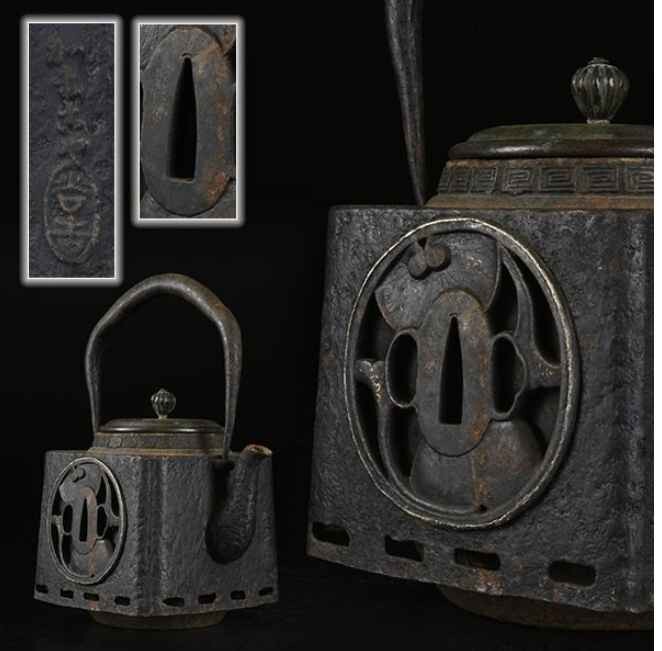
Hello all! Great information about the "water kettles". Very interesting stuff. But does anybody have any insights, opinions, or thoughts on when the water kettle (with the tsuba on its sides) that I included in my previous post could have been made? Edo period? Post Edo period? That is the question I am asking (was the kettle made in the Edo period or not). The fact that the Japanese culture uses the water kettles to add iron to their diet or that iron water kettles release iron ions into the water (and the tea) -although interesting - is not important to me (as it is to some!) and it is way off topic (my opinion!). Thanks!
-
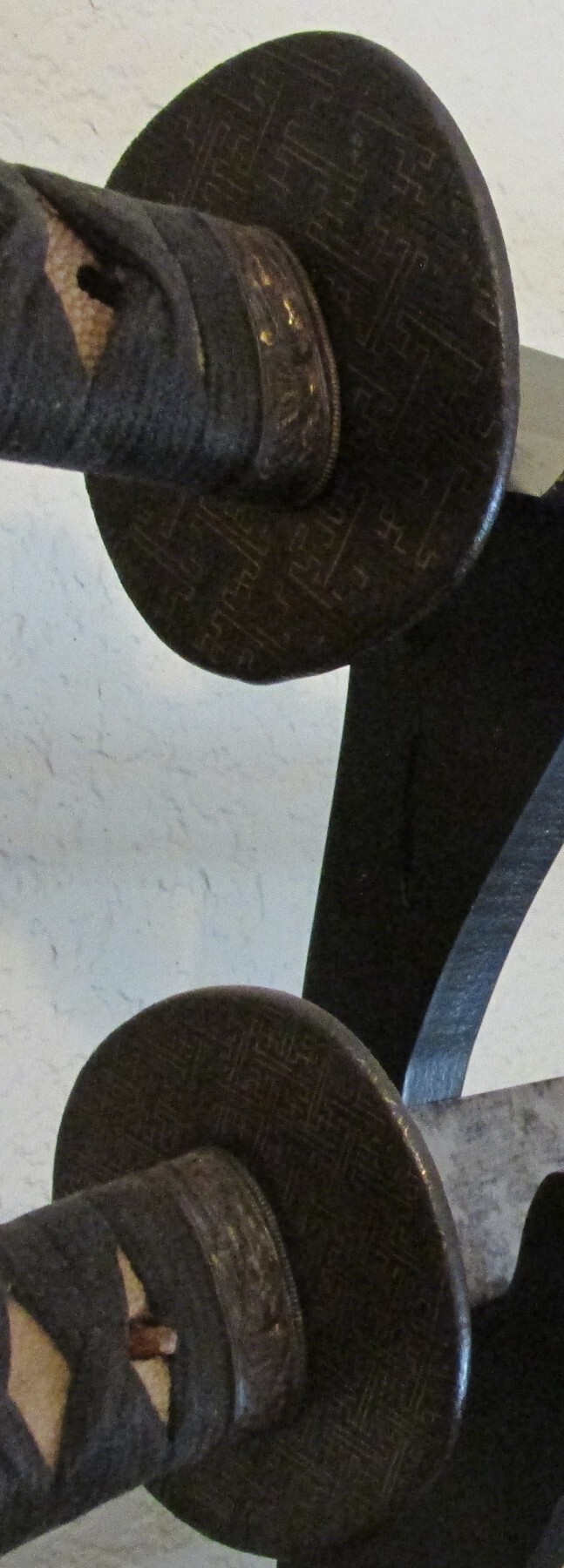
Two of mine on my daisho. They are what "caught my eye" first and got me interested in the daisho!

-
Hello all! So, this particular tea kettle came to my attention during the Brian stage of “find some other kids to play with. Not my forum”. Those of you that keep up with the forum know what I am referring to. Anyway, all that is in the past. I have included pictures of the tea kettle with the tsuba on it (both sides of the kettle). I have also included a description that was included with the kettle. I think it finally sold for about $330.00 U.S. dollars. I could not ascertain when the kettle was made. Perhaps Edo period? Perhaps not? Any thoughts and opinions would be appreciated. With respect, Dan


-
Is that circuit board made from cast iron? I know, I just couldn't resist! Ha, ha, ha, ha, etc!!! (hey all, I am back!).
-
"You have miles to go before you reach that". What do you mean? I need to collect more money so I can buy stuff and then have a "professional interest in Japanese art"? You have dug your own hole long ago and have not realized it. You are already "baited" by your own bias, and you can't figure that out! Oh well, good luck!
-
Of course you have "no comment to the above". That means you would have to "take sides". Let's just keep talking about the "dollar bill". That is much safer! With the respect you think you deserve (wait, no once again I am being too kind!. Let me just say with "no respect") Dan
-
That’s interesting. So, it seems tsuba collecting is all about the “dollar bill”? Let’s forget that Brian stated to me in another thread “Who cares?? Everyone with a decent and professional interest in Japanese art. What a stupid thing to say. As for negative comments....good. This is NOT a safe space. We call out stupidity here. I suspect _____ is a far more mature person and will take the criticism to heart and become a better collector without taking it personally. Unlike yourself.” So, who wouldn’t take this comment from the “Head Administrator” personally? I could never afford to spend over $300.00 U.S. dollars for a tsuba (usually between $50.00 to $150.00). Well, Brian, here is a negative comment. So, a collector that can’t spend a s**t load of money is not a “professional” and doesn’t have a professional interest in Japanese art? What is a “professional tsuba collector”? Someone that can only afford “museum quality” pieces? Dealers? Hey, how about us other “tsuba collectors” that survive on one social security check to the other? Are we considered “collectors”? Are we “worthy” even though we collect “inferior” pieces, and as stated to me on another thread “and earn your place here.”? And oh yeah, make no mistake. I would have responded to Brian on the other thread if he hadn’t “locked it”. How convenient is that for him! Dan