
Dan tsuba
-
Posts
859 -
Joined
Content Type
Profiles
Forums
Events
Store
Downloads
Gallery
Everything posted by Dan tsuba
-
Yes my friend! Imagine the things that daisho has seen! Too cool! Unfortunately, my daisho is in Arizona. Right now I am in Wyoming! Maybe one day I will take a picture of the other side of the daisho katana showing the wood shavings placed in the ito when I get back to Arizona. But hell, I probably will never remember to do that! Anyway, some interesting stuff. The "vibes" I get from a few of my tsuba (and this daisho) is just something I attribute to the messages from the Universe! I know, too weird!! Onward!
-
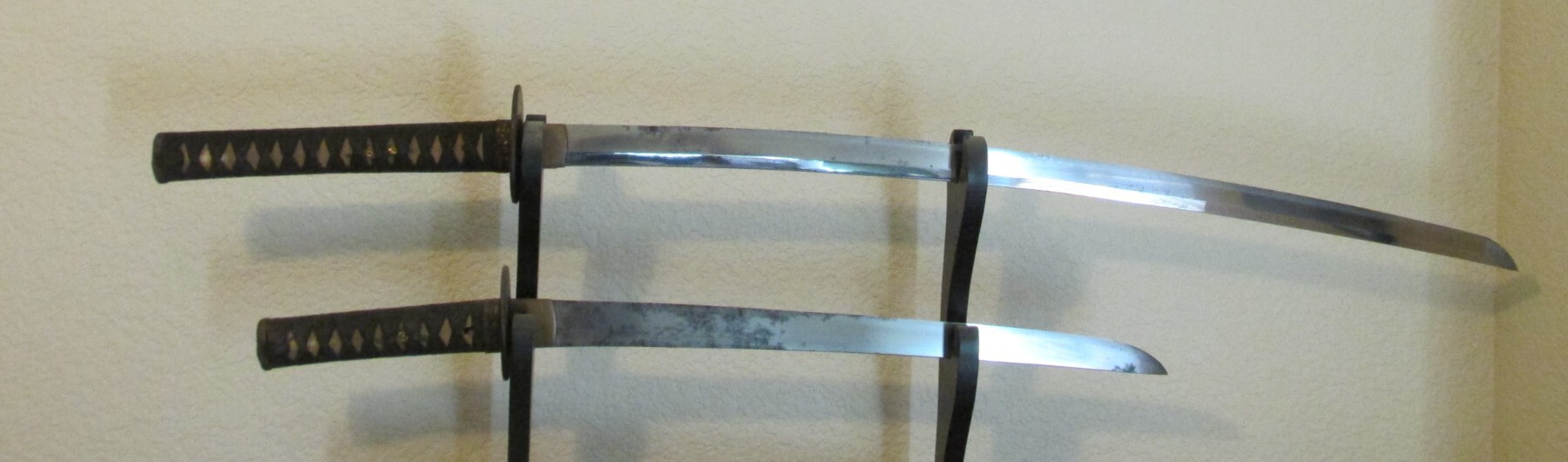
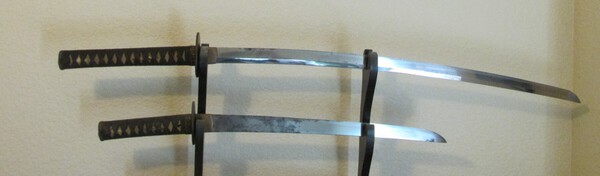
My friend, George. I don’t have any wooden menuki. But I have a daisho set from about 1580 that I know was owned by a poor samurai. The ito was worn in areas on the tsuka of the katana and he replaced the worn ito with wood shavings. The tsuba is inlaid with brass that could have been used in battle, daily wear, or court appearances. So, one tsuba for all occasions! I don’t want to get “weird” on you. But I have had “vibes” from some of my tsuba. When holding this daisho, it just communicates to me that the owner was poor. Picture attached of the daisho, although I could not download a picture of the tsuba. Hey, I am old and totally computer illiterate! Although the wood shavings in the ito are on the other side of the tsuka. Anyway, interesting stuff! Onward my friend!
-
My friend, Ghoul (George). I have no idea if you can get the nodes reparied! Anyway, I am looking forward to when you recieve your wakizashi and finding out any further details of the piece! The adventure continues. Hurrah! With respect, Dan
-
Hello Ghoul! I don't know much of anything! But, I would say Edo. Tsuba looks like a chrysanthemum theme. The emperor nods on the same (ray skin) look to be placed in and are really not part of the original ray skin. Although, that seems to have been done alot during the Edo period. Can you seperate the tsuka (handle) from the blade and show the tsuba? Maybe there is some sort of mei (signature) on the tang of the blade or tsuba? If you don't know how to do that, ask the members of this great forum! I am sure many members here can help you out. With respect, Dan
-
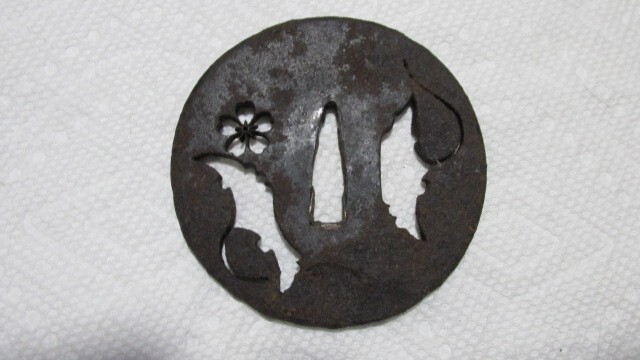
Hello all! (I know that many of you must be saying “Can’t this retired old guy find anything better to do”! But right now, for me, this area of research is fun and exciting -at least for me!) Well, I have included more pictures of some of my rusted tsuba (a few have been cleaned-but not by me!). Once again, you can see that the rust has “attacked” a large area of the tsuba and has left pitting and depressions on the surface. The rust has not confined itself to one small, tiny area of the tsuba. What I am trying to show on this thread is that rust “attacks” a large area of the tsuba (at least on my tsuba!). Now what is of interest (for me!) is the tsuba shown in my last 2 pictures. I am fairly certain (personal opinion!) that it is a cast iron tsuba. For those that are interested (and it probably won’t be a lot of you!) I base that opinion from the information on page 13 (from my post of January 8th ) of my “Tsuba casting molds?” thread -which can be found here- https://www.militaria.co.za/nmb/topic/38416-tsuba-casting-molds/page/13/ I know my pictures here are not the best, but that is as good as I can get them! The adventure continues! With respect, Dan


-
Hello all! Oh no! Not me again!! Thanks, Spartancrest for your picture of the “before and after” of your namban tsuba. (And I agree with you, how can you clean a sukashi tsuba like that and leave the area on the inside of the sukashi carving alone. All you would have is a tsuba with some of the rust removed, and some of the rust not removed!) I think (don’t know for sure!) that an iron tsuba is totally different in its rust formation than a steel sword. I have both antique rusted iron tsuba and antique rusted Japanese steel swords. My antique Japenese steel swords (and other antique edged weapons made from steel I collect) may have some “rust spots” on them, but the rust does not cover a large area of the blade. On my antique iron tsuba, the rust has “attacked” a good-sized portion of the iron tsuba. Whether that is because, over the years, the steel swords have been taken better care of then the iron tsuba, or whether there is a difference in the rust (corrosion) of steel compared to iron (which I personally believe is the case) is something I do not have the expertise to establish. Spartancrest, I have included your pictures below. Once again, I see that the rust (corrosion) has “attacked” a large area of the tsuba (not concentrated in a single area), although some areas appear to be more slightly "eaten away” than other areas. Anyway, I have attached pictures of two more of my rusted (corroded) tsuba (yes, and I have more of them!). One has been cleaned (not by me!) and the other has not been cleaned. The first two pictures of my tsuba shows a “sea cucumber” motif type tsuba that I think is cast iron (but where is a cheap non-invasive “cast iron only” metal detector when you need one-ha, ha, ha, etc!!). I think I am starting to see a “trend” here. If a tsuba has been rusted, there will be several areas of “pitting” of the metal. Some “pitting” areas may be larger than others, but the “pitting” and rust “depressions” appear over a large part of the tsuba. Not just in one tiny specific area. Anyway, just some interesting stuff to keep this old man busy! All pictures of rusted, or rusted and cleaned tsuba, would be appreciated. As well as members thoughts and comments and what they think about this subject area that is being presented. With respect, Dan


-
Sam, You are a gentleman. Apology accepted, no worries!! With respect, Dan
-
Sam, You stated, “so I just want to know the truth.” Well, my friend, like was stated on that old T.V. series “The X files” – The Truth is out There!! However, finding the truth can be difficult! I don't know, maybe cast or maybe not! I give up! Other much more knowlegable members than I am will probably "chime in"! Just having some fun here! It has been my experience on this forum that some members take themselves much to seriously! The adventure continues (we will see what other members think of your very nice tsuba), and Onward my friend! With respect, Dan
-
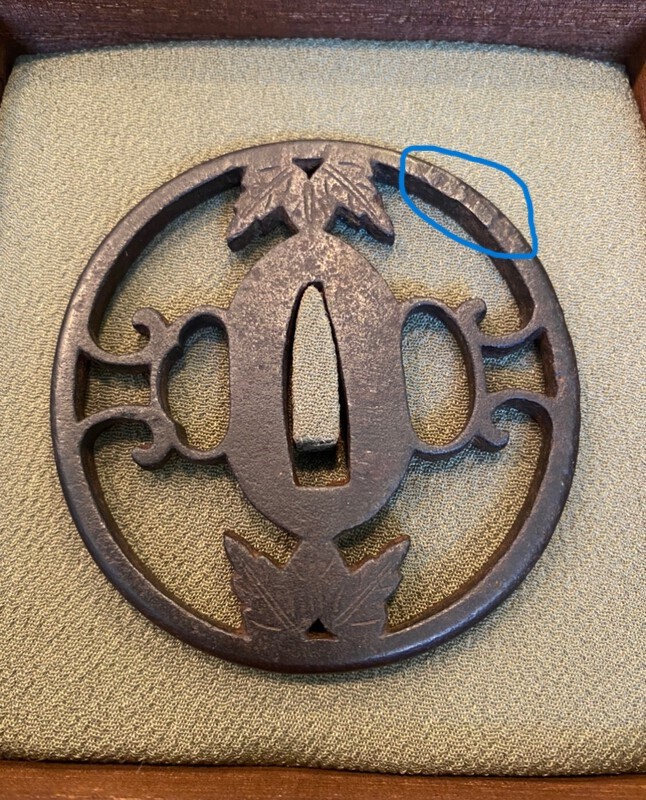
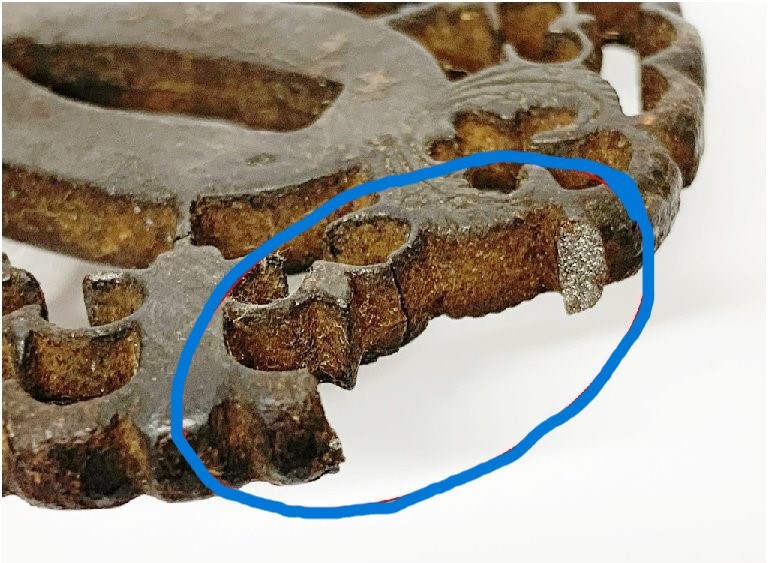
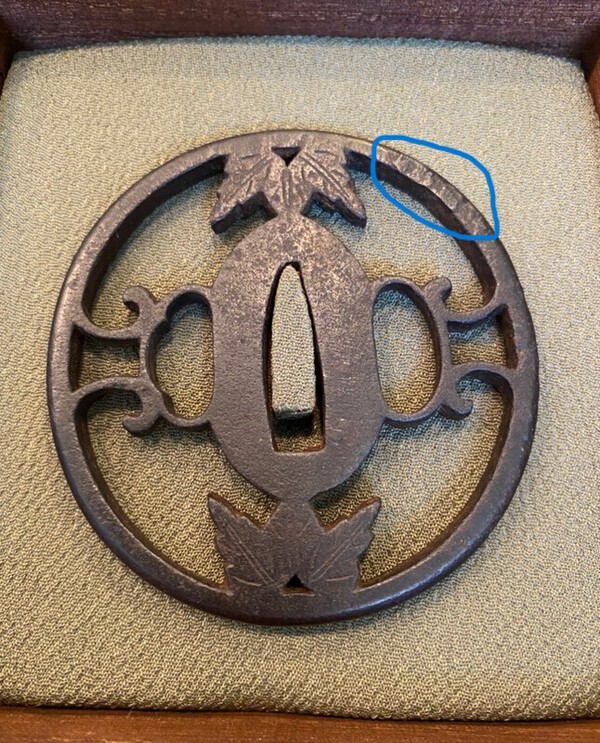
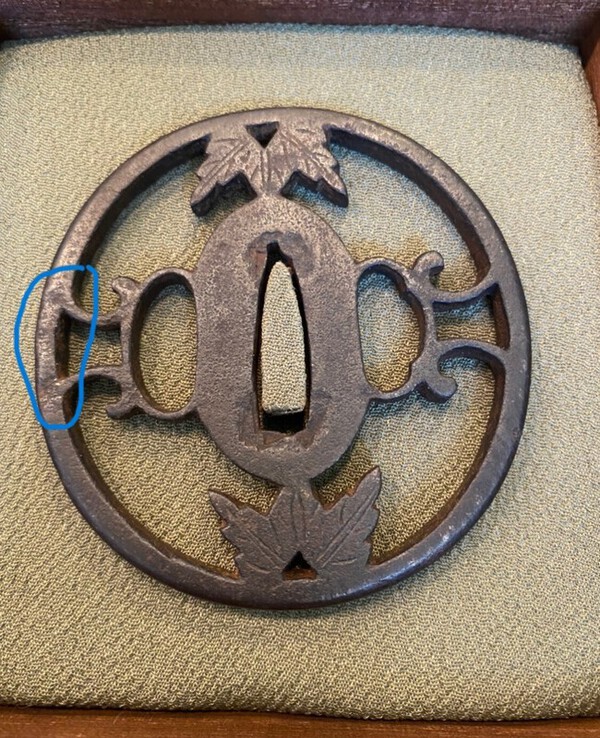
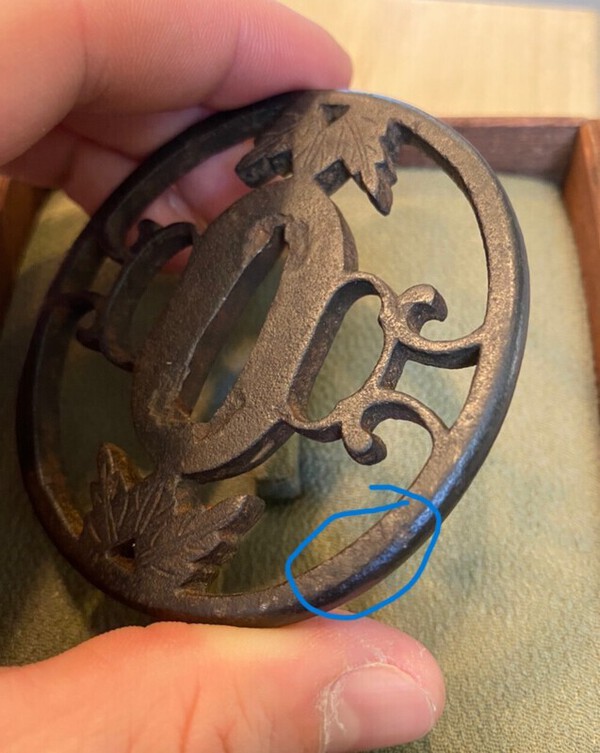
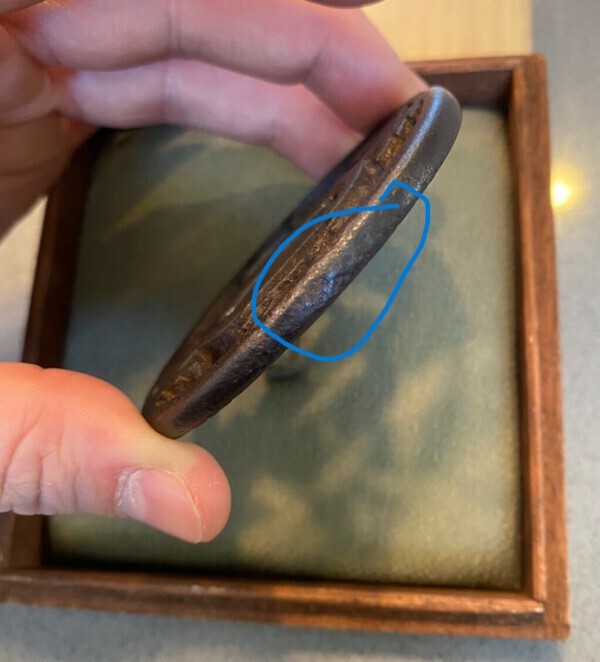
Hello Sam! Thanks for adding those pictures to the thread of your tsuba taken under the LED! I don’t know (and other opinions would be appreciated), but I think I see signs of casting. There appears to be a “casting seam” down the middle of one of the leaves (it was not fully filed down). There is also what appears to be a flaw on the bottom of one of the “swirls” attached to the hitsu-ana. Also, a “flaw” on the side of the seppa-dai that was probably something stuck somewhere in the mold? Anyway, I have included your picture with my interpretations of what I see circled. What are your thoughts about it? With respect, Dan

-
Thanks Stephen! What a great job you have done on cleaning that tsuba! I have included your pictures with a small area of concentrated rust circled on the tsuba shown on the left hand side (since it seems to me that-as in my pictures-the rust has “attacked” a large surface area of the tsuba). Bottom picture is the tsuba rusted, top picture is the tsuba after your great cleaning job (that must have taken some time and patience!). What I am trying to ascertain is how an area of rust (corrosion) looks after the tsuba is cleaned. I have read posts on this forum where I think a member may mistake what I deem as a “casting flaw” for what they think was an area of rust that was cleaned. Yes, it all comes back to cast iron tsuba and yes, I could be totally wrong about if it is a flaw or cleaned rust (that is what I am trying to figure out!). Anyway, I think this is an interesting endeavor and may give some insight into identifying hand forged or cast iron tsuba. It gives this retired old guy something to do! With respect, Dan

-
No one can make a determination unless it is subjected to non-invasive metallurgical testing.(as I have stated before in several threads). Otherwise it is just a "best guess" by those that think they know!! This is the 21st century! There has got to be an inexpensive way to test these things! But does any seller really want to do that? Imagine the "dollar bills" that would be lost to sellers if a tsuba listed as "hand forged" turns out to be "cast"! My opinion, but it is all about the "dollar bill"! Just my opinion, my friends! With respect, Dan
-
Hello all my friends! You all know I appreciate a “little controversy”; it is a great leaning experience! Actually, I have been thinking about this particular “rust” subject for a couple of years, but a post from another member on a current thread led me to this. It is about rust (corrosion) on iron (hand forged) tsuba. As I am only a “low end” collector of tsuba, I have purchased (over the years) several rusted tsuba. They are still much appreciated, have a good home, and I learn from them! I have attached several pictures of a few of my rusted tsuba. What has always interested me is that the rust seems to have attacked a large part of the surface of all the tsuba shown. Yes, sometimes the rust has “eaten” away at a particular area, but the rust (as I stated) seems to cover a large area (on both sides) of the tsuba. Does anyone have any pictures of were the rust on their tsuba has only “attacked” a very small area of the piece? I don’t have any tsuba that show that pattern of rust (corrosion). Thanks! With respect, Dan


-
Hello all! Just some stuff from some of my previous posts on another thread. Nov, 4th, 2023- “Could anyone actually differentiate between an extremely well-made cast iron tsuba and a well-made hand forged tsuba? As I have stated previously (several times in this thread) I feel the only way that a determination could be made is to subject the piece to non-invasive metallurgical testing (I refer you to Dr. Lissenden's thesis paper and quotes stated in one of my previous posts - to be found on page 12 of this thread - his entire thesis can be found on line). Until that can be done (or someone is willing to take a hammer to a possible cast iron tsuba!) I think that it would be extremely difficult to make an accurate determination.” January 28th, 2024- (this quote is referring to another tsuba, not the tsuba shown in the recent posts here) “Obviously that tsuba is made from cast iron. Whether cast in the Edo period or not is impossible to determine. Probably the only way to deterimie if it was actually cast would be to subject it to non-invasive metallurgical testing. I purchased a similar tsuba that was pictured on that water kettle a couple of weeks ago (pictures also attached). That tsuba has a mei. There are a plethora of these similar motif tsuba being sold on various purchase sites. How is it possible to determine a hand forged from a cast iron one of these? I know that a mei can be “faked”, the tsuba could have been made after the Edo period and a “fake” mei from the Edo period added to that tsuba. Or the tsuba could have been made in the Edo period with no mei, and a “fake” mei added later. Or the tsuba and the mei can reflect the actual maker of the tsuba in the Edo period. Without taking a hammer to the piece and seeing if it is brittle and breaks (cast iron), how does anyone determine such things? I even have discovered that if a tsuba like this is papered by the NBTHK, it still can be very misleading. I have found that the old green papers can be incorrect and themselves could have been forged! Are we all just “floundering” around when it comes to the more inexpensive type of iron tsuba and just must take our chances? Who is right in their determination if a tsuba is hand forged and not cast? Who is wrong? I mean can a description of a tsuba being listed by a reputable seller be wrong? I know, maybe I am just overthinking this thing. But how can tsuba collectors be certain of anything with so many variables that turn up and present themselves? I mean is it possible that knowledgeable people could be incorrect in their determination? I have even heard were the NBTHK could make mistakes!” With respect, Dan
-
Hello Sam! I am probably totally wrong and don't want to "rain on your parade" (I am certain other members will let me know!!). But this is what I see! Pictures attached. With respect, Dan
-
Whatever leaf! My opinion is that the tsuba is cast! It looks to have several casting flaws. Take a hammer to it and see if it breaks! Onward! With respect, Dan
-
Hello all! I was looking around the forum and found a thread from 2019. It is interesting and talks about cast iron tsuba. The title of the thread is "Tochibata cast tsuba". The link to the thread is listed below- https://www.militaria.co.za/nmb/topic/30579-tochibata-cast-tsuba/ I quote a part of the first post on that thread- “School as Tochibata, a group of blacksmiths who made farm implements and seemed to have made tsuba as a sideline.” Just some more interesting stuff! With respect, Dan
-
Hello Yves! I can only guess at an answer to your question. But I can only figure that some daisho fittings get lost or become separated from one another over time. I mean we could be talking about a couple of hundred years that the daisho swords and their fittings were worn by a samurai, things happen! With respect, Dan
-
Thanks for that insight, my friend, stating "suggesting that some tsuba of this type at least were cast". Oh no! Here we go again! Just kidding!! With respect, Dan
-
Is that "manhole cover" type tsuba hand forged or cast!! Ha, ha, ha, ha, etc. Just having some fun! With respect, Dan
-
Yes, overcleaned by someone. But who cares! The last time I said something like that I was "jumped on" by a lot of so called tsuba "experts"!. But don't get me started on the negativity that this forum can create! I think your tsuba are nice tsuba to add to a collection for a new collector. Hell, I would like to add them to my collection! Someone has to give this type of tsuba a good home!!! Learn from them and appreciate them!! With respect, Dan
-
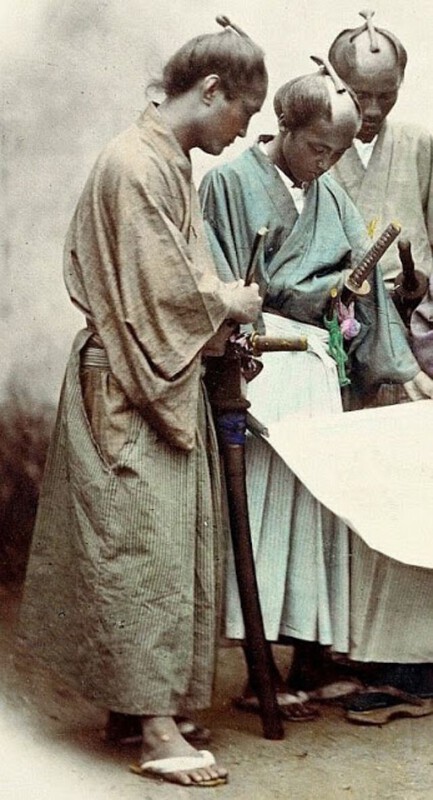
Thanks Thomas! You are correct. I zoomed in on the picture, and what is on top of the samurai’s head is perfectly tied hair! Also, thanks to Spartancrest for your post. I quote part of it here “Kanzashi came into wider use during the Edo period, when hairstyles became larger and more complicated, using a larger number of ornaments. Artisans began to produce more finely crafted products, including some hair ornaments that could be used as defensive weapons.” The picture you included in your post may just be how the kogai could have been used to hold the hair (with the added feature of a possible defensive weapon and an “ear scoop” on one end!!) ? The adventure continues! With respect, Dan
-
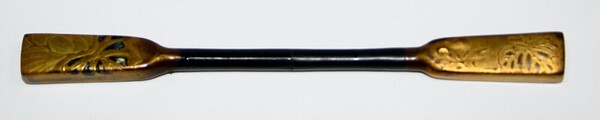
Thanks Thomas! Your post makes a lot of sense. Although the samurai on the left of the photo in my previous post seems to have his hair tied, the two other samurai on the right of the picture seem to have something on top of their head. I have included a picture of what I think that object is. It is also called a kogai (picture included below), although not the metal kogai that is also referred to as an "ear cleaning" (or whatever) tool and is shown in my above post. So, was the metal kogai an ear cleaning tool? Was it a hair arrangement tool? Was it used to thrust through the ear of a defeated opponent? Was it used as some sort of dull surgical tool to extract an embedded arrow? Was it used for eating food? Or did it have all these uses or some other unknown use? Who knows? Just some more interesting stuff! With respect, Dan
-
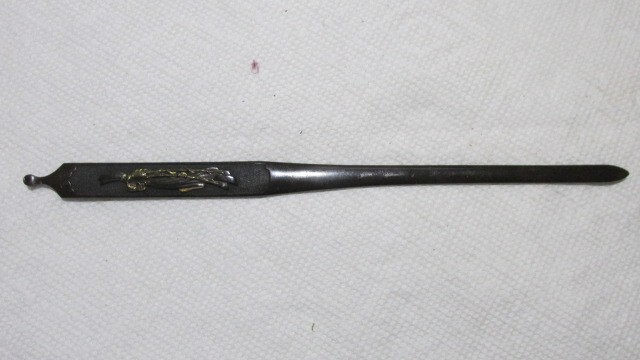
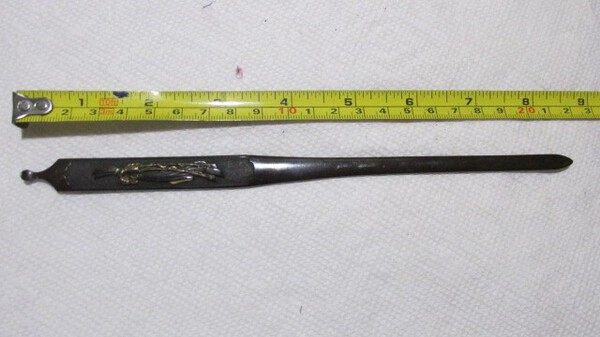
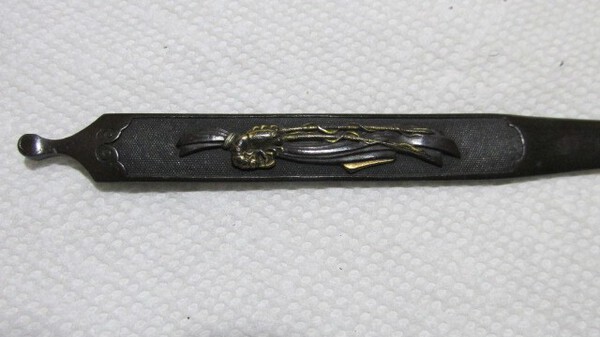
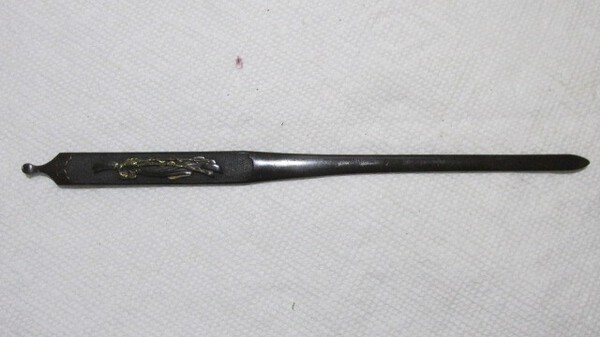
Hello all, So, I was finally able to afford and buy a kogai (pictures attached). Let’s talk about ear cleaning.! I put the “scoop” end in my ear. Yes, it probably could help in cleaning out an ear, but my pinkie finger goes further in my ear than the “scoop” end of the kogai! So why use the “scoop”? How about a hair arrangement implement. I don’t think so. It appears to be on the heavy side to be used for that function (it would fall out of the hair), and it is not like any Japanese kogai hair arrangement tool that I have seen on the websites (picture attached with samurai with kogai in their hair). So, what was it used for? I have seen pictures on this forum on the below thread- https://www.militaria.co.za/nmb/topic/25292-usability-of-kogai/ of Japanese woodblock prints showing subjects using the “long end” of the kogai in ear cleaning. But one “slip” in the cleaning process and the ear drum is damaged or ruptured! How about a dull surgical type tool? Maybe something that can be used to remove an arrow from the subject without cutting the area of the body with a sharp kogatana?? Is that a possibility? I just think that there was more to the kogai’s use than just maybe ear cleaning and possible hair grooming! With respect, Dan
-
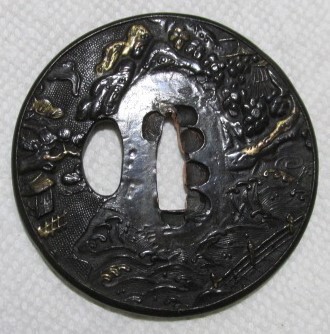
Another one of my sanmai tsuba. Bridge, water, and mountain scene. Onward! With respect, Dan

-
I just received this (what I consider). a beautiful sanmai tsuba! Purchased from Japan for $63.00 U.S. (which included shipping!). It makes a great addition to the collection! Just wanted to share! Show me yours, and let's have some fun! With respect, Dan