Dan tsuba
Gold Tier-
Posts
840 -
Joined
Content Type
Profiles
Forums
Events
Store
Downloads
Gallery
Everything posted by Dan tsuba
-
I just watched a video (what I consider super great!) about tsuba at the N.Y. Metropolitan Museum of Art. They show (and explain about) some beautiful tsuba! The enthusiasm shown by the two people that are in that video is infectious! Thanks, Brian, for posting that video! The video can be found here- https://www.militaria.co.za/nmb/topic/54438-nice-video-on-tsuba-from-the-ny-met-adam-savage/
-
My friend John C. Making a catalog of our tsuba collection for our heirs is a great thing to do and maybe it will let them realize that we had a great, interesting, and educational hobby. Or maybe they won’t care and just want to sell what we collected! Anyway, it won’t be my problem! But I will say that when I published my small books, Amazon KDP was great! I watched some YouTube videos about it. And even as computer illiterate as I am (with my one brain cell!) I figured it out! Amazon KDP doesn’t cost a thing! You only pay (and it is not very much) when you order your proof copy. I really enjoy that you can always edit and add new things to your book without much of a hassle. Onward my friend, to me taking pictures of my tsuba collection!
-
Thanks my friends for your kind words and support about cataloging my tsuba. So, here is something I was just thinking about (with my one brain cell!). I have self-published two small books using Amazon KDP. Not to sell them or make money, but just to have my research written down in a book type format. Yes, I am old school and prefer reading a book to reading a computer screen. Also, if my computer stops working or I lose my thumb drive, I still have something written down that anyone can access. Now what is cool about Amazon KDP is you can order proof copies to check out your work, and you can always edit or add to your work at any time. Also, Amazon KDP is a print-on-demand system. No minimum number of copies have to be ordered. Once someone orders a book, it is printed at the nearest Amazon KDP facility and sent out. So no major expense has to be invested by me in my catalog of tsuba idea. So, I think I will digitally photograph my collection and describe the tsuba or maybe just show pictures and the price that I think the tsuba are worth, so my heirs will have some clue as to what to sell them for. Then I will send a copy of the book to all my kids (not really kids any more at 43, 49, and 51 - but middle-aged adults!). Then when I pass, they will be coming over to the house with a copy of my book to pick out the tsuba that they want! Maybe they will keep some or sell some (or all!). Hey, but that won’t be up to me anymore!! I think this tsuba catalog book thing is a good idea!
-
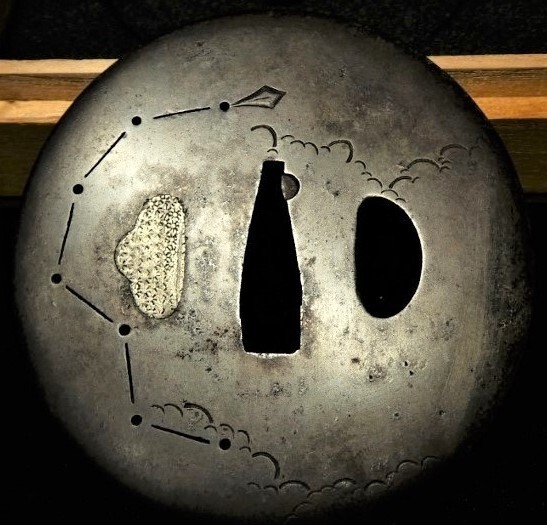
Thanks Mauro, I may have finally found out how to use Google translate (yes, you can teach an old dog new tricks!). So here is your translation shown above- 鐔 寒山拾得図 * tsuba Kanzan Jittoku zu 朧銀銅广地丸形 * oborogin migaki-ji maru-gata 耳打返高彫 * mimi uchikaeshi takabori 金銀色絵象嵌 * kin gin iroe zōgan 銘定常金象嵌 * mei Sadatsune kin-zōgan 昭和甲辰年春吉日 * Shōwa kinoe-tatsu-nen haru kichijitsu [1964, spring, an auspicious day] 寒山誌 * Kanzan shirusu Then Google translates that as shown below- Tsuba (sword guard): Kanzan and Jittoku design Oborogin (frosted silver) and copper ground, round shape Raised relief carving with turned-back edges Gold and silver inlay Signed: Sadatsune (with gold inlay) Shōwa Kinoe-Tatsu year, spring, an auspicious day [1964, spring] Recorded by Kanzan
-
My good friends, I know that we have been through some major conflicts on some other of my threads on this forum (oh let’s think, like my "Tsuba casting molds?" thread!). But when the end is in sight (come on God give me at least 10 to 15 years!), everything doesn’t matter anymore. Maybe a little too much philosophy! Oh well! This is a great forum. And I will continue to put forward my thoughts on subjects, no matter what kind of backlash I get. Hey, that is just me! Starting tomorrow, I will start taking digital pictures of my collection to start cataloging them! Onward and with respect!
-
I would like to ask the opinion of members on this subject If I have more than a decade left to live, I will consider myself lucky. Hopefully, I am lucky! Should I try to make a catalog of my meager (about) 200 tsuba collection? As many members know, I collect what many would consider low end tsuba. Is it worth my time to try to catalog my tsuba? I mean who knows, after I pass, they will probably end up in a Goodwill or Salvation Army store because my heirs really have no knowledge about tsuba and won’t care about my collection. Just asking for opinions. e
-
Hello Mauro, Thanks for the hakogaki pictures and your statement of “The hakogaki is well written and states some perfectly legitimate assumptions about the tsuba. Unfortunately (or rather, thank God), it is not by the Satō Kanzan. Below are others hakogaki, likely written by the same “pseudo-Kanzan,” concerning modern tsuba.” Unfortunately (as much as I have tried!) I can’t read Japanese. Why is everything written about tsuba in Japan always written in Japanese? Ha, ha, ha, ha, etc! Just having a bit of fun! Anyway, I don’t know enough about computer translation to translate the hakogaki. If someone out there can translate them, I think that would be of interest to many members that read this thread. Thanks!
-
I have always thought that Dr. Lissenden’s thesis on namban tsuba was ahead of its time. As most new subjects written by forward thinking academia individuals usually are. It is a great read, and I refer to it often in my own research.
-
I can see what everyone is saying about the tsuba shown being modern (not Edo period or before). What do you call tsuba like this? Replicas, forgeries, or fakes? Unfortunately, I feel bad for the collector (or anybody else) that purchases one of these thinking that the tsuba is an original authentic Edo period tsuba. I mean to get ripped off for about $2500 dollars (or more) is not a fun thing. My motto, if I don’t spend a lot I can’t get ripped off for a lot (but that’s just me!).
-
In appreciation of John P. Lissenden. Dr. Lissenden (who received his PhD before submitting his master’s thesis on another subject and area of study) was a member of this great forum. Unfortunately for the tsuba world, he passed on several years ago. Dr. Lissenden wrote a master’s thesis on namban type tsuba. In some of my posts on other threads, I have referred members of this forum to his excellent paper. If anyone wishes to gain further knowledge on namban type tsuba, I highly recommend his thesis. It was written in 2002 and (in my opinion) is a masterpiece! Dr. Lissenden’s paper can be found on this website- https://etheses.dur.ac.uk/4129/1/4129_1648.pdf Just something I wanted to pass on to newer members of this forum.
-
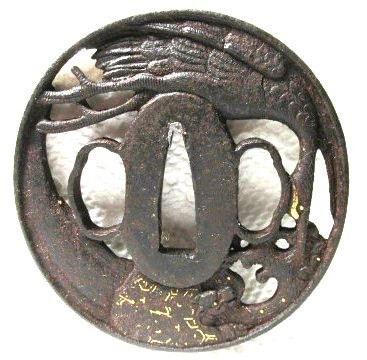
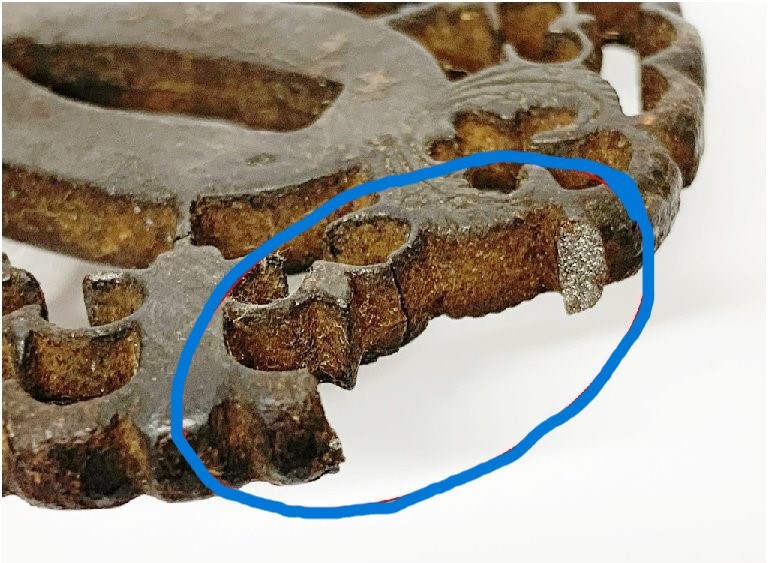
So, here is my latest acquisition from Ebay. $117 dollars with shipping within the U.S. (I don’t want to pay the tariffs from Japan!). I have always liked the sea cucumber motif. Anyway, I don’t think it was too shabby of a deal. I got to looking at the tsuba and I noticed something in the nakago-ana and the hitsu-ana. Has the metal of this tsuba been folded over? Included pictures below are of the tsuba. Then the close-up pictures (taken by my digital microscope) are views of the nakago-ana and hitsu-ana. Those close up digital pictures at the bottom of this post showing the paper clips have to be clicked on and downloaded (and I think you have to be signed into the forum to see them-I don't know why?), yes I am computer illiterate (but at 75 years old, I have an excuse!). If this tsuba has been folded, it is the first tsuba that I have that shows that. I would appreciate the opinions of other tsuba collectors, since my knowledge of tsuba is extremely limited! Thanks! 20251212145717501.tif 0002.bmp 0003.bmp
-
Again, comparing collectible Colt revolvers to collectible tsuba (yes, I really like Colt revolvers!). The amount of craftsmanship on some museum quality tsuba is superb and breathtaking. They are beautiful and a testament to the artistic capabilities of their makers. I love looking at pictures of them. Why? Because I could never afford them! So, I must appreciate them from afar! Just like Colt revolvers! The first picture shown below is of a superbly crafted and artistic model 1851 Colt. The next picture shown is of a model 1851 Colt that I could afford! Although both revolvers perform the same functionality. Just like highly artistic tsuba compared to more plain looking tsuba. I guess if I ever win the lottery, I will upgrade my collection of tsuba!
-
Collecting tsuba is a very interesting and educational hobby. Each collector has his own reasons for collecting his specific type of tsuba. Some collectors seem to collect tsuba that are expensive museum quality type tsuba (and those types of tsuba have been shown recently on this forum). Which is great for them, and if I wanted to I could afford to purchase a museum quality type tsuba. Now whether those museum quality type tsuba were ever mounted on a blade or used for other than royal court appearances is unknown. Remember that probably many samurai had more than one tsuba for each of their blades. Maybe one for royal court appearances, maybe one for daily wear, and maybe one for battles. I, on the other hand, prefer to collect tsuba that show their age and have probably actually been mounted on a blade and carried on a daily basis. It is similar to a collector of 1873 model Colt revolvers. In the first picture shown below is a presentation 1873 model Colt. It has probably never been fired or carried in a holster. The selling price was started at $50,000 dollars. The second picture is an 1873 model colt. It shows signs of use and wear and was more than likely put in a holster for daily carry. The selling price was about $3,500 dollars. Collecting tsuba (for some) may be all about purchasing the most expensive tsuba that they can afford (maybe museum quality tsuba that may have never been mounted or carried for very long on a blade). But to some, it may be that they collect tusba (that are not museum quality pieces and are not super expensive) because those tsuba they collect were probably actually used and carried on a daily basis and thus are a link (both real and maybe spiritual) to the daily lives of the wearer and user of the piece. Just my opinion.
-
Off topic here, but this (once again) is getting personal because of some members frustrations with this thread. Rokujuro (Jean), Just because you are frustrated with what I am presenting on this thread (and for the most part you site no resources or references or show pictures to back up your stated opinions and statements in your posts) there is no reason to resort to name calling. I can only guess that you were referring to me when in your last post you stated, “Don’t feed the trolls!”
-
Hello again! I came across an interesting thread on this forum from 2023. https://www.militaria.co.za/nmb/topic/45170-mass-produced-tsuba/ It talks about mass produced tsuba, a few posts talk about cast iron tsuba and if those tsuba could have been made in the Edo period. Anyway, just some more interesting stuff!
-
Curran, A great post! You stated that “with each school and each maker, there are _SOFT_ rules about size, shape, finish, and %_percentage of seppa dai vs total volume displacement of the tsuba.” Also was stated “At least amongst the Higo schools, certain schools and certain generation had specific rules.” I am very interested in what you stated. Can you provide pictures or references that I can refer to about these rules? Thanks!
-
Hi Arnaud (OceanoNox). Great research on finding that Edo period publication! You stated that it has to do with making tsuba out of recycling old farming tools, and I did notice some pictures of tsuba in that publication. So, I figure you must have translated some of it. I appreciate you advising me how to translate the rest of it. However, I don’t have the technological tools or know how to translate it. Maybe someone on the forum can translate those pages with tsuba shown on it and post it? That would be very helpful! As an addendum to this post. I inquired on the internet “how many millions of Japanese edo period texts are awaiting to be translated into English”. This is what the internet stated- “There is no exact number, but there are certainly many thousands, and likely millions, of Edo period texts awaiting translation into English, though a comprehensive figure is not available. A vast amount of information from this fertile period of literature and art exists in handwritten and printed formats, and a significant portion of it has not yet been translated or studied in depth by English-speaking scholars. Factors contributing to the large volume of untranslated texts: Vast quantity of materials: The Edo period (1603–1867) was a time of significant population growth and increased literacy, leading to the creation of an enormous number of books, manuscripts, and other written materials. Variety of genres: Texts span numerous genres, including literature, history, philosophy, art, poetry, and practical guides, each requiring specialized translation skills. Complex language and script: Edo-era Japanese was written in a complex script using Chinese characters (kanji) and Japanese phonetic scripts (kana) that differs from modern Japanese, making translation a specialized and labor-intensive task. Limited resources for translation: The number of translators with the specific linguistic and historical knowledge needed to translate these texts is limited. Incomplete cataloging: While there are collections, many texts are not fully cataloged, making it difficult to even identify the full scope of what exists and needs translating.” Also, found this on the internet “Keeping Knowledge Secret in Edo Period Japan (1600-1868) found at this website- https://www.jstor.org/stable/48647105?seq=1 So. maybe there was stuff written about the making of cast iron tsuba in the Edo period that has not come to light yet or was kept secret? Who knows? Just some more interesting stuff.
-
Hi Brian, Kind of off topic here. So, in your last post you seem to be referring to instruction manuals written in the Edo period that tells and describes how to make an iron tsuba. In part of your post (which was referering to cast iron tsuba) you stated- “Clearly the Japanese were very embarrassed about doing it. Because they managed to hide all the old writings on it, pattern books, instruction manuals, pretty much all the documentation that they did routinely for all the other methods.” I would very much be interested to see those Edo period instruction manuals that describe and state, step by step, how to make a hand forged iron tsuba (hopefully they have been translated into English!) since as you stated- "pretty much all the documentation that they did routinely for all the other methods.” Could you please post some links or references so I can check them out? Thanks!
-
Well, my friends there you have it! If a tsuba was made from cast iron in the Edo period (and cast iron has a high carbon content) and then decarburized (to lower its carbon content) and in doing so make it more malleable for addition of motif or design, could that ever be determined or detected? Maybe even with non-invasive metallurgical testing, could that testing discern if it was first cast and then decarburized? Where is a university degreed metallurgical expert when you need one? Like I said before, maybe this thread needs to be locked? In my opinion nobody really knows anything, and everybody is just guessing. Only a few courageous members are willing to take a stand that cast iron tsuba were made in the Edo period. Just my opinion.
-
Well, I found an interesting comment to the Marcus Sesko article (which is a great article) about the Nara find of casting molds. That discovery initially started me on my journey on this thread about cast iron tsuba. I was referred to the Sesko article by a post on this thread dated 1/27/2022. I haven’t revisited that article until about an hour ago! What I found was a comment (written by another individual) added at the bottom of that article on 10/12/2022. The article by Sesko can be found here- https://markussesko.com/2016/01/20/cast-sword-fittings/ Here is what part of that comment stated- “I have long maintained that many sukashi tsuba were originally cast and then converted to malleable iron by carburisation – in effect by heating in firescale. We know this process is used for kettles, allowing the surface to be chiselled and otherwise worked. The commonly advocated method of their production, being cut out of a plate by sawing, would demand the existance of sawblades capable of intricate cuts, similar to modern piercing saw blades. By casting and then carburising, the basic form of the tsuba would then only need refning using files or even more likely scrapers.” Just some more interesting stuff!
-
Hey Kai, Welcome to this great forum! I like your tsuba even though it appears to have been overcleaned. I agree with Spartancrest that your tsuba was mounted at least twice. Also, another nice thing about your tsuba is that the kogai hitsu ana (one of the holes in the tsuba) has been filled. Which to me shows a kind of customization of the tsuba. I usually don't pay over $150 for a tsuba. I think you paid a fair price for yours.
-
My opinion here, but I liked the old ranking system better. How are the ranks derived at anyway? The number of threads one starts? The number of likes one gets? The number of posts one has? Maybe ranking should be given to an individual by the number of members that view a thread started by that individual and find that thread of interest? I mean, anyone can post something and get a number of likes (or not). But holding the interest of members on a thread over a period of time is something totally different all together, especially on a controversial type thread (let me think, who am I referreing to?) Just my opinion.
-
When the Dr. told me I had a cataract, I said no. I don't have a Cadillac, I have a Dodge! Of course, I went out and got hearing aids after that! Ha, ha, ha, etc. Again, way off topic here but I had to put my 2 cents in!
-
Jean. Once again, you just don't get it do you. You stated "Compare with real TSUBA!" Martin stated "Is it really Meiji era tsuba or otherwise? I mean it looks really nice so even if it was contemporary i would probably get it. It is priced around 40 Euros." Why can't you just support Martin in what he finds interesting to him? He already has stated that he thinks it may be Meiji. Real tsuba or otherwise, if he likes it, that what is important. Why do you always have to put someone down with your "Compare with real TSUBA". By capitilizing "TSUBA" what are you trying to say? Are you a "TSUBA" snob?
-
Martin, I like the tsuba! It is well done and maybe it is not cast, but machine cut. It is nicely painted and shows great detail (my opinion). I don't know! Maybe it was made in the last century? But it doesn't appear to have been mounted on a blade. But if you like it, that is the important thing! Onward!