

Dan tsuba
-
Posts
947 -
Joined
Content Type
Profiles
Forums
Events
Store
Downloads
Gallery
Everything posted by Dan tsuba
-
Hi Florian, Thanks for your ideas and suggestions in your post (although backing up your statements with pictures and/or references would have been desirable). Yes, I know and have stated in a previous post in this threat showing the old Japanese star chart that the number of stars is not identical to the tsuba and I also stated something like that there are a lot of stars out there to add to any constellation. Now, as far as I am concerned, (especially in the pattern of that constellation) the match is close enough. I also now think that the constellation shown on the star map tsuba is the Little Dipper. If you refer to the caption under the star chart (in that previous post of mine), you will see where it is stated that the stars shown in the circle are centered on the North Pole. That is exactly the location of the Little Dipper, and it is the constellation that I circled in blue on that star chart. I don’t think all of this is a coincidence. Then you stated, “While the sun and especially the moon are ubiquitous in Japanese art, poetry etc. the stars are as far as possible ignored.” Well, I found on this thread below a quote from you that I quote part of below; “In Your case the motif is stars, so I think we have a kamon constisting out of a stellar group and three other stars on the right side.” Then you can go to this website below- https://irohakamon.com/kamon/hoshi/juuboshi.html Scroll down somewhat until you see all the kamon with stars. So, as you stated, “the stars are as far as possible ignored”. Well, I don’t think so! And I believe that some tsuba artisans made some tsuba to depict star maps (constellations). Onward, the "puzzlemaster" (referring to what Sam S. referred to me as in one of his posts on this thread!).
-
Florian, In your post at the top of this page (page 3) you stated "With all due respect – I can see no sense in harping on Your theory without solid evidence." Well, if you refer to my post above showing an old Japanese star chart with a constellation almost identical (or exactly identiclal-depending on how you interpret it) compared to a star map tsuba (that I also showed a picture of) what more solid evidence do you need? Let me know, and I will see if I can find the evidence that will convince you.
-
Colin- Well stated and I agree! Hey another good statement of yours that I may quote later on. Well done!
-
Hi Colin! I really like and have quoted (in more than one post on this thread) a part of your post from page 1- "Warning……rabbit hole approaching!….or maybe a black hole? Engage maximum reverse warp." As on some other forums I belong to (for some of my other hobbies), some people don't know really that much about the subject in the thread and they try to derail or divert the thread to another subject. They failed to "Engage maximum reverse warp"! Ha, ha, ha, ha, ha, etc!
-
"Random strands of DNA…(?)". Ha, ha, ha, ha, Piers! Nope, I don't think so!
-
First off, thanks Baka Gaijin (Malcolm ) for that link to some great information about the history that the stars played in ancient China and Japan. Now to Scogg (Sam), Thanks for that great compliment of “puzzlemaster”. I really like that! At least I have a Zen mind, beginner’s mind. In other words, you can only add tea to a teacup that is not already full. Just like you can only add new information to a mind that is not already full. Anyway this “puzzlemaster” is at it again! I think I found a Japanese constellation that is fairly close in comparison to a constellation at the top of a star map type tsuba. I have included a picture of that old star chart map with its caption. Then I included a close-up picture of a constellation (circled in blue) that I located on that map, and it is a pretty close match to a constellation shown on a tsuba. Then again, I have included a picture of a star map type tsuba that I think has that very close match to the constellation shown on the map (the constellation at the top of the tsuba). Yes, I think the tsuba constellation may show one more star than the map. But hey, there are a lot of stars up there to add to any constellation! Onward (from the puzzlemaster !).


-
Hi Piers, Nice Netsuke. So do you think that these holes filled in with a gold colored metal can also be stars?


-
Mauro, You are a funny guy. But I would appreciate it if you would state your opinons regarding what has been stated on this thread instead of throwing vague statements out there. Communication is key. You seem to have thrown away the key!
-
Hi Sam, Like I stated before in part of a quote from Colin “Warning……rabbit hole approaching!….or maybe a black hole? Engage maximum reverse warp.” You stated in your post “No organization is infallible. But when weighing who's more likely to be correct, I'm inclined to trust the NBTHK over you. And your argument to support your claim just isn't convincing to me. No offense intended. If you're asserting that the NBTHK is wrong, are you saying that you have information or expertise that they do not? If so, then that's the evidence I'd be interested in seeing. Until then, I think it's more likely that the NBTHK's interpretation is the correct one. The similarity between shapes just isn't enough to erase their observations and experience, in my opinion.” First off, as far as my argument to support my claim. Evidently, some people on this thread are convinced. Evidently, you are not one of them. As far as “evidence I’d be interested in seeing” again, that has been presented in this thread. Then you stated, “The similarity between shapes just isn’t enough to erase their observations and experience, in my opinion”. Well, do you know if the NBTHK has a person on it whose hobby is astronomy? Then in a previous post you stated “that this incomplete yet precise geometric grid was intentionally meant to represent stars.” Maybe that was a part of the art on the tsuba “that this incomplete, yet precise geometric grid was intentionally meant to represent stars.” Maybe that was part of the artisan's intention. I mean how many times have I read various threads on this forum (can’t remember which threads-hey I am old!) that stated something like tsuba artisan’s used various deliberate methods to depict various objects. Like I stated before, the tsuba I call star maps are not intended to be astronomically correct in showing the distance between the stars. The artesian only intended to show the pattern (constellations) the stars made when interconnected.
-
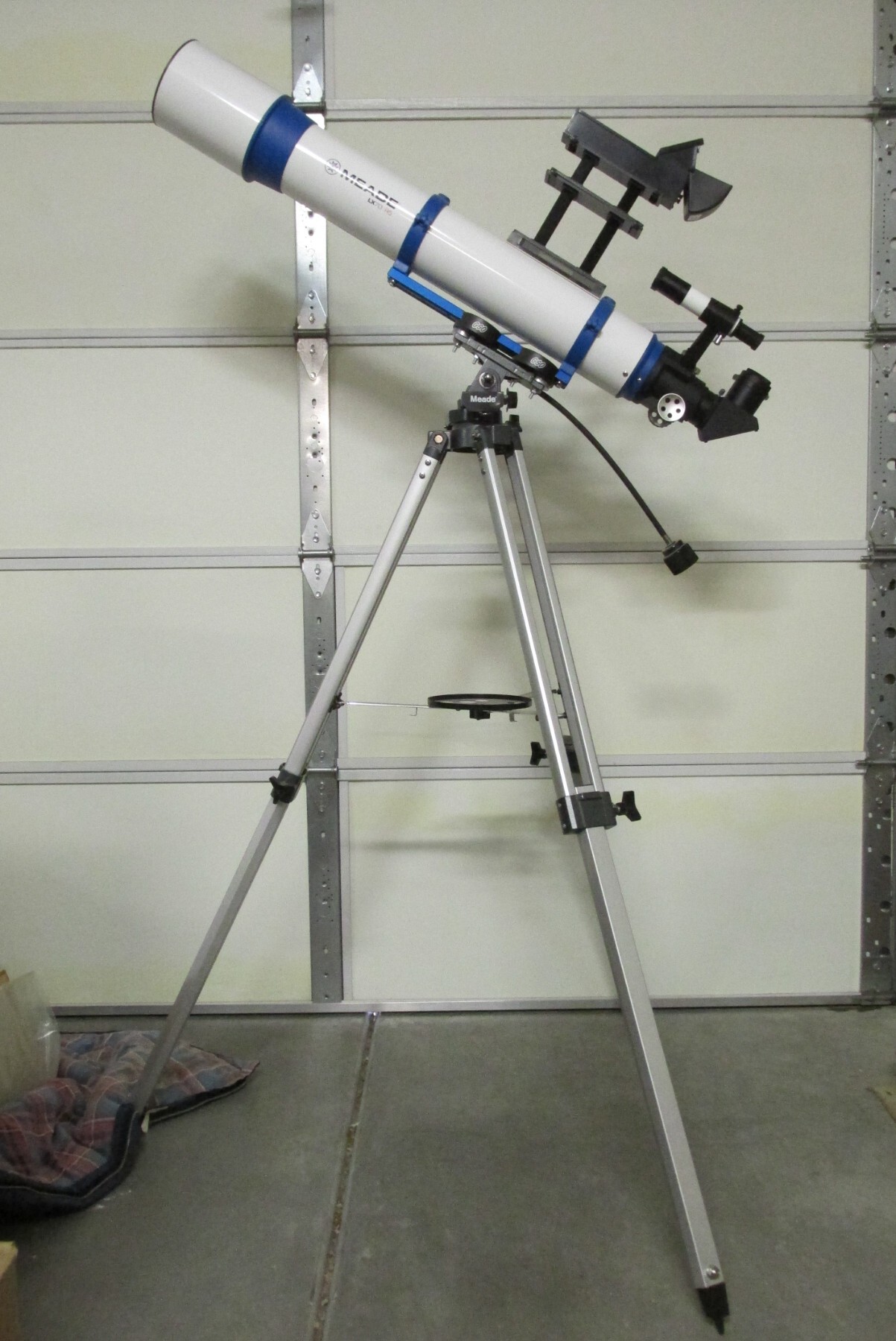
Hi Sam! I really like your well written posts! You explain yourself very well, and I get what you are saying. Thank you! But in rebuttal, you stated "That distinction is also supported by the NBTHK attribution accompanying those examples." Well, I don't know. Is it possible that the NBTHK could be incorrect? You also stated "or look up at the sky itself." You probably missed my previous posts where I stated that about 25 years ago astronomy was my main hobby, with my 5 telescopes. I have included a picture below (shown previously on this thread) of my main 120mm lens refractor telescope (that I haven't used in about 20 years). So, yes. I have looked up at the sky itself! And I may know a little bit about what I am talking about!

-
Hi Sam, Well, I think in my previous post I summed up clearly my opinion on what I call star map tsuba and supported it with a picture of (what I consider) a star map tsuba, a reference, and several pictures of a constellation. Now, you stated your opinion in your very well-written post. But I don’t see that you placed any references or pictures to support what you stated. As far as you continuing your subject in your post, I would suggest a part of a quote from Colin from a previous post of his on this thread- “Warning……rabbit hole approaching!….or maybe a black hole? Engage maximum reverse warp.” Hey, just my opinion.
-
Hello all! So, let’s take a look at the tsuba that I call star maps. It is obvious (to me) that the tsuba craftsmen were not trying to make an astronomically correct interpterion of the distance between the stars. I believe what the artisans wanted to show was the general pattern that the stars made when they were interconnected. As an example, let’s take the constellation Cassiopeia with its easily identifiable “W” shape. Below I have shown a tsuba with the constellation Cassiopeia on the bottom of the tsuba. Then I have shown a star chart and pictures of the Cassiopeia constellation taken from this website- https://en.wikipedia.org/wiki/Cassiopeia_(constellation) Now, adding some minor stars or NGC (nebula or clusters) to the “W” of Cassiopeia (as I believe the Japanese did – unlike the Greeks) you get the general pattern of the “W” of Cassiopeia shown on the tsuba below. Personally, I don't think that is a coincidence.

_(cassiopeia-ann).tiff-Copy.thumb.jpg.a23671c66d72ba214fd469aeae907669.jpg)


-
Hi Sam! I see what you are saying. But remember, the area on a tsuba is limited to make a motif. I think the main idea in these constellation type tsuba is to show the pattern that the stars make. Those patterns of stars are easily recognizable to those of us that were, at one time, in the hobby of astronomy. As far as the minor stars that the Japanese used to add to their pattern of constellations (which the Greeks didn't use) I would have to refer to my very accurate and specific star charts that I used about 25 years ago. Unfortunately, those books of star charts are not here with me in Wyoming. They are in my other place in Arizona. Onward!
-
So, what constellations do I think are shown above in the tsuba that I purchased? Now, obviously, the Japanese added 1 or 2 (or more?) minor stars to some of their constellations which the Greeks didn’t do. And they also didn’t necessarily connect the star patterns together as the Greeks did to form their constellations. But the general layout of the stars (constellations) no matter how you connect those stars together, is nonetheless unmistakable. The constellation (in its orientation shown on the tsuba) at the top of the tsuba is the Little Dipper (Ursa Minor). The constellation (actually a star cluster) shown at the bottom of the tsuba is the Pleiades. My opinion, and I could be incorrect. But they are definitely constellations.
-
My recent purchase-

-
Mauro, In a previous post on this thread you stated “I don't think this type of pattern has anything to do with stars,...”. But you think the picture of the kozuka-ana shown by Nicolas is “Possibly the representation of a bat (flying in the night sky)”. I agree with Nicolas, and I can see the type of hat in the kozuka-ana that he is referring to.
-
Well, Nicolas; As I see it, the stars (small holes) are not the important thing on the tsuba. The slots interconnecting those holes that show a pattern (a constellation) that the small holes (stars) make is the important motif design on the tsuba. But that is just my opinion.
-
I don’t know. So, next time a tsuba with holes and slots (which I am certain those holes and slots depict constellations and not incomplete Shippo type patterns) gets sent in for shinsa what will the experts say? Will they say (and I quote from Piers post referring to a post from Mauro that showed (in my opinion) a constellation type tsuba that went through shinsa- “Shippō Mon (Chirashi) Sukashi Tsuba 七宝文散透鐔 (Scattered) Shippō pattern perforations” Or will the shinsa panel maybe now recognize that those holes and slots may represent something else? I mean just some more interesting stuff to present as food for thought!
-
Well just some more interesting stuff. So perhaps concerning the orientation of the holes and slots depicting constellations on tsuba, the orientation of the motif may have something to do with the time of year that the craftsman that made the tsuba was looking at the constellation. As an example of this, I asked the question from AI on the internet - what does the big dipper appear like over Japan. The response is in quotes below- "Over Japan, the Big Dipper appears as a prominent northern asterism, easily identifiable by its ladle shape of seven bright stars. Known culturally as Hokutō Shichisei (Northern Dipper), its position and orientation in the night sky shift depending on the season and time of night. Because Japan lies between latitudes 24°N and 45°N, the Big Dipper behaves like a giant wheel turning counterclockwise around the North Star (Polaris). Its appearance changes throughout the year: Spring: The Dipper is high in the northeastern to overhead sky at dusk, appearing upright with the handle curving downward from right to left. Summer: It shines high in the western or northwestern sky after sunset, appearing to tip or stand on the edge of its bowl. Autumn: The asterism dips closer to the northern horizon and appears upside down, sometimes resting flat on the bottom of its bowl. Winter: It appears low in the northern to northeastern sky, beginning to sweep back upward in a nearly vertical position. Because of Japan's relatively southern location compared to regions like Scandinavia, the lowest parts of the handle may dip very close to the northern horizon during the fall, but it remains visible year-round. Historically, the stars have played a major role in Japanese folklore, Shintoism, and Buddhism, where the asterism is often associated with the god Amenominakanushi or the Bodhisattva Marici."
-
Something I used a long, long, time ago to see a galaxy far, far, away! Star Wars! Ha, ha, ha, ha, etc! But, you can see the Big Dipper, the Little Dipper, Cassiopeia, the Pleiades (and all the other constellations) with the naked eye! I am certain that the supposedly shippo pattern tsuba with the holes and slots (as shown in previous posts above) are star maps showing constellations.

-
So, in response to Sam's post above- Yes, I am sure that the constellations had different names in the Edo period of Japan and some of their constellation patterns of stars was different than the Greek constellations. But, there are just some star patterns that can’t be mistaken (or misinterpreted) no matter what their name (and like I stated in another post on this thread-25 years ago astronomy was my main hobby with my 5 telescopes!). I asked AI the following question- “cassiopeia constellation in edo Japan” The answer is below- “In Edo-period Japan (1603–1868), the northern constellation Cassiopeia was primarily interpreted through the lens of imported Chinese astronomy and Myōken worship (the deified Pole Star). Because of its distinct zig-zag shape, it also became a localized cultural symbol in arts and landscape design. The Celestial Context in Edo Japan Sino-Japanese Star Maps: The Japanese adopted the Chinese system of asterisms. In these historical charts, the stars of Cassiopeia were incorporated into larger celestial walls and palaces, such as the Huagai (The Canopy) and Gedao (The Flying Road across the River). [1, 2] Myōken Faith: To many samurai and commoners, the northern circumpolar skies held deep religious meaning. Myōken (the deified North Star/Big Dipper) was a revered figure. Because Cassiopeia rotates closely around the celestial pole, it was a tied to these essential navigational and spiritual poles of heaven. [1, 2, 3, 4] Western Influence: During the later Edo period, the eighth Shogun, Tokugawa Yoshimune, loosened restrictions on foreign books. Through the Dutch trading post in Dejima, Western star catalogs (including Ptolemy's Greek constellations) entered Japan, introducing the myth of the "Queen of Aethiopia" to Japanese astronomers. Cultural Symbolism and Gardens Ryoan-ji Temple: One of the most famous cultural applications is the interpretation of the rock garden at Ryōan-ji in Kyoto. Some architectural and garden historians have noted that the strategic placement of the 15 stones in the Zen garden acts as a mirrored reflection of the Cassiopeia constellation. [1, 2] Art and Literature: In the ukiyo-e and literary traditions of the Edo period, stars were intimately tied to seasons. The continual movement of circumpolar stars like Cassiopeia across the northern sky was utilized for both agricultural and horological timing.”
-
Hello all! The weblink below is a monthly star chart guide to constellations and star patterns visible in Japan. It may be of interest. https://www.nao.ac.jp/en/gallery/chart-list.html Also, I put the question to AI of what constellations are visible to the naked eye in Japan. The answer is shown below- “Because Japan shares similar latitudes with the rest of the Northern Hemisphere, stargazers can view nearly all northern constellations year-round. Constellations change with the seasons, with summer and winter offering the clearest, brightest skies. [1, 2, 3, 4, 5] Key Constellations by Season Summer: The Summer Triangle dominates the night sky, made up of the bright stars Vega (in Lyra), Deneb (in Cygnus), and Altair (in Aquila). You can also spot Scorpius low on the southern horizon, recognizable by its red supergiant star, Antares. [1, 2, 3, 4, 5] Autumn: The skies cool down to reveal the Great Square of Pegasus. Andromeda and Perseus are also easily visible, and from very dark skies, you can spot the Andromeda Galaxy with the naked eye. [1] Winter: Winter provides some of the most spectacular viewing, featuring Orion (the Hunter) and his belt, and the dogs Canis Major (home to Sirius, the brightest star in the night sky) and Canis Minor. You can also clearly see Taurus and Gemi Spring: You can look for Ursa Major (the Big Dipper) swinging high overhead, which acts as a helpful pointer to the North Star in Ursa Minor. Leo (the Lion) is also prominent. [1, 2, 3, 4] Iconic Asterisms Subaru (The Pleiades): While technically an open star cluster in the constellation Taurus, this is arguably Japan's most famous naked-eye celestial sight. The cluster is known locally as Subaru (meaning "to unite") and is instantly recognizable. The Milky Way: The radiant band of the Milky Way is clearly visible to the naked eye throughout the summer and early fall. [1, 2, 3, 4]”
-
Interesting discussion! Anyway, I have shown a picture below of shippo type patterns. Then the next picture is a shippo motif tsuba. The following picture is a constellation type tsuba. I personally don't think that the shippo type patterns look anything like the constellation pattern.


-
Bruno, Thanks for the reference to that thread in 2011 ! I guess at least 4 members thought that the motif could be that of a constellation. But they didn't know which constellations. The constellations and star patterns shown on the tsuba in the first picture on that thread are the Big Dipper and the Pleiades (which is a star cluster). Those constellations and star patterns (along with the Cassiopeia constellation) are the only 3 star patterns that I have seen on tsuba (thus far!).
-
Found this tsuba on a seller site. It also depicts the Big Dipper and Cassiopeia constellations. Although the seller doesn't describe it that way. I don't think the seller has any idea that it shows constellations.






_(cassiopeia-ann).tiff-Copy.jpg.a757babc1a6dc07f533edb514ffff796.jpg)





