ChrisW
-
Posts
2,414 -
Joined
-
Last visited
-
Days Won
7
Content Type
Profiles
Forums
Events
Store
Downloads
Gallery
Everything posted by ChrisW
-
Looks like a utsushi of a Muromachi piece to me. Aizu Kanesada (11th) did pieces that give off a similar feeling to this one. Probably Shin-shinto.
-
From Japanese Sword Index: "The Kanefusa lineage of swordsmiths of Mino Province dates back to the Muromachi era in the 1400's. The 23rd generation Kanefusa worked during the WW II era and was a direct descendant of this famous line of swordsmiths. This lineage continues today with the 25th generation Kanefusa. The 23rd generation Kanefusa's name was Kato Koichi. He was born in 1900. During the Showa period he studied under Kato Jumyo and worked in Seki (Mino / modern Gifu prefecture). During the war years he made many blades for the military, both army and navy, and for civil officials. He won numerous awards in sword exhibitions and contests during this period. He was ranked 1st Seat (National Swordsmith) in the 6th Exhibition of Swords held in 1941 (Slough). He was ranked Kibin no Retsu in 1942 by Kurihara Hikosaburo at the Tosho Banzuke (J.Kim). Many of his blades are signed as being prize winning blades. Blades by the 23rd generation Kanefusa have received origami from the NBTHK or NTHK. This school of swordsmiths is noted for making a special style of hamon known as "Kanefusa midare". There are several blades known made by Noshu Seki 23rd Generation Kanefusa which have the kiku-sui crest carved as a horimono on the blade (not on the nakago). These blades were not made at the Minatogawa Jinja Tanrensho and have no known connection with it. These swords probably were a special order from a group of naval officers or a naval officer's club associated with the Minatogawa battleship. This same style Minatogawa crest is occasionally found on blades by Asano Kanesane. These are also thought to be special order blades and not associated with the Minatogawa Jinja. Among signatures on the 23rd Generation Kanefusa blades are: Kanefusa Fujiwara Kanefusa Noshu Seki ju Fujiwara Kanefusa Seki ju Ni ju San Dai Kanefusa Noshu Seki ju Ni Ju San Dai Fujiwara Kanefusa saku kore (oshigata shown left) Some blades bear inscriptions about awards or being prize winning blades. Sho or Seki tang stamps may appear on the nakago. Some of his blades were signed nakirishi mei. He forged both traditionally made gendaito and non-traditionally made showato using mill steel, thus each blade must be judged on its own merits. Kanefusa blades are found mounted in shin-gunto (army) or kai-gunto (navy) koshirae and shirasaya. The 23rd generation Kanefusa is listed in the Toko Taikan, in Hawley's Japanese Swordsmiths, and the Nihonto Meikan. " Kanefusa produced medium to high-grade showato and medium to high-grade gendaito. As for which your sword is? It would have to be judged in-hand to have a proper opinion rendered. But if there is a noted lack of Seki or Sho stamps, then it speaks more towards the possibility of gendai but it is not conclusive on its own. The present of nie/nioi, hada, and other particle activities would be conclusive. Also, I recognize that you're new to this, so some terminology: Showato = mass produced, machine assisted swords made in a non-traditional manner. They are worth less than gendaito and are usually made considerably less well. Gendaito = hand made, traditionally made swords made of tamehagane. Made during the last few years of the 1800s and up to the end of 1945. They have all the characteristics of older-made Japanese swords and are worth considerably more than showato. I THINK I can see particle activities, but that call should only be made in-hand. You can directly message me if you need more assistance. ~Chris
-
Bring it by the Indiana Token Kai tables at the Chicago Show next year and I'll help you lighten your load! Sure, its no Gassan blade but its still an attractive enough blade in my book. It looks like a decent enough Kaga blade as Kirill says.
-
Hidden spear in katana koshirae
ChrisW replied to Gerry's topic in Auctions and Online Sales or Sellers
Pretty sure this is a fantasy piece made from real components. -
What type of sword is this?
ChrisW replied to William Jennings's topic in General Nihonto Related Discussion
Burmese Dha, missing most of the ornamentation that one would have. -
Need help identifying please
ChrisW replied to Jomel8838's topic in General Nihonto Related Discussion
Later Edo mounts, missing the kurigata. Interested fluted saya. Condition isn't beyond saving, not sure of the signature on the tsuba.. looks like it was dropped and has cracked through. Cast metal maybe? Can't tell much of the blade itself without closeups, but also probably Shinshinto. More pictures would help assess the condition. The best way to get an opinion is to get an in-hand assessment done by a collector or dealer you trust. -
You are more than welcome to attend the next Indiana Token Kai meeting and bring it for an in-hand assessment by our members. You'll also have the opportunity to see and handle many legitimate nihonto there! We meet every third Saturday of each month, 10am to 2pm, downtown Martinsville Library. Message me if you'd like directions/details.
-
Agreed, this does not look to have any of the typical hallmarks of Japanese craftsmanship.
-
Swords etc that I’m taking to the Sept. Birmingham Arms Fair
ChrisW replied to Matsunoki's topic in Swords and Edged Weapons
A shame you can't post outside the UK! I get the feeling you'd get some very quick sales internationally. -
A terrible loss, may his family find peace. We have lost a great artisan.
-
Gimei blades were made/marked at all points throughout the history of nihonto. Regardless of whether or not this blade is gimei, it is almost certainly an older blade and could still merit restoration. Find a trusted polisher and ask their opinion. You could also take it to a sword club meeting and get opinions there. It is very hard to judge such things from photographs!
-
Thank you all for the advice! I've no horse in this race, just trying to get information for a friend. He will appreciate your sage words! I'll inform him of how to check.
-
Thank you Moriyama-san! Now hopefully someone can piece the mei together. I would also appreciate your opinion on the workmanship. It looks decent to my eyes, but I am still not experienced enough to make such a call.
-
Hello gents! I have a friend here who has had a Kozuka come into his shop. He asked if I could obtain a translation and any information on the artisan. He would also like to know what the theme is and the general quality of the work. Lastly, he is wondering what a fair market price for such an item might. Thanks for any and all opinions!


-
Any clubs in the Detroit/Toledo area?
ChrisW replied to Bob Sawitski's topic in General Nihonto Related Discussion
Mark! Conway! I'm almost insulted that you didn't mention the Indiana Token Kai! We have our meetings every third Saturday of every month (unless a holiday intervenes), from 10am to 2pm at the Morgan County Library in downtown Martinsville, IN. Message me if you have additional questions! ~Chris, ITK Co-Founder -
Sword Care/Maintenance: Isopropyl Alcohol
ChrisW replied to Big Jimp's topic in General Nihonto Related Discussion
We were actually discussing this at our Token Kai meeting last week. Its been my standard since I started over 14 years or so ago. I prefer very fine unscented tissue paper or microfiber cloth, both will achieve the job but with microfiber having multiple uses (since its a larger area to start with). -
Info on kaiken, small tanto, other knives
ChrisW replied to PongPing's topic in General Nihonto Related Discussion
I can attempt to answer 2-4. 2. There are a lot of types/shapes of 'small knives'. To name a few: kogatana (the blade in the side slot of a saya, used as a general utility knife), the yoroi-doshi (armor piercing tanto), the ken (two-sided dagger), osuraku-tanto (has a very long boshi, where half or more of the blade is boshi). 3. Any of the aforementioned could be signed, with kogatana having the least likely probability to be legitimate signatures. 4. Kogatana are by far the cheapest usually, with ken tending to be the most expensive/hard to find. Osuraku are pretty up there too (many of the best ones were made by Kiyomitsu). Kogatana can be had for as little as $50 on fleabay (eBay) usually, and the others will run low thousand to several thousands depending on condition, school/smith, papers, etc. Here's a picture of two ken (three actually, but only two are tanto sized). I'll have to see if on a sunny day, I can get a good picture of my yoroi-doshi.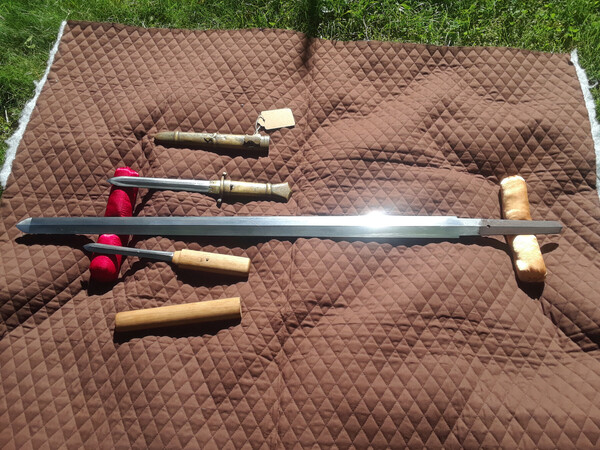
-
Any info regarding this tanto?
ChrisW replied to Karasunoir's topic in General Nihonto Related Discussion
Theoretically, could it not be reshaped into a much smaller tanto? Similiar to how a naginata-naoshi has some of its boshi removed, I wonder if the same could be done to this blade being that it is an osoraku tanto. -
It is a fatal flaw on any blade, but it can be considered somewhat forgivable on very old (early Kamakura or Heian) or very historically significant blades.
-
Japanese felling axe. Had one very similar to it. Traded it for my new ken!
-
Information in samouraï sword
ChrisW replied to Pat5353's topic in General Nihonto Related Discussion
Agreed. A poorly rendered fake. Hopefully not too much was spent on it. This site has a lot of available resources for you to study. And when you're ready, reputable sellers who can hook you up with a genuine article. Stick around and move past this initial stumble! -
Perhaps Southeast Asian, like Vietnamese or Cambodian? Mind showing us a picture of the tang area and the hole in the tang? The soft-metal casting looks too crude to be Japanese. The whole thing looks like something done in the past century as a tourism piece. Might be loosely Japanese inspired? But I doubt its actually Japanese.
-
Forgiven! And please, its just Chris. Or Christopher if you insist. If you ever come to the Chicago show, be sure to stop by my table and I'll show my tanegashima as well!
-
Well, you can't tease us and not show and tell!
-
A shame you got rid of it so soon! I would have at least waited for an opinion on it from a polisher you like first (someone who does it for the love of swords and not necessarily the money... as if there is much money to be made for the time spent anyways!) Not to be crude, but to quote a favorite author of mine, Kurt Vonnegut Jr. once famously said, "Opinions are like assholes, everyone's got one." I find that opinions fly fast and quick when people are looking to add it to their collection or they have some sort of interest in it. Also a shame you didn't give me first crack at it, I would have probably went for it. Oh well! I am sure it will find someone who will take it on. As for the blade itself, its possible it was an omi-yari, but to me... it looks like a ken and looks ubu. They're not standardized pieces and they're fairly rare. The final judgement would have been a good polisher and then shinsa. Ken were made through all time periods, so it matters little if the patination does not appear to be that old. The only problem that I can see on it from the photos would be that long ware that appears to be running up most of one side of the blade. As for the possible atobori? It'd study the patination of the nakago closely to see if the rust within the carving seems to match the rest of the nakago. If it doesn't, then I guess we have an answer. Lastly, I've taken a risk of a ken before.. returned it too. I discovered that there was a nasty hagire hiding within the pitting on one side of it. Was the quickest return I could have made. So I understand your hesitance! Best of luck to you Piers! You'll find one soon that speaks to you I am sure. ~Chris