Carlo Giuseppe Tacchini
-
Posts
2,121 -
Joined
-
Last visited
-
Days Won
8
Content Type
Profiles
Forums
Events
Store
Downloads
Gallery
Everything posted by Carlo Giuseppe Tacchini
-

Stibbert Museum
Carlo Giuseppe Tacchini replied to Jean's topic in General Nihonto Related Discussion
It is possible to make an agreement with the curators to have a longer, even full-day visit, even just for the japanerse collection, but this is obviously more expensive than the regular visit. Limitation in number of visitors apply in this case as well. Lots of swords hidden because of poor polish, especially the older ones. But worth the money as they'll put out the items you ask (whenever possible) to discuss them. I bet you won't know about pidgeons drops that occasionally occurred... Some have just been restored or still under restoration (Spadavecchia is specialized in laquer so this is her main concern). However can't say ig they'll be displaied again. Definitively, Venice is not a good environment for Japanese weaponry. -
Say hello to fellas
Carlo Giuseppe Tacchini replied to ashibagou's topic in General Nihonto Related Discussion
Refreshing news. Welcome. -
Oakeshott has a similar one: "A sword has three battles or three hundred years in it, whatever comes first.".
-
when and why would you find tsuchime on a nakago ...
Carlo Giuseppe Tacchini replied to jason_mazzy's topic in Nihonto
I wish I was so knowledgeable to give the answer that even the author doesn't dare to express... -
when and why would you find tsuchime on a nakago ...
Carlo Giuseppe Tacchini replied to jason_mazzy's topic in Nihonto
Being the "when" already addressed, still remains the "why" so here is my opinion. Others might disagree with full right of doing so. Tsuchime (hammer signs), Sensuki (scraper signs) and Yasurime (filemarks), are supposed to provide an irregular basis that offers greater friction to the Nakago,avoiding to put too much stress to the Mekugi (when removable tsuka with wooden mekugi are used) or to provide grip to the glueing mean when fixed Tsuka are used. Tsuchime could be the first to appear in swordmaking considering the easy way to produce them. Sensuki should be the second as Sen were already known in the Kofun, while files seems to have been introduced only in Narajidai. This timetable seems to be supported by the fact that you can find swords with Tsuchime together with Sensuki or Sensuki together with Yasurime but almost none with Tsuchime mixed with (poor) Yasurime. These exceptions can be explained with the association of tsuchime and lower quality from a certain date onward. Many Swords in the Shosoin show Tsuchime, Sensuki and Yasurime but, generally speaking "...excellent swords are scarce among those having tangs finished in Tsuchime alone. Fine examples that can rival with the best of medieval and later swords are found among those with the tangs combining Sensuki and Yasurime" (quote from "Swords Blades in the Shoso-In" edited by The Shoso-In Office, Tokyo 1974, emphasis mine). All Teboko and Hoko Nakago in the Repository show Tsuchime only, while no Tosu has Tsuchime. They are all finished with different types of Yasurime (but one that has Sensuki combined with Kiri Yasurime). Just as a curiosity note, but still possibly addressing us to the functional reason of these finishes, is the following quote from the same source : "The Kurozukuri Tachi in the Middle Section has, in its Haki-Omote (obverse when worn) side, an oblique line running from the ridge of the Mune to the blade face. Closer investigation is neccessary to determine whether this is a burin mark or a crack in the surface of steel. If it was incised purposedly, it is a valuable material suggesting possible connection with a thick oblique line, not quiet like the character Ichi, incised with a burin on an early sword of the Ichimonji School of Bizen Province in the Kamakura Period". (emphasis mine) -
Best wishes from me too Mariuszk. Any picture from the event will be highly appreciated.
-
This Week's Edo Period Corner
Carlo Giuseppe Tacchini replied to Bugyotsuji's topic in General Nihonto Related Discussion
Makes sense to me. -
This Week's Edo Period Corner
Carlo Giuseppe Tacchini replied to Bugyotsuji's topic in General Nihonto Related Discussion
Thanks, it is totally new to me. I suppose that after the "Pax Tokugawa" most of these lesser items were destroied. I wander if fragmented shots were used for the type of game they had to engage... -
Great to see the 3 top translators engaged in the same topic...
-
This Week's Edo Period Corner
Carlo Giuseppe Tacchini replied to Bugyotsuji's topic in General Nihonto Related Discussion
Piers, this is interesting. Were there "average" quality (matching the quality of the item in question) firearms for hunting as well ? -
I think it's interesting and quiet a brilliant idea. Video reviews of Armor books : http://www.joanseeuw.com/ Bookmarked.
-
I second Lorenzo on this, Bojan.
-
Radiocarbon dating of steel
Carlo Giuseppe Tacchini replied to John A Stuart's topic in General Nihonto Related Discussion
Nice reading. Downloaded for future reference. Thanks for sharing, John and Ford. -
Yanone anynone?
Carlo Giuseppe Tacchini replied to Marius's topic in General Nihonto Related Discussion
Nice reading, Mariuszk. Thanks for sharing. -
This Week's Edo Period Corner
Carlo Giuseppe Tacchini replied to Bugyotsuji's topic in General Nihonto Related Discussion
Great pic. Thanks for sharing. -
I second Craig here. Boris arrived to put one of his swords under a special x-ray machine to study it. Can't wait to know more about it. Mistakes occurs, but Boris is usually cautious and accurate.
-
I prefer to pay a little more, getting in touch directly with Paul and have a *signed* copy.
-
Flaws or Provenance
Carlo Giuseppe Tacchini replied to Justin Grant's topic in General Nihonto Related Discussion
So you restore Shelby and Jaguar for hobby. Then, let's try to shift the similitude from swords to cars. As example you're linking to a sword by no less then Masamune with no fatal flaws. Just kirikomi that are perfectly acceptable or even desirable under a collecting point of view. However the basis still is : the sword is a rare masterpiece, with no fatal flaws with a documented history. Items like this are out of reach for everybody but an handful of people (worldwide). This is comparable to a Shelby with its original damaged bonnet/hood that Cary Grant drove hurting the Porche of Marilyn Monroe, according to genuine fotographic documentation of the time. Still, the mass of "old cars" (and swords) out there are the mass-produced or maximum average ones. Let's take an average Alfa Romeo Giulia GTA owned by 3 generations of "John Smith", that has seen much better days and has been restored with pieces of any other car available to maintain it marching in someway (reshaped and re-tempered), either for need or for nostalgia. No way to have it registered at R.I.A.R. (Registro Italiano Alfa Romeo) because it's nomore original and far from good conditions. No documents that proves anything in its past but the understandable affection and dreaming of the owner. This is your sword (and the car with which I learnd to drive, demolished 20+ years ago). Everything in between can be considered collectible, but there are irrefutable criteria as artistic quality, scarcity, conditions, documented history that makes the difference. Honourability (that can't be measured and is subjective) shouldn't be considered substitutive, nor in conflict with the above criteria, just considered as a seperate quality, that can be applied, in full right, even to NCO Gunto or rusted "Rebellion swords" according to the feeling of each individual. IMHO, of course. -
What ? No more wrestling with polar bears ? Or is it for winter season only ?
-
Katana ware on mune
Carlo Giuseppe Tacchini replied to miner1436's topic in General Nihonto Related Discussion
Rich, most likely it's a product of an error in Kitae and not a fatal flaw, but you should show it in person to somebody knowledgeable near to you. Some small kizu are reparaible (better, can be hidden) during the polishing process, *if* the blade deserve and is in need of such polish. -
Luthor, have a look here, great article : http://www.una.edu/faculty/takeuchi/DrT ... migaki.htm
-
Keith. I owe you a good laugh. I take note of this for future use.
-
This Week's Edo Period Corner
Carlo Giuseppe Tacchini replied to Bugyotsuji's topic in General Nihonto Related Discussion
Indeed, AFAIK Japanese is the only people ever to have willingly step back from this technology, for various reasons, until Meiji restoration. -
Eric, good job. Guess you're the right person to post also the way Naginata Nakago were inserted in an oval staff, maybe with pictures.
-
Tanto Pistol History with photos
Carlo Giuseppe Tacchini replied to watsonmil's topic in Tanegashima / Teppo / Hinawajū
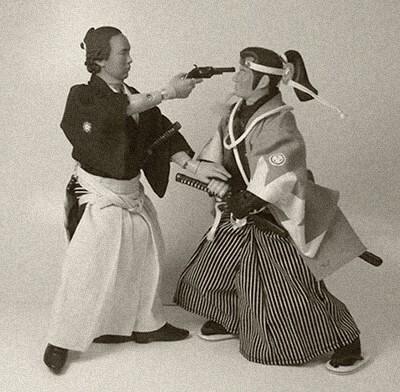
The late Edo italian photographer Felice Beato was able to take a shot... :D