Curran
-
Posts
4,712 -
Joined
-
Last visited
-
Days Won
25
Content Type
Profiles
Forums
Events
Store
Downloads
Gallery
Everything posted by Curran
-
Looks to me like Kampei too. Nidai Kanshiro's younger brother, and he did often sign on the back of tsuba. A fair bit of gimei's of Kampei's signature exist for various reasons. He was a good signature to add to mumei pieces if you wanted to up the value of a Higo piece. Yet, like I said, one of his particular quirks was he often signed on the backside and has been known to date a few of his pieces since he lived a long life into the early 1700s. So it could be legit. I wouldn't venture an opinion, since I cannot see it well enough. Interesting though, as it looks much more Hayashi. But it isn't as if the Higo boys didn't borrow designs from each other all the time.
-
Hayashi design of Fishnet. More of a Hayashi->Kamiyoshi seppa dai shape. [Kamiyoshi assumed the Hayashi school] I cannot read the supposed signature. It looks more kodai Higo to me, but tell us what the signature says?
-
Well, remember that we could be wrong. Sado Island has a very interesting history. I don't know how the tsuba evolved, but they have a very distinct feel to them. Masculine, often a bit 'heavy' or thick of appearance. Usually a refined iron with dark patina. Simpler yet strong designs. Easy to imagine the needs of the island's maritime and mining influence on those who made them. I haven't handled many. Yet the NBTHK is very consistent in labeling certain tsuba as 'Sado'. My personal opinion is strongly that it is Sado.
-
I too thought Sado, at first glance.
-

Sword Display
Curran replied to Chishiki's topic in Sword Shows, Events, Community News and Legislation Issues
Thank you for updating on this over the years. It has been a touchstone and rolemodel for how I would ultimately like to have displayed my much smaller collection. I wish life was such that I could attend these displays in person. Thank you for the photographs. -
Tsuba Signature: Bushu Ju _(?)_ _(?)_ Kiyo
Curran replied to Curran's topic in Translation Assistance
Grev, I've caught a few kanji errors in Haynes before. Given the over 12,000 smiths he recorded- a few oops pop up on minor artists. As to this being an unrecorded artist: it might be, though skill level of the carving is very high. Might be an alternate name, or read differently, or ? Uwe- your guess is as good or better than mine. This one totally stumped me. As Steve guided us, hard to know how this one is pronounced vs how it was recorded. I have this one on the side-desk to try and tackle more this weekend. It will eventually go up for sale, but I'm more hooked by the challenge of figuring it out first. What is the point of having all of these books if I don't exhaust them first? -
Well said Markus. Many of you knew him better than I did, and I wish I had gotten to know him earlier in my adventures upon this field.
-
Tsuba Signature: Bushu Ju _(?)_ _(?)_ Kiyo
Curran replied to Curran's topic in Translation Assistance
Thank you gentlemen. This was certainly beyond my ability. There is no way I would have gotten 'Nari'. I did not know the way for writing Saito, but then I've always been surprised that some of the more common names like 'Watanabe' have quite a number of strokes to them. I'll cross my books as much as possible and see if I can find any match. As John said, it does seem rather unusual name for a Bushu work. With all the Art Nouveau - Durgin Iris feel to it, it seems classically Bushu or Bushu Ito. The signature: rather atypical than the usual Bushu Ito 'Masa____' line. -
Tsuba Signature: Bushu Ju _(?)_ _(?)_ Kiyo
Curran replied to Curran's topic in Translation Assistance
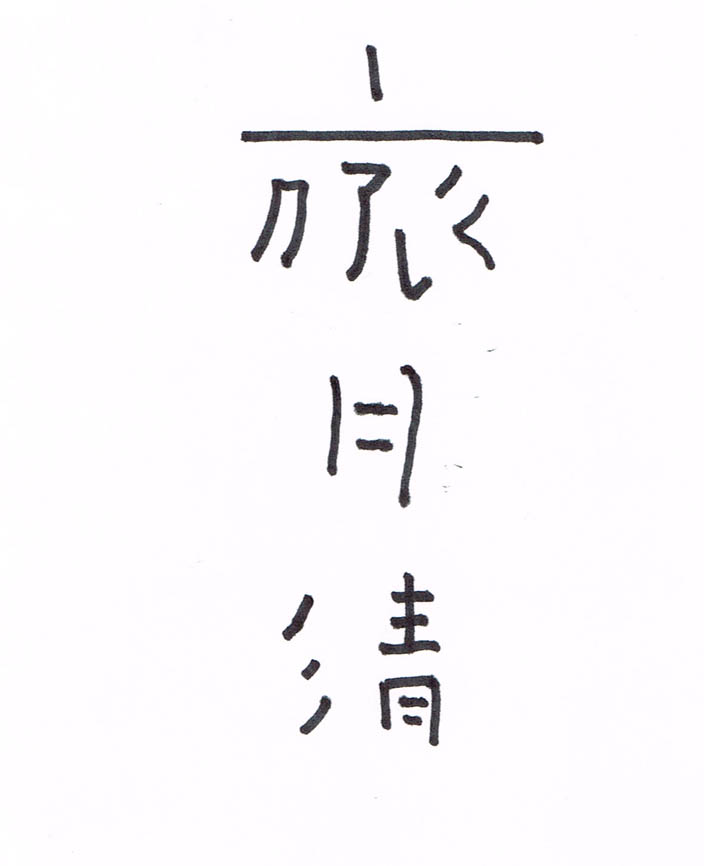
Moriyama-san, あけましておめでとうございます - Happy New Year Today was 12 hours of rain, so no more photographs. I put the tsuba under magnification and drew the signature. I know the first character looks strange [wide spread in spacing], but that is very very near to how it is on the tsuba. I greatly appreciate the help, as this one has me befuddled.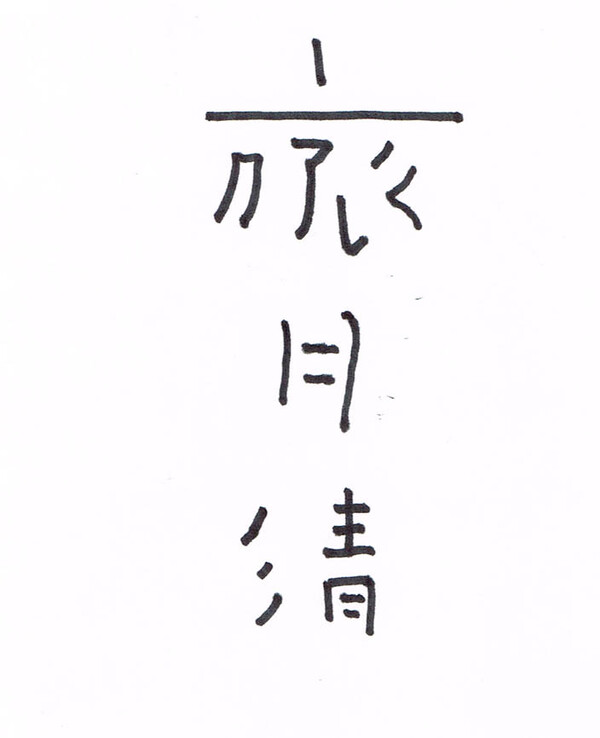
-
We traded jokes in Italian & German humor at the Tampa show. I got to know him through a shared sense of humor, and missed the banter when he did not attend Tampa. We would also talk about fittings, and I knew him by reputation to be a great kantei expert of nihonto. I am very sad to know he has left, but one of his last jokes was appropriate for saying goodbye and a good way to remember him. Thank you for letting us know.
-
Tsuba Signature: Bushu Ju _(?)_ _(?)_ Kiyo
Curran replied to Curran's topic in Translation Assistance
Yes, our old Canon Sureshot has its good and bad days. Stephen, I actually was just working on updating the smart phone since ours is a few years old. --- I was trying to figure out the two characters and totally stumped by the first one. Looking at the second character under magnification, it just a sort of a double cross-bar H with some hook at top and bottom. ----Then I just happened to look up at the Chinese painting above our fireplace that we've had for 20 years. "Lotus and Kingifisher" 1930 by artist Xie Yuemei.... Same double cross-bar H as in her signature 'Yuemei'. The Kiyo character is correct, but how to read 月清 in any way that makes sense or is a recorded artist hasn't come up yet. I will draw and scan in the first character, as it is an odd one and drawing it in Jisho.org provided no direct hits. -
Tsuba Signature: Bushu Ju _(?)_ _(?)_ Kiyo
Curran replied to Curran's topic in Translation Assistance
Steve M, As always, thanks for your help. I will try with photos again later, though the dark-n-cloudy day does not bode well. I'd considered 月, but the character is odd in that it doesn't seem to have the top stroke and looks more like an H with two crossbars. That turns up nothing on Jisho.org, nor does drawing the character above it. -
Anyone In The U.s. Making Custom Made Fittings Boxes?
Curran replied to nagamaki - Franco's topic in Tosogu
None that I know about. Been waiting a decade for someone to pick up that role, and considered bringing one of the Japanese to the states for a while. It is so difficult now to move tsuba above the 200,000 yen in and out of Japan *legally*. Sending a dozen just for fitted boxes can be a royal pain in the neck. The general opinion is carry them yourself next time you go and drop them off with one of the gents there. I've never actually managed to do that. -
I've owned and had this tsuba on display a very long time. I must shameface admit I do not remember the signature. Second to last is simple, but seems incomplete. It isn't Akikiyo, or Harukiyo. Not sure how to read it. Help is greatly appreciated.

-
This was a pleasure to see. Nice higher level fittings with a lot of grace to their spatial design.
-
English text: not one that I am aware of existing. Perhaps a member had it privately translated. Or you can orchestrate one of the drives we have had from time to time to have a particular book translated. I'd be in for it. Lawson recently spearheaded one for the Echizen book. For the most part this Namban book is simple enough that even someone with beginner to intermiediate Japanese like me can crawl through it. That is probably not what you want to hear, but the reality is often we are left to climb these minor mountains on our own. Gents like Markus and Paul Martin are the super Japanese language sherpas we didn't have years ago. Personally, I am immensely thankful to the years of translations that Nobody-san has volunteered to this board.
-
Artist name is Hideyuki.
-
Grev- Theirry posted the book I mentioned to you before. It is a bit harder to come by nowadays.
-
Sword papers say "Bizen Osafune Sukesada" The Sukesada were a long line of smiths. Your papers also say it is O-suriage mumei. Ie. Signature probably cut off when sword was shortened. It is very common. There is more information, that I hope others will help with.
-
Agree that I don't think size as a primary kantei point for Kanayama. Small but nice and expensive one: http://www.tsuruginoya.com/mn1_3/f00111.html I sold a favorite one (could be seen in Nihonto Koza) to a collector/friend this summer. Still hurts to look at pictures of it, but it has been a tighten-the-belt year and I've had a few things talked off me. That one was also on the smaller side, but very fine. An opinion of 'what is Kanayama' sort of differs a bit depending upon book and year written.
-
I don't think that is "large", but yes it is a pretty Owari example.
-
Yep. Envious. While I have a few very kind friends, nobody like this in my family. Congrats Max on family that considerate. Heck of a gift.
-
Unless you intend to use the tanto as an ice pick, those grain openings should be insanely stable. The engravings are bonji. Religious reference. Quickly: https://en.wikipedia.org/wiki/Siddha%E1%B9%83_script Entire books published on them.
-
Ware are pretty common. As Paul said, more acceptable in some schools than other. It boils down on how much they bother you. Tends to bother the newbies more, though I saw one recently that bucket of icewater'd all sex appeal of an otherwise lovely blade. Given the construction of many Japanese swords, I think it is more likely to see them near or along the mune after they've seen a few polishes. Last year I was looking at a beautiful Juyo Shikkake (one of the Yamato schools). 4 ware along the mune, though none anywhere else on the blade. Yours I see, but it will be half under a habaki. It registers, but not much to my eyes on what otherwise looks like a nice blade in good polish.
-
2nd Period. Good size. Tokubetsu Hozon I believe? A friend of friend & former client was setting up to buy that. I noted the other day that it was sold, and assumed he'd finally grabbed it. It looks like someone else got it. One of Norisuke's best tsuba is a Yagyu copy very close to this design.