Bugyotsuji
-
Posts
14,410 -
Joined
-
Last visited
-
Days Won
281
Content Type
Profiles
Forums
Events
Store
Downloads
Gallery
Everything posted by Bugyotsuji
-
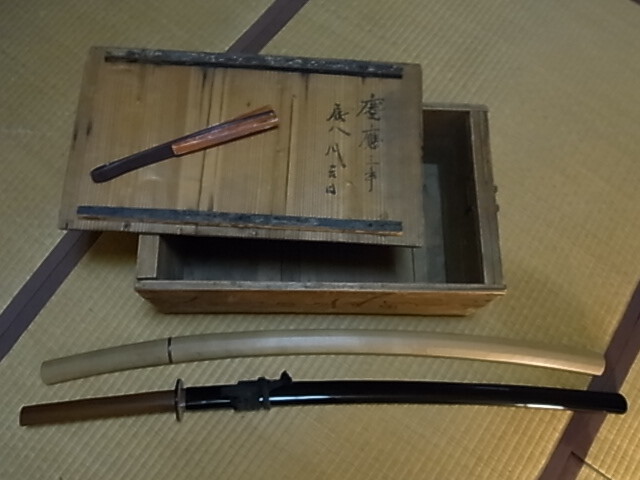
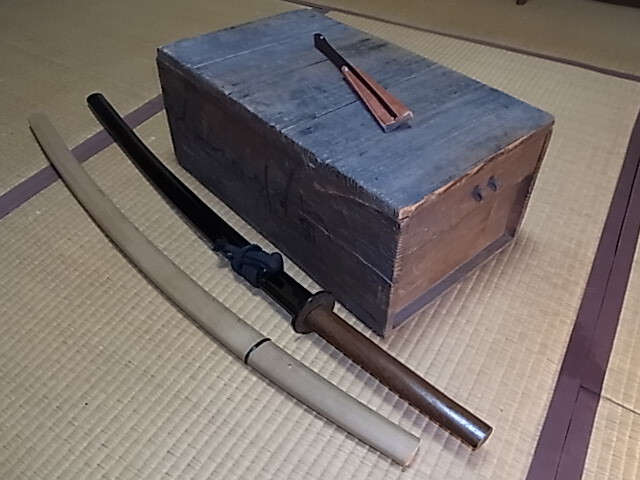
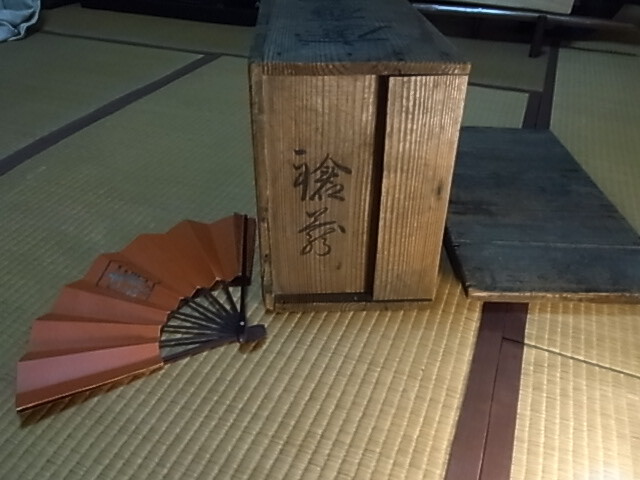
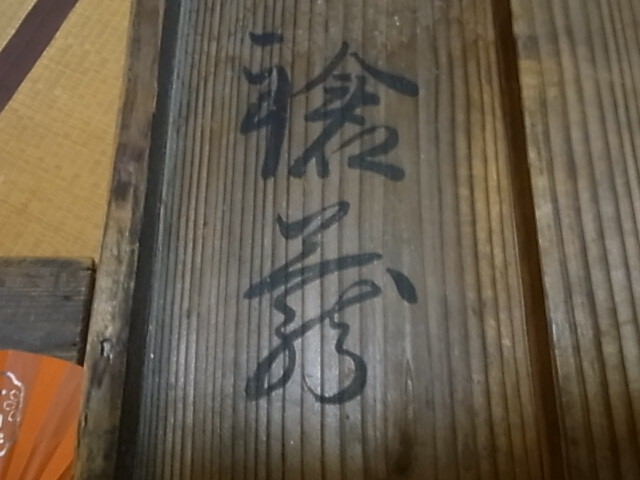
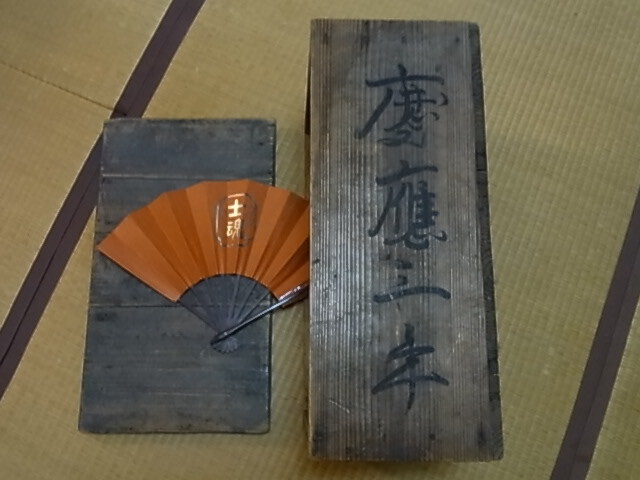
The packing case had been there for 100 years, I am guessing! :lol: (Unless you are saying 'we' in the Royal sense! ... but still the Yari would have had a tempered edge, right? Here are some pics of the box. I am tempted to use it as a work bench.
-
Eric, I have posted it before, but despite a search couldn't find it. (May be on the old site.) PS Just found it on this page in the Edo Period corner. Fuzzy shots and the explanation Kanji have gone strange. This part of the thread must have come from the old site and the Kanji were lost. It could be so-so 'Yari nest', 鎗蔵 (?) or Morita San suggested possibly a name, Yorizo? viewtopic.php?f=9&t=2554&st=0&sk=t&sd=a&start=150 It's larger than it looks there. Will get some better shots this evening.
-
Whoever placed a Kikuchi blade on the end of a bamboo pole and tipped the balance in battle may just have started a trend. The point of a spear, I was told, was to thrust up for the enemies' eyes. From bamboo to wood, and from Tanto, to Yoroidoushi, to dedicated steel spear blade may then have been a logical progression, diverging from Naginata/Nagamaki. Since the handles of Naginata/Nagamaki were oval in cross-section, the idea of a round pole must have been new and outside the box. On a lathe, round cross-section may indeed have been easier to fashion. Wood would have caused fewer splinters than bamboo, but could be made just as slippery for sliding thrusts. As with Kazu-uchi-mono for swords, it must have been easy for smiths to mass produce short spear blades. The straighter they are, the easier they will fit into a box too. In fact I have just such a box at home, with the 'proper' (?) character for Yari written on it, and I can imagine it padded with straw and being gradually filled by smiths roundabout the forge. Most of the above is the product of a modicum of input plus a fertile mind and not much more.
-
Well, you have convinced me. In juxtaposition with your chappie there, then I would say almost certainly yes...
-
Alan, thanks for the reply. I ask because I had a repair done to the iron/steel firing pan of a matchlock. Maybe it was a type of arc welding. (?) It's a good job and very solid, but it looks silver and different, and it refuses to take patination. Please ignore as necessary. In the meantime I'll try and recall what process they called it in Japanese.
-
Nothing to do with the price of fish really, but one so-called knowledgable person, a long-time Japanese collector assured me that looseness was deliberate and to be desired as it was one of the mechanisms absorbing the shock of contact with hard objects. The design of the tsuba, particularly sukashi, was another method of recoil absorption, he was saying.
-
A repaired Tsuka should provide good reinforcement to a cracked Nakago. Can silver solder really be repatinated?
-
Please show us what it looks like!
-
Just read a little article last night before switching out the lights that suggests the adoption of yari had something to do with battle tactics. With a Naginata/Nagamaki, you spun around and slashed in all directions. Old-style fighting. As the battlefield became unidirectional, with the enemy massed and to the front, then ranked use of the long Yari spear against cavalry became essential. Two types of spear were mentioned. Very long plain ones with slippery handles to allow jabbing, ie gripping with the right fist and sliding through the left. The actual Ho or blade did not need to be large, often 5cm was sufficient. Shorter and more decorative high quality spears were carried by cavalry. The long spear gained a new lease of life when matchlocks appeared as they could sandwich and protect gunners whilst they were reloading. (You have a nice life-size display of this in the Royal Armouries, Ian.) The article mentions that the Kanji that we commonly use for Yari 槍 is actually wrong. With the tree 'hen' figure on the left this character should properly be read Hoko. The proper Kanji for what we think of as Yari should be 鑓 or 鎗 with the 'hen' for metal. As an afterthought when I was switching out the lights, this increase of long spears must have coincided with mass breeding of war horses and purpose-built mounted warrior units. The article is in Japanese, but I can post a photo of the page and provide a translation a) if you are interested and b) if I do not contravene copyright. Ikkojin 3 March 2010 'Sengoku Busho Nyumon' Special Edition. KK Best Sellers, Tokyo p.107
-
Carlo, can you provide a closer shot of the writing on the picture of the 'Japanese war crossbow'? It seems to say that this bow was excavated from a Kofun tomb in Pyongyang in Korea, but my eyesight is not good enough to read the fuzzy letters. If I am wrong, forgive me. The other day when the subject of hagire etc in yari came up, and, would this be a bad thing in a spear, I asked a close friend for his opinion. He said that Yari have yaki-ire, because yari were whirled around and used for slashing. So, even when yari succeeded naginata on the battlefield, did old habits die hard? Also, reading this thread (forgive me, but I have been ill recently and I've only just caught up) it struck me that there may be some truth in the idea that straight yari were used by peasants for warding off or surrounding and capturing hostile wild animals. Perhaps there was a cleanliness/purity prohibition bound up in this. One blade for animals, requiring no art, and one for war, requiring great skill. Did a breakdown in the old codes lead to indiscriminate use of previously forbidden weaponry on the field? Did function finally prevail over convention? PS There's quite a good discussion on the history of Yari here, with the Japanese section from 1/3 of the way down the page. They say that Hoko is the old word and Yari took over from hoko. There is also a reference to the earliest depiction of a Yari in a painting in Kamakura times. http://ja.wikipedia.org/wiki/%E6%A7%8D I'll be seeing some sword related people this weekend, so I'll float Ian's question there.
-
Very clever how he has got the ivory to look like copper. Thanks for posting.
-
Help required with translation please
Bugyotsuji replied to ironron's topic in Translation Assistance
Personally speaking, and I am not an expert, I can see why you might question this Mei. On the other hand I accept that there are indications that it might not be Gimei. Armed only with that one limited photograph and no background story, it is like being asked to judge the whole forest from an angled shot of a section of bark. -
Translation of japanese registration document
Bugyotsuji replied to diprivanman's topic in Translation Assistance
Gifu Prefectural Education Committee. The registration certificate itself is very new, ie 2009. -
Ouch, who are these cowboys messing around with the Watanabe Collection?
-
THE JAPANESE MATCHLOCK A Story Of The Tanegashima
Bugyotsuji replied to estcrh's topic in Tanegashima / Teppo / Hinawajū
Eric, there are two volumes to this work in Japanese, but possibly only the one in English. Firstly may I agree with you that there is very little in English on this subject and in such detail. It's a great coffee table book to leaf through. Please be aware that there are many things which you will need to take with a pinch of salt. This is a public site, so I cannot say more here. Suffice it to say, it needs quite a bit of further editing of one form or another. Congratulations! -
This Week's Edo Period Corner
Bugyotsuji replied to Bugyotsuji's topic in General Nihonto Related Discussion
Well, if a Wara-buki-yane わらぶき屋根 (thatched roof) is/was able to keep out the rain, then why not on a personal level too? -
The rubbing is almost impossible to see, and copying the characters does not really help unless you know Kanji inside and out. It will really come down to those shots. The shadows should provide some definition. Try lighting from each of eight directions, and gently angled shots!
-
This Week's Edo Period Corner
Bugyotsuji replied to Bugyotsuji's topic in General Nihonto Related Discussion
Vaporis' book looks like a good read. The author himself appears and comments in the linked thread, if anyone has too much time on their hands! http://forums.samurai-archives.com/viewtopic.php?t=4007 -
Can you get much closer to the characters, and get them maybe two at a time, from different lighting angles?
-
This Week's Edo Period Corner
Bugyotsuji replied to Bugyotsuji's topic in General Nihonto Related Discussion
Hot chilli peppers to keep the circulation warm. She swears they make a big difference. -
This Week's Edo Period Corner
Bugyotsuji replied to Bugyotsuji's topic in General Nihonto Related Discussion
I wonder how warm those are, especially when wet. A Japanese friend climbs mountains every winter and stuffs her socks with crushed Togarashi peppers... -
This Week's Edo Period Corner
Bugyotsuji replied to Bugyotsuji's topic in General Nihonto Related Discussion
Thank you Koichi san. Perhaps you are right. We need to wait until all references are collated. Certainly in speech humans tend to shorten words, and the Japanese are no exception. If we agree that Mabishaku and Babishaku were shortened to Mashaku and Bashaku, then we have come full circle. I am a bit surprised by the 1891 writing in which the English word 'speed' is used in Katakana. It makes me wonder whether the writing has been subsequently altered or retold... Ian, that is such a good picture you have found there. Anyone who doubts the use of Tanegashima matchlock pistols on horseback should see your illustration. I am going to print it out for my collection. -
This Week's Edo Period Corner
Bugyotsuji replied to Bugyotsuji's topic in General Nihonto Related Discussion
To summarize, I am sensing that the term 'Bashaku' used by many Japanese and Western dealers of Japanese antiques is wrong. I cannot find any examples of this word with these Kanji and this meaning in any Japanese dictionary. The correct usage must be either what Sasama Sensei says above, Ba-bishiyaku, Ba-bishaku, Ba-bishyaku, Ba-bisaku or the same with Ma- or Uma- instead of Ba, or something very close. Remember that these are mostly semi-incorrect attempts to reproduce the Japanese sounds, so the Romanization will never be perfect. The word for horse comes from an ancient sound that comes from North Korea and the Mongolian steppes, and is formed with the lips like mma or umba. Put that sound before Hishaku and, following Japanese language conventions, the H changes to B. Thus we end up with Ma-bishaku, Ba-bishaku or Uma-bishaku. In the various Japanese dictionaries that I have consulted, both printed and on the internet, the usage Ma-bishaku is by far the most prevalent. I would be happy if the world could standardize this now to Mabishaku ( or Babishaku). = Horse-handle-cup. NB The expression of the sound in English of 柄杓 hishaku/bishaku can be bishyaku or bishiyaku because they are differing attempts to reach the same Japanese sound. *We must be careful with Sasama sensei's bishiyaku, however, as that can sound like four syllables to an English speaker, whereas in Japanese there are only three, hi/bi + sha + ku. -
Admirable sentiments from all above, especially Brian's last comment. A Fascinating 2011
-
This Week's Edo Period Corner
Bugyotsuji replied to Bugyotsuji's topic in General Nihonto Related Discussion
Apologies, Eric. The museum description says: From Left, Kutsuwa (Bridle bits), Shiode (saddle tie handles), Muchi (bullwhips), Mabishaku (horse dippers), and Aori (horse cover/splashguard). And yes, what an excellent picture, Ian. Even the Kutsuwa seem to be part of his dress. Many thanks. Happy New Year everyone.