Bugyotsuji
-
Posts
14,698 -
Joined
-
Last visited
-
Days Won
299
Content Type
Profiles
Forums
Events
Store
Downloads
Gallery
Everything posted by Bugyotsuji
-
 Robert, as Rokujuro says above, you could have one made up. There are very few around; most of those rarities that come up are cleverly 'aged' reproductions like the one above. The head was rounded, usually solid iron. I have seen an example in a museum of an explosive one with a fuse attached, but they were probably later and even rarer. The rope was often soaked in oil, and although I imagine they were lit before firing, it is said that the muzzle flash was enough to set them alight. The 'sights' on these cannon are almost entirely decorative since they were never 'aimed' directly at anything.
 -
Are you in Japan?
-
The stamping imprintation process I am not sure about. One of my guns has similar stamps all over the barrel, but extra work for whoever forged (yes) this barrel, means probably for a wealthy class of client. 大筒 O-zutsu literally means large barrel and was more commonly used for large-bore hand-held matchlock versions, so-called 'hand-cannon', but also loosely covers your cannon too. Neither expression is entirely satisfactory from a western point of view, but this never seems to have bothered the Japanese too much. When you use the word Taiho 大砲, it is correct for a cannon, but then you are into field and naval cannon, etc. so to us today it has later date connotations. Hiya-zutsu and early Taiho both denote barrels with touch-holes, with no 'lock' mechanism.
-
Looks like a lovely little example, ticking all the boxes as far as I can see. Are those inches along that ruler? These little cannon babies are called by the generic name 火矢筒 Hiya-zutsu (flaming arrow barrel) as there was an evolved tradition throughout Edo of shooting flaming bolts (棒火矢 Bo-hiya =bolt flame arrow) rather than lead or iron ball. There were various ways of mounting them on swivelling, sliding and angled bases, using ropes to take up recoil.
-
Always nce to have cryptic messages on things. In this 'case', the dates do not seem to match, but it's the contents that matter! What is written on the fantastic Noshi Maedate, John?
-
If anyone is visiting Japan this fall/autumn, see if you can get down to Okayama where there are two very good displays planned. 1. Bizen Osafune Sword Museum will run theirs over eight weeks in September and October, with 40 top Bizen swords, including about 15 from private collections that have never been seen in living memory before. Five will come from Hayashibara. The rest will be from the sword museum itself. 2. Okayama Prefectural Museum will have a top quality exhibition running for five weeks from 8 September to mid-October. Recently-polished Hono To will be part of the 84 blade display, including the large Kozuke Daijo Sukesada that I was not able to post photos of. Interestingly all this positive public activity by the sword society has drawn favourable glances from the authorities, and there is a plan afoot to award this Sukesada some Prefectural special status.
-
Posted this in advance a month ago, but the event will be tomorrow for 50 members of the NBTHK sword society. It'll be musical chairs and after round one there will be a book where you can register for a second turn if you feel up to it. 1. 太刀Tachi. 正恒 Masatsune, 重要美術品 Juyo Bijutsuhin. 2. 刀 Katana. 無銘 (Nagamitsu) 3. Tachi. 国宗 Kunimune 4. Tachi. 雲次 Unji 5. Tachi. 備前国長船住近景 Chikakage 6. Tachi. 備前長船康光 Yasumitsu 7. Tachi. 備前長船経家 Tsuneie 8. 刀 Katana. 備前国住長船源兵衛尉祐定作 *Sukesada 9. Tachi. (古青江 Ko Aoe) 正恒 Masatsune 岡山県指定文化財 Okayama Prefecture designated Juyo Bunkazai 10. Tachi. (古青江) 助次 Suketsugu *This Genbyoei/Genbei no Jo Sukesada might be the son of Yosozaemon, or possibly the grandson (Nidai Genbei). Will ask.
-
Matt, yes, I agree that Sho-in reading is one possibility, but there are others, such as Sho-on, Ko-in, Ko-on, and so on. I am interested in how Tom comes to that single reading conclusion, to the exclusion of any others. It's a little take-it-or-leave-it, point-blank, do you not think? If he knew of or found another example of the artist's work, then I would be happy enough to accept it.
-
Tom, can you share your thinking?
-
Apart from far-fetched imagination, nothing to offer here. What kind of carving? (The imagination, for what it is worth is 小 being a humble reference to oneself, perhaps after retiring from great office and starting anew as 隠居, and novice carver.)
-
From Nihonto webpage, 満鉄鍛造之・昭和癸末春」九八式軍刀 Mizunoto Sueharu (Matsushun)
-
The Bushi Meaning Of Nasubi, Eggplant, Aubergines
Bugyotsuji replied to Bugyotsuji's topic in Tosogu
Or a sign that this (wandering) samurai came from Nasu Kogen? 那須高原 -
The Bushi Meaning Of Nasubi, Eggplant, Aubergines
Bugyotsuji replied to Bugyotsuji's topic in Tosogu
A proverb from Suruga? Tokugawa Ieyasu, when asked to describe the three top/highest things in Suruga, choosing three famous specialties of the region, said Mt Fuji, hawks and eggplants, it is alleged. Hawks fly high. Nasu were expensive when they first hit the marketplace, (when all foods were seasonal, often enforced by law) and also had the secondary meaning or sound 成す (Nasu = make a fortune). http://koyomi.vis.ne.jp/doc/mlko/201001040.htm -
Tosogu sometimes have Nasu(bi) depicted on them. I began to wonder about the symbolism of Nasu 茄子 and how they came to be considered good luck in Japan. Some casual reading dredged up the following. If anyone cares to add or subtract from this, please feel welcome to participate. The first and most popular reference seems to be to the important New Year's first dream scenario, 1富士2鷹3茄子 where if your very first dream is about Mt Fuji you will have a seriously propitious year ahead. The order starts 1. Mt Fuji, 2. Taka (hawk) 3. Nasu... and goes on to... 4. A fan 5. Tobacco and 6. Zato. https://matome.naver.jp/odai/2138841244106234001 So if you dream of eggplants, that is the third luckiest of dreams to have! http://buzz-media.net/moving/2990/ The reasons for their luck seem to be a little more obscure. They symbolized wealth and child-bearing. Could this be connected with the second character 茄子 being 子 child? One reason common to both Nasu and Zato, (the bald figure seated on a cushion, like Biwa no Hoshi) is that both eggplants and Zato are hairless, 毛がなし (Ke. ga. nashi. = No hair). When spoken this sounds like 怪我なし (Kega. nashi. = no injuries). Japanese humour at its best, where baldness sends everyone into paroxysms of laughter, and the bald guy on stage is subjected to endless jokes and slapstick. Finally they have tradionally been valued for their medicinal value. So, to summarize, aubergines were traditionally virile, medicinal, and being bald, would keep you safe from injury. (?)
-
Rewrite of lost thread. Here are two panoramic shots taken in the Meirin Gakusha Museum in Hagi City. Takes time for the whole page to load. Look for bottom 2 shots labelled "2号館幕末ミュージアム" here: www.city.hagi.lg.jp/site/meiringakusha/photo.html On 9th July, eleven of us went on a 14-hour round-trip to a newly opened museum in Hagi City, an old castle town in Yamaguchi Prefecture down near the S.W. tip of Honshu. We went in two cars, and seven drivers took turns driving in revolving 2-hour stints. The curator of the Meirinkan Gakusha, (old Hagi Domain School) who also donated much of his own collection to make up the backbone of the display rooms, came out to greet us. Old friends. He showed us around 'his' eight rooms of artifacts/artefacts. There was everything you could imagine from the end of Edo, his area of speciality, and in the last two rooms enough guns and cannon and Bakumatsu dress to equip a ship of the line. Sunday, and the place was fairly popular. An usher at the door insisted on speaking English with me. Before we started I asked if photos would be permitted. Mr Ogawa looked anguished but then answered firmly in the negative. Over lunch I asked if there was a booklet for sale. "Not yet", he murmured apologetically. There is a movement among museums in Japan to allow shots with a smart phone, but not with a proper camera, so I informed him of that too, in case he did not know, but gently of course. Actually I love this old guy and told him I would not take any shots. I also assured him that as soon as I got home I would advertise this place abroad for him. He looked pleased. I left a congratulatory message in the visitors' book. Imagine my surprise after rooms of truly unique medical equipment, astronomical instruments, compasses, maps etc., to discover several things that I already own, some of which I had not appreciated the uses of. To my greater surprise, he also had a room full of all kinds of Jingasa, a wall of Nirayama, and another wall of the black soft leather Momonari kabuto/jingasa that I had been wearing recently, perhaps 15 of them, with gold Mon on the front. I took him aside and asked what their correct name should be. He looked me straight in the eye and said, "Jingasa? Boshi? We do not know. That is the problem. So much work still needs to be done in this area!" The only sword related objects were Choren practice breast plates and bokuto painted to look like real koshirae, mostly from Satsuma. Jan would have enjoyed the racks of Choshu guns, and Mr Ogawa's explanations of the background to almost every article. For example, fasten your seatbelt, he pointed out that whereas most Choshu guns have chunky 8-sided muzzles, some have bulbous muzzles. Why? This question had puzzled scholars until a certain discovery was made. Yokoyama Tatsuemon Sukenobu is recorded to have gone from Bizen to Yamaguchi with his son to teach gun making. That is how and when the 'Bizen-style' bulbous muzzles appeared! (Choshu were to place orders for thousands of guns from both Sakai and Bizen which had a common ancestry of gun forging.) Tatsuemon Sukenobu, swordsmith turned gunsmith, is growing more and more famous, both here in Bizen, and also down in former Choshu Mohri lands! There is a Gassaku Hono-to sword in a shrine there, made by father and son. Several of our guns in the teppotai proudly bear his name. (In the museum yesterday there was a fully-working little cannon, on original wooden structure, which was made by Sukenobu. Interesting to see this cannon had a matchlock serpentine working through the central spine of the butt to the touch-hole, a feature I have never seen before. The iron pinch flaps reminded me strongly of the ones on my long pistol.)Oh, and other memories bubbled up during the night. For Anthony. Among the Hinawa-Ju were two Ozutsu biggies, a 65 Monme and a good-looking 150 Monme. He was saying that for each of the first four rooms, the top expert in that field in Japan came in to consult. Room 1. Astronomy Room 2. Geographical Surveying Room 3. Medicine Room 4. Mechanical arts Room 5. Bakumatsu Upheavals Room 6. Military uniforms Room 7. Guns Room 8. Cannon Will the display stay the same, or will he occasionally rotate from his collection, I wonder? And those massive wigs from the battle of Aizu! Purple, black, white, he had them in a wonderful Aizu display, and more at home he assured me! Anyway, if you are planning a historical trip to the south west of Japan, try and work this place in the Hagi Domain into your schedule!
-
From what I can see, much better than expected!
-
"ho-No-To Kenma Project"
Bugyotsuji replied to Bugyotsuji's topic in General Nihonto Related Discussion
Thank you Guido. -
"ho-No-To Kenma Project"
Bugyotsuji replied to Bugyotsuji's topic in General Nihonto Related Discussion
Thanks, I'll read up. -
"ho-No-To Kenma Project"
Bugyotsuji replied to Bugyotsuji's topic in General Nihonto Related Discussion
I am here to learn. Please give us your view of the valley! -
"ho-No-To Kenma Project"
Bugyotsuji replied to Bugyotsuji's topic in General Nihonto Related Discussion
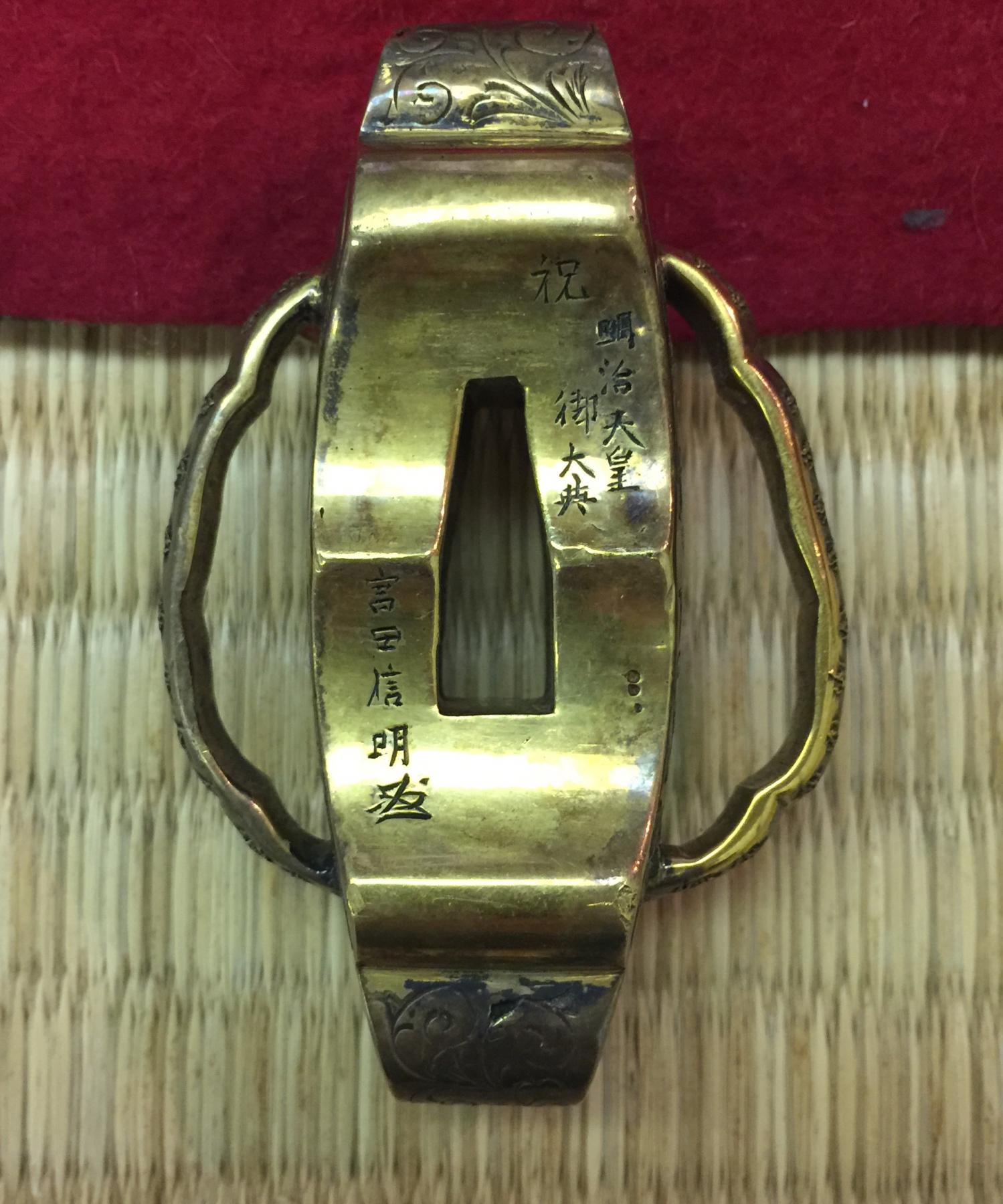
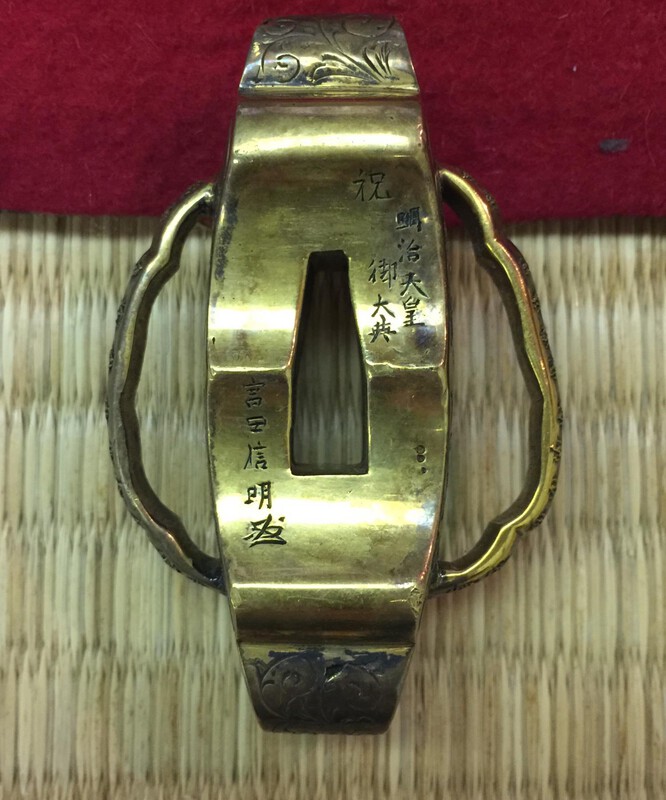
Guido, the slim one is the Hosodachi, as described, apparently. Not only is it less wide, but there is no thickness to it at all. They were worn for special court visits even by non-Samurai, so often there is only a Tsunagi or Takemitsu inside. Only someone from a Samurai family would insist on having a real blade to go inside their Hosodachi koshirae. I have taken a shot of the Mei inside the Tsuba. It records the occasion for which it was made.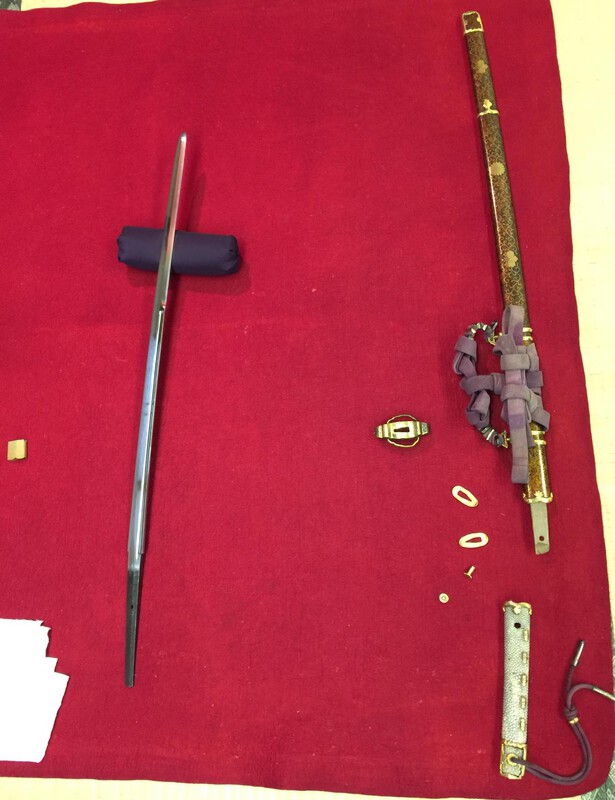
-
Bob, all is forgiven. You are most welcome. Looking forward to the photos.
-
Bento boxes often rock!
-
Haha, for a moment I was hit by a flash of jealousy! (Your tsuba are probably worth more than 20 koban though). Nice home for them.
-
Nice chest for the other thread even. The locking strip is a good feature. Any hidden drawers? How small/large is it?
-
This took several hours of work in serious pain with a crook back, Bob. Are you still out there?