Bugyotsuji
-
Posts
14,633 -
Joined
-
Last visited
-
Days Won
293
Content Type
Profiles
Forums
Events
Store
Downloads
Gallery
Everything posted by Bugyotsuji
-
This Week's Edo Period Corner
Bugyotsuji replied to Bugyotsuji's topic in General Nihonto Related Discussion
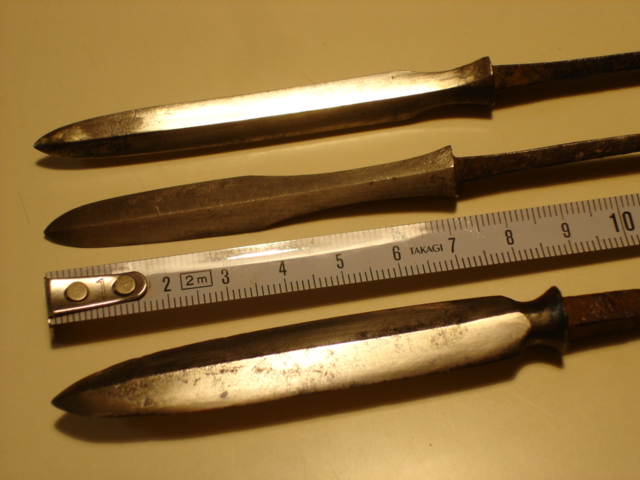
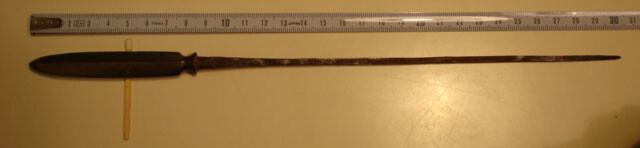
Some closer shots of the Shiri (bum/butt) = arrowhead.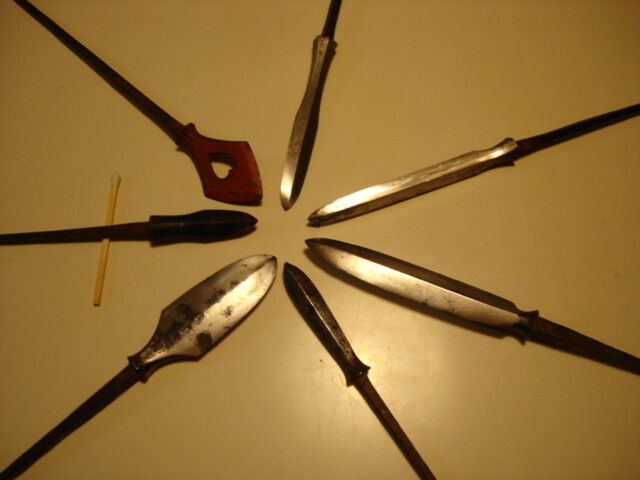


-
This Week's Edo Period Corner
Bugyotsuji replied to Bugyotsuji's topic in General Nihonto Related Discussion
The last two.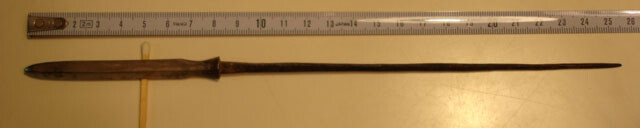
-
This Week's Edo Period Corner
Bugyotsuji replied to Bugyotsuji's topic in General Nihonto Related Discussion
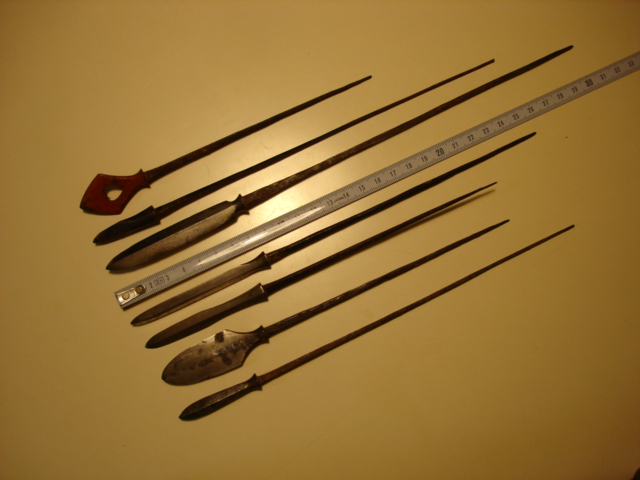
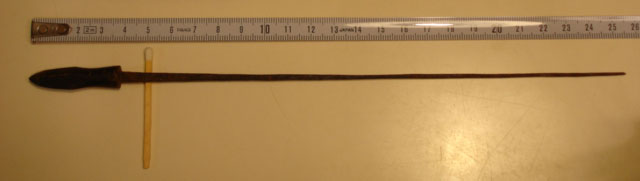
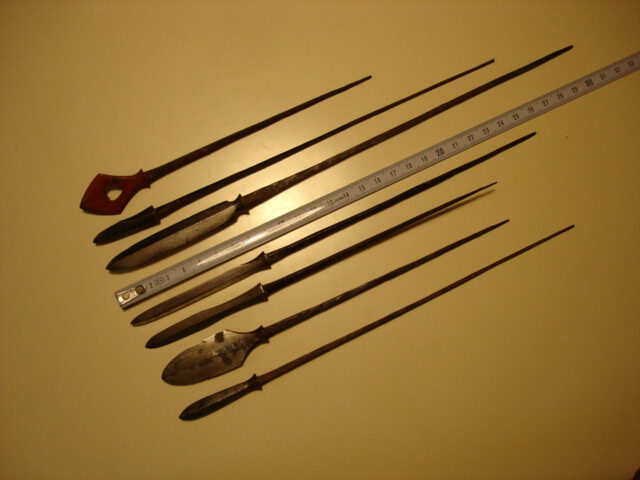
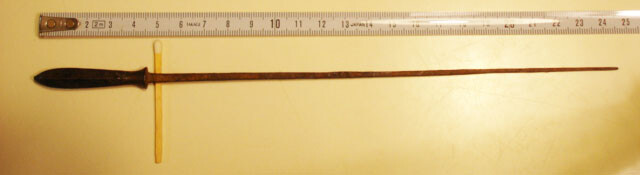
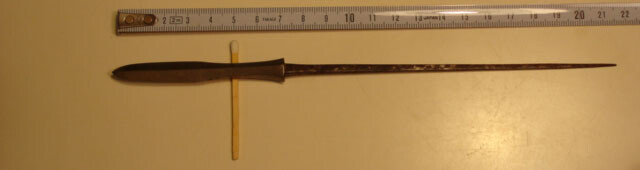
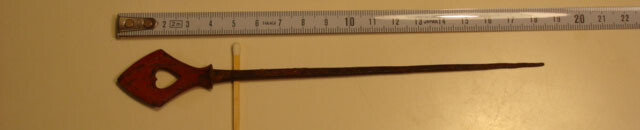
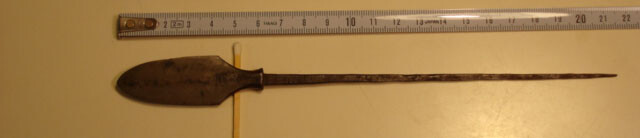
Here goes with a photographic blend of science and artistry! The largest is 30cm from tip of the Yajiri, to the end of the Nakago; it could almost be taken for a yari spear. The blade is 7.5cm or 8 cm in length, depending on whether you stop with the cutting edge or with the collar. The shortest is the red one, 18.5 cm in overall length, with a blade 4 cm long by 2.5cm. Most of them were polished to some extent by the person who gave them to me. One is coated in red and one in black lacquer. The red one is Ino-me sukashi. None are signed with a Mei, but two have horimono remains on the blades. Thoughts. I wonder whether the bowman had a choice of tip available, depending on what kind of enemy was approaching? Like a set of golf clubs??? The variety surprises me. Disclaimer. These are nothing like some of the really beautifully-worked yajiri one can find and pay huge prices for. I love such, but they are in a different world! One day when I can afford one... These below were as stated from a certain castle armoury/storehouse. Notice the match is at 5cm.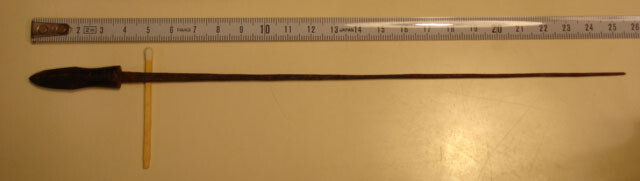
-
BTW, what is 'bemol' ? (Oh, and general question. Why would an auction house send such a very unhelpful photograph? My photos are nothing to write home about, but you couldn't take a more annoying shot even if you tried. You begin to wonder whether they were trying to hide something...)
-
This Week's Edo Period Corner
Bugyotsuji replied to Bugyotsuji's topic in General Nihonto Related Discussion
Thanks Stephen for rescuing us from ourselves. In order to freshen the air, I will post some piccies of the Yajiri. He gave me a representative of each of several different types that they found in there. -
This Week's Edo Period Corner
Bugyotsuji replied to Bugyotsuji's topic in General Nihonto Related Discussion
Brian, would you care to explain the meaning of that to some of our Japanese members? -
This Week's Edo Period Corner
Bugyotsuji replied to Bugyotsuji's topic in General Nihonto Related Discussion
Er, Brian, is the bear a Catholic? Our hearts all surely beat to the same number here. The only drawback to a packed Kura, I should imagine, would be the sheer quantity of objects salted away, and ... ... ... my total lack of ability to judge the market value of most of them. -
Can't believe this thread. It's sickening that eBay can be used upside down like this... all their checks and balances work in favor/favour of the dishonest... and actively shut out the innocent party... grrrrr
-
This Week's Edo Period Corner
Bugyotsuji replied to Bugyotsuji's topic in General Nihonto Related Discussion
From your post, Brian, I can tell that you know a lot more about this subject than I do. My quick answer is... please let me off the hook! Here is some general knowledge, however. Fire being one of the 4 great disasters, all things of value (for those families possessing such things) would be put in a self-standing plastered and tiled storehouse away from the main house, perhaps in one corner of the courtyard/garden. The walls, doors and window shutters were very thick and it was designed to stand up to almost anything, including earthquakes, another of the 4 calamities. A wealthy family might have more than one 'Kura'. As they got packed with family heirlooms, it became a bit of a chore to go in and sort out/index, so in many cases no-one really knows any more what is in there. The door was usually bolted and locked with at least one massive padlock to guard against thieves. There is a type of antique dealer, much disliked in general, called an Ubu-dashi-ya, (a displayer/seller of freshly-discovered objects that have not seen the light) who goes round villages looking for houses with their Kura still intact. He will call at the house and try to persuade the owner to let him into the Kura storehouse to see what there might be for him to buy and sell. If a Kura is destroyed in an earthquake, this is a time of anxiety for the family and an opportunity for others. Kura are also regularly broken as houses are rebuilt or land is developed, and sometimes the family asks the builders to organize someone to sort out and sell off the contents, giving welcome opportunities for rich pickings for those in the know. Rich widows might try to sell off the contents quickly if the tax authorities announce they are on the way to evaluate and decide probate. I have seen no official figures on numbers of unopened Kura, but you do see them still all over the place, especially in the countryside. They may be empty, or they have in some cases been made into living space, but there must be many that remain untouched, even though antique dealers loudly bemoan the scarceness of such. -
This Week's Edo Period Corner
Bugyotsuji replied to Bugyotsuji's topic in General Nihonto Related Discussion
This week's corner, but... still the same week where you are? It's midnight in Japan, so maybe a new week here. Had a very mixed day today. Had to attend a funeral in Mie Prefecture, a four hour drive from here. Standing outside in the baking heat with no shade or hat while the priest droned on inside. The girl is only 19 and she has lost her father, the sole breadwinner for the family, to a stroke. Through a friend I was introduced to a husband and wife who are descended from the Scribe/Karo to a famous Daimyo. Their family have the keys to the castle Kura and they showed me some of the things they inherited, including some amazing swords and koshirae. Envelopes full of fascinating seppa of different thicknesses and materials, fuchi kashira, tsuba, menuki, etc. (Have you ever seen a leather seppa? I examined it with a magnifying glass and told them I thought it was lacquered wood.) One sword was So-shu-den, Chikuzen no kami, Sa no Kunihiro. The fuchi and kashira were by Masachika. They had a letter to the Lord from Tokugawa Ieyasu, among other things. As a gesture of friendship, they gave me some long nakago yajiri arrowheads from the castle inventory. 14 hours there and back. -
Just asked about the backlog and was told: "You will wait 6 months for a Juyo sword to come back from Shinsa. Oh, and 18 months for the paperwork." So, what are we complaining about guys?
-
This Week's Edo Period Corner
Bugyotsuji replied to Bugyotsuji's topic in General Nihonto Related Discussion
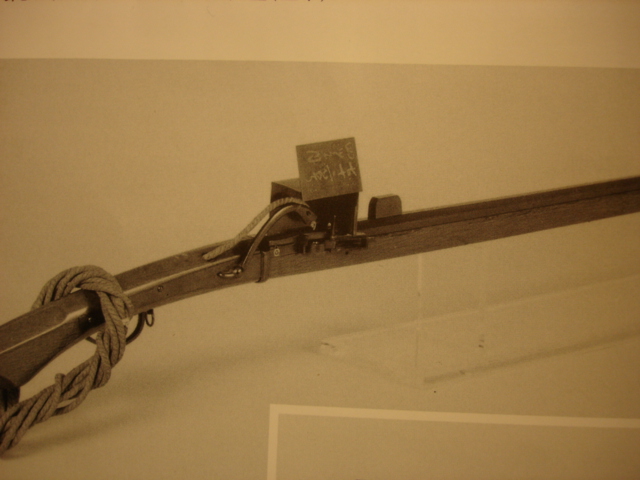
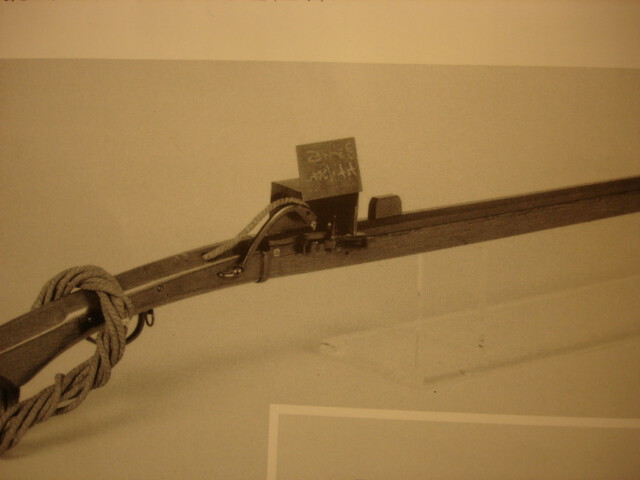
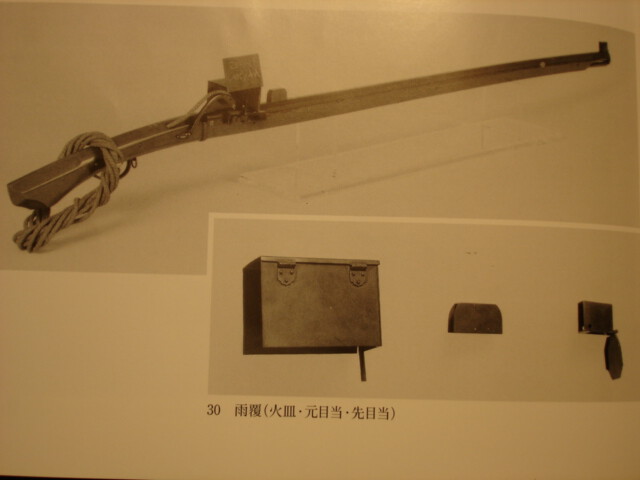
Thanks for that Ian! Excellent stuff. Later today I had a look around and found a catalogue of an exhibition held some years ago in Nagoya Castle. The rain box here is quite different from the one I was planning to post (hand-made by Sawara Taira out of leather) and looks to be made of sheet metal. This one doesn't seem to cover much of the match, and I am not sure how it fitted on. Anyway, we know know that there were at least two versions and possibly many more. Materials were lacquered leather or paper, or metal sheet? We had a bit of a chat among our matchlock company members this afternoon and the leader, who tends to be fairly knowledgable, said that Sawada Taira's word Ama-ooi is actually wrong. The Nagoya catalogue as per photos below also labels them Ama-ooi, but I was assured today that they should be called Ama-yoke', or rainguard. Perhaps they were called by different names in the various regions.
-
This Week's Edo Period Corner
Bugyotsuji replied to Bugyotsuji's topic in General Nihonto Related Discussion
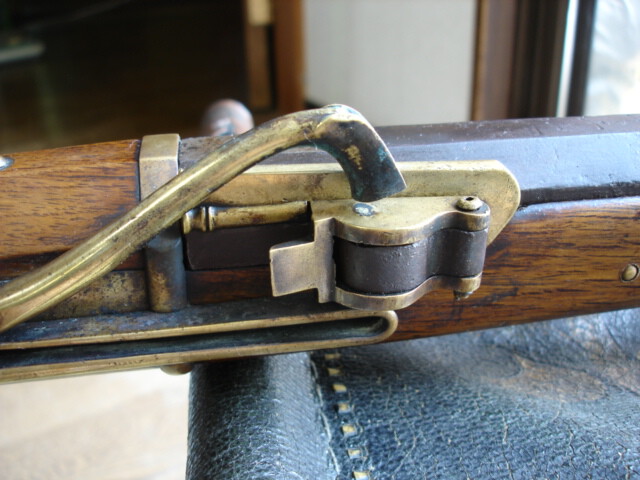
For complete protection against the wind and rain, and to stop the enemy seeing your lighted match at night, you could cover the whole match and mechanism with a lacquered paper box-like cover, this also was called Ama-ooi, or rain cover. The whole thing was placed over the top of the barrel, and fixed with a single wire which sat into the hole in the top of the pan cover pin! It must have quivered slightly, balanced as it was on one vertical wire unless the wire continued round and snapped shut under the barrel in some way. Material for future study... I have a picture here in Sawada Taira's book, Nihon no Furu-Ju 日本ã®å¤éŠƒ p. 133, but... there is a clear warning in the back about copyright, so perhaps it might not be wise to show it publicly here. (Sawada Taira is quite famous/influential in Japan; it would really not be clever to get on the wrong side of him!!!) PS An indication of how popular these lacquered rain protectors might have been is the fact that almost every matchlock ever produced in Japan had the hollow pin in preparation for fitting the black box Ama-ooi. -
This Week's Edo Period Corner
Bugyotsuji replied to Bugyotsuji's topic in General Nihonto Related Discussion
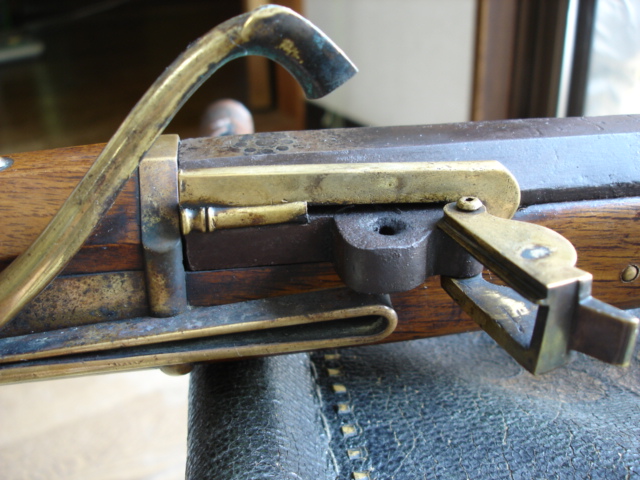
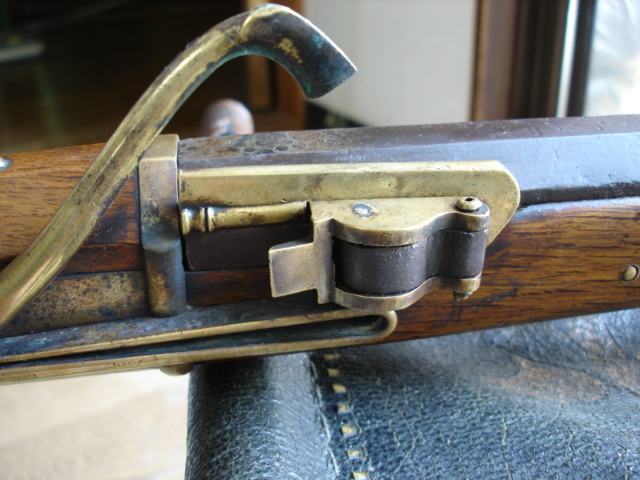
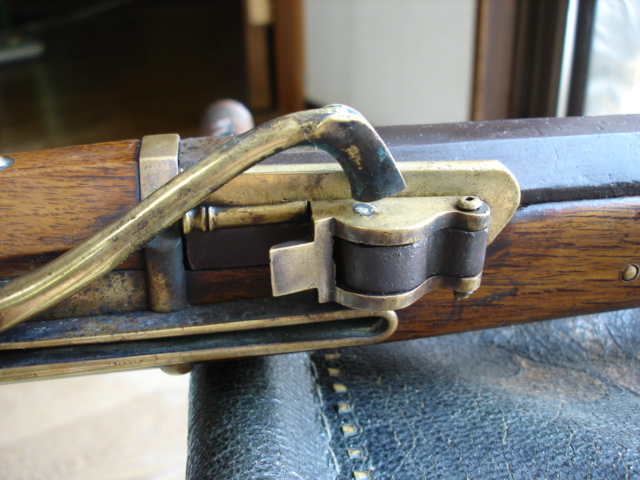
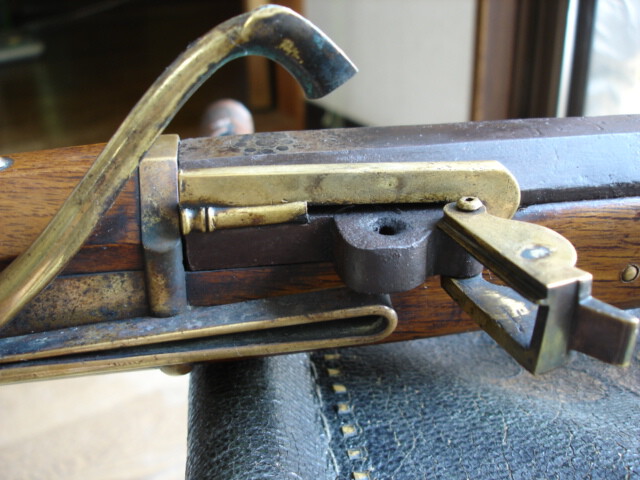
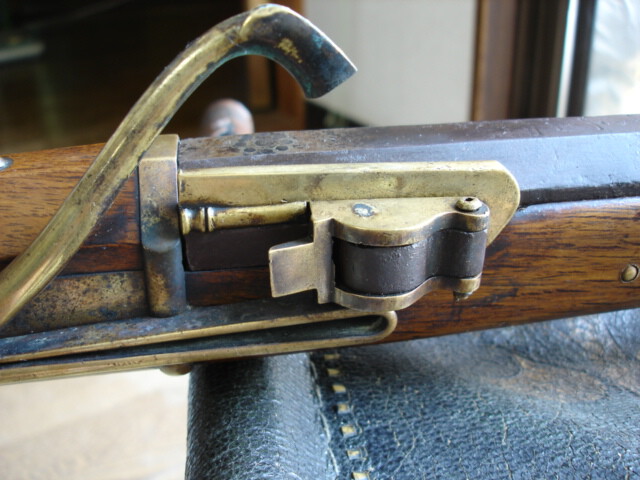
Lafayette C Curtis over on myArmoury.com had an interesting question about how the priming pans were protected on Japanese Tanegashima matchlocks. Gabriel Lebec has been acting as an in-between ferrying messages back and forth between us. Many thanks, Gabriel. Below are a series of photos illustrating my own matchlock and the degrees of protection available. One. The pan lid which fits/sandwiches quite snugly over the priming pan itself, in both closed and open position. I've pulled up the serpentine. Two. Notice the brass partition behind it, called the Ama-ooi, or rain protector. This was to stop water coming off the barrel and working its way under the inner rim of the cover, and divert it backwards or forwards.. Three. Notice the hole in the top of the pan pin. Your matchlock should ideally have this hole; the pin itself is actually hollow.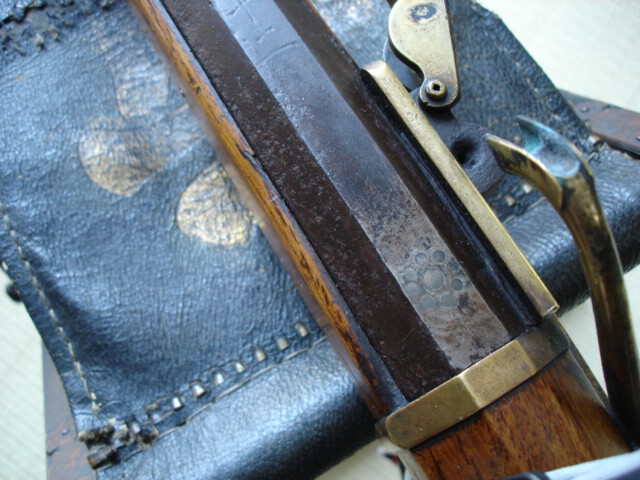
-
When you say weight, John, do you mean the feeling of weight in the hand, or the actual weight measured on a scale, relative to its size? This one I broke my own rules and bought unpapered over the internet. It was smaller than I'd hoped, but it is certainly quite heavy. I will be showing it to my Tsuba collector friend later today, so hope to get some direct feedback from him. Any little hint or comment nudges the story in a new and interesting direction. Even if it's not what I thought, I may learn a new lesson in discernment. It is slightly unbalanced, isn't it, and there is a section missing for the edge of an imaginary hitsu-ana.
-
It's something I've been asking Japanese people about this last week or two as most dictionaries don't mention it. They use it so casually and quickly it's difficult to pin them down. This set of words (Noboru/Sagaru) is the way they perceive history. It's like a river. If something 'Noboru' (goes up) or 'Jidai ga noboru' (The age is quite high) then it's further up the river and is more ancient, and as you come down the river towards where we are now it 'Sagaru' or 'Jidai ga sagaru' (the age drops) and becomes more recent or younger. I checked this concept with various people including a Nihonto shinsa expert and found it was 'commonsense'. In the West some of us see history going left to right, others right to left, some back to front, others up to down and some down to up! How about you, John? :lol: PS What makes you curious about the iron?
-
You asked John and he's not answering so far, Stephen. I don't know what Shinsa he put it into, and there is nothing else written on the sheet, but if they are returning swords starting from June 30th, as it says, then...
-
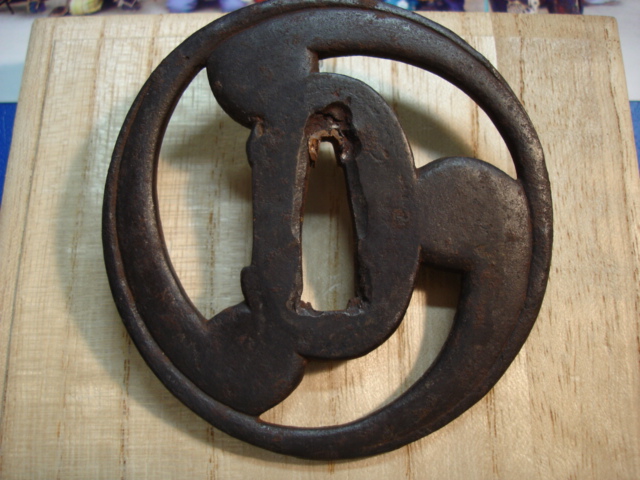
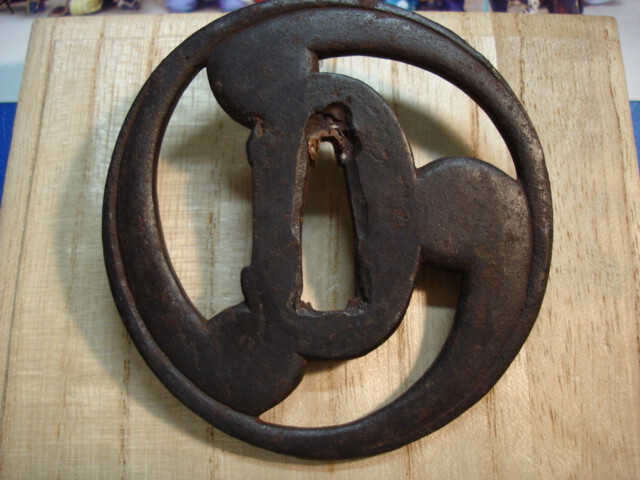
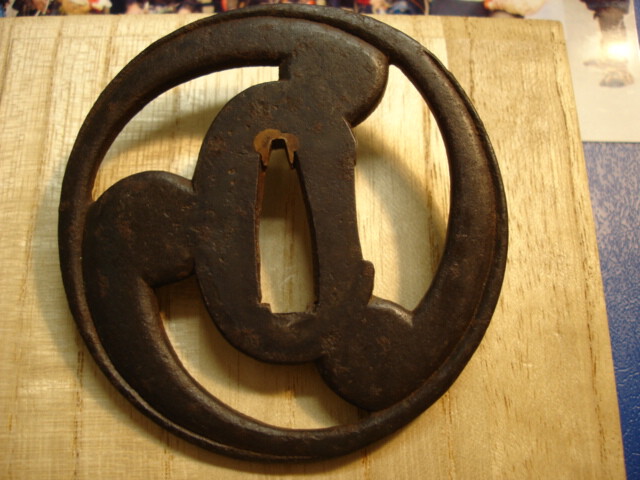
Can anyone tell me anything about the tsuba itself? How should I characterize it? Even about the one above it, if you've been holding back for some reason. For better or for worse! (Besides the comment on the imposing quality of the seppa-dai, the dealer said 'Jidai ga sakanoboru' which sounded better to me than 'jidai ga sagaru'. My mate said he also has one, and they made quite a lot of Mitsudomoe sukashi tsuba. But that is all I know or believe about it, apart from the fact that it is obviously made of iron.)
-
I suspect that you may be right, Guido. If you get the sword back in August, John, then you may expect to get the paperwork a couple of months after that. Lots of things to look forward to then!
-
Actually it just means that it wasn't presented to TokuHo Shinsa because it was submitted only for Hozon. One can apply for both Hozon and Tokubetsu Hozon at the same time; in that case it would have a stamp either saying "pass" or "failed". Thanks Guido for the clarification. So, what the shop told me was a pack of porkie pies. I have now had two of mine pass Hozon, having been told that I had to go step by step... grrrrrrrrrrrrrrrrr
-
Hi John, Your 'Hozon Bango' Preservation Number is 883. Top right it says 'Tanto' above 'Kaneyoshi', and below that in red it says 'Go-kaku' or Pass. There is a line drawn through 'Tokubetsu Hozon' clarifying that at this stage they are only allowing you the first step of Regular Preservation. On the left it states that this is a notification of the facts stated on the right. The process of returning submitted object(s) will be started on June 30th. Nothing will move on Saturdays, Sundays, or National Holidays.
-
So much for that one, then. Today I purchased this tsuba. The reason I bought it? Having been to see the site of Hashiba's (Toyotomi Hideyoshi) brilliant 'Mizu-zeme' capture of the Western fortress of Takamatsu Castle, I was stunned by the actions of Shimizu Muneharu and the way he committed Seppuku. His Mitsu-domoe Mon suddenly came to mean something. As to the tsuba itself, what do you think? The seppa-dai is quite large and thick, comparatively. 7 x 7.6 cm, 2.5mm at mimi, 4mm at seppa-dai.
-
Help Needed – Sword Bought at Auction
Bugyotsuji replied to eureka123's topic in General Nihonto Related Discussion
Good advice there, Brian. Oh, and Bob, don't forget to put it back together very carefully or they could claim you damaged it! -
Seikadô exhibition
Bugyotsuji replied to Guido's topic in Sword Shows, Events, Community News and Legislation Issues
Unfortunately yes. :lol: Yasutsuna is the earliest sword smith ... grooves make a sword more resistent to bending ... how much more can someone [self-deleted profanity] an article who obviously had the chance to get it straight from the museum/curator? You don't like the lady, then! :lol: On a positive note, the article made me want to go and see the exhibition. -
Seikadô exhibition
Bugyotsuji replied to Guido's topic in Sword Shows, Events, Community News and Legislation Issues
Apologies if this is a repost, but have you seen this article? http://search.japantimes.co.jp/cgi-bin/ ... 626a3.html