Bugyotsuji
-
Posts
14,637 -
Joined
-
Last visited
-
Days Won
294
Content Type
Profiles
Forums
Events
Store
Downloads
Gallery
Everything posted by Bugyotsuji
-
Hmmm... thanks for that! Now...
-
The registration 'Toroku-sho' is usually taped or elastic banded onto the shira-saya like that. Messy, but nothing unsual. The quick and definitive answer to your question is no, there is never any indication as to whether it is Gimei or not. The Education Authority simple records the markings and dimensions of the sword or gun and assigns a serial number to it. I see yours was registered with the Miyazaki Education Board in Kyushu.
-
Do either or both of these books go into the historical changes in yari design by age?
-
Hi Lee, welcome to the site. There is quite a bit of detail and puzzle in your post, so I suspect that no-one has been willing to try and answer, since it may take some time to marshal the old thoughts. I will start the ball rolling by saying that it was interesting hearing about your background and the plans for passing the sword on to your daughter. Would it be possible to take some more piccies with an overall view as we cannot see the wood for the trees? It is hard to imagine what you describe about someone actually cutting a sword short to fit in a bag, and we would wish to see the difference between that and any suriage, for example. As to the Mei, did you read that yourself? It is generally on target, but I sense that the way you have cut the words may not fit quite right. I will go away and study them, but I suspect someone else will step in and provide the necessary dusting up!
-
Very nice. It does look surprisingly long. At first I thought it was my computer screen which does that to everything. I had a lovely one in full koshirae with a gold and silver Kikusui mon on the 'blade' but foolishly sold it to a friend. He still refuses to sell it back...
-
This Week's Edo Period Corner
Bugyotsuji replied to Bugyotsuji's topic in General Nihonto Related Discussion
I agree that the Mei is irrelevant. But FYI, the Mei seems to be Kanemoto (兼元). Would it be correct to say that after Hai-to-rei some swordsmiths switched from making swords to making these Hikeshi, Jitte, and so on? -
This Week's Edo Period Corner
Bugyotsuji replied to Bugyotsuji's topic in General Nihonto Related Discussion
That one looks in good condition, a good solid one with reinforcing rods, and nice to have it signed like that. Belt hook too. There was a need to pull the straw off the roof ASAP, and I also heard that firemen in Edo were often hired thugs who would push families out of their houses and smash the houses down to create firebreaks. The answer to your dreaded question is that yes, from the odd one that I see, I believe there are some being produced today as 'antiques', if not en masse. -
This Week's Edo Period Corner
Bugyotsuji replied to Bugyotsuji's topic in General Nihonto Related Discussion
This morning (Sunday) I got up at 6:45 and drove an hour to quite a good little antiques market. You really need to be there by 5 or 6 am to go for those fresh tidbits, so you can see I was laughably late. Sorting through a pile of worm-eaten Ukiyo-e Hanga I found two that took my fancy. Both were of beauties in kimono, but I was more interested in the furnishings around them. One lovely lady was reading a scroll letter? and on the bed beside her was a small wooden...er... uh... toggle/board? of some kind with writing on it. Now I had just seen such a toggle two stalls down so I called the owner and asked what it was. A hi-uchi-gane spark striker, for flints, he said. I bought the wooden holder part, even though the iron striker itself was missing. One of these days I'll find a blade that goes with it. Perhaps I should have bought the print to go with it too! The second print showed an Edo beauty reclining, with a Wa-rosoku candle burning brightly on a lacquered stand behind her. This print had been washed and cleaned and rebacked neatly with some washi paper to disguise the worm holes and the dealer wanted me to cover his outlay on the restoration first, before haggling over the print itself. Again, I left the print, but I know where this dealer has his permanent shop, so I can always go there if necessary. This brings me to this week's corner, and I've been thinking about Andon lamps and lanterns, and shoku-dai candlesticks and candle-holders. These have always attracted me, but they tended to fetch high prices when I couldn't afford them. Little by little, I have grabbed bargains over the years and have several now dotted around the house. Not attempted to photograph them yet, though I did post a candlestick on this site (the old site?) some months back when we were discussing the caltrops Matsukawabishi Hishi Mon. Took the project no further at the time. Would anyone like to show off anything along these lines? It can be any class, from museum quality to simple folk ware. No competition intended. The aim is to show the variety of lights that were in vogue at some time, in a country of wooden houses prone to earthquakes. I am always amazed at the inventiveness of pre-Western Japanese society. -
Welcome to the site Kevin. I am in the West of Japan, two or three hours further west from Kansai but the November DTI event looks like something I would hope to be able to fit in. (Not even sure when it is...) If you ever get down this way give me a pm. Where is Najio, BTW?
-
The mei on the reverse looks 政晃 (Masaaki?) to me. Yes, that's good, and it makes sense too!
-
I've seen broken katana or wakizashi blade sections that have been refashioned into tanto. Would this be a possibility here, I wonder?
-
三æ¡é•·å‰ä½œ "Sanjo Nagayoshi Saku" Does it say æ”¿ç”·ä¹ on the reverse? Had to turn my computer upside down to stare at that. That's what it seems to be saying, until someone has a better suggestion.
-
This Week's Edo Period Corner
Bugyotsuji replied to Bugyotsuji's topic in General Nihonto Related Discussion
Well, I don't knoiw about academic reliability, but I am convinced! How do you find these things, Moriyama san? It looks like a long ro-ka, specially designed for kneeling/seated archery. Thanks. Very easy to slip back in time... -
則定 Am I seeing Norisada there?
-
This Week's Edo Period Corner
Bugyotsuji replied to Bugyotsuji's topic in General Nihonto Related Discussion
You knock me over with the comprehensive nature of your reply, Moriyama san. I have had a look at your links and immediately learned that the two games were esentially the same, but played quite differently in Kyoto and Edo. I also learned that my Japanese is not good enough to take advantage of all the information that you have offered. Let's hope that other readers will gain something from your offerings. I will go back and attack again, though. In the meantime, thanks for the wonderful background information. A friend of mine showed me a small bow the other day which looks similar to the one used in the Furyu-karakurenai Ukiyo-e Hanga at the bottom of your post. The bow is painted in gaudy coloured stripes, is solid, of one piece, and is thicker and stronger and rounder than the ones in Ian and my box sets. -
This Week's Edo Period Corner
Bugyotsuji replied to Bugyotsuji's topic in General Nihonto Related Discussion
Thanks, Ian. Well, I'll be blowed! Here I am never even knowing such things existed and you actually had one all along! Plus yours has a Mon on the box lid, on top of everything virtually assuring it belonged to someone special. That really is uncanny. And they are so similar, sizewise, colourwise, and structurewise. -
This Week's Edo Period Corner
Bugyotsuji replied to Bugyotsuji's topic in General Nihonto Related Discussion
Fantastic stuff! The idea about the name, Yarizo, is an interesting thought. With kane-hen, the meaning might not necessarily be 'spear' then? Is that why you suggest it might be a name? Thank you so much, Morita san. This was really starting to bother me! -
This Week's Edo Period Corner
Bugyotsuji replied to Bugyotsuji's topic in General Nihonto Related Discussion
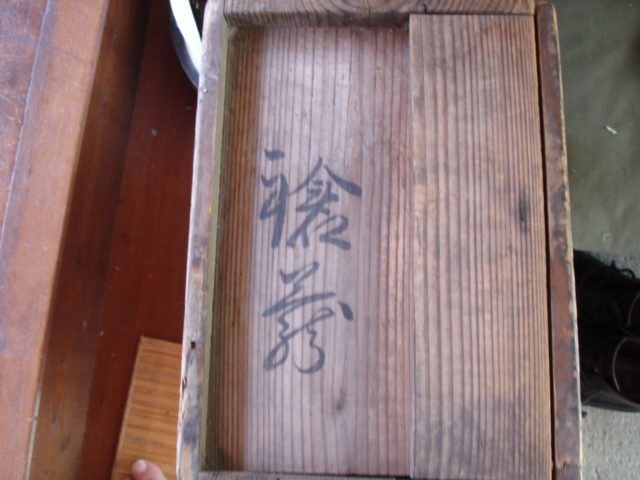
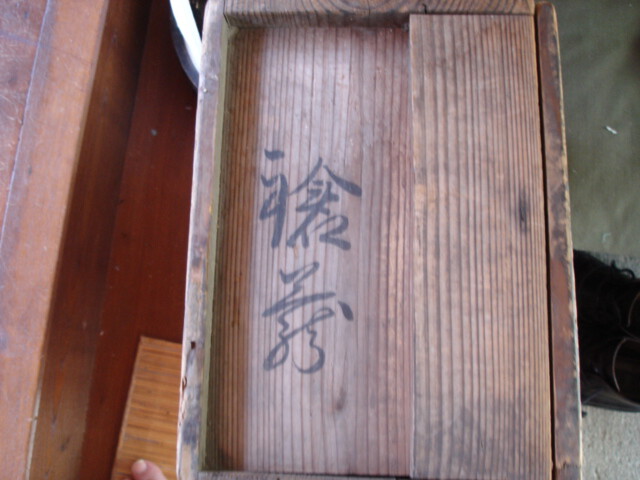
The stall holder told me he thought the two Kanji read Sou-Sou, but can anyone help? The first one looks like Yari æ§ã€€but the second one is difficult. Is it some form of Kura/So, 蔵 倉 庫 with the meaning of Osameru, or put away? Yari-kura? I know there are lots of expressions in Japanese pronounced sou-sou, including one that means a row of long sharp objects, but does anyone get such associative meanings from this repetition of sounds? -
This Week's Edo Period Corner
Bugyotsuji replied to Bugyotsuji's topic in General Nihonto Related Discussion
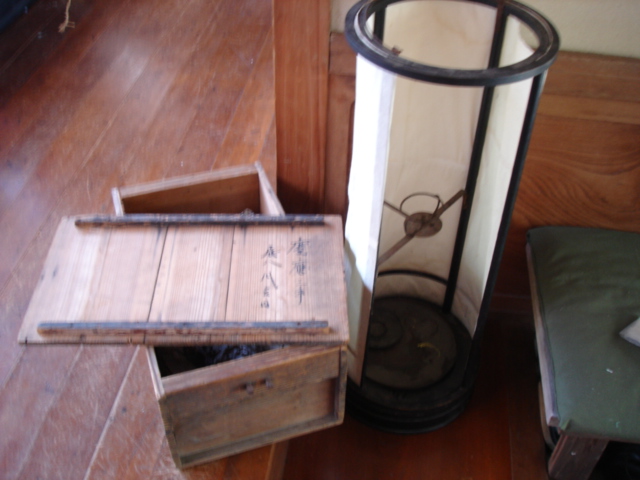
The sword shop advised me not to bother sending any Yajiri, or Yanone, away for professional polishing. To be expected, of course. The last few nights I have been sitting here sanding down the arrowheads with water and progressively finer paper. Having reached a good medium limit (leaving enough of the Mei on the blade of one so it can still be read) I wiped them with clove oil and wrapped them up. Today I went to visit a twice-monthly farmer's market where they have a few antique stalls and bought some interesting odds ands ods. 1. A little folding calibrated magnifying glass stand. 2. A tall black Andon light stand. Genuine, cheap as chips now... 3. A fairly roughly-made swordsmith's large-ish toolbox from Bizen, with the date Keio 3 in inkbrush, 1868, and further characters intimating... 'spear store'??? 4. An E-ma wooden board with a picture of some chappies doing Sankin Ko-tai on it. Their Haori Mon is the Kuginuki Mon that is on the little bow 'n arrow set, which partly explains the purchase. Painted in the old style, but probably recent, but cost next to nothing. 5. Two silk woven cords which will be useful for tying sword bags, boxes, etc. In the afternoon I went round with a mate to an antique dealer's stiflingly hot warehouse. A quick whip through resulted in: 1. Two tsuba boxes with their little cushions (new, probably made in China) 2. An old black wall-rack for ... swords, spears? A Do-jo Bo rack? 3. Three long Jidai-bako boxes for, wakizashi, tanto, arrowheads, etc. a. Newish? narrow white keaki wood tight-lidded box, 2 rests inside, length 62cm W7.5cm b. Old Jidai bako with overhanging lid, length 64cm, W12cm c. Old Jidai bako with flat lid, Length 89cm, W14.5cm. Dated in ink on bottom, Tempo 13 Nen, or 1843. The above is my humble contribution to this week's Edo Period Corner. If you can use your imagination, then we won't have to use bandwidth... hehehehe :lol: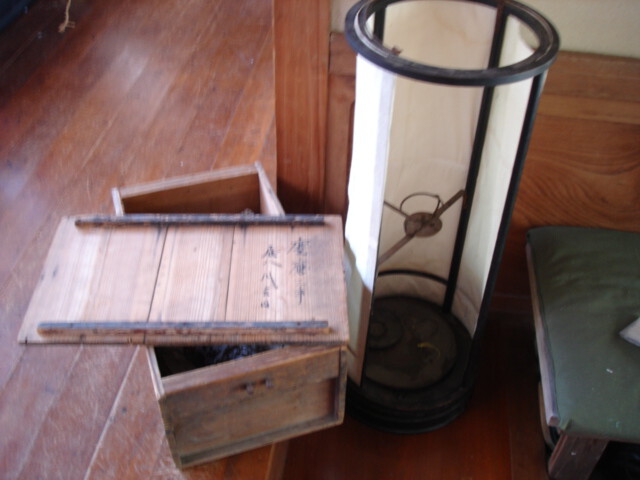
-
Just read this thread for the first time, and well worth the read. The original title put me off, but having finally read it, I have had to expand my perceptions of the history of iron usage. Thanks guys.
-
This Week's Edo Period Corner
Bugyotsuji replied to Bugyotsuji's topic in General Nihonto Related Discussion
I'll look forward to seeing those, Ian. The Japanese seem not to be interested in them so much. Perhaps these all went abroad... -
This Week's Edo Period Corner
Bugyotsuji replied to Bugyotsuji's topic in General Nihonto Related Discussion
Ian, you have definitely found something now, and piqued my curiosity further! Good stuff. Yours sounds better than mine with the gold! The flat heads were a mystery, but rubbing chalk or ink on them... now, that does make infinite sense. There are in fact what I thought were rust rivulet markings near the flat round tips, but dipping them in ink might have caused the iron pins? inside the shafts to rust and leak out like this. Secondly I could find no difference in the arrows until I read your comment above. The flights are all white on mine as you will have seen. Now I can see rings round the shafts, though, between the flights! Painted in... silver? They go from one ring to six. I, II, III, IIII, IIII I, & IIII II with a funny gap for numbers above 4. It would be good if you were able to find and post a piccie of that Ukiyoe Hanga... PS It is my impression that these sets are very rare. None of my Japanese antique 'expert' friends had ever seen one before. The Yoshiwara connection, though, does suggest that they must have been in fashion at one time. -
This Week's Edo Period Corner
Bugyotsuji replied to Bugyotsuji's topic in General Nihonto Related Discussion
Good link there, Brian. Thanks for that. I had a bit of a read up here and there, and discovered that the Kabura-ya were used primarily to 'purify' the field before a battle. The secondary effect would make more impression on me, I suspect. Oh, and one more discovery. Re-examining the bow and arrow box (posted earlier) with some friends, I learnt a bit more about it. It was probably part of a full set of display objects for Tango no Sekku, The Boy's Festival, now 5 May, which celebrated Sho-bu or the warrior spirit. This was not celebrated in every household till well after the beginning of Meiji. Until then it was probably only observed in high status families, and the Mon on the grip of one of the two bows suggests it belonged to a Daimyo. (One of my acquaintances is a Daimyo descendant, and he pointed this out.) The Mon is the Kugi-nuki design, a square with a square hole in the centre: http://www.otomiya.com/kamon/kibutsu/kuginuki.htm See top row, centre. This was the Omote Mon of the Hori family from Iida in Nagano, at the end of Edo. -
This Week's Edo Period Corner
Bugyotsuji replied to Bugyotsuji's topic in General Nihonto Related Discussion
Can anyone clarify the following, one way or t' other? Someone I respect told me that the red lacquer sukashi yajiri above, with the Ino-me center/centre, is actually a Kabura-ya, designed to whistle, (or make some kind of scary noise) in flight. -
The fourth Kanji looks like it has been hit and distorted, making it difficult to read. The Mei should continue 藤原 å£å£ä½œ/é€ but it looks like you've lost the name of the actual katana-kaji.