

Bugyotsuji
-
Posts
14,626 -
Joined
-
Last visited
-
Days Won
292
Content Type
Profiles
Forums
Events
Store
Downloads
Gallery
Everything posted by Bugyotsuji
-
The following steps will make life easier for anyone contemplating separating the barrel and stock of their Tanegashima matchlock, in order to read the Mei. Illustrations below, Pics 1~5. PART ONE...... OPENING 1. Remove the Karuka (ramrod). This allows the stock to relax its grip on the barrel. 2. Don't touch any pins connected with the mechanism, the pan lid or any to the rear of the mechanism. Remove the two (sometimes one, or three or four) horizontal Mekugi pins from the Mekugi-ana in the wooden stock, forward of the mechanism, pushing from left to right with the gun muzzle pointing away from you. (Pic 1) You can use your Nihonto Mekugi-nuki pointer to get them started from the left side. They should be made of bamboo, (preferably smoked) but some Mekugi pins may be brass. You may encounter difficulty if the pins have been inserted incorrectly after their arrival in the West. Adjust accordingly. Note 1: Note they will be of slightly differing sizes. Lay them out in order to help you remember correct replacement. Note 2: When replacing you will know the barrel is sitting in the correct position if the pins slip back miraculously into their original positions. Note 3: Some guns have an extra brass band holding the stock and barrel muzzle together. Slip this off, noting whether it has an inherent 'correct' direction to it. 3. You are now nearly ready to separate the barrel from the stock. WAIT. Place the butt of the gun onto a soft object like a slipper and hold the gun upright. 4. Pull back the serpentine into locked open position. It's delicate, and may fall, but be patient and try again. 5. Hold the gun stock near the muzzle, between the straightened fingers and thumb of your left hand, barrel towards your left palm, (Pics 2 & 3) and push the top of the barrel out with the heel of your right hand against the muzzle itself, until the barrel releases from where it is normally seated, with increasing strength if necessary. Some stocks have shrunk over the years, so you may need to bang the barrel out with hits from the palm/heel of your hand. Note: A rubber mallet may be necessary, but in that case you may want to save yourself trouble next time by candle-waxing the inside of the stock to decrease stickiness. (Or whatever your preferred method of gentle lubrication might be.) 6. The barrel should still be seated at the breech end, split out at an angle of about 10~20 degrees? Lift the whole barrel out gently so as not to damage the lock or stock sides. 7. On the underside of the barrel, (Pic 5) you may find the Mei, which is often the location and the gunsmith's name, (as in Nihonto), an indication as to the method of manufacture, and in very rare cases may give a date. You may also find some numbers indicating manufacturing process or related parts for castle guns or guns made in pairs or in quantity. Note: There is a high possibility that it will be badly rusted and almost illegible. Be careful not to attack the rust with any approach that you may regret later. How to deal with that is a separate subject. 8. Look for any lettering (possibly in brush and ink) inside the stock itself which may tell you something about the carpenter. 9. If you are lucky, the large, usually square-headed, Bi-sen ('bee sen') plug-screw will twizzle out of the barrel breech (Pic 4) and make cleaning it 100 times easier. Don't damage the Bisen with a heavy wrench. It will always carry the scars, not good; in the worst scenario the screw will split and shear in half, drastically devaluing your antique Tanegashima. There are methods of removing stuck Bisen screws, but that too is another specialized subject. (Initially you can insert penetrating oil from both ends and tap in all directions with a rubber mallet, and repeat over several days or weeks as necessary.) For a general idea of what they look like opened up, see the three photos in the middle of this page: viewtopic.php?f=9&t=2554&st=0&sk=t&sd=a&start=90 Identify the Bisen screw, the Mekugi pins, the open serpentine, the removed Karuka, the rubber mallet, and the separated barrel and stock.
-
This Week's Edo Period Corner
Bugyotsuji replied to Bugyotsuji's topic in General Nihonto Related Discussion
Good idea. The photos for the illustrations will be in a week or two, when I get back to Japan, if people don't mind waiting. -
This Week's Edo Period Corner
Bugyotsuji replied to Bugyotsuji's topic in General Nihonto Related Discussion
Milt, your gun should open almost as easily as a Nihonto, with a couple of things to watch out for. Looking for and reading any Mei is part of the fun of ownership. If you need a tip or two I can post here for everyone, or PM you. -
This Week's Edo Period Corner
Bugyotsuji replied to Bugyotsuji's topic in General Nihonto Related Discussion
Yes, you are correct, John. The shorter ones were pure pistols, ie Tan-zutsu, or short cylinder/pipe/pistol. Slightly longer ones were for the cavalry, with better range and accuracy, but not too long to make reloading on horseback difficult. Ba is 'horse' and Jo is 'upon'. Often they would have an Ude-nuki-ana cord hole between the Mekugi-ana. Karuka. The scouring stick, or ramrod, is generally called a Sakujo, but the older and more proper name for a Tanegashima matchlock rod is Karuka. They were wooden in general, sometimes bamboo, and had a hole in the narrow end for passing a cord through. They slide in backwards and 'lock' (stick) with a gentle turn to one side. They were easily lost and longer ones probably broke fairly easily in the heat of battle, especially when ramming something extra tight for better fit and therefore range. No point in anything elaborate, therefore, and easily replaceable the night before a battle. Better examples would have a decoration or reinforcement round the tip, but they tend to be plain. Towards the end of Edo there was a switch to metal rods (sometimes on a swivel joint) enabling just such extra pressure when defending against the West's encroaches. -
This Week's Edo Period Corner
Bugyotsuji replied to Bugyotsuji's topic in General Nihonto Related Discussion
Apologies Stephen, for the sidetrack. I've done my best to tie them in somehow! Milt, thanks for posting your Bajo-zutsu. Sakai, I guess. Is that a brass cap on the tip of the Karuka? Any Mei in the place under the barrel? -
This Week's Edo Period Corner
Bugyotsuji replied to Bugyotsuji's topic in General Nihonto Related Discussion
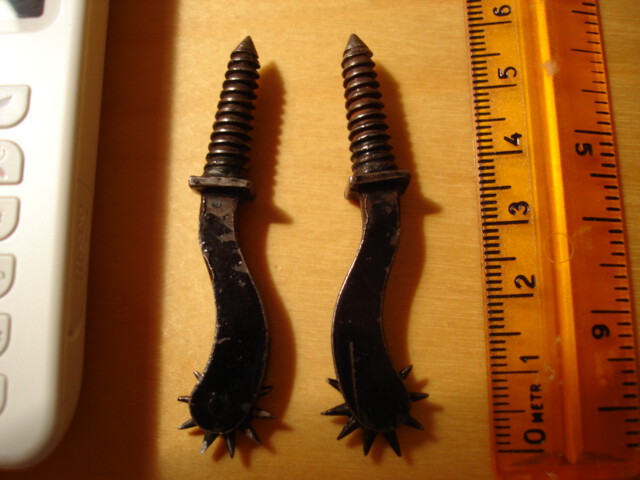
Well, now, you are all guessing wildly but I was hoping someone would know for certain, as I don't. Milt's suggestion is just what the dealer told me. Miniature spurs, possibly as a symbol of the workshop making them, possibly as a project for an apprentice spur maker. I bought them on the spur of the moment, and was chagrined to discover that careful examination of one of them had not been good enough. Never assume that because they are a pair, the other one will be in equally good condition. The dealer showed me the good one. I paid good money for these. When I got home I discovered the other one was jammed/rusted solid and someone had broken one of the very sharp spikes trying to get the wheel to move. Grrrr............ Spurs are called Hakusha in Japanese, which also means encouragement, or urging, today. (Oh, and two days of gentle application of penetrating oil, and very careful work with pliers, files and picks has eventually freed up the second wheel, for the first time in many a year, I suspect.) So how were Japanese horses urged forwards, do you suppose? -
This Week's Edo Period Corner
Bugyotsuji replied to Bugyotsuji's topic in General Nihonto Related Discussion
OK, this is even more seriously off-topic, but it's a kind of quiz. There is no connection with Japan, as far as I know, but I was given a date of about 1820 (Edo Period, innit?). In the UK right now, so please forgive... Questions. 1. What are they? 2. What do you call them in Japanese, if indeed such things were known in Japan? hehehe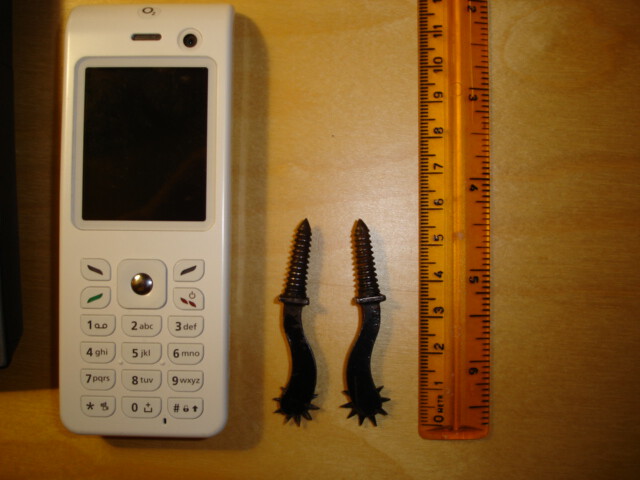
-
This Week's Edo Period Corner
Bugyotsuji replied to Bugyotsuji's topic in General Nihonto Related Discussion
Erm... what kind of a dragon is that, Milt? :lol: -
Hi Nick, the simple answer is the Katana kaji is 'Moritsugu', on 'a day in September'.
-
Symbol of long life, turtle?
-
This Week's Edo Period Corner
Bugyotsuji replied to Bugyotsuji's topic in General Nihonto Related Discussion
Agreed. Very satisfying composition and detail. (Is the Mae-date a face, or an insect, or what, I wonder?) -
He mentions the age on all of his other items, Curran, but not on this one. And all of them end with 'No claims, no returns' at the bottom. Not saying there was anything wrong with it, but with the very high quality of some modern tsuba, and the high price he was expecting for this tsuba, you can never be too safe... IMHO
-
Pete, yes, I looked at that, but I think the top is Nogi-hen. Nobody will know, but in the meantime I would lay my money on Ko-zan.
-
Try Kozan (or Kyozan), if the first character is Kaori...
-
Hmmm... no declaration as to age on this one. Possibly forgot to mention it. And, 'No Claims, No Returns.'
-
Would it be possible to get a clearer shot of the 'first' Kanji, the 'second' Kanji and the 'third' Kanji, please?
-
Have to agree, that tsuba looks really special. Congratulations!
-
I put 'top' in inverted commas as they would be on the 'bottom' for display purposes.
-
Guido, that is excellent, and has cleared up a long question mark I had hanging over me. So, the loop would be fitted over, using the left hand, before withdrawal, or it would hang loosely until the sword was drawn and the wielder could slip his right hand through it. There is a twist in the illustration, so maybe it needed a special flick of the wrist... The udenuki holes would invariably be on the 'top' of the tsuba, then, I wonder?
-
This Week's Edo Period Corner
Bugyotsuji replied to Bugyotsuji's topic in General Nihonto Related Discussion
Ya got me there! I'm liking your painting! -
Great to hear from you Ken. Sounds like you've been having fun! Occasionally a mantis-themed object appears and I wonder where you are. Glad to have you back (with a fine filly in tow?).
-
This Week's Edo Period Corner
Bugyotsuji replied to Bugyotsuji's topic in General Nihonto Related Discussion
Wow, just waves! Beautifully done. That's quite unusual, in my very limited exposure to Japanese painting. The signature? A specialized field. Way over my head. Yoshihisa Saku? You could try posting this in the translation section, Rob. One of our heavyweights might be willing to step in. -
John, do you know of any illustrations showing how this worked in practice?
-
Thank you for the information, Moriyama san.
-
This Week's Edo Period Corner
Bugyotsuji replied to Bugyotsuji's topic in General Nihonto Related Discussion
Ian, thanks for posting those. A sudden thick vein appears! :lol: Your clock is a new world for me. I wouldn't even know which way up that was or where you read the time... It looks like a fantastic object, though. Can you find anyone who might be clever enough to work on it for you? (For love, not money?) The Douran is very nice. I am in the UK, so unfortunately no Kamon books to hand. Do you know the Kanji characters for Yendo? As to your two long guns, which you have sensibly cut in half for the shot... (but where's the muzzle end? Would like to see that!) :? they look like good examples. Do you know their bore/caliber/Monme? I have no trouble with the Sakai gun as everything shown looks representative. The lower gun, though, might be Okayama, with influence of Bizen. Would it be possible to include a shot of the rest of the muzzle end? Can you confirm whether there is a two-inch cut/shaved away section at the top/end of the stock/butt on the opposite side from your cheek? (Do I see it in your shot there?) Is there a kemuri-gaeshi on the back of the pan, and is the pan lid slightly open in your photograph? The rounded 'filed' barrel could be typical of this region. A Rakkyo (pickled-onion) muzzle shape might confirm this. Oh, and you've obviously had them apart.... do they not have any Mei?

