Bugyotsuji
-
Posts
14,897 -
Joined
-
Last visited
-
Days Won
312
Content Type
Profiles
Forums
Events
Store
Downloads
Gallery
Everything posted by Bugyotsuji
-
Edo Period Corner Part II
Bugyotsuji replied to estcrh's topic in General Nihonto Related Discussion
Haha, John, so the answer is never quite so simple, more a compound answer, a 必然 'hitsuzen' rather than 自然 'shizen', a necessary occurrence, the inevitable coming together of disparate factors, rather than a simply natural one. -
Edo Period Corner Part II
Bugyotsuji replied to estcrh's topic in General Nihonto Related Discussion
And photos 2 and 3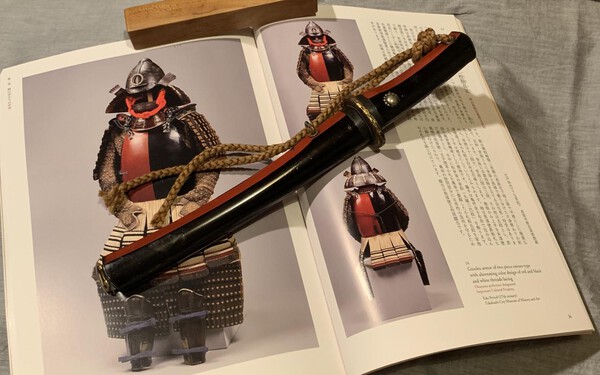
-
Edo Period Corner Part II
Bugyotsuji replied to estcrh's topic in General Nihonto Related Discussion
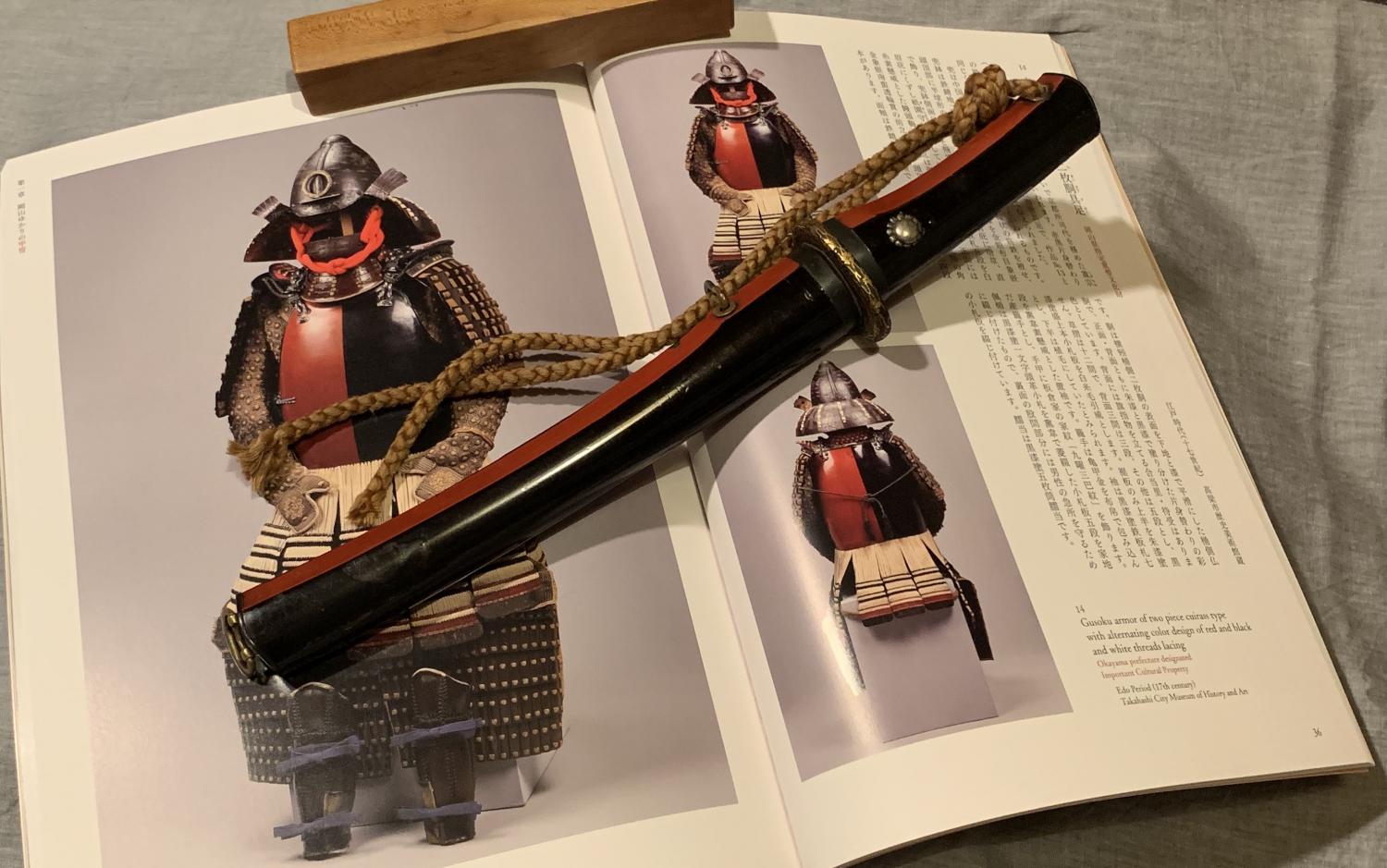
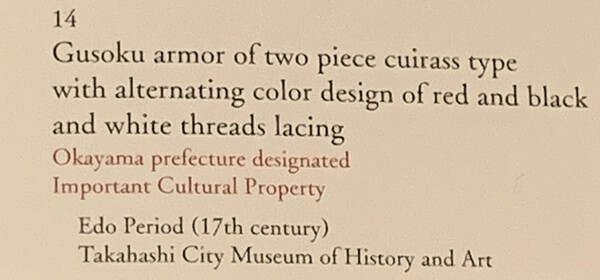
Recently my brain started seeing associations concerning specifically red and black lacquer, perhaps the two most common colours, with a history going back thousands of years throughout the Far East. Think eating bowls and armoured parts like Kabuto, hanbo, etc., often red inside and black outside. (Granted you do also find quite a lot of opaque or semi translucent lacquer used for protecting a variety of materials, e.g. washi paper, leather, iron, etc against the weather.) Which came first, the chicken or the egg? Did the people choose the colours according to some deep aesthetic sensibility, or did they find them in nature? The question of why these two colours for lacquer seemed to answer itself one day on a walk near here. See photograph 1, with luck. Opening a small Christmas present early I discovered a red and black lacquered koshirae for a Tanto or kogatana (perhaps), with a wood tsunagi blade inside. This reminded me of a red & black set of armour which I saw at the Japan national armour convention held in Okayama at the Prefectural Museum this year. See thread: https://www.japanesearmorsociety.org/phpbb/viewtopic.php?f=29&t=354 This set of armour belongs to the Takahashi City Museum of History and Art, and the colour combination had at that time immediately reminded me of Italian, perhaps Vatican armour. The plate below said '17th C'. Photos 2, 3.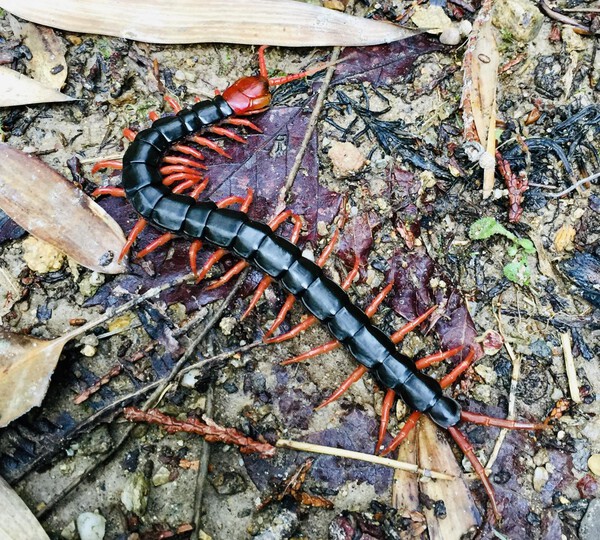
-
Head Scratcher... Any Guesses As To What This Says?
Bugyotsuji replied to rkg's topic in Translation Assistance
The only thing I can make out at first glance is the writing on the right, 伏見 (Fushimi just south of Kyoto).- 1 reply
-
- 1
-

-
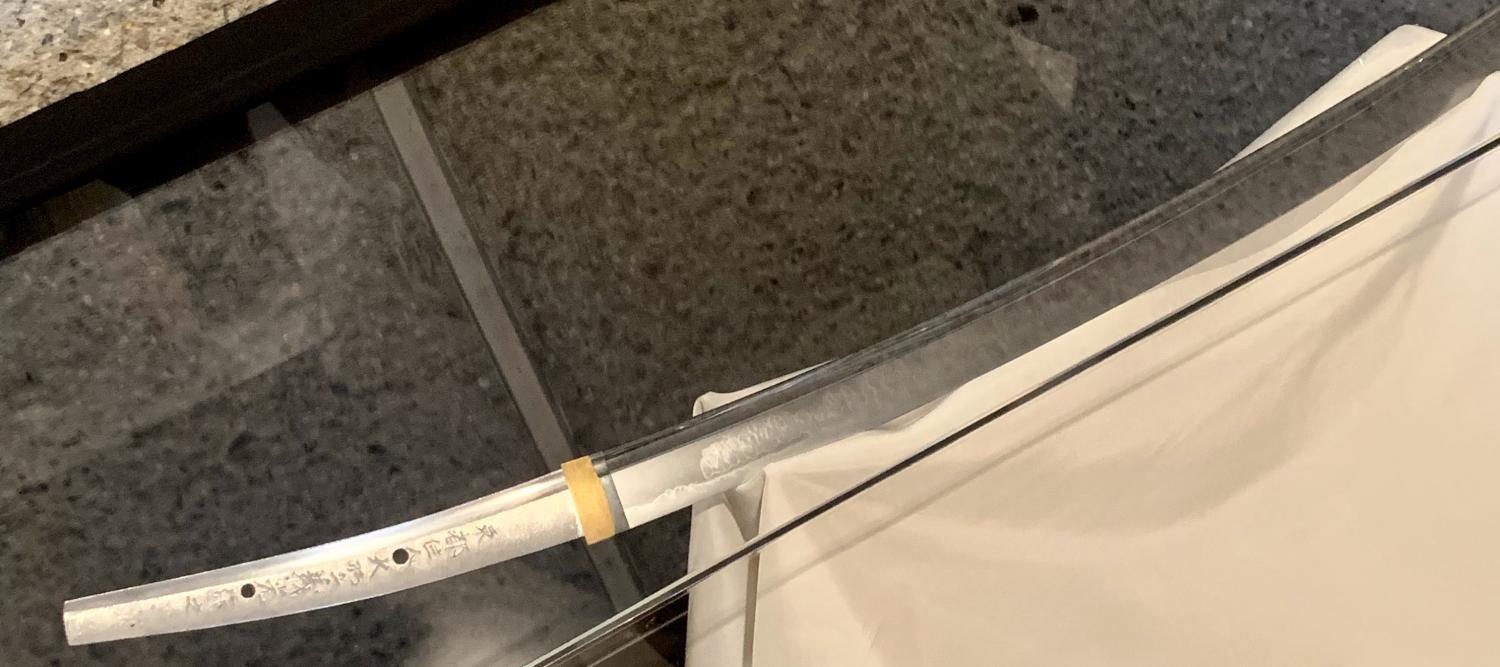
See the large figures in the middle of the second (setouchi) link above. As of 20 December 2018, JPY107,556,800 in donations so far, just short of US 1 million?
-
The Setouchi page is not in English, the bird squawks, but you can see the sum. Below on the world website page there are updates on its twitter and FB links? (Not yet checked these out myself.)
-
A letter was dropped on my front doorstep. 海外のクラウドファンディング https://www.kickstarter.com/projects/setouchi/reclaiming-the-soul-of-a-city-the-yamatorige-proje?ref=project_link 瀬戸内市のサイト https://setouchi-cf.jp/?fbclid=IwAR0io8x7aBzea5vkyygo1isoGhsYUz1W8XsZX-Ol3i8g3XsjOGoE3gfxGV0 瀬戸内市のページで金額はわかりますが、英語では書いていません。 海外のページ下にあるツイッターかフェイスブックで新しい情報を発信しているようです。
-
Ken, re the daily state of the fund, I have floated a washi boat down the stream. I expect a red-crowned crane will fly back with some information in due course.
-
Good question. Hmmmm.... will ask. Watch this space...
-
Hi Luca, look at Katai 堅い (Katai) and 紋散らし (Mon chirashi) https://ejje.weblio.jp/sentence/content/%E7%B4%8B%E6%95%A3%E3%81%97
-
Possibly an example of ‘Ignorance is Bliss’.
-
BaZZa, I did not want to push the 'Like This' button. (No 'Ouch' button available.)
-
Thanks for the additional information, Steve. We'll all get there one day!
-
Since Malcolm has inserted his tin/can opener and the worms are escaping, please allow me to agitate them further. Faced with the character 作 if you say tsukuru you choose a word that even children will understand, and you emphasize the meaning, and the fact that the smith ‘made’ it, regardless of the kanji, because commonly-seen 造 also can be read tsukuru. If you say Saku however, it sounds more adult and classical, and you are reading 作, or specifying that the smith inscribed this particular kanji. (造 is not read Saku, but Zou) Clear as mud now?
-
Great information. Oh, and fantastic timing, with the Gishisai in Ako happening today! https://www.city.ako.lg.jp/kensetsu/kankou/matsuri/gisiai.html
-
Ludolf's link above to David Fuller does not seem to work. I am trying to find out something about Sue-Nio 二王寛清, around 1470 maybe. Just reading his name took more than an hour of cross-referencing and elimination! I know, it's love, isn't it!
-
Settsu Kaji could mean ‘a Settsu smith’, ‘a Sakai smith’, no?
-
The second one down on the left, Uwe, what do you see there?
-
Giving up for the moment, but something keeps calling me back to reconsider: 押鍛冶 There were at least 25 gunsmiths in Wakayama who called themselves Oshi kaji, a name that some say originated from their tongues being cut out to prevent the secrets of gunsmithing from spreading. Although some signed with the actual (not pc today) sound and character for 'dumb', others kept the sound but used the verb Osu 押す 'to push', as 押し i.e.Oshi . Perhaps some higher power would step in and sort us out! Thoughts anyone, to push this game forwards?
-
Ed, we are in the same boat. The Ju character has extra strokes so it needs a leap of faith, suggested partly by context. The left line is 1.口 2.口 3. 治 but to pick apart the first two I will need to crank up the brain and open some books. No.2. has 金 hen, so that is where I will start. (Just woken up!) In the meantime other beavers will surely be at work on it!
-
Three lights. Nor did I, but this concept makes sense. I hesitated to say 日月 jitsu-getsu (sun and moon) for the lower holes because of the extreme size difference.
-
Yes Ed, you can bust this one with a Bonji at the top and a Kao at the bottom. There are two lines of three characters in the central body, with the living place on the right. Starting hint, 泉州住
-
https://kotobank.jp/word/烏-438156 A quick look at Karasu gives a third meaning of 太陽 ‘the sun’. Whether this can be a poetic exchange for 日 or not, I know not. And as to whether people used to see black spots on the sun’s surface way back when...? Ref: An old Chinese saying that there is a three-legged crow in the sun. https://kotobank.jp/word/金烏-480756#E3.83.87.E3.82.B8.E3.82.BF.E3.83.AB.E5.A4.A7.E8.BE.9E.E6.B3.89
-
Kasane mitsu-boshi? 重ね三つ星 https://kamon-db.net/wp/wp-content/uploads/2015/12/kasanemitsuboshi-640x640.jpg
-
You can see how closely the smiths aimed to recreate the hamon.