Jussi Ekholm
-
Posts
2,289 -
Joined
-
Last visited
-
Days Won
44
Content Type
Profiles
Forums
Events
Store
Downloads
Gallery
Everything posted by Jussi Ekholm
-
 Lukrez wrote amazing post above. As I am not a business person I haven't thought about specifics of market that much. However once you see how many swords there are currently for sale every day of the year, it is easy to understand that the dealers will probably have their own guidelines to price the average items. While it pains me to say it the vast majority of Japanese swords are average items. I am not talking about the quirky items that I personally like, just that even on various levels of quality most items are average. For these average items Japanese dealers most likely have their pattern to price the items and then they can add or reduce price depending on the actual item. Now these are just examples that I chose randomly to give an example. There are 99 Mumei katana with Rai Kunimitsu or den Rai Kunimitsu attribution at Jūyō. Now 13 of them have advanced to Tokubetsu Jūyō (well I am not yet sure of the origin of 2 of these new TJ) + 1 Mumei Kunitoshi and 1 Mumei Kuniyuki were switched to Kunimitsu at TJ. That would leave 86 Mumei Rai Kunimitsu Jūyō katana and I am sure the big dealers will have a common price for Jūyō Rai Kunimitsu katana that they will then adjust depending on the actual item. I have so far recorded 176 Mumei Ko-Mihara katana. I would assume that dealers will have a common base price for Hozon, Tokubetsu Hozon or Jūyō rated item. While the "ladder theory" that Michael mentioned above is not 100% accurate there is usually a minimum price that Jūyō items tend to fetch, and it would need to be a very good Mumei Tokubetsu Hozon Ko-Mihara to achieve the minimum price for Jūyō mumei Ko-Mihara. Even if in my personal opinion the cheaper item might be better, the Jūyō papers carry a prestige. As far as mid-higher level items go NBTHK papers are just something you pretty much expect the item to have. And the attribution that NBTHK gives to a mumei item can have a massive effect on the actual price of the item. There are actually lots and lots of Japanese swords available for purchase at any given moment. As I started to browse many Japanese dealers years and years ago, I was surprised how many high quality items are even listed online by big dealers. Some big inventory dealers like Aoi Art or Meirin Sangyo add few new Japanese swords to their inventory pretty much every day. I was just looking at Yahoo Japan and there seems to be 5,210 listings at Japanese Sword section, there are items that are not swords in there too so I think something like 3,000 swords would be closer to truth. Every now and then an item that was on Yahoo JP makes it to inventory of more established dealer. I admit I am completely clueless about inner workings of sword dealers, their relationships, and most importantly the dealer auctions. I can just imagine the price dealers actually get the basic items is quite low as they are able to make profit even on their cheaper offerings that would be quite affordable. In my personal opinion the high end items are just very small part of the market and the majority of items are lower and middle tier items.
 -
I fully understand Brett and I think it is very important to be supportive of new enthusiasts to the hobby. As someone with quite modest means for collecting I know very well that spending multiple thousands into a purchase is something many people will need to seriously consider and weigh the different options. That is why I initially started looking at the prices and trying to figure out things in order to make most of my potential future purchase. It can be extremely difficult to understand why for example one mumei Ōmiya attributed sword is 600,000 yen, another is 1,100,000 yen and third one 2,800,000 and to be totally transparent I sometimes still struggle to understand the pricing for some items. Originally years I was thinking that there could be a major difference on a 700,000 yen sword and 600,000 yen sword. And many cases there can be major differences just not ones that might affect the price too much. For me personally when an item is jumping through dealers or sold multiple times, it just makes me think there must be something on that item as people don't want to keep it even though the item would be really nice. Here is an example of a Ko-Bizen tachi that was listed at 3 different high quality vendors lately. https://web.archive.org/web/20221203191527/https://wakeidou.com/pages/522/ https://web.archive.org/web/20230603022557/https://eirakudo.shop/token/tachikatana/detail/425951 https://web.archive.org/web/20240424230207/https://www.samurai-nippon.net/SHOP/V-2051.html Each of them had it priced slightly differently but they were of course around the same ballpark. The Japanese dealers of course know their pricing very well. I think the Paul Davidson collection had awesome items but a low level collector like me isn't the target audience. I just felt many of the estimates were beyond what I would have been looking at. Well of course I couldn't afford a single item from there. The most interesting item for me was the Kozori Sadamitsu wakizashi and I think that could have been a good deal: https://www.sothebys.com/en/buy/auction/2025/important-Japanese-swords-and-armour-from-the-paul-l-davidson-collection/a-ko-wakizashi-signed-bishu-osafune-sadamitsu However the smith is completely irrelevant as long as high end collecting goes so I would guess the Tomomitsu and Morimitsu got a lot more eyes on them, well the Morimitsu seems wonderful item. Of course I understand that my personal view is skewed towards overvaluing some items and not realizing the real potential for most of the items.
-
Hello! I have finished it and keep updating it yearly. Here is the version I uploaded to NMB: Since then I have done only separate yearly Jūyō results over the years. And I have been correcting errors to the big index on my pc as I have gone through all Jūyō items few times over the years. I think NBTHK should release the 71 shinsa results soon now in december, so I can update them in too and post a full index with all of the corrections. When you are typing thousands of kanji there have been some errors I made. I just got 5 Jūyō books from Yahoo JP that are in the mail. Then I will have all books from 1 to 56 on my bookshelf, and as I have few others too I am only missing about 10 or so books. And for Tōken Bijutsu I have pretty much completed my collection for the moment, I am only missing 21 of the very early numbers and I have 800+ magazines in total.
-
I consider myself as a sword researcher with 0 financial interest. Now will you still believe that line if I will tell that I have 575 pages of sword prices, and have tracked down interesting swords for over 10 years... Here is a link to an old version that I shared to NMB I think almost 7 years ago: After posting that I had some interesting discussions with few people, back then I didn't understand the bigger picture too well but I try to think I have learned something in 7 years. I had some good ones with Darcy and while we sometimes butted heads a bit as we had maybe a bit different view of the some things, now with more experience under my belt I've come to realize that the actual historical prices are pretty unrelevant. As I go through all of my regular sites every week, I just type down the price down as a habit as I had done it for so many years. Main point for myself is just tracking down the items themselves for my database. Jūyō items are actually quite easy to track down when they pop up as I have the basic data. One thing is that different dealers will sell the same item for different prices and it is just normal in life. Some can squeeze in larger profit (and will have to do it for business) while some are satisfied with smaller profit. I was just commenting last month to a smaller Japanese dealer that they have excellent prices, their answer was of course logical that they are online only, so they don't have any additional costs. Compare that to some of the top dealers, showroom in Ginza with staff etc. I feel that the only relevant thing is the current price of the item and how comfortable you are with it. Items are one of a kind items and if you are happy with the price I think that is the only thing that matters. Of course every week as I browse through all of the interesting new items that dealers and sites in my list have put out, I do keep immidiately thinking how something feels overpriced or something is actually feeling like a very good deal. I am actually super happy that Tōken World at Nagoya won the Mikazuki Kanemitsu, now I can see it some year when I visit Nagoya. For me that is the most important thing that people can actually see the items in museums. Had some top tier private collector won the item, most people would never had the chance to see the sword. I won't say anything about the big auction houses, just that I am extremely against them. I will much rather support Japanese and International dealers and would even pay premium for them for the same item rather than deal with extremely greedy auction houses. Sword dealers have a passion for this which auction houses lack.
-
I saw this sword at 2024 NBTHK exhibition, and I do need lot more sword study to really understand things. As the NBTHK article states "This is the perfection of Sōshū den work". I personally liked the Sadamune and Hiromitsu short swords in the same exhibition far more than this Masamune.
-
Slightly Cursed Kanemitsu
Jussi Ekholm replied to Francis Wick's topic in General Nihonto Related Discussion
Unfortunately to me the one with red background seems to be signed 備州長船清光 (Bishū Osafune Kiyomitsu). Kiyomitsu smiths were very prominent during late Muromachi. One thing that might be taken into consideration is that it is common for us to call a gimei for a big name smith, while there could have been other smiths signing the same way. Like for example for Kanemitsu we will easily not pay too much focus on Kanemitsu signed katana like the one in this thread as it does not be a work of Nanbokuchō Kanemitsu. Well that does not maybe make a huge difference to most if it would be by unknown Muromachi Bizen Kanemitsu or a gimei. I just think the Japanese sword appreciation is extremely top heavy as they are the ones featured in almost every reference. -
Slightly Cursed Kanemitsu
Jussi Ekholm replied to Francis Wick's topic in General Nihonto Related Discussion
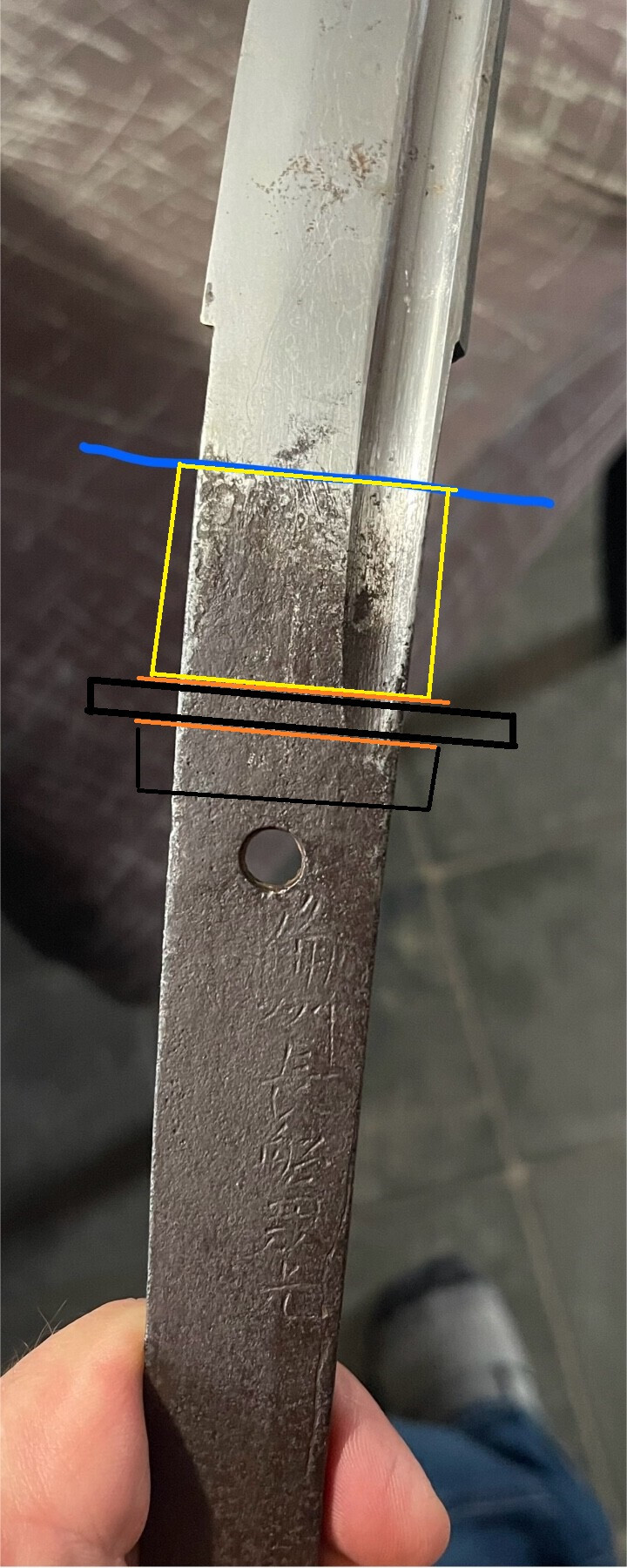
I would agree with the view that Jacques has on this. I would think it would most likely be late Muromachi Bizen sword, wheter actually someone named Kanemitsu that I cannot say. However I would think the sword is in original state. I tried to do quick sketch with paint how I would expect it to look originally in fittings if it would have been machi okuri at your line, of course it is just a rough sketch to give an idea that I have in my mind. To me the hole placement looks perfectly normal now in current state, if it would have been machiokuri then the original hole would have been unusually close to the machi. . I do have some amazing resources on Bizen swords, however I have not been able to find a reference signature of any late Muromachi Kanemitsu. I am extremely grateful for this thread as I tried to search them and ended up discovering absolutely massive Nanbokuchō naginata by Kanemitsu that I was not aware of before. Finding items like that in Japan makes me very happy. One "cursed" thing about smith lineages where there are extremely famous ones is that then many later generations can fall into obscurity.
-
Here is a tachi by Bizen smith that is dated 1435 Here are some Muromachi ones that I found online. Bungo katana: https://www.e-sword.jp/sale/2013/1310_1045syousai.htm Bungo tantō: https://www.toukenkomachi.com/index_en_tachi&katana_A021018.html Very little info on this: https://n-kosen.com/item/3647/ Out of polish: https://buyee.jp/item/jdirectitems/auction/q1206573915
-
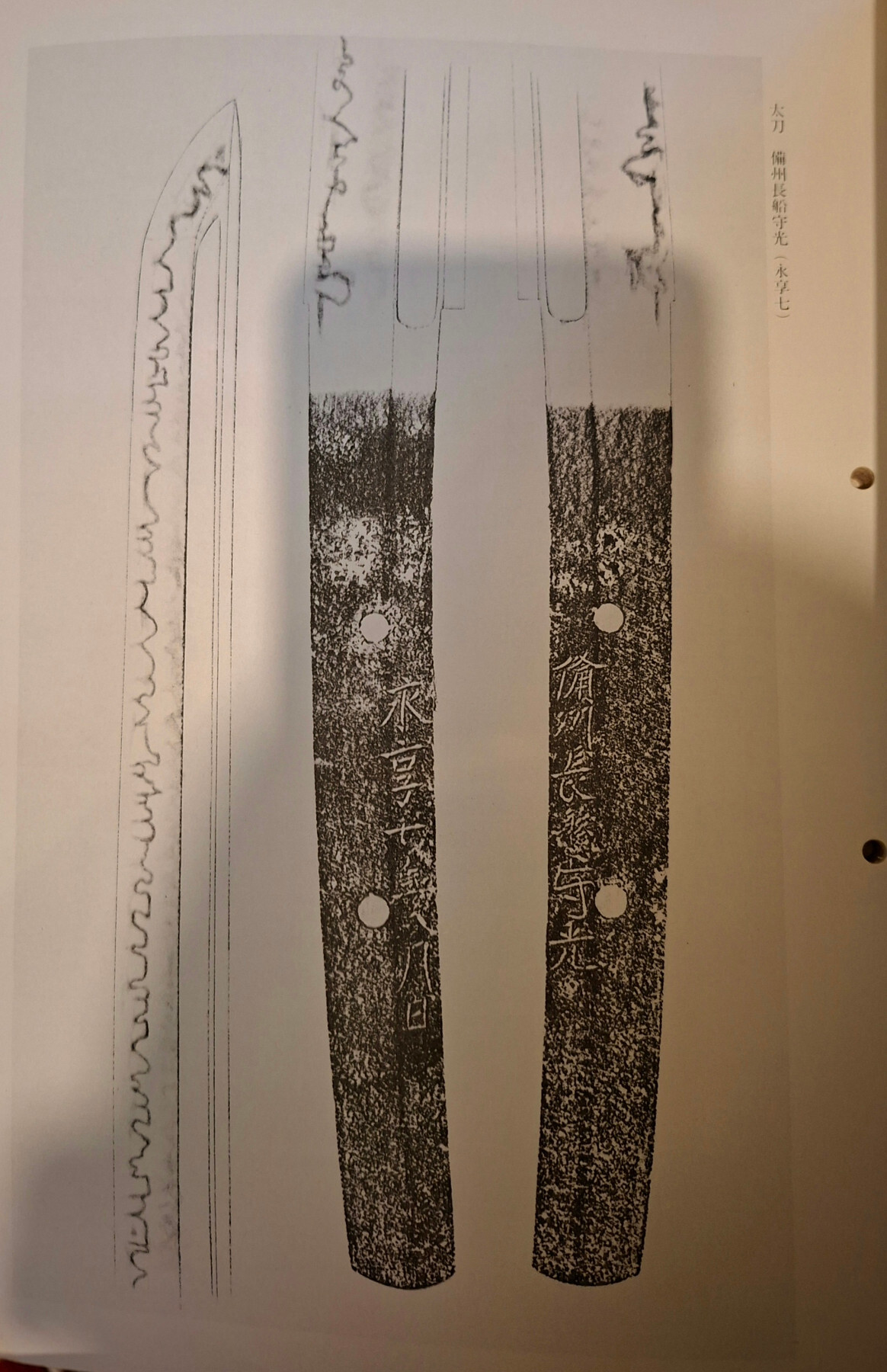
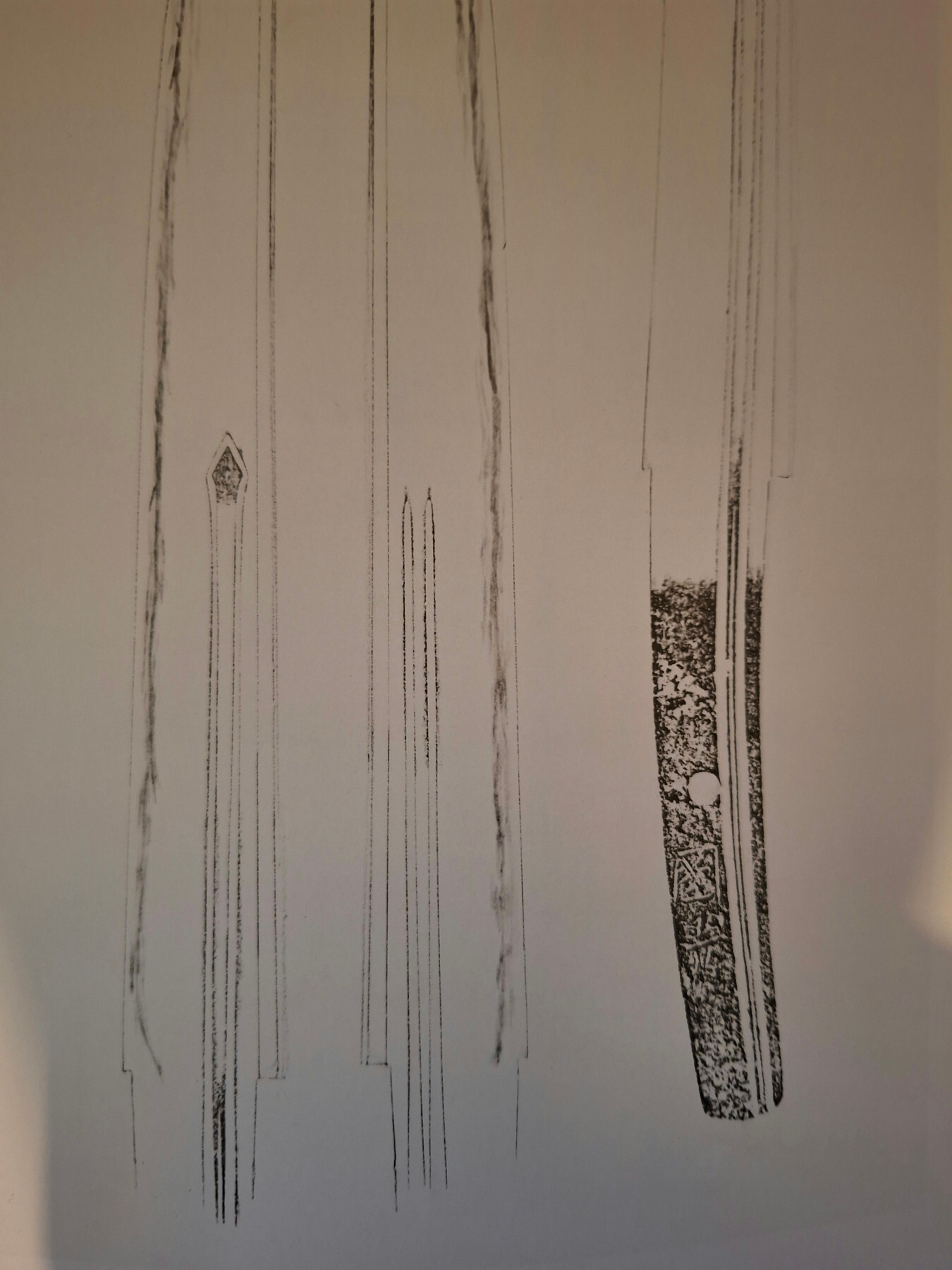
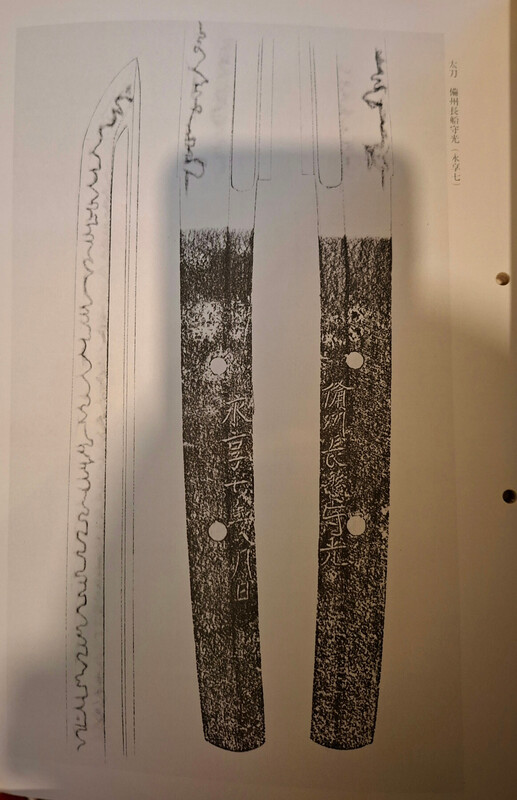
There is as Morimitsu (守光) lineage in Bizen Kozori group that extends into Muromachi. I have just few examples of Nanbokuchō/Early Muromachi items by them, as I don't record older, however I believe the lineage continued into later Muromachi. Morimitsu (守光) is actually pretty rare name, when you look at Meikan or Sesko, there are only very few smiths that used the signature in general.
-
I think for this sword NBTHK and Aoi Art have a differing viewpoint, pretty much the polar opposite views. NBTHK specifies in the paper that sword is ō-suriage and Aoi states that they see the sword as almost ubu. Unfortunately I cannot say which one is correct, and I could see both as plausible opinions by just seeing few pictures. Unfortunately I just have seen this in Jūyō book and now at Aoi website so I don't have it in any other sources. NBTHK can also judge suriage mumei blades as tachi but for that to happen I would assume a certain amount of original nakago must be present for that to happen.
-
Bizen Osafune Goro Zaemon jo (Kiyomitsu) (your review and opinions?)
Jussi Ekholm replied to SammyT's topic in Nihonto
In my opinion the tang was most likely signed as, Bishū Osafune (Insert smith here) 備州長船□□. It does not feature the common Gorōzaemon signature, 備前国住長船五郎左衛門尉清光. -
WW2 Japanese Naval Sword
Jussi Ekholm replied to Swords's topic in Auctions and Online Sales or Sellers
It seems like an interesting sword. Gassan signatures are usually located around the original hole on the tang. So I would think the lowermost hole is the original one, or it has been very slightly cut completely off. Now as the current length seems to be c. 73,5 cm and to me I would assume the sword has been cut down something in between 10-15 cm or so, so in original form it could have been c. 85 cm blade. The sword seems to have a large kissaki, which is throwing me off a bit, as almost all of the old Gassan tachi and katana in my references have small/smallish kissaki. I think I could only find 1 reference with a large kissaki: https://www.nipponto.co.jp/swords2/KT218912.htm To me the sword is a plausible Muromachi period Gassan sword. The long length and large kissaki are few things that are throwing me off a bit as I cannot find similar reference item. -
While maybe not as sexy as Jūyō submission I would re-try the Tokubetsu Hozon first even if intending to send the sword in for Jūyō. Mumei swords can always get different attributions depending on the shinsa, so I would think that is always worth a try. I know if I would be living in Japan I would definately try to buy and resend some mumei swords in hopes of scoring big attribution. Unfortunately for us outside Japan it is way more complicated to send the sword in. Of course there is always the human bias mixed in, as I probably wouldn't re-send a very good mumei attribution because the new one might be a lot worse.
-
Just a personal thing but I would focus only on the one with brown handle, and in that only for the blade (perhaps the guard [tsuba] might be mildly interesting too, depending on several factors). That is the only sword that seems interesting to me but to be said I am extremely narrow focused person and my view is not the normal view. I feel as a more general view the lot can be bit interesting with a lot of variety, of course lots of things will depend on the asking price.
-
My guess is 山本武蔵守 Yamamoto Musashi no Kami and rest of the signature is cut off.
-
Here are 4 Jūyō swords by Gorōzaemon Kiyomitsu that are currently for sale or have been in the past. Jūyō 15 - item 148: https://buyee.jp/item/jdirectitems/auction/r1205155585 Jūyō 15 - item 149: https://asahitoken.jp/contents/01_token/details/token-A/A_sd406.html Jūyō 45 - item 91: https://www.touken-sato.com/event/katana/2015/10/K-kiyomitsu_gorozaemon-01.html Jūyō 13 - item 121: https://www.token-net.com/juyotoken/juyo-20230501.html
-
The original shop is asking 3,600,000 yen for the Hosokawa Masayoshi At shop: https://bizenya-katana.com/?thoken=作陽幕下士細川正義造(刻印)-2 At Yahoo: https://buyee.jp/item/jdirectitems/auction/w1123570814 Just to be noted that some Japanese dealers do not deal internationally.
-
I believe it is authentic and among the longest Yasutsuna tachi in existence today. It was featured as a reference item in 2019 Kasuga Taisha Yasutsuna & Ko-Hōki exhibition book. In the brief text for the book it is mentioned to have been shortened c. 10 cm making the original length of c. 90 cm. It was also in Japan in 2022 as part of The Heroes exhibition: https://shizubi.jp/exhibition/20220702_theheroes/220702_01_eng.php However I believe it was not among the swords that NBTHK authenticated for Boston Museum in 1976:
-
I must say your Sukesada looks like a wonderful sword, I am personally liking it more that the Kiyomitsu. However the Gorōzaemon Kiyomitsu must be a wonderful sword in overall. I admit I do have a very soft spot for these late Muromachi "named" Sue-Bizen smiths. They made wonderful items, and I personally value them very high in appreciation. I think the quality in my eyes is often better than some of the cherished Kamakura smiths for example. Some items by Yosōzaemon Sukesada that I have seen in museums have been just stunning. I think Jūyō submission might always be a very complicated process, and to be honest I don't really have a clue what they are searching for. As was discussed in one other thread there are pretty much always "the usual suspects" that will pass regardless of the session. I was looking that Gorōzaemon Kiyomitsu has currently 16 Jūyō swords passed. The last one passed in session 65, unfortunately I haven't yet got that book. However the one before that one passed in session 45. So 20 year gap between passes, and I am sure some nice swords by the smiths must have been submitted within the 20 years. A rough guideline drawn from the last c. 15 years of results is that unless it is a "named" Sukesada (and among them most notably Yosōzaemon), your late Muromachi Bizen might have hard time passing through. Here are the total numbers of the 1500's Bizen smiths passed in last 16 sessions Jūyō 55 to 70. There are 5 Yosōzaemon Sukesada, 8 other named Sukesada, 7 non-Sukesada Bizen smiths from 1500's. So 20 1500's Sue-Bizen blades passed in total in 16 years. Now just for fun comparison in the same 16 years 39 unsigned Rai Kunimitsu blades have passed...
-
Shintōgo Kunimitsu Tantō....diamond in the rough?
Jussi Ekholm replied to Lewis B's topic in Nihonto
These are the ones I have info so far 96,1 cm - Jūyō 27 76,1 cm - Tokubetsu Jūyō 2 (Mutsu Shintōgo 陸奥新藤五) 74,2 cm - Jūyō Bunkazai - Seikadō Bunko 73,6 cm - Ise Jingū - Dedicated by Tokugawa Ieharu in 1769 73,4 cm - Tokubetsu Jūyō 7 70,5 cm - Tokubetsu Jūyō 12 68,8 cm - Private collection - Was featured in 2002 Masamune: A Genius Swordsmith and his lineage (4 Museum combination exhibition) 65,4 cm - Jūyō 20 For the Ise Jingū item it is explained in the book that mei is good but the upper portion of the sword is in rough condition. Text also states that this particular item is noted as Bizen Kunimitsu in Tokugawa Jikki. However it is now seen as work of Shintōgo Kunimitsu. Unfortunately I have never seen a Shintōgo Kunimitsu tachi in person. -
Lowest rated Juyo swords?
Jussi Ekholm replied to Mikaveli's topic in General Nihonto Related Discussion
I have collected c. 80% of the Jūyō books and for statistical nerd like me they are worth their weight. Most important thing for me are the actual cm measures of the swords, they allow me to create a good mental image of each sword. However I couldn't really say much about those swords quality wise by just reading the entries from the book. There are many things that make me scratch my head but I must just agree that the experts know so much than me and their view is much more valid than mine. I tried to look into Ichige Norichika as unfortunately I am compeletely clueless about that smith. I believe he is sometimes regarded as the best Mito swordsmith by experts. His contemporary Naoe Sukemasa also has similarish Jūyō record 6 passes between sessions 17-27 and then 2 passes 41 & 42, while Ichige Norichika has 5 passes in sessions 17-25. Their teacher Ozaki Suketaka has 3 passes in 14-20 and 1 sword passed in session 63. Now for some older Jūyō sessions NBTHK gave out very detailed submission and pass numbers in their magazine. Here I will focus on the very large sessions 23,24,25,26, that have fairly large submission numbers and extremely high overall pass rate. So lot of Jūyō items in these sessions. It might not be known that well but during this time NBTHK gave Kotō and Shintō submission numbers. Session 23 Kotō 557 submitted and 337 passed - Shintō 364 submitted and 156 passed -> so Kotō has 61% pass rate and Shintō has 43% Session 24 Kotō 590 submitted and 356 passed - Shintō 428 submitted and 127 passed -> so Kotō has 60% pass rate and Shintō has 30% Session 25 Kotō 450 submitted and 250 passed - Shintō 369 submitted and 91 passed -> so Kotō has 56% pass rate and Shintō has 25% Session 26 Kotō 366 submitted and 282 passed - Shintō 211 submitted and 88 passed -> so Kotō has 77% pass rate and Shintō has 42% I know people have done pass rate calculations etc. as many would want to "beat" the game and get the maximum amount of info would be helpful in this. However NBTHK stopped giving out the submission numbers for Kotō and Shintō and just had overall number for swords from session 29 onwards. Roughly from 29 to 39 sessions the number of swords submitted in overall reached c.1500 swords per shinsa session and only between 8% to 15% items in overall passing. So pretty radical change was made at that time. -
Shintōgo Kunimitsu Tantō....diamond in the rough?
Jussi Ekholm replied to Lewis B's topic in Nihonto
I think Jacques has a valid point above that would fit well to me, I cannot differentiate the smiths or generations from 2 character mei. However there is also another point that can be seen from Nihontō Kōza page. For Kunimitsu there is the text for tachi "As for tachi, there is just one piece..." Now so far I have been able to find 1 ōdachi and 7 tachi that are seen as work of Shintōgo Kunimitsu. There are also some more unknown Kunimitsu smiths, even in late Kamakura. I didn't even remember there was this Senjuin Kunimitsu tantō (which is the only blade I know by him) in Jūyō 20 as I am going through the book. NBTHK puts this as the work of Senjuin Kunimitsu and identifies it as late Kamakura piece if I understood the text correctly.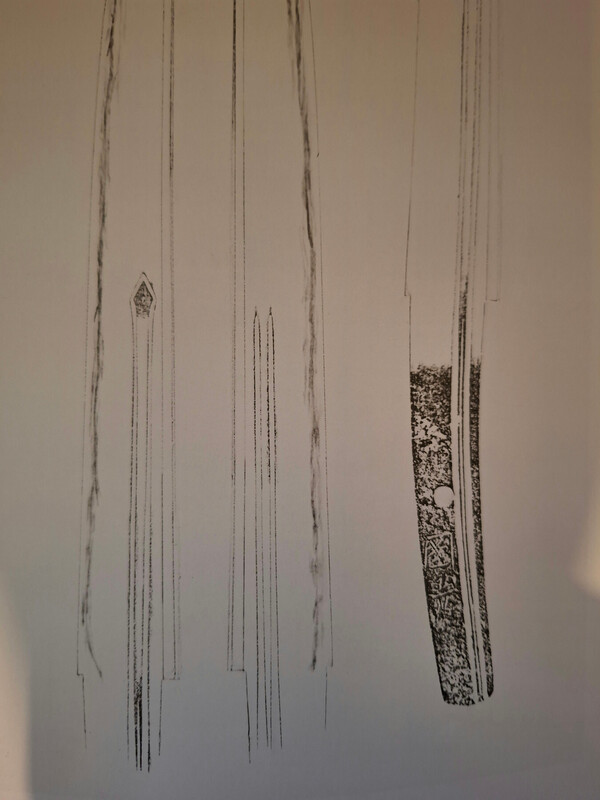
-
To me these both seem to be very good swords. This is just a personal opinion but in my eyes the Yasumitsu is the better sword in overall but I would go for the Ko-Mihara. As many might know my love for ōdachi it is funny that there are wonderful ōdachi by these smiths. Well the Ko-Mihara ōdachi is by Masaie (signed) so specific work instead of school work. What is also funny is that they are pretty close in size to each other. The Masaie ōdachi is in the collection of Yasukuni jinja and the Yasumitsu ōdachi is in the collection of Futarasan jinja. In overall usually I like Yasumitsu work style a lot more than I like Mihara work. However unfortunately the Futarasan jinja Yasumitsu is not in as pristine condition as the Yasukuni jinja Masaie, out of those two the Mihara ōdachi is more to my liking in overall, and it is of extremely high quality craftmanship. Also the Nagoya Tōken World has absolutely stunning Ko-Mihara Masahiro blade that in my eyes is a lot better than lot of the swords by "higher valued" smiths at Tōken World museum. So battle of my favorite swords by these smiths go to Mihara, however I have huge appreciation for Morimitsu & Yasumitsu in my opinion both are top tier smiths and I have seen stunning work by both and in general I like them more than Mihara smiths.
-
Lowest rated Juyo swords?
Jussi Ekholm replied to Mikaveli's topic in General Nihonto Related Discussion
I think Brano made a good comment that the majority of Jūyō swords come from pretty small number of smiths. It is just NBTHK style of appreciation. Now the Kotō portion of Jūyō passes usually pretty much looks like this Few Awataguchi A lot of Rai Few Hasebe Few Nobukuni Quite a bunch of variety of 5 Yamato schools Few Shintōgo / Yukimitsu Maybe Masamune / Sadamune / Hiromitsu / Akihiro Some Shizu / Naoe Shizu Few Nanbokuchō / Muromachi Mino Few Tametsugu Few Norishige / Gō Some Ko-Bizen Lot of Ichimonji Some Osafune mainline Few Hatakeda / Ukai Few Motoshige Bunch of Sōden-Bizen Bunch of sideline Bizen Some Muromachi Bizen Few Ko-Aoe Bunch of Aoe Few Ko-Mihara Bunch of Sa school works Few Enju To me this above is not all that exciting as it happens year after year, I want to find unique an interesting pieces passing. For example a jō-saku smith that I like for some reason is Taira Nagamori (長盛). However there are only 2 wakizashi by him that have ever passed Jūyō. To me it would be much more important to have 3rd sword by him pass the shinsa than 190th Mumei Taima blade or 216th Mumei Aoe blade. Unfortunately NBTHK does not really value Bungo stuff (Excluding Yukihira and Sadahide). I was thrilled to see a first blade by Bungo Norisada pass in Jūyō 67. I do not have the art eye for details but even I must admit that many of the mumei Jūyō items are actually stunning swords and well deserving the Jūyō title. It is just my personal feeling that too much suriage mumei stuff pass. I would rather steer more passes towards very good quality signed work by Muromachi period smiths than bulk of suriage mumei Kamakura/Nanbokuchō stuff over and over again. Still it is NBTHK's game and their rules apply. There are even Tokubetsu Jūyō swords that are in my opinion not awarded by their artistic merit but rather extremely valuable historical value. Then in my personal opinion there are also the opposites where just the artistic merit pushes the sword up to Tokubetsu Jūyō level as to me the sword itself is not that interesting just the workmanship is stunning. I have seen both variations in person, and it is just personal opinion and quite possibly I might not understand the intricate details. -
Lowest rated Juyo swords?
Jussi Ekholm replied to Mikaveli's topic in General Nihonto Related Discussion
That is a super rare item Steve congratulations. It is so far the only Ko-Aoe Tsuneyoshi (経義) sword I have been able to find anywhere. I think sometimes it is really difficult to identify generations for various smiths and sometimes the various genealogies have slightly different working eras and generations. If I understood NBTHK text correctly they wrote that there are famous Hirotsugu working Meiō (1492-1501) and Tenbun (1532-1555) but by reading text I was getting that this particular sword might be seen as work after Tenbun, and hence they specify (時代室町末期) for the particular sword. Now I generally just classify 末期 & 後期 both as Late XX but I believe there is more specific notation that 後期 means late period and 末期 means end of period. It is very slight nuance and to me it does not make that big difference but there is noticeable enough difference for NBTHK to make these tiny classifications. Now what classifies as mid- late- end- that would be a whole another question. How many generations of Hirotsugu smiths there were in total, etc. For example Nihontō Meikan has different main periods for some Hirotsugu smiths when compared to Sesko Index. Nihontō Meikan has the Meiō and Tenbun Hirotsugu listed that NBTHK stated in their text. Now to make it tricky Fujishiro actully has 2 Hirotsugu that are listed as jō-saku. They are listed in Bunmei (1469-1487) and Eishō (1504-1521). Maybe Markus has combined these two smiths under one smith in his index entry. So it can be tricky as all of these various sources have slightly different information about the Hirotsugu smiths. The Hirotsugu in Jūyō 20 book NBTHK specifies that item as Meiō period work. Unfortunately I don't have book 61 that would have 2 signed Hirotsugu. Also NBTHK has sometimes upgraded their view on things over the years which is only reasonable. So for some smiths there can be genealogy differences if you compare for example Jūyō 12 text and Jūyō 68 text (just hypothetical example but there has been increase of knowledge in 50 or so years)