
Hoshi
-
Posts
806 -
Joined
-
Last visited
-
Days Won
10
Content Type
Profiles
Forums
Events
Store
Downloads
Gallery
Everything posted by Hoshi
-
This is insanely good work. Well done, the piece exalts power and faith.
-

Motokasane: how important for structural integrity?
Hoshi replied to jdawg221's topic in General Nihonto Related Discussion
Hello, The kasane per se does not inform you on the state of the sword. The delta between the top of the nakago and the kasane is the indicator you need to pay attention to. There are smith-level trends, school-level trends, and most important: era-level trends on the thickness of the kasane. The most well-known is the transition between Kamakura and Nambokucho, where Nambokucho swords have - on average - a much thinner kasane. As for the structural aspect, remember that it interacts with the thickness and level of the shinogi, the niku, and the width of the motohaba/sakihaba. Controlling for these factors, a thicker kasane indicates a sturdier sword, all else equal, but it is first and foremost a balance of different geometrical elements. Also take note that skilled smiths created a balanced descending gradient between the motokasane and the sakikasane which is one of the most important contributor to the feeling of balance. This descending gradient is generally not uniform - the gradient tapering accelerates towards the tip. This type of geometry is often followed by Soshu-Joko smith (Masamune, Norishige, Yukimitsu, Go, Sadamune), leading to an impressive feeling of balance on a robust and masculine sugata, and this generally drives the contrast with shinto/shinshinto smiths, whose blade tend to feel 'tip heavy'. Koto blades with a thick motokasane (7.5mm+) are considered a plus and can contribute to passing Juyo, and this is generally a strong point. 5.5-7.5mm: normal kasane below 5.5mm : thin kasane Above 7.5: thick kasane Best, Hoshi -
Transition from koto to shinto periods
Hoshi replied to Mikaveli's topic in General Nihonto Related Discussion
Just trust me. Or, if you are so inclined, I suggest your search the forum, read Darcy's old blog, read Markus's sesko blog, pick up a beginner friendly book, etc. This is a topic that has been re-hashed since the dawn of NMB, and I don't have the mental fortitude to dive into it. It's based on 700 years of sword appreciation. But it is also an arcane topic that takes a fairly long investments of time, in-hand experience, reading, etc, to establish what makes a "good" sword. -
Transition from koto to shinto periods
Hoshi replied to Mikaveli's topic in General Nihonto Related Discussion
-
Transition from koto to shinto periods
Hoshi replied to Mikaveli's topic in General Nihonto Related Discussion
Hello, It's more complex than that but it isn't a mystical deep topic either. Multiple structural factors were at play which have a historical basis. I. Near extinction event of expertise during the late muromachi, e.g., Floording of the Yoshii river, war, etc. II. The only major production center left was in Mino, which focused on quantity, lowering production cost and quality III. Smiths from Late Mino, notably Daido, went on to repopulate the craft IV. During the momoyama/early Edo, smith location changed from being industrial villages of entrepreneurs competing against each other towards in house castle smiths with a fixed allowance. This structural change reduced the beneficial effects of competition between smiths/schools. It was not just the centralization of steel production that was at play. - The near universal dominance of Sue-Mino smithing technics that would go on to seed the Shinto period. And we all know that Mino was the lesser of all traditions in terms of quality, but the most effective in terms of output. - The loss of the battlefield feedback loop - The loss of proximity-based competition from independent schools/smiths (e.g., what used to go on in Bizen province) - The change from independent smith entrepreneurs towards house smith retainers with a fixed allowance - A general reduction of demand by the clients for high-end quality swords due to economic and social factors. You have notable exceptions as always, with Yasutsugu and Umetada smiths working directly for the Shogun trying to crack the puzzle of how to make Koto-level swords, then Hankei, etc. Cheers Hoshi -
This is not a good sword. Uneven nioiguchi, nie-kizure, and crumped ara-nie. There is a reason for the price.
-
Which would you get? Mei or Mumei
Hoshi replied to RichardY's topic in General Nihonto Related Discussion
It's not a named sword, this would be a sword with Go (Name). It's a zaimei Muromachi blade, from a group of makers that have been extremely prolific. These blades are commodities, with the exception of the rare custom ordered ones that generally (but not always) carry the full name of their maker (e.g., Yozozaemon, Gembei...). Nakajima Rai is a bucket attribution for blades that are "almost Rai Kunimitsu" but show less ji-nie, less nie-utsuri, more nagare...etc. It's second tier Rai. Even mumei Rai Kunimitsu is also often a problem, there are just too many of them, with a significant portion being rather uninspiring. That said, a length of 75 cm is rather rare, especially for the Muromachi Sukesada, which could point towards a custom order. Unfortunately, without detailed photos or videos, it's impossible to say more. Perhaps, the less risky strategy is to buy the cheaper 75cm Sukesada, study it and save money. -
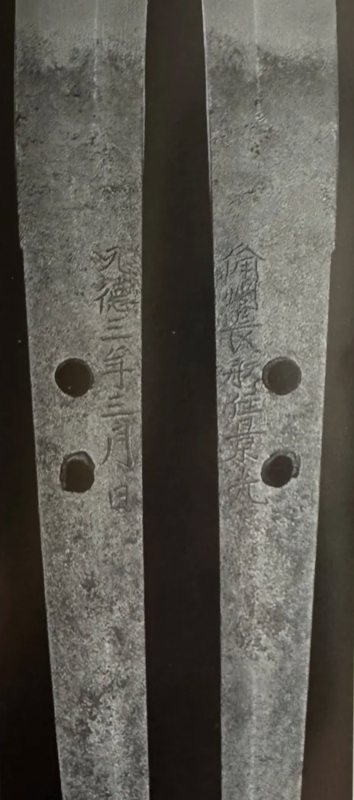
100% Gimei. If it had any chance of being real, with the high-level deki that is expected of Kagemitsu, it would be valued well beyond $100,000, and then and likely go straight to Tokubetsu Juyo. Here is a genuine signed/dated Kagemitsu nakago for comparison.
-
Fantastic Rayhan, thank you for your efforts.
-
Greatly appreciated @Kiril, I read it with interest. Thank you for putting the time and effort to write this piece. I liked the part about Kyushu Nihonto. It's a much overlooked production center, with scarce attention in the literature available in English.
-
Hello Rayhan, Beware your forays into such arcane knowledge... A good amount has been written by Darcy on this topic over the years, most notably here. It is a good primer before engaging in more advanced discussions. But, to cut the chase - these sessions are called in Japan the "phone book" sessions, because the Zufu volumes are simply enormous owing to the number of blades that pass. The data, however, indicates that it isn't average quality per se that is lower, but that the variance is greater. This is evidenced by a greater proportion of blades from these "phone book" sessions ascending to Tokubetsu Juyo, compared to later, harsher modern sessions. At the other end, we see a lot of JINO (Juyo in name only), blades which today could never make it to Juyo. These sessions also coincide with the rise in popularity of the hobby in Japan. For better or worst, It is my understanding that the trend stops more or less after Kanzan passes away, and the leadership takes a strong policy shift in favor of increasing the baseline-level quality needed for a blade to pass Juyo. In these policy shifts, I believe that the personalities the judges is reflected - Kanzan Sato was the true "man of the people", foremostly concerned about making the hobby accessible, whereas Honma Junji was "Daimyo blade" person, who believed in stricter standards to keep the Juyo designation meaningful. Both approach have their pro's and con's, and it is debatable who, in the end, is right. JINO are obvious arbitrage targets for the western market, which is due to a lack of in-hand experience, and hence relies on ladder theory to build its pricing model of what constitutes a 'good deal' - For this reason, the effect you observe on price is due to a selection bias that puts JINO on the market, blades that often can't be sold to Japanese collectors. How to recognize a JINO? These heuristics are useful: - Unusual length and mumei status (e.g., mumei Yamato Wakizashi...) - Unusual period (e.g., muromachi-era blade...) - Unusual smith (e.g., a smith that never passed Juyo before, or after...) And there is more, of course, but it becomes complicated. As is often the case in Nihonto, there are exceptions to the heuristics above, these are not rules, but merely clues. Always consider the entire picture and beware of shortcuts. EXHIBIT A: A JINO. A mumei, 48cm Shikkake Naginata-Naoshi from a "phone book" session: EXHIBIT B: NOT A JINO. A zaimei Awataguchi Yoshimitsu from one of the "phone book" sessions. The blade is Meibutsu. Best, Hoshi
- 25 replies
-
- 12
-

-

-

-
Hello, From the middle to Kamakura period to the early Nambokucho, great many tanto were made to the highest level of quality and intended for the warrior elite and the aristocracy. The customer base was exigent, and hence the quality was supremely high. The tanto was a specialty of the Awataguchi, Rai, and Soshu schools. Tanto from this period and by these schools rank very highly and command high prices. Here you can see why, this is a tanto attributed to Soshu Yukimitsu. Notice the quality of the jigane, with rich ji-nie, and the soft nioiguchi that covers the ha like snow. In my opinion, the best tanto offered online at the moment. As said earlier, tantos cycle slowly as they are kept by aging collectors to be appreciated late in life. It takes a lot of time and learning to appreciate tanto sincerely, not out of memetic desire. Collecting tanto is somewhat of an older collector's thing, with business done in person, with the great ones rarely ever hitting the public markets. When they do hit the market, the prices are not for the faint of heart. Here is a sublime tanto by Rai Kunimitsu, sold for 240'000$, hammer price. Hope this helps, Hoshi
-
@Lewis B For me, this is a headscratcher. I do not understand the Kotetsu market frenzy. To put it in perspective, this is high-end Koto grandmaster price territory. Mikazuki minimum bid was 1.5M USD. It was a sealed auction, and it sold. Because it was a sealed auction, we do not know the final price. It was purchased by the Nagoya Token Museum, they made a press release announcement. Overall, this is close to the best outcome possible, as the blade will be made available for appreciation by the broader public, and it remains a "Founder-led" museum that is constantly innovating and seeking to improve its collection. Normally, items at this level do not make it to the open market. Very rarely at the DTI. This is a rare historical anomaly, as it belonged to a well-known American collector. At the ultra top end, respected Japanese dealers do not engage in "price maxing" (with the exception of the occasional crazed Osakian) - but rather, carefully seek out the best client, preferably with the approval of its current owner. Many such items have dibs registered sometimes decades in advance, and word given is faithfully followed in Japan. We often hear that the "sword chooses the collector" - this is only true up to a certain level. At the extreme high-end, it's the collector that chooses the collector, and often decades go by. Discretion, loyalty and respectability take precedence.
-
Open debate is wonderful indeed. The state of knowledge in nihonto evolves over the years and I am thankful for this. The sources that I have found to be the most transformative in my knowledge: Kanto Hibisho Gokaden series Token Bijutsu Meihin Extracts from Juyo and Tokuju Zufu Darcy’s posts on NMB, his site, blog, and lessons. Plenty of Tanobe sayagaki Especially, the combination of all of these. if future me was speaking to past me, I would recommend skipping a few of the generalist, picture-poor treaties that are cited so often.
-
Dear Kirill, I read your treaty with attention, and I am glad to say that my initial position of skepticism has been wholly dispelled by your balanced analysis. There a few sections that could be improved, I believe, that would make your treaty "state of the art" recommendation in the western world. In any case, it is a great foundation to build upon. This is a great service to the community, and I applaud you for taking the time to craft it. Best, Hoshi
-
Hozon or Tokubetsu Hozon, it makes absolutely no difference for me, in my area (Kamakura to Nambokucho blades). - it is relevant for fittings, as it becomes an indicator of importance (as opposed to a mere checklist). - it is relevant for Showa period swords, where TH is rarely awarded. There, I believe it may contain some information about relative Importance. TH is a checklist, and one that keeps on changing. If you learn the checklist, you do not need to get the paper, unless you plan to submit to Juyo. As Ray justly points out, The NBHTK has moved the goalpost with mumei Muromachi blades receiving TH.
-
Don’t restrict yourself too much when looking for a Kamakura period piece. It can take many years to find a good, healthy Kunimune that has textbook characteristics. the vast majority of them are unfortunately worn down, or compromised in some way. Don’t buy a sword because the maker is a “big name” - chances are, what you’re looking at on the open internet are the compromise pieces that don’t get traction in the Japanese market. The gems go quietly to top clients who have a standing order with dealers. Great swords from this period are disappearing to private museums and foundation. Be patient, and take your time to learn and examine great blades.
-
I strongly suggest you get @Ray Singer’s help on this one and follow his recommendation. I can vouch for his character and ethics. The blade is likely quite valuable. It has Nambokucho period aura. Soden-Bizen or Sue-Sa comes to mind. Perhaps a few tens of thousands of dollars. Much less if it’s later work suriage, or if it has unseen flaws. More if it’s from a famous Nambokucho grandmaster. Which is unlikely, as cutting tests weren’t performed on top master blades. In any case you’re looking at ~1 year + significant costs to get it appraised, certified, and restored if it makes sense financially. Best of luck!
-
Mogusa and Adjacent Ichinoseki Schools
Hoshi replied to Zoglet's topic in General Nihonto Related Discussion
The "Nibelungen theory" of Nihonto. The mythical dwarven smiths of the North... For Hoju and related schools, @Jussi Ekholm is your man. Jussi has a deep interest in this school, and I'm sure would know exactly where the key references are to be found, to build a good foundation. -
Trustworthiness of sellers on yahoo Japan
Hoshi replied to JeanEB's topic in Auctions and Online Sales or Sellers
Dear Jeb, As you wisely put it, If it is too good to be true, chances are, it is. Sanjo Munechika... Ko-Bizen Tomonari... For onlookers, beware the lure of the Sirens of Greed. "Come here...gold, I offer you gold...at the price of lead..." "Priceless treasures...that only YOU could find...come, come closer, take the gold..." At best, when you wake up from the drunken, greed-fueled fever, you will realize it was lead all along. You will put your mistakes behind, cut your losses, and gaze upon the steep path of learning ahead, and engage with it in earnest, and with passion. A financial hangover, a blunder on the path. At worst, you will succumb to pride, and convince yourself of your judgement, that you truly, maybe, have found gold at the price of lead. There you will begin your descent into Nihonto Hell. A place antithetical to knowledge, a path of self-deception with only ruin ahead. You will work to convince yourself that a cabal of dark-hooded "experts" have elected themselves above you, for their own gain, to deny your prize. A conspiracy to deny your worth. You will preach, and convince a flock of resentful souls of their own righteousness, and carry their cause. You will fight tooth and nail to spread the immaculate truth, to take down the cabal, and perhaps even setup your own booth to peddle your treasures to followers in the process. Or you may emerge from this fever dream in the Limbo of Nihonto: Relativism. "Whatever" There are no superior sword, there is no excellence, no art. It is all in the eye of the observer. Nothing matters. There is no up, there is no down. There are only perceptions. There are only opinions, and they all matter the same. Lead is gold, to me, and therefore it is true, by virtue of being my "lived experience". Beware out there. -
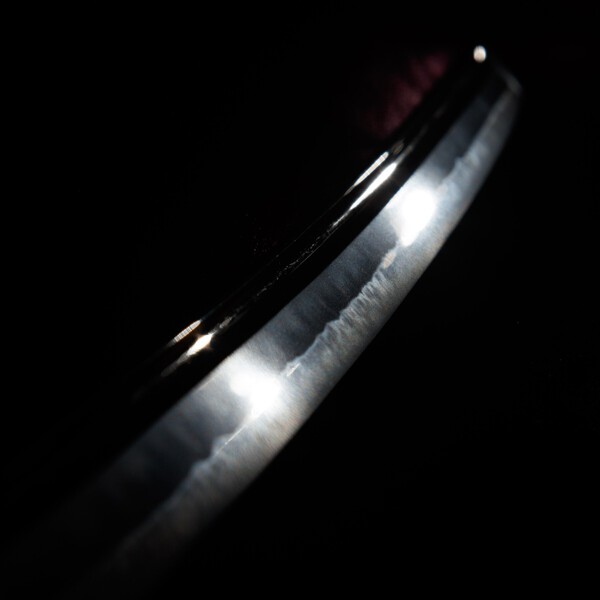
This is a wonderful topic, and I appreciate all the photos and references being shared. Lovely to hear again from you @Rayhan. Welcome back. I am still not sure myself how utsuri was obtained, but I (weakly) subscribe to the temperature-control theory and single quench, so far at least. Annealing, thermocycling, are two plausible alternative theories. I believe the focus should not be utsuri - but rather, antei - the dark band above the hamon. How was antei obtained, and how does it differ metallurgically from the white-ish band above? (utsuri). I believe this is important, because the utsuri itself is the default jigane state whereas the Antei is where the metallurgical alterations of interest occur. I have not seen a convincing metallurgical analysis comparing the three bands: hamon, antei, and utsuri. This is an important gap. I would be very grateful for a credible reference to come to light. Regarding a photo of utsuri, here is a striking midare-utsuri on a Tokubetsu Juyo blade by Osafune Kagemitsu (photography credit to Ted Tenolds). This is a good base to anchor the conversation. Notice the 3 distinct bands: - Hamon (and the nioi-based substructure forming the nioiguchi and the ashi) - Antei (the dark area above the nioiguchi) - Utsuri (the whitish area above the utsuri)
-
Hi Kevin, The ji is executed in itame mixed with mokume, and although it is denser on one side compared to the other, it is within the normal range of variation. First tip: don't over index on the distinctions between itame, mokume, etc...it's just not that important, in the end. Likewise, don't fixate on minute irregularities in the ji, in Japan nobody really cares. What you want to train yourself to look at (sugata aside): pay attention to the hamon: is it bright and clear?, the nioiguchi: is it consistent and luminous? the quality of the ji: is it lustrous with ample jinie? And the expected midare-utsuri (which cannot be seen on the current photos, alas). You'll notice that the blade's ji is rich in jinie, and is quite lustrous, which is a rarified feature for Nambokucho works. The most important of these qualities is the nioiguchi. It is rather thin, clear, and consistent. Then look at the form of the hamon, you'll recognize that it resembles closely the hamon pattern of his master, Kagemitsu, with an angular and almost kataochi-style gunome. This lets us infer that this is relatively early work of Kanemitsu, before his prime phase where he executes his hamon in a noticeably different way. Pay attention also to the slanting and brilliant ashi that give the hamon depth and clarity. It is a worthy Tokubetsu Juyo blade. Personally, I am more fond of such early Kanemitsu work with the brilliant ashi, and angular kataochi-style gunome, compared to his more mature style. Is it in the upper echelons of Tokubetsu Juyo for Kanemitsu? Not quite, and that is reflected in the price. It is certainly a lovely blade. Hope this helps. Hoshi
-
Hi fellow Swiss, The photos are difficult to interprete, but based on what you have, I'm afraid that they do not conform to Kencho's characteristics in a way that makes me confident in the attribution. Kencho (And Chogi) for that matter, have a different hamon shape and structure. The nie is likewise too intensively expressed (from what I can discern by squinting) in your photos. I can't make pronouncements on the Boshi, as the photos make it difficult to discern what is the hardened area. There is what appears nie kuzure, and an undelineated nioiguchi composed of blotchy nie. The simplest way is perhaps to think of Kencho as being more wild than Chogi, with sharper ups and down, and an overall more nervous appearance, whereas Chogi expressed a more wavy-like, more in the alpha frequency band to take a radio analogy. Kencho by contrast, goes into much higher frequencies of ups and downs. Some blades fall in the middle and can go back and forth. Both smiths were probably close to equal in skill. Kencho is one of the unfairly classified smiths by Fujishiro as Jo-Saku. His Tokubetsu Juyo record would point that he is at least Jo-Jo saku, or even close to Sai-jo saku. Now, this is based on the tradition of attribution, in reality we have only three signed works left by him and they do deviate from the canonical Kencho in significant ways. The Honami judges that did issue kiwame to Kencho are also the unreliable ones, so we don't have a lot to go with. Kencho is really a vibe of Soden-Bizen. Some of his works are truly wonderful though, and some even prefer Kencho over Chogi or Kanemitsu. Regarding the "kizu" folder - the Kirikomi is not what you should be concerned about. There are two Fukure in that blade, one in the ha. This is a signifiant condition issue. Good luck in your search, I would recommend skipping this one. A great Kencho attributed sword, however, is a solid path that I would recommend pursuing. For reference, here is a legitimately excellent Kencho: https://www.sothebys.com/en/buy/auction/2025/important-Japanese-swords-and-armour-from-the-paul-l-davidson-collection/a-soden-bizen-school-katana-attributed-to-kanenaga It's one of the great heights of the Nambokucho period's Bizen tradition. Good luck!
-
Nihonto Substack: The Falling Leaf Sadamune
Hoshi replied to Hoshi's topic in General Nihonto Related Discussion
Happy to hear! Positive feedback is encouraging. If there are enough interested people that follow the substack, it'll keep me motivated to post more research! The Shizu line is fascinating. Did you know a new zaimei Shizu daito was uncovered and passed Juyo Shinsa this year? I'd love to do a writeup on that blade, but the odds to get in-hand and do photography aren't on our side. To each his own. I'm basing my research on the NBHTK's tradition of attribution, and belong firmly into the "Tanobian" school of thought, which is itself extension of Honma Junji's approach. As you know, appraisals on mumei blades are partly specific features, partly quality gradients, depends on the case. For those interested, the best way to dive into it is to buy Markus Sesko's excellent (and ongoing!) translation of the Kanto Hibisho. I can't recommend it enough, it's a rare glimpse into his stream of consciousness. Get it here. Beautiful photos, great write-ups, and in-depth research, this is what I miss most. Hopefully, we can re-create some of the magic of Yuhindo. Best, Hoshi -
Nihonto Substack: The Falling Leaf Sadamune
Hoshi replied to Hoshi's topic in General Nihonto Related Discussion
Thank you! The photography is the work of Ted Tenold (and the copyright owner, photos reused with permission). The photos are from Darcy's original post on Yuhindo.com.