
Hoshi
-
Posts
804 -
Joined
-
Last visited
-
Days Won
10
Content Type
Profiles
Forums
Events
Store
Downloads
Gallery
Everything posted by Hoshi
-
 Hi @Toryu2020 My apologies, It will be added very soon. It’s a good occasion for me to ask what other clubs and societies I’m missing. Do we have a directory somewhere of active societies? Best, Hoshi
 -
Hi, The codes can be finicky at times due to the way Email works. Check your spam folder, and if still nothing - retry a few times. It’s working over here. best, Hoshi
-
Hello, After discussing with experienced friends in the business, generating credible and professional .pdf brochure is basically equipping scam sellers with nuclear-grade fraud material. My north star is to create a more trustworthy and reliable market for the field. So, can't have that, at least not in its current form. Shortest lived feature on NW, it will be accessible in a gated form at some point in the future. Cheers, Hoshi
-
Hello, @Rawa, you can now download a structured PDF of the item from the listing page. It takes about 10-15 seconds to generate a .pdf, which you can save on your computer. Press the "download document" button to begin the generation process. It will show you, in order: item, item photo, artist overview, and market comparables. Few observations: 1) On-demand PDF gen really hammers the server hard. I will be gating this behind login and possibly adding a per-user cap. 2) It will take time to polish in order handle complex edge-cases such as long dealer photos that need computer vision for page-size segmentation before vectorizing. Before I invest more time into this, I would love to hear from other users of the platform if they value this feature, so - let me know. Best, Hoshi


-
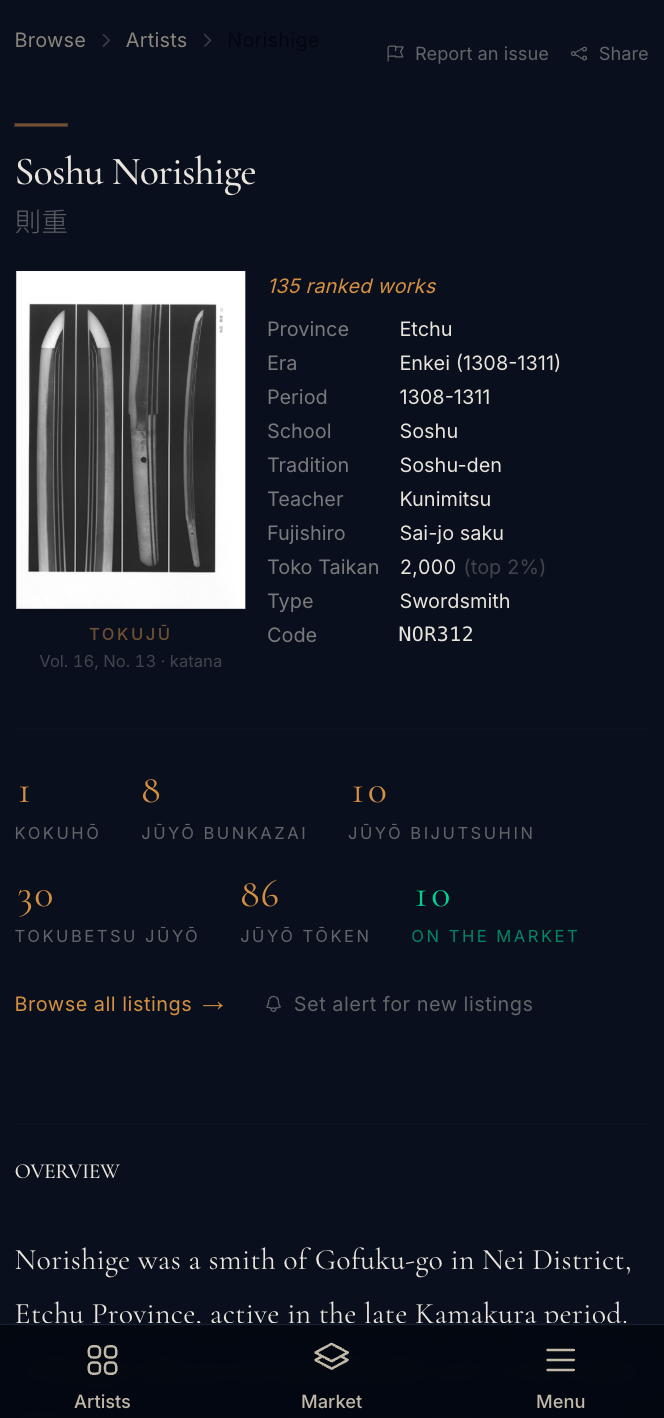
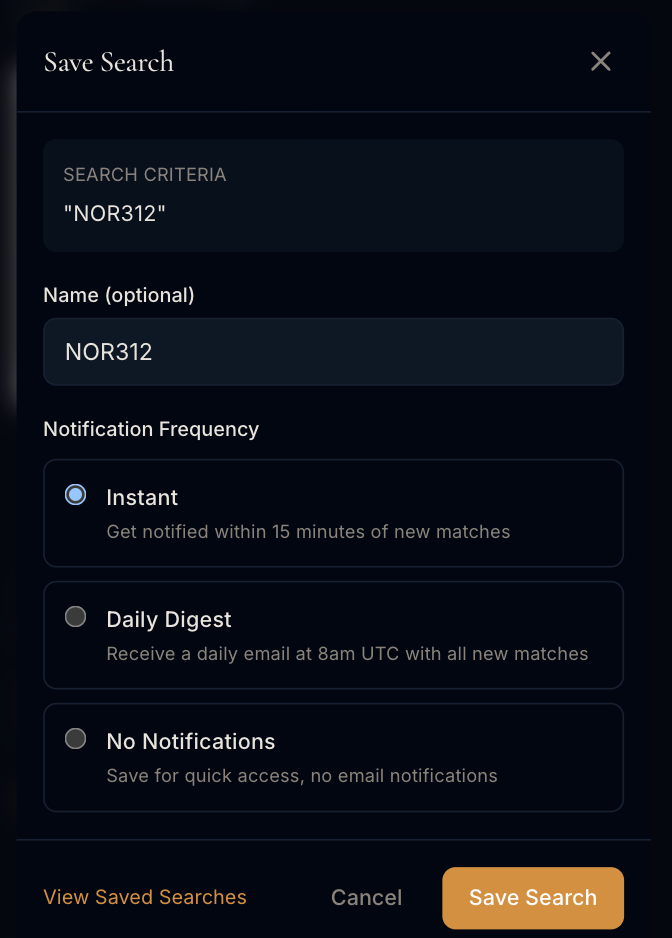
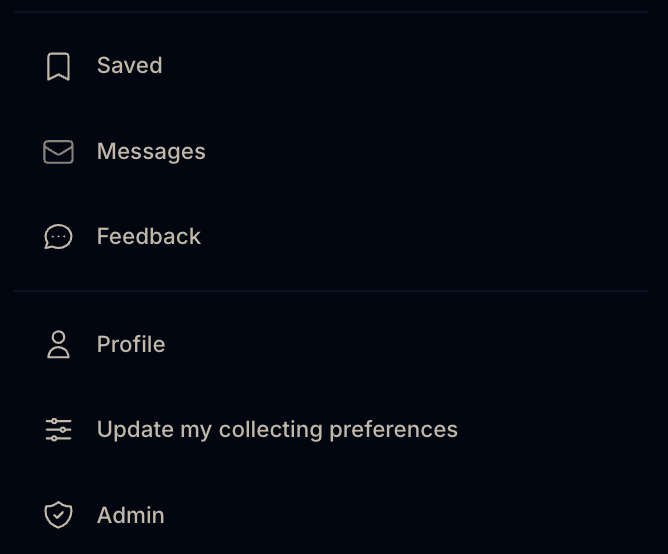
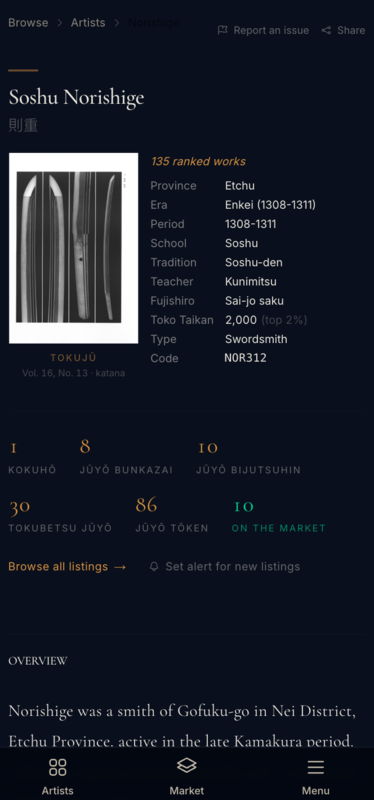
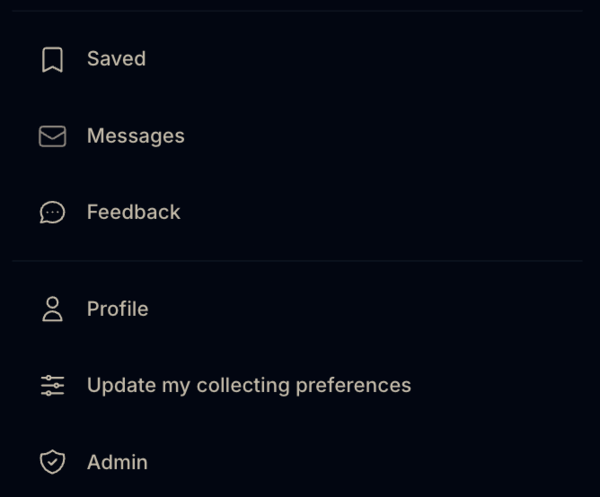
Hello, Yes, this is a core part of the product BETA features we are testing out. Oh my, I'm really dismayed you did not find the feature on the app immediately. Please let me know how to make it more obvious @Lewis B After running a search, simply press the "Get Alerts" button. It will add the alert to your account, and send you an email. Because the app is not an iOS native app, the notification will happen through your email notification on your phone. You can also go on the Artist pages, and select an artist you're interested in: Set your alert parameters: Alternatively, the easiest path is to conclude the onboarding via "Update my collecting preferences" in the app triple dot menu button. This will trigger a short questionnaire and tailor alerts to your preferences. You will then get email alerts as soon as an item appears in the market in the next 15 minutes. Best, Hoshi




-
Hi, What would you “save as PDF” - the listing image and metadata? Tell me more about it, I’m curious, and I want to make sure I understand. Best, Hoshi
-
Hello, Great to hear, yes - it is built as a modern app for tablet and mobile. We're now up to 66 dealers worldwide and over 8000 items to choose from and compare, updated 12 times daily. Yes, a great amount of AIs are running tirelessly behind the scene to normalize, triage, translate, assign and understand the data coming in from unstructured websites across languages. This would not have been possible without recent advances in frontier models. Now a question for you @Rawa - What would make this app even more valuable for you? Cheers, Hoshi
-
Paper level for big names / attribution
Hoshi replied to klee's topic in General Nihonto Related Discussion
Hello, Delicate questions. In general, I recommend staying clear from recent TH papers to big names if you cannot assess it in hand and with sufficient experience studying higher level designations for said master. If this is not possible, only go in after having it appraised by someone who can hold it in hand, and has such experience. This is the value that a trusted dealer or collector friend brings. The reason for this is that the Shinsa panel is in a succession phase where it has to invest into new judges and ensure proper knowledge transmission - and this is a bumpy road. I has been so for a few years, let's see what happens at the upcoming Tokuju Shinsa. The last session had some eyebrow raising anomalies. For pieces attributed to Awataguchi Hisakuni, Shintogo Kunimitsu daito, Go Yoshihiro, Masamune without historical kiwame a respected Hon'ami judge or an entry into the Kanto Hibisho, it is quite delicate at the moment. I would even be exercise caution right now with zaimei pieces. With this wide caveat in place, there are still incredible pieces that can surface from time to time. Value wise, every tier of paper de-risks the object, that's all it does, the object does not change, and it is this de-risking that drives market perception and creates the price premium. If I'm a dealer and I tell you I have one of the best Nagamitsu, and it's sitting at TH, and I ask you 40 million yen for it, you're going to think I'm crazy. You won't believe me unless you have the knowledge to truly and deeply assess it, in relation to the corpus, and come up with your own conclusion that it is, in fact, one of the best extant Nagamitsu. Now if I tell you it passed Juyo session 3, then Tokuju session 6, all of a sudden it's a different story probabilistically speaking it is very likely amongst the ultimate blades extant. Sure, it might be the 'lesser' of the series, but these sessions contained an incredible density of treasures and on average, they contained more peak works. Advanced collectors know this, and dealers too, forming common knowledge around these heuristics. On the other hand, if you're one of the most experienced collectors in Japan, and you've "seen it all" - you look at the blade and you just know. You don't need the Juyo or Tokuju paper, you know what's out there, you've experienced most of it, you've been in the circles. You're ready to pay 40 million JPY in a blink for that blade sitting as a TH Nagamitsu. What's the value of his top blades? It's price = n/a. And the dealer might be very relieved you recognized it as such, and happy to sell it to you, because time is money and waiting for submission cycles is financially painful. He will put you into his serious client book, and propose you more such pieces in the future. If by miracle you get handed to you a zaimei Hisakuni tanto with denrai to the Imperial family -at Hozon- in good condition, it will be millions of dollars, and now the paradox kicks in that the buyer will be even happier as it's a secret blade that isn't recorded anywhere as some collectors just enjoy the secrecy a lot. This can help - for artists you follow, as you're looking for comparables out there, check out NW's artist database: https://nihontowatch.com/artists/nagamitsu-NAG281 Just be careful out there, if it looks like it's too good to be true, it probably is. I hope this helps, Hoshi- 21 replies
-
- 11
-

-

-

-
Hi, This is an delicate topic. Swords do get elevated to Juyo Bunkazai, albeit rarely. As far as I know, 3 Tokuju blades have been subsequently elevated to Juyo Bunkazai. As you rightly point out, there are many Tokuju swords deserving of the Juyo Bunkazai designation (The Tokuju "long tail" is vast, and arguably goes all the way to National Treasure). Amongst them, the famous Osafune Mitsutada ken. Owners of top Tokuju blades, however, are uninterested in upgrading the status of the blade to Juyo Bunkazai. This is because ownership becomes a burden, you have a duty to exhibit, and your home will be inspected by police officers to ensure proper care is taken, and the state gains the right of first refusal on any transaction. Any increase in value from the designation becomes subject to the 40% Japanese capital gain tax, and you are obliged to report the sales in a world where discretion prevails. As the Uesugi family council once said "these laws smell of communism" - and this attitude still exists today. This is why the Mikazuki Kanemitsu, along other masterpieces, never got the designation. The trend has been the opposite: Juyo Bunkazai blades "get lost" over time. As always, follow the incentives. Best, Hoshi
-
GOAT book. Absolutely necessary in every library, and I do not say this lightly.
-
The last of the Gyobutsu swords
Hoshi replied to MassiveMoonHeh's topic in General Nihonto Related Discussion
Thank you brett, great work! I would highly recommend reading the book "Honma talks" - I think Markus has a translation available. It gives many details on the "behind the scenes" of the Imperial collections an many other high-ranking collections. The challenge with Gyobutsu is that the majority of them do not have any designation from either the NBHTK or the Ministry of Culture. Items of great scholarly importance, such as a zaimei Masamune tanto, or a tachi signed by Kagemasa and Kagemitsu as joint work, or a Mitsutada with a complete long signature, and many others - are not documented anywhere else. it's crucial to keep track of these important and undocumented pieces. Even if they have lost their status post-war due to the tax regime change that ruined the Imperial family and its Junior branches, these blades do not carry any official designation and are thus the 'dark matter' of Nihonto. On another note, the post-Nambokucho blades in the collection can be eyebrow raising - there are many lower quality works there, and Honma remarks on this. One thing that is incredibly interesting: the vast majority of their holdings consists of signed blades, and with a clear statistical preference for Bizen and Yamashiro over Soshu, which perhaps reflects a certain disdain towards swords produced to the taste of the Kamakura warrior class. From the Meiji to the pre-war era, there was a great re-evaluation of schools such as Ko-Bizen, which has remarkably low origami valuation by the Hon'ami family compared to where they sit today in the elite hierarchy. Figures such as Imamura Chogi were instrumental in shifting the balance of taste amongst the elite. Honma Junji did not hold Imamura Chogi in high esteem, and takes a number of jabs at him in his book. Emperor Meiji's collection was probably the peak of the Imperial family's sword holding and accumulation. During the Meiji restoration, many great industrialist families heading the powerful Zaibatsu have gifted Emperor Meiji incredible blades. Best, Hoshi -
Hi Mike, You can compare with other Omiya offerings on the market here: https://nihontowatch.com/artists/NS-Omiya Hope this helps, Hoshi
-
Hi Janne, Great feedback. I implemented the report feature, which also lets user ask for new features, report item data bugs, or artisan data bugs, or general bugs. Top navigation bar: Item card: Artist/School page: And good idea on the dimension filtering. I added it for Nagasa, this is the easiest. Weight, I'm afraid is not documented consistently, more than 90% missing data. Motohaba and sakihaba I would say are of marginal utility. Note that there are some data errors on some items, as is to be expected. Best, Hoshi




-
Hi, yes. This is a data bug. A juyo item by a unicorn smith called "Iemura" from the Oei-period has been mistakingly assigned to the Showa smith Emura. Thank you for the report, the error is now fixed. Note on the BETA: There are many data bugs currently. For obscure smiths with 1 Juyo, best assume it's an assignment error. Best, Hoshi
-
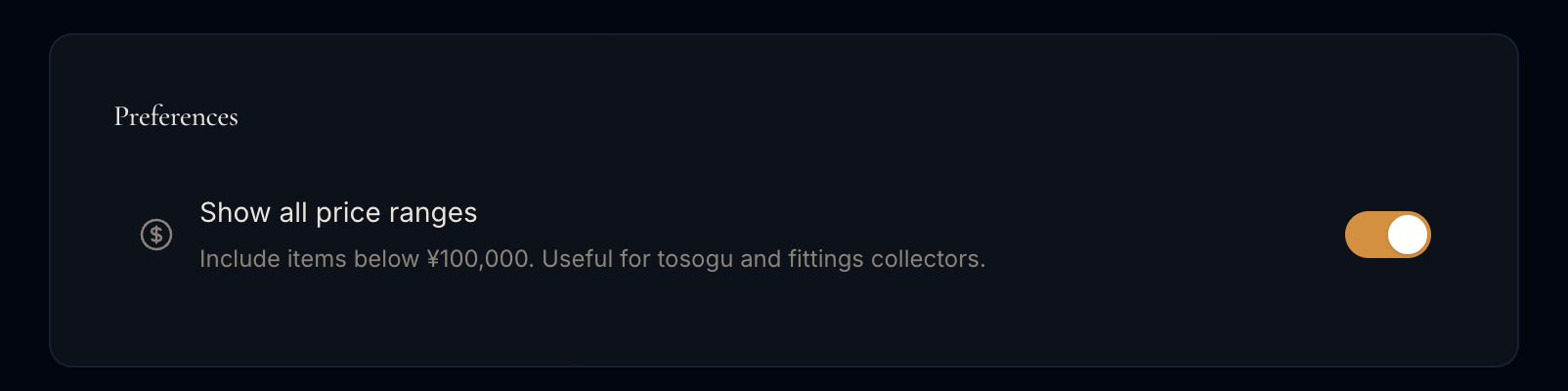
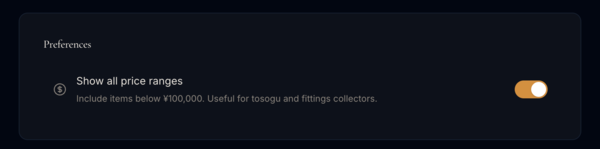
Hello, Following on popular demand, show all items is now the default. If you want to hide items under 100'000 JPY, you can toggle the option in your profile. There will be issues with strange items appearing (books, flyers for museum visits, other type of objects) appearing in this price range which are misclassified. If this becomes too much of an issue, I will revert. In the meantime, this change has added about 1500 new tosogu items which are now visible to all. This brings our total items for sale to almost 7000! Happy hunting, Hoshi
-
Hi, I added a toggle in profile that lets you enable view on listings less than 100K. Go to profile -> activate toggle. https://nihontowatch.com/profile You'll see absolutely everything. Enjoy. Best, Hoshi
-
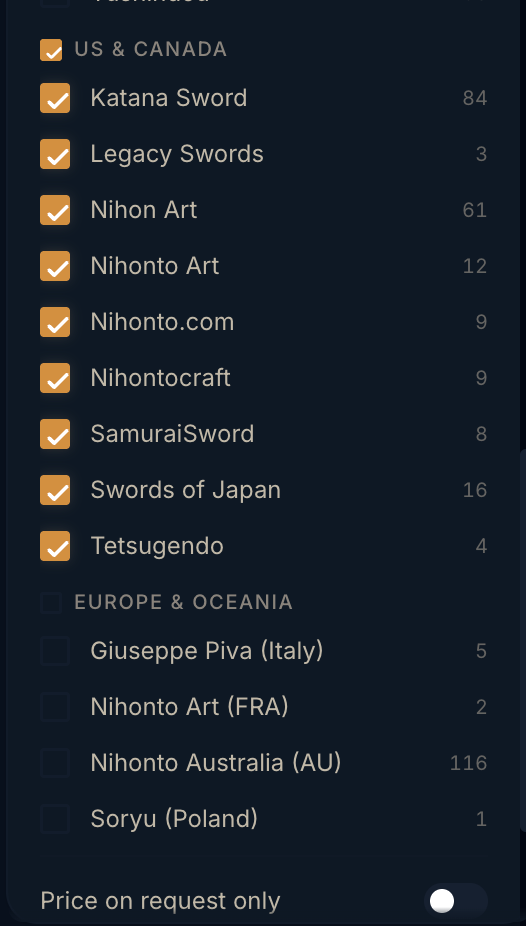
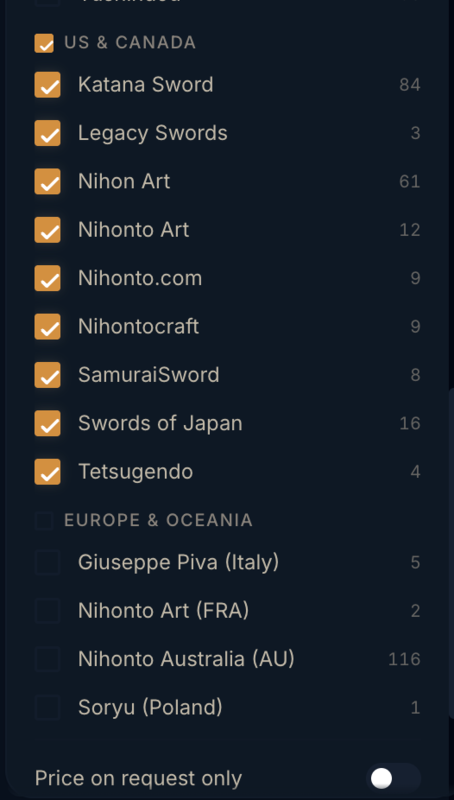
Hi, Thank you for your feedback. Convenience is important. Now, you can tick all dealers from the North American continent. I genuinely appreciate the feedback, and more feedback would make me even happier. I want to hear it all. Best, Hoshi
-
Hello, This is super valuable feedback, I've made the appropriate changes to make the registration pathway much clearer. Thank you, Hoshi
-
Hello, Are you referring to the email verification code? I'm aware email codes have been slow since the announcement, this is to the traffic on the email service. Otherwise, let me know what you mean by 'not obvious' - I'll make it better. Many members here and dealers have written over the last few days with requests, we're up to 52 dealers today. PM me what you'd like to see. Best, Hoshi
-
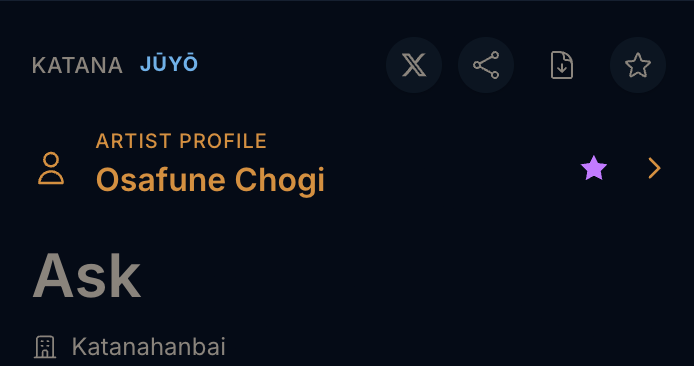
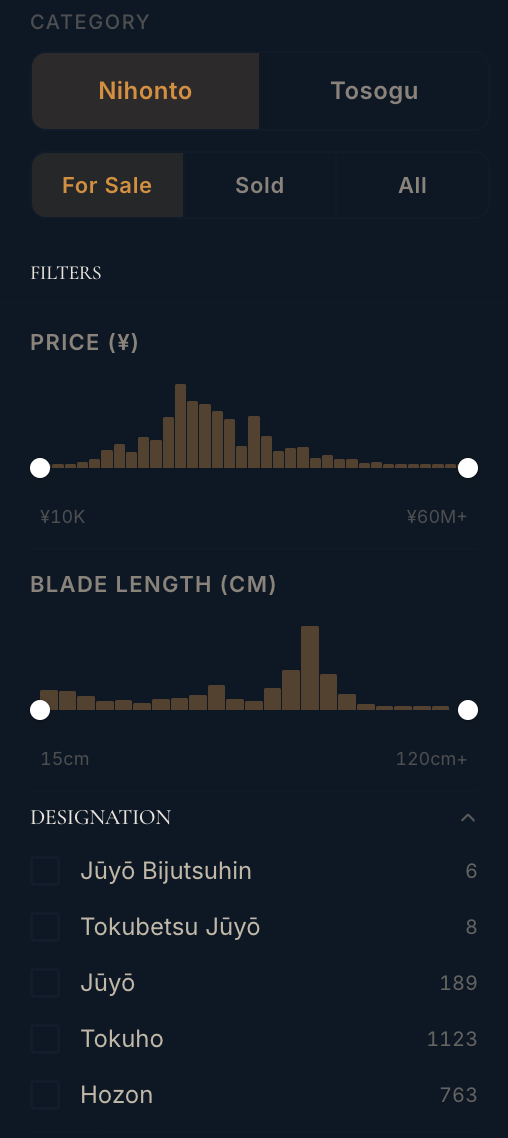
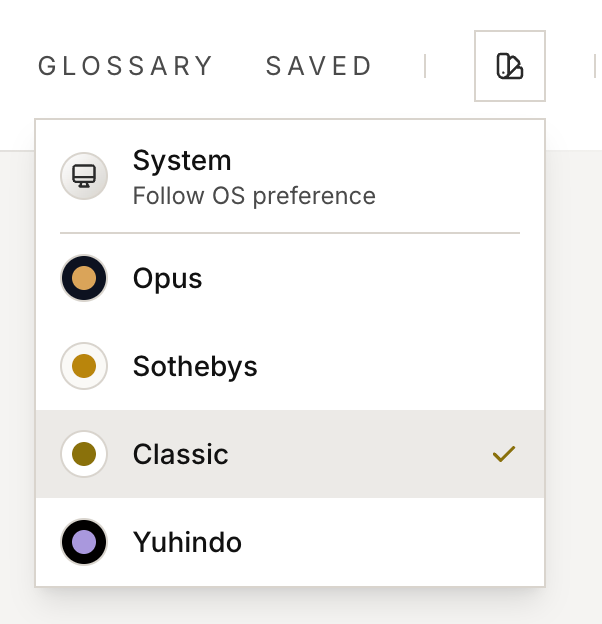
Hello, Great feedback. I added a special UI mode for accessibility. It's called "Classic" Click the right most icon: In the dropdown, select "Classic" And from there, it should be light mode with large fonts. I hope this helps. Currency conversion is already implemented, and takes the live FOREX from the Frankfurt exchange. In the filter panel, on desktop and mobile, select: Keep the feedback flowing, it helps tremendously. Enjoy everyone, Hoshi


-
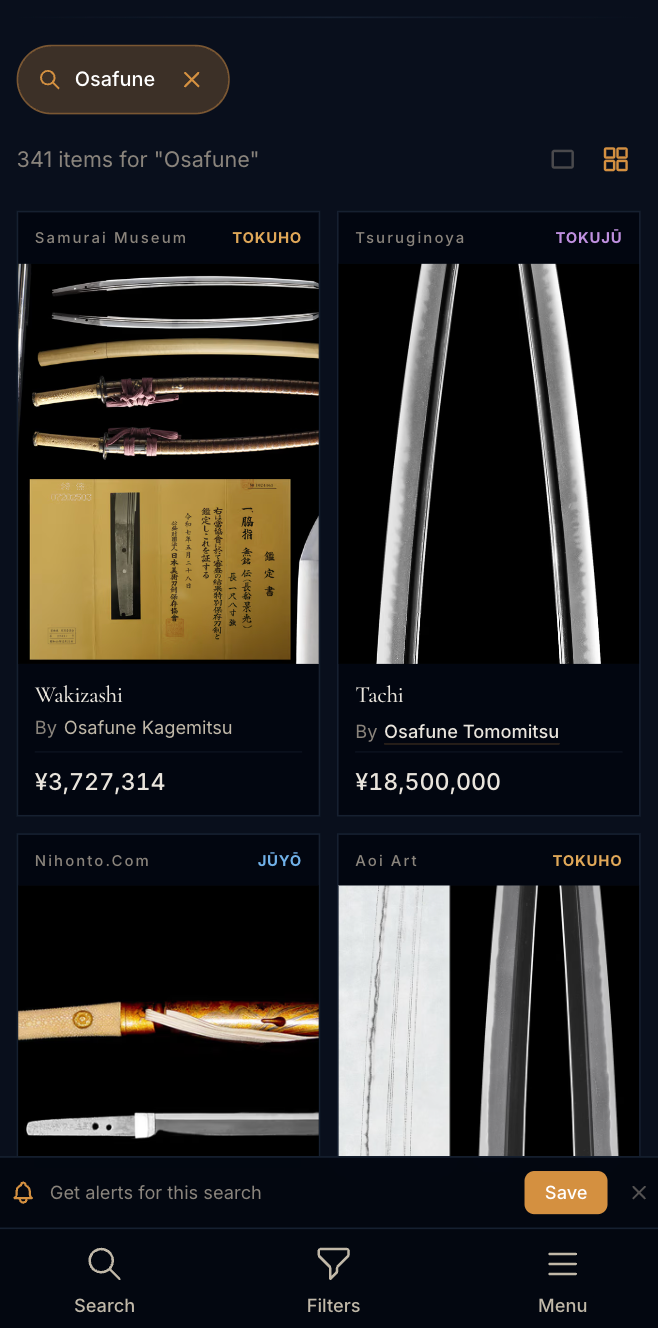
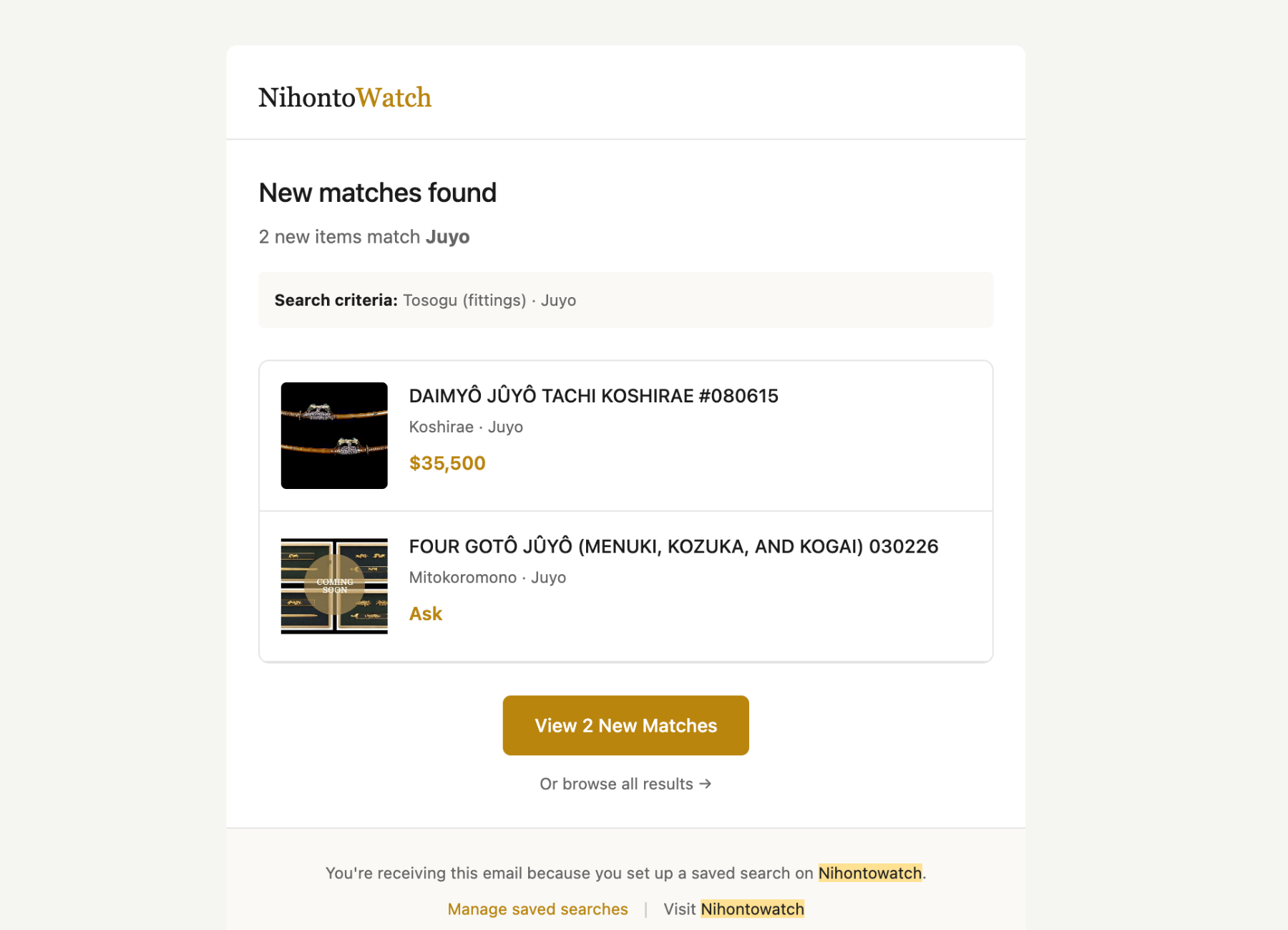
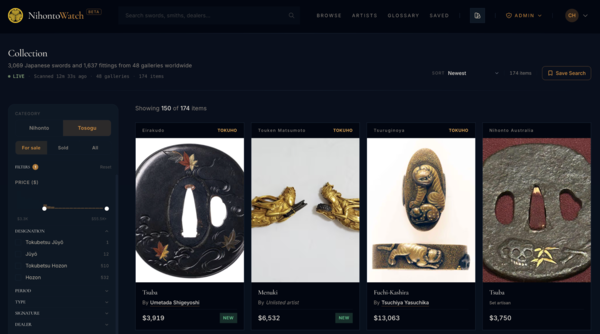
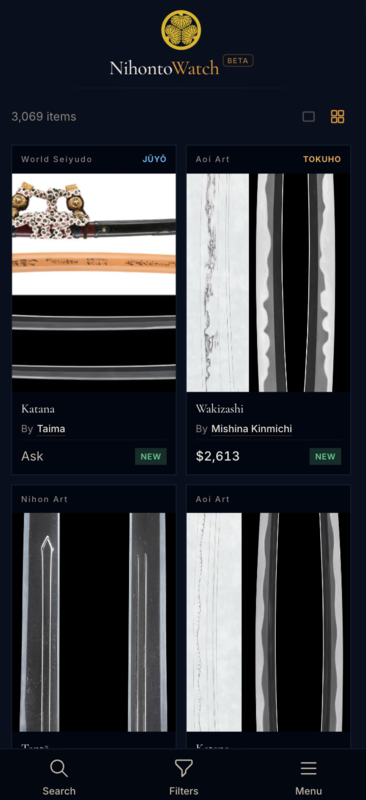
Hello everyone, TLDR: Interested in Japanese swords and fittings? I made this to help the field. Open nihontowatch.com on your phone browser, and add to home screen (Share → Add to Home Screen). Thank me later. --------------------------------------------------------------------------------------------- I have been thinking for quite some time about the future of our field. I have been blessed with incredible mentors and opportunities, most notably the late Darcy Brockbank, who was so generous in sharing his knowledge. Since his tragic passing, I have felt a responsibility to carry that work forward. What I am about to present, I built as an homage to his memory. Our field has problems. We operate in a field of extraordinary depth without being equipped with the knowledge and tools to understand what we're looking at when we browse the market. Refreshing dozens of dealer websites every week, most in Japanese, copy-pasting listings into translation apps, pinching to zoom on sites built twenty years ago — market awareness is just painful and you miss things constantly. You spend an hour and walk away unsure you have seen everything. And this is just the market experience. The deeper problem is access to knowledge. There are no catalogues raisonnés for artists. Yuhindo would have grown into it — it was planned. But alas, Yuhindo is no more. No way to know, with any confidence, whether a price is reasonable without decades of experience or tens of thousands of dollars invested in published references. No way to know why something costs what it does. Communication with Japanese dealers remains daunting for most. No easy way to know who is a reputable dealer. The barrier to entry is simply too high, and this friction keeps our field artificially small. Fine art has Artnet. Watches have Chrono24. Antiquarian books have AbeBooks — markets with comparable depth and comparable opacity, served by platforms that bring transparency and accessibility. These fields have benefited immensely: they have enabled new entrants in droves to collect in confidence. Our field needs more knowledge and transparency to build interest and trust.Japanese swords and fittings. Eight hundred years of collecting history at the highest levels. The category that contains the most national treasures in Japan. The indefatigable search for perfection of an entire civilization. And yet, we have nothing. This had to change. As I write this, there are 3,021 Nihonto and 1,607 Tosogu items for sale across 44 dealers, Japanese and international, in a single searchable interface. Every listing is structured with attribution, certification, measurements, and artist intelligence data. NihontoWatch is on track to follow 100% of the online market for genuine items with NBTHK papers. Refreshed 12 times a day. Everything is translated and structured, as it trickles in live. But what is this worth, if it's so hard to know what you're looking at? Especially for newcomers, it is so hard to tell what you're looking at. This is where the magic is. I am nostalgic of reading through Yuhindo's artist descriptions. It made me deeply appreciate the field. It got me in. NihontoWatch scales this experience and creates something approaching a living catalogue raisonné for every Tosogu and Nihonto artist. It matches every listing against a database combining the complete Juyo, Tokubetsu Juyo, Juyo bunkazai, Kokuho, and Gyobutsu designation data — over 23,000 items at the highest level, with rich text in classical Japanese. This data is then processed, synthesized, and presented into NihontoWatch's artist directory in a way that is respectful of the NBTHK's copyright. With this, you'll be able to discover a maker's historical reputation through quantitative analysis of exhaustive provenance records, in ways never seen before. Over time, all of these artist pages will come alive, forming an ever-expanding knowledge base. - How rare is it? - How many Tokuju? - How many designated works ranked Juyo and above? - Why is this important? - Where does it rank relative to other works? - What is for sale right now? - What was for sale recently? All the answers are in. These are questions that come up constantly in our community, and until now, answering them required years of collecting published references worth tens of thousands of dollars, and patiently indexing them with post-its or one-by-one in a spreadsheet. Only professional dealers or major collectors could afford to do this. This is a BETA, so there are errors. The more obscure the artist, the higher the error rate, and there are still basic errors I need to fix with some famous artists. A lot of algorithmic tinkering and curation ahead. It will keep getting better with your feedback. See the results for yourselves: - Soshu Masamune: https://nihontowatch.com/artists/masamune-MAS590 - Ichimonji school: https://nihontowatch.com/artists/NS-Ichimonji - Yasuchika (tosogu): https://nihontowatch.com/artists/yasuchika-TSU001 - Goto school: https://nihontowatch.com/artists/NS-Goto Click one and explore the designations, the provenance abalysis, the measurement distributions. This is just a first shot — over time this data will grow. Here is one where I have published an item I studied for my Substack article on Mitsutada: - Osafune Mitsutada: https://nihontowatch.com/artists/mitsutada-MIT281 Imagine Yuhindo, but with a page for every artist and every piece ever captured on camera. Saw a national treasure at an exhibition in Japan? Share your photos on NihontoWatch's artist catalogue. In the future, owners of particular works will be able to publish them to the artist's catalogue. Think of it as a growing, community-curated knowledge base for every artist in the field. And so much more Browse and filter: Designation, dealer, item type, school, province — all filterable, all instant. Prices display in JPY, USD, or EUR. Every filter combination is a shareable URL. The sold archive tracks thousands of items for pricing research. And it works for every budget, for collectors at every level. - All Tokubetsu Juyo Nihonto on the market - All Tsuba with Hozon or Tokubetsu Hozon, maximum price $2,000 Setsumei translations: On some items, you can press the floating book icon on any Juyo item to toggle between photos and the Juyo setsumei translated text. For most Juyo and above items, the NBTHK evaluation text from the dealer's page is identified by computer vision and translated into English. It will fail if the dealer has not posted the Juyo Zufu extract, but in the majority of cases they do, and the result is remarkably accurate. Do use responsibly — the quality is great, but not perfect. Always purchase professional translation from Markus Sesko when contemplating the purchase of a Juyo-designated piece. Search alerts: Never miss an item again. Define keywords and filters and save them. NihontoWatch will run your search every 15 minutes, and when something new appears, immediately send you an alert email. In practice, missing a listing that fits your interests becomes almost impossible. Tip: I recommend avoiding overly specific queries. "Juyo tsuba" or "Kamakura signed tachi" are safer than specific artists such as "Yozozaemon Sukesada," which would be more fickle. Broad queries give you the best market coverage. Inquiry emails: Press "Inquire" on any listing to draft a professional inquiry in Japanese. Handles etiquette and formality, and can help you request the 10% consumption tax exemption available to overseas buyers. Did you even know you could get 10% off? How many new entrants lost 10% on this, at least at the beginning? I for one did. I've seen countless high spenders neglect to request it while shopping across Japanese galleries. Glossary: The technical language of Nihonto and Tosogu is deep and specialized — needlessly so for non-Japanese speakers. Anytime a technical term comes up, you can click and see what it means. Over 1,200 terms, searchable, automatically linked from the setsumei translations. Who remembers always keeping an index open to keep track of terms when studying Juyo items? https://nihontowatch.com/glossary How best to use NihontoWatch While it works wonders on desktop, NihontoWatch works most beautifully on your phone. I use it every day — it feels like I have the market in my pocket. Open nihontowatch.com on your phone, hit Share → Add to Home Screen. And voila, you have an app. It becomes something you check with your morning coffee, the way one might check the news. A word of caution The data has errors — always verify independently. This is a tool to explore the market, not a substitute for critical thinking. If it looks too good to be true, it likely is, and this system can't easily correct online misrepresentations. Old listings where dealers have not marked items as "SOLD" will still appear as available. Listing errors will slip through, but data quality improves continuously as the system learns over time. Get involved - Missing a listing or dealer you like? PM me or post here. - Bug? PM me or post here with steps to reproduce. - Dream feature request? Reply in this thread. I will keep this thread active and share major updates when time permits. Everything is free right now, and will remain so until ready for official release. This is no trivial task, and it is expensive to operate — it will need to be covered in some way down the line. It will be tempting to keep it for yourself. But if we want our field to grow, we must share knowledge and expand market access and transparency. The single most impactful thing you can do right now is help others discover and use the tool. Share it with your study group. Share it with your collecting circle. Share it with a friend who has been curious about Nihonto and Tosogu but found the barrier to entry too high. That barrier just got a lot lower. Farewell, Darcy. This is for the teacher in you. Hoshi


- 105 replies
-
- 50
-

-
-
-
-
nihonto-db.com, Nihonto Database and interactive tools
Hoshi replied to nulldevice's topic in Nihonto
Dear Chandler, Thank you for your effort, it has been a pleasure following your project. You bring the type of energy that the field needs, a deep curiosity coupled with builder energy. The map of Japan is great interactive material, and the timelines are insightful as well. I look forward to seeing how this evolves, and getting to know you better. Best, Hoshi -
New Video from British Museum
Hoshi replied to MassiveMoonHeh's topic in General Nihonto Related Discussion
Hi Robert, I couldn't agree more. My earlier comment was not criticism of the focus. The factual errors that we have vehemently denounced are the product of a particular paradigm of historical analysis that focuses on power dynamics, deconstructionism, and post-modern revisionism. In this paradigm, convergence towards historical accuracy is subordinated to the greater goal of pushing novel narratives to enact society change. It is this inversion of teleology that I take as responsible for the fall of Western scholarship in our field. Or, simply put: when the purpose of scholarship shifts from "finding out what was true" to "changing what people believe," accuracy becomes optional and errors become inevitable. Hope this helps to clarify my position, Hoshi -
New Video from British Museum
Hoshi replied to MassiveMoonHeh's topic in General Nihonto Related Discussion
Alas, This video is very difficult to watch. Beyond the factual errors, it is representative of the lack of museum budgets for qualified curators and European decline in museum scholarship on Arms & Armor. This is not to blame the presenter. His effort is earnest, and I am sympathetic to his predicament in the society he is embedded in, it is a survival strategy. He is but a symptom of a deeper societal issue. This is a general trend, museums follow the elite taste and ideology of their donors and subsidizing government bodies. Sadly, the BM has been marred in a battle against the Woke Mind Virus and its denunciation of colonial history that renders everything it owns, hires, and does, suspect. The presenter is a product of this tension. It is an unfortunate situation, but this too will come to pass in the broader arc of history when necessity calls back for common sense. Best, Hoshi -
Indeed, hence why I did not mention his name, nor that of Yukimitsu.