


Hoshi
-
Posts
823 -
Joined
-
Last visited
-
Days Won
10
Content Type
Profiles
Forums
Events
Store
Downloads
Gallery
Everything posted by Hoshi
-
Thanks for pointing this out Matt, Its good reference material. Interesting how the smith who performed the suriage kept a piece of the old horimono, making it extremely clear that the Bohi was added after the suriage (as is often the case, I read). I never saw something like it.
-
How do you see this? Could you point out what image you use to reach this conclusion about the Boshi? you mean by comparing the AOI and Juyo Oshigata? EDIT : you posted the reply before I could post my question! all clear.
-
Hahaha, some fantastic comments in this thread. Hideyoshi the "nouveau riche" chastised the old keepers of ascetic virtue. I've seen my fair share of Juyo koshirea with exuberant theme which have left me drooling... Omori, Natsuo, Goto masters... However, I have never seen I believe, a Koshirae in the wabi-sabi style which has been recognized as a masterpiece. It would be fantastic is someone could post a few images :-)
-
I really like the idea of an online museum with very high quality pictures. The community is so spread out across the globe, and for those of us who aren't in Japan or the US, it's hard to go to meetings. So far, we have Darcy's fantastic website, and Aoiart.net which are both good sources for high quality blades.
-
Let's do this PM sent, Steve! I just spent the evening reading about zen aesthetics and tea ceremony, to set the mood.
-
It's nice. I don't like the background color coupled with the deep blue font on top, and I find the icons below distracting as they come out too sharply from the otherwise subdued and calm feel. Perhaps go for a plain black/dark grey background and smaller donate/mailing list etc icons? Or add a tab for these. I like the sword page more, but there I could do without the white canvas and just let the text/image float in the background. Of this this is highly subjective and just my opinion, and in any case it's a fantastic start!
-
Well, where to start... Thank you for all the great responses, I'm proud to be part of such a community. I plan to give a big boost to my nihonto and tosogu library this year, and I will for sure get some of these books on my shelf (PS: I'm interested in wholesale buying if someone wants to sell his book collection, Tosogu, Nihonto, and Japanese aesthetics, PM). This is indeed true, looking back two years ago my taste for bling was wholly unrefined, I remember seeing a Soten Tsuba and loving it - but looking back at it now I really don't understand my judgement anymore. Since then I've tuned my preferences, after studying some of the great Goto masters. Perhaps - and this really puzzles me - five year from now I will have veered towards the folk art and zen-inspired pieces, It's strange how preferences evolve, but I disgress... Not rambling at all, thank you for sharing! That's indeed what I was getting at with aesthetic appreciation. Thank you for the suggestions, these concepts really do seem to be the key. Very kind of you Steve, I'd love to skype over one of these days - and if you could show me some of the pieces of your collection and expand on what triggers the aesthetic experience that would certainly be the fast track to enlightenment! But beware of unearned wisdom, as they say...
-
I know a lot of you are enamored with iron tsubas, and somehow dislike the bling shakudo ones. I'm a great admirer of the latter, as I truly enjoy the meticulous works of inserts and carving, and gold tones give them relief and vibrancy. That said, I'm genuinely trying to learn how to appreciate the iron ones, which so far I don't "get". Is there a good place to start? What should I pay attention to as a criteria for quality? I've tried the iron bones thing - and I also tried to enmesh myself in the zen-like qualities of plain pieces, but...I can't. I'm thinking its an acquired taste, like coffee. Hence, I'd love if a few of could could share your story about how your learned to appreciate old iron, and what qualities you find in them that elicit a sense of aesthetic fulfillment. Where to look. Cheers Chris
-

Mekugi Hole Placement - Do Not Repeat
Hoshi replied to Vermithrax16's topic in General Nihonto Related Discussion
This is so sad it's funny again. I see swords with four or five mekugi holes, couldn't the tsuka maker adapt his craft to the existing hole? I never really understood what would be so bad about placing the pin slightly lower on the tsuka after a reasonable suriage. Was it convention? for functional reasons? I don't know but it seems odd that in the culture obsessed with treasuring their heirlooms they would be so eager to give it a chisel-happy tsuka maker, and you see this on TJ blades... -
It's tricky. I too tried have ventured down that road and I learned the hard way. Fushi, Saya entrance and Tsuba need to match in size, otherwise it looks off and you'll need a very good craftsmen to make it all fit, which means custom seppas, plugging hitsu-ana depending on the setup, etc. It's going to be expensive because you don't want some amateur to go digging into your nice tsuba. It's very hard to find a matching theme AND matching proportions, and matching makers on top of it become nearly impossible. I went for a gempei war goto/kyo-kinko set and it took a very long time to find matching pieces, then having it adjusted, etc. Over a year and a half. If the Tsuba doesn't fit, you will need to place sekigane inside otherwise it will wobble and feel like some mish-mashed souvenir shop piece. Restoring Koshirae is going to put you in red when the time to resell comes. What you like isn't what the guy next door likes, and Tosogu/Nihonto collectors are somewhat of a different bunch. Chances are, after a few swaps, by the time it reaches a dealer he will tear the thing down and sell the pieces individually as it is more financially sound depending on the value of the fittings. The only circumstance in which it is economically viable if it you're dealing with a truly high-end sword and hire top-end artisans, then its cherry on the cake, both aesthetically and financially. It's really a labor of love and an exercise in patience, but it's also the occasion to learn a whole lot about tosogu. It's also one of those things where unforeseen issues arise in the process, things you never even imagined could be a problem. And finally it is eye-opening, as you realize that most Koshirae on the market that are bundled with mid-range swords have been stripped of any interesting pieces that could be sold separately for a premium. I recall Darcy saying that there are only 55 juyo and above Daisho Koshirae, a tiny amount compared to all individual pieces that are rated as high - that alone gives you an idea of the economic incentives at play... However, its undeniably fun to be perpetually on the lookout for that perfect missing Tosogu. If you're lucky and live in the US, you can take your sword to a show and play Tetris...
-
I agree with Dirk, it also crossed my mind. But I just can't get it to work without being overly biased. One could examine trends as a function of Shinsa session. But its very difficult to draw any conclusions w.r.t to the putatively evolving tastes from the jury. Could simply be that the supply of certain smiths/school is exhausted, or order effects in the Shinsa sessions (submissions are certainly not random over sessions, as earlier ones for sure had most of the top blades held by old families, which would skew the results). In any case I think the noise in such analysis would obscure whatever signal is left, its too easy to draw wrong conclusions. If anything, it tells us something about what sort of blades were brought first to shinsa, and this tells us about the tastes of powerful families in Japan, which is interesting in itself. Line graphs showing how the footprint of each school grew as a function of time (shinsa session) would certainly be interesting to look at, but conclusions should be measured. The challenge here is to think of what sort of analysis can be performed which are not overly tainted by the absence of the full dataset (e.g knowledge, and numbers about what failed). The second challenge is that Shinsa submissions are not random as said above. It's possible to heuristically get over this if we have a reasonable counterfactual in the form of a prior to implement in the analysis, but its not easy.
-
Looking at trends in Tsuruta-san's postings - it seems that the criteria for Hozon has been increased lately. He used to say "we guarantee hozon" far more liberally, and I faintly recall a comment with some frustration undertone saying he would guarantee it, but that he isn't so sure these days anymore. Perhaps its a conscious attempt to increase standards as a backlash for a overly lax ones in the recent past, or perhaps a tentative to keep hozon inflation under control. Who knows. It would be good to have some sort of simplified feedback, to keep frustration to a minimum - but the potential to offend would probably be intolerable.
-
Cheap Tokubetsu Hozon Papered Blade On Aoiart
Hoshi replied to cisco-san's topic in Auctions and Online Sales or Sellers
Those AOIjapan typos really garner a lot of attention! The clerks there really struggle keeping up with the volume. I don't really get why collectors are using heuristics such as "cheap for paper category of tier X". Is it resell value? It's compounded by the fact that websites selling to foreign markets generally do arbitrage with blades that won't sell well on the Japanese market. I mean, if you're in Japan dealing with a wholesaler, it makes sense, as prices are notably lower than when dealing with boutique stores and this is reflected in the impression of a bargain (e.g. if you get in the good graces of Hataya...) - but in this context its just asking for trouble. From the nuggets of wisdom I've been collecting on this forum, the foremost appraisal of value for a mumei blade is the attribution to the smith, papers are secondary. I tend to look for the opposite pattern - good looking blades that seem undervalued - and then again my judgement is in its infancy, hence I'd rather defer to more experienced collectors. -
You can glean this information in the second chart, which confirms your impression. Take the percentages in the second chart, and divide the TJ with the J number to get the ratio of TJ to J normalized over the number of J and TJ blades. Yamashiro : 1.18 Bizen : 1.13 Soshu : 1.3 You may then calculate the relative ratio between schools to calculate the relative footprint difference, which is a good proxy for appreciation. Soshu>Yamashiro>Bizen What I'm curious about is the distribution of smiths within each group. We can parse out how much of a school's success is due to general techniques compared to particularly outstanding smiths if we compare distributions over all blades by smiths. If say, Soshu group has 100 smiths, and 10 of them are responsible for 90% of the TJ, then we're dealing with a select few outlier smiths that are incredibly valued. If say, in the Bizen group, we have 1000 smiths, and 400 of them account for 90% of the TJ, we know it's the school's techniques which are valued most. In other words, we can assess how much these techniques have spread from the top smiths to become the school's signature versus insularity of excellence. Of course there is bias in this analysis as top mumei blades tend to be attributed to top smiths, but it would be enlightening nonetheless. I can think of a lot of questions...what else is recorded in the dataset? Shinsa session, blade age, mumei status? I would presume...
-
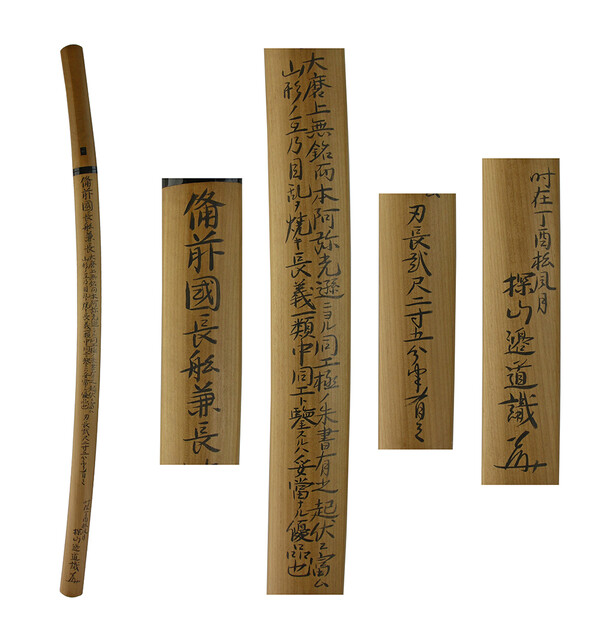
And here is Markus Sesko's translation :-) Absolutely worth it to get a professional translate it. Ô-suriage mumei shikaru ni Hon’ami Kôson ni yoru dôkô kiwame no shusho kore ari kifuku ni tomu yamagata no gunome-midare o yaki Chôgi ichirui-chû dôkô to kangami-suru wa datô naru yûhin nari. Hachô 2 shaku 2 sun 5 bu yo kore ari Jizai hinoto-tori matsukazetsuki Tanzan Hendô shirusu + kaô Bizen no Kuni Osafune Kanenaga [The blade is] ô-suriage mumei but bears a red-lacquer attribution by Hon’ami Kôson to this smith. This masterwork is hardened in a very undulating yamagata-style gunome-midare which suggests that the most appropriate attribution amongst the Chôgi group is to Kanenaga. Blade length ~ 68.2 cm Written by Tanzan Hendô [Tanobe Michihiro] in the sixth month of the year of the cock of this era (2017) + kaô Which is enlightening. He agrees that within the Chogi group, Kanenaga is the best guess. But he doesn't necessarily agree with the Chogi group. Omiya at the back of his mind? Who knows!
-
It's all because of you, Jean. I wouldn't have made this purchase online if it wasn't for the vouching of the members of this board. So, thank you for drawing attention to it in the first place - it's a great opportunity for new collectors to be able to benefit from the judgement of more experienced collectors when it comes to appraising blades available on the market. It can be a tortuous path, and scanning for new offerings requires a trained eye and time commitment, and I'm short on both. Very happy how this came out, and I can't wait to pull out the books and study the blade.
-
What can I say, thank you so much for sharing your earnest and enlightening opinions. I won't be submitting it to Juyo, it's for appreciation and learning. Maybe, when the time comes for us to part... but that's a long way in the future. I will however get Mr. Sesko to translate the Sagayaki professionally.
-
Thanks, I enjoyed it too.
-
Interesting, thank you Matt for the translation. The link to the images are gone and it's not on aoiart.net (yet?). I'll upload a few images when I get home, which I saved for reference.
-
Hi, I recently acquired my second nihonto on an AOI.art auction that was brought to my attention by Jean, which I think is truly wonderful :-) (the blade, and the board member!) An O-suriage shumei blade by Kanenaga. I had a Sagayaki made and it came out as so, according to AOI art translation. Am I right in assuming that, if we remove the cultural elements and read between the lines it says : I don't have much experience reading Sagayakis. I think this one is fair for the blade given the price, when compared to other works attributed to this smith. Not a good, nor a bad surprise. But again, I don't have much experience and I'd like to hear what you guys think. Cheers Chris
-
I'm surprised the market is willing to pay so much for a jo-jo saku Shinto smith. But then again, I know so little...
-
Mumei (Ko Bizen) Wakizashi
Hoshi replied to nagamaki - Franco's topic in Auctions and Online Sales or Sellers
Thanks Ray! I wasn't aware you could see the results after the bidding period expired. -
Mumei (Ko Bizen) Wakizashi
Hoshi replied to nagamaki - Franco's topic in Auctions and Online Sales or Sellers
What did it fetch? -
Excellent initiative! Opening up new markets to foreign collectors, a welcomed initiative for those of us who aren't accustomed to transacting in Japanese. Some very fine pieces highlighted on your website. If you could get automated translations + search function it would be an absolute dream, and I'd be browsing everyday. PS: Your site shows up as not secured on Google Chrome, the Https:/ is flagged are untrustworthy. Fix it asap!
-
Every Now And Then .......
Hoshi replied to nagamaki - Franco's topic in Auctions and Online Sales or Sellers
50% above reserve price. Someone needs to keep track of these auctions. It's valuable knowledge esp. when we're dealing with names that aren't in the "Big" category reaching Juyo prices on TH blade. Tells us a lot about the intrinsic valuation of the pieces and the market's opinion. Unfortunate that realized prices aren't on AOIart.net.

