Bruce Pennington
-
Posts
14,501 -
Joined
-
Last visited
-
Days Won
175
Content Type
Profiles
Forums
Events
Store
Downloads
Gallery
Everything posted by Bruce Pennington
-
February 1945
-
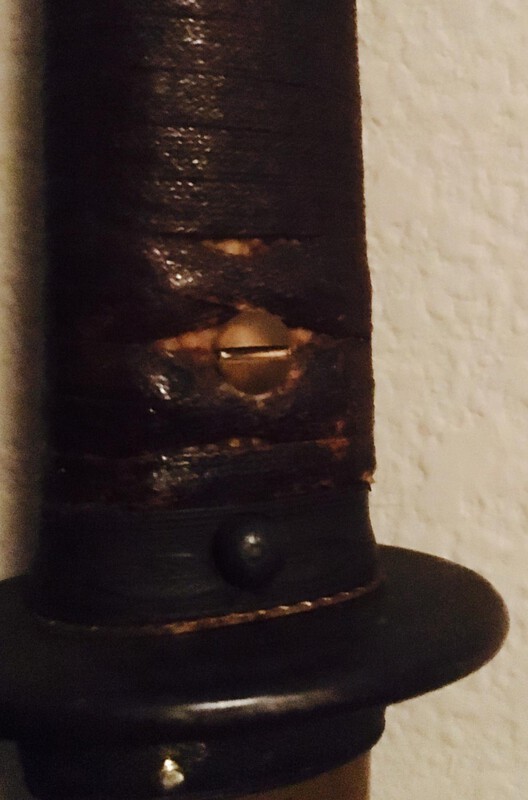
Here's my fix: a brass 10-24 1" screw. I spray painted it with some Japanese helmet color paint.
-

Shin Gunto To Review & Ask For Assistance
Bruce Pennington replied to Erwin's topic in Military Swords of Japan
Yes, I was thrown off too! The "occupied lands" gunto tend to use inferior metals and/or forging (I don't know the metalurgical science), and corroded must faster. Also, the nakago is always poorly formed which sets them up to look just like a fake. -
Ok, learned something more! After examining mine, on two of them, while shining a light throught the mekugi ana, I can see a sheet metal on the other side between the tsuka wood and the ito with a hole for the screw! It's very thin. On the other where where I cannot see it, it's possible it has simply slid down out of view.
-
Shin Gunto To Review & Ask For Assistance
Bruce Pennington replied to Erwin's topic in Military Swords of Japan
I'm stumped that I didn't think of that before, as I've defended a few of these over the past 3 years, but for some reason, it never occured to me this time! I'm searching for past examples and have a couple over on Warrelics (even with the same katakana): http://www.warrelics.eu/forum/Japanese-militaria/appraisal-some-Japanese-swords-please-sword-number-3-a-398208/ a couple here: http://www.militaria.co.za/nmb/topic/20284-my-friends-gunto-looking-to-identify-as-much-info-as-possible/?hl=%2Boccupied+%2Blands&do=findComment&comment=207650 http://www.militaria.co.za/nmb/topic/20876-island-made-gunto/?hl=%2Boccupied+%2Blands&do=findComment&comment=212799 And at Gunboards: Stegel Jo Saku Members 160 posts LocationAustralia Posted 30 March 2016 - 04:53 PM Back to the OP and topic of this thread, there was a lot of discussion over at Gunboards with this subject, opinion appears to be equally divided. Here's a few links if you are interested : http://forums.gunboards.com/showthread.php?473825-2nd-sword-what-is-it and this one has pictures of Indonesian and Chinese collaborators with Japanese style swords: http://forums.gunboards.com/showthread.php?385909-Senior-NCO-Sword&highlight=SENIOR+SWORD -
Neil, I just learned something today! I'm new to collecting Rinji model gunto (tip-o-the-hat to Nick Komiya!) and have 3 - all missing the lower "peg" but having the upper mekugi. I just assumed the lowere mekugi was missing. When I switched the mekugi to the lower position, the hole in the same' was ugly, it was so large. Now I know why - it was cut for a larger headed screw! Would you do me a favor and pull one out and give me a good set of pictures? Also, exactly WHAT are the threads imbedded into - the nakago ana? or the tsuka wood?
-
Neil, You always amaze with the unusual, and beautiful, things you find! The only reference I've ever found that discussed cost/style variations is the Ohmura site. He shows one, which I've never seen except for his site, that he calls an expensive upgrade. So cost clearly may have been a reason for some variants.

-
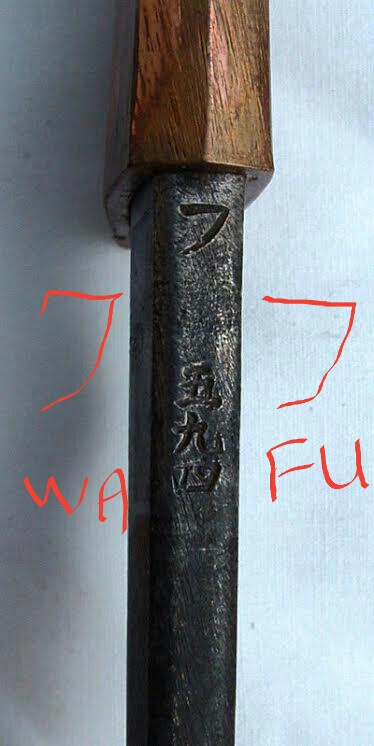
Also, you got me curious about katakana and I found a chart. Isn't this one of yours "Fu" rather than "Wa"? The wa should have a 3 stroke, and yours looks like 2 stroke?
-
Bruno, I was re-reading the Ohmura page for another thread and noticed that he has a nakago with "Hi 226" listed (the one on the right of the 3 depicted). For some reason, he doesn't show a picture of it, it's just listed in the text below the picture of the nakago.
-
After re-reading Ohmura-san's page, it seems he is claiming that the difference in nakago inscriptions were simply changed at March 1943. No change in manufacuture is discussed or implied: The blade Tang AFTER MARCH 1943 (caps added for emphasis). Mei: "Nan" Mantetsu Kore o Tanzō Uramei: Spring. 1943 Manufacture number: Hi 226 I'd never caught that before, thanks!
-
Stephen, we mean the kanji above the number. Any idea?
-
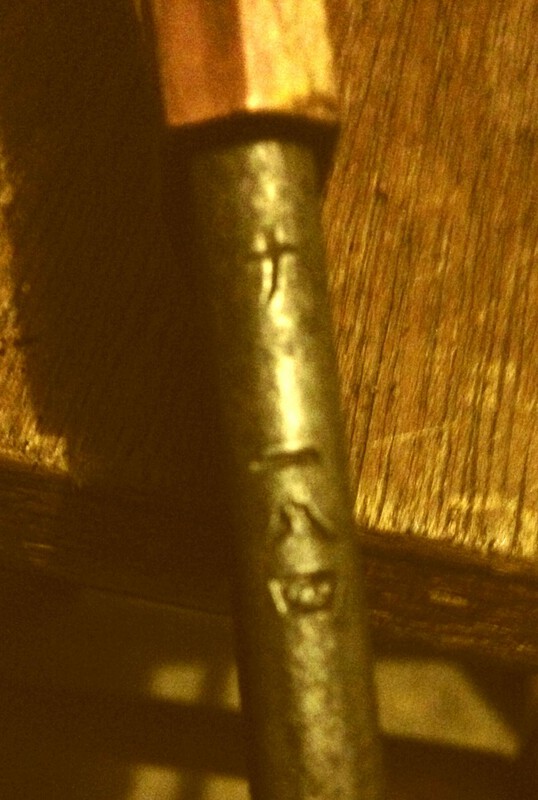
Bruno, As far as I know, no one really knows what the serial number is for at all, so the reason for the katakana isn't known either, I'm afraid. Someone, maybe it was Ohmura, tentatively called it a contract number, but it was speculation. I always assumed the one on mine was the number 10, but now that you've raised the question, I wonder. Do you read these? If so, what is mine, it's neither of the ones you showed:
-
Justin, I'm a little out of touch on Type 98 market value. The market seems to be down just a bit right now, so John's figure might be right. They used to sell for $1,000 and over, but in nice condition. Personnally, I thing $750-1,000 is a good ballpark range, depending upon what you what, what you're going to do with it, etc.
-
Great! Pictures came in! The small stamp is the "Seki" stamp. 70% of all war sword were made in that province. It also means it is made by non-traditional means. Someone else will have to translate the smith name.
-
Neat story! Can't see pictures though! I see
-
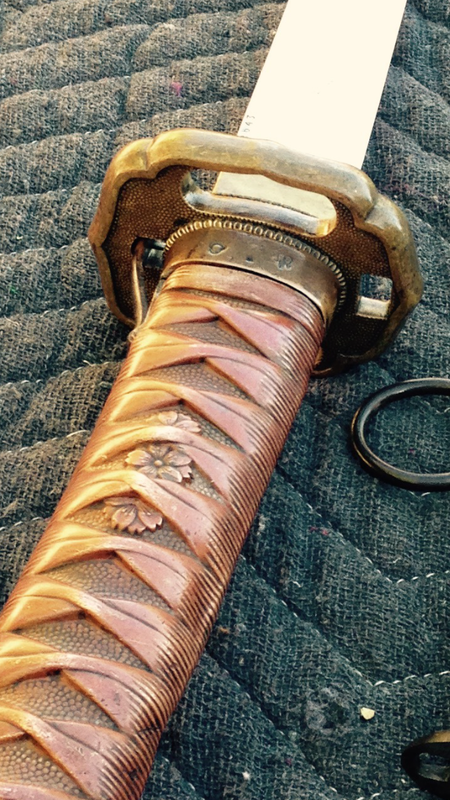
Steve, just killing time while we wait - I agree the saya is good. Also the "plugged" mekugi-ana may be a trick of lighting. But on the issue of copper-handled tsukas - mine only has one, at the top, and I thought that was true of most, if not all, copper tsukas.
-
I see what you mean. When you look at the kissaki end, the "fuller" seems to meld into just reflections, maybe from the lighting or ceiling. Looking at the tsuka, though, there appears to be a filled mekugi-ana at the fuchi end. Plus, and Shamsy, you can correct me if I'm wrong, but none of those stamps looks like the Kokura stacked cannonballs. Didn't ALL the copper-handled gunto have the Kokura stamp? But, again, poor pics. ............. {growing old waiting for more word from seller!}
-
Wow, never heard of a double fullered copper. Picture obviously too poor to read the serial number. Please let us know if you get a reply. Zooming in gives the impression there are 5 numbers plus stamp. If so a clear fake. We'll see what response you get.
-
Steve, you're right, I didn't feel right about my '45 date. On the numbers, one of the reference books listed over 250,000 officer and as many NCO swords surrendered. So that's over 500,000 at the END OF THE WAR.
-
Welcome Jim! You have a nice shingunto made in January of 1945 (could be off as I'm reading this in the mountains on my cell phone). Someone else will be able to give you the smith name.
-
Wow Johh, thanks for the link! Sobering.
-
Wow, interesting!!!
-
Ww2 Army Gunto Saya With Non-Army Handle?
Bruce Pennington replied to vfox's topic in Military Swords of Japan
Jay, The fact that this blade was cut in two supports the probability that this was surrendered after the war. Thousands of blades were destroyed this way beacase they were war weapons. Very tragic. I've seen several pictures of soldiers carrying old blades in combat saya. It was common. There was a serious shortage of officer swords and many private blades were donated to the war effort. Some were totally refitted with army or navy fittings, while others were simply put into combat saya. This looks legit. -
According to Nick, the images showing the cutting edge horizontal were showing how to sharpen. The images with the edge up are readied for dulling. So, when you say all the blades were issued without edge, do you mean that every blade made had to be sharpened by the soldier? The thing that really got Nick's discussion going was the "cring-worthy" requirement to dull the cutting edge of weapons once in a peacetime setting - something I was completely unaware of.
-
Thanks to Nick Komiya at Warrelics for this very important insight to the practice of sharpening and dulling blades for wartime and peace. This went for all blades including bayonetes: http://www.warrelics.eu/forum/Japanese-militaria/sharpening-dulling-blades-were-taken-granted-675938/