


Bruce Pennington
-
Posts
14,654 -
Joined
-
Last visited
-
Days Won
176
Content Type
Profiles
Forums
Events
Store
Downloads
Gallery
Everything posted by Bruce Pennington
-
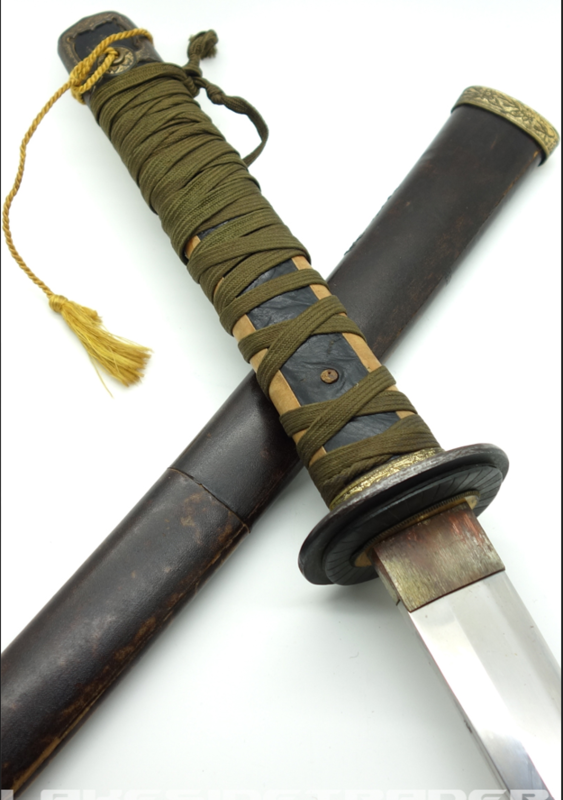
Yes, but I think this one you've posted most likely is late-war. The blackened kabutogane, and painted same' (or rubber) are common characteristics of the late-war kaigunto. Here's a pic from that link Thomas mentioned, thanks Thomas!
-
Eric, Could I get photos of both sides of the nakago and an overall shot of the gunto, please, please, please, please?! Did I say please?
-
Yes, I saw that too, Conway. Just overcome by moving events to follow up. I just checked Sesko's list of Masahiro, and he has EIGHT Showa era smiths listed! Inaba Tanrenjo was located in Seki (Noshu), and only one of the Masahiro in his list was from Gifu: "MASAHIRO (正弘), Shōwa (昭和, 1926-1989), Gifu – “Masahiro” (正弘), real name Hattori Kazuichi (服部一市), born July 30th 1907, he worked as guntō smith" So Inaba isn't part of his real name. Maybe the mei is indicating he was Masahiro of Inaba Tanrenjo.
-
Trystan, What sort of gunto was this in? Also, what are your thoughts? Do you think he's saying his art name is Inaba Kanenami, or is he saying he is Kanenami of Inaba (forge)?
-
An update: Asked Mal Cox if he could clarify the yuki vs taka question. He checked with his exert advisor (wife!) who says this kanji would be read as "taka". So, taketaka it shall be! Thanks to all for the help.
-
Thanks Thomas! I needed a "Wow" "Thanks" and "Love it" emoji for that one!
-
Yes, I have seen the black fabric on wartime kaigunto, and I remeber one that was mid-war'ish on the date, which supriesed me because I had previously only seen the fabric on late-war swords. As to yours, just from the picture, it looks like yours is painted/lacquered directly onto the wooded tsuka, which I've seen frequently on late-war kaigunto. You have it in hand, though, can you tell if there is a layer of fabric that has been painted over? John, I, too, used to think that celluloid was a late-war invention, but it is seen on swords throughout the range of war years. My Mantetsu, dated 1941, has it. Also, do you have links or examples of celluloid on souvenir swords? Don't think I've seen an example of that. Not a criticism, just wondering.
-
Thanks Conway, just what I needed. You probably already know this, but that semegane that is split really goes much lower on the saya. Might be able to move it back down there and glue the split cack together.
-
Great, thanks! I think I see it close to the end, right? Also, thanks for the additional "Inaba" stamp and stamped number "453". Didn't have that one in the files! Safe to assume this is in kaigunto fittings?
-
Ok, just ordered one, thanks Uwe!
-
 Note-to-self: No more posting photos taken in my garage workbench!!!
 -
Sword collecting in America
Bruce Pennington replied to BIG's topic in General Nihonto Related Discussion
Over 100 pages! Guess it's going to take a while to read, but looks interesting. Thanks Brian! and Peter! -
Kai Gunto saya types compared
Bruce Pennington replied to Kolekt-To's topic in Military Swords of Japan
And thanks, Alexi, for bringing this one back up. I really enjoyed re-reading it! -
Nlf Gunto Discussion
Bruce Pennington replied to Bruce Pennington's topic in Military Swords of Japan
@Conway S I'm hoping for a shot or 2 of the full package. I like to keep am overall shot along with the nakago and blade. Sometimes the rig is fully standard, but sometimes there are variations, like having more navy fittings than standard. -
Good one! When I hit the translate button, it comes out Taketaka. Hmmm.
-
Nice example of the Seki Token contractor stamp! With the Kokura Army Arsenal stamp, this blade would have been made, most likely, prior to 1942. Guys that track serial numbers could narrow that down for you. Nice job cleaning up the cosmoline.
-
Nlf Gunto Discussion
Bruce Pennington replied to Bruce Pennington's topic in Military Swords of Japan
@Conway S Could you post a good photo of the fittings, too, please? Looks like someone tried to file off the anchor stamp! Strange. So another duplicate painted number. We previously recorded a #65 Toyosuke souvenir. I have 2 other souvenir blades with stamped numbers: Mumei, no date, number 358 written like 358; painted number unreadable Mumei, no date, number 414, painted number 54 -
Sesko doesn't list either version, so it's anyone's guess between the two, I suppose.
-
Thanks Piers! Japaneseswordindex.com is my primary source and they only have "printed" not "cursive" kanji, and "幸" is what they have for yuki. I don't have a reference to search for cursive kanji.
-
@Conway S Do you have more photos of the sword? Any other markings on the nakago? The only military place I know of (not that my knowledge of military manufacturing is that extensive!) is Osaka. But they used a different kanji on blades. 阪
-
I have a real tough time with the cursive style mei. I feel good about the "Take..." but not about the "yasu". For the stamps guys - "883" on the nakago. Stainless blade in kaigunto fittings. Appreciate the help, guys! Thanks as always.
.thumb.jpg.bc90b83f1182133bae7464b701d7c4d1.jpg)
.thumb.jpg.b86e18d18d6774c8be82d925c1d64ff2.jpg)

-
We’re going to need @Kiipu @BANGBANGSAN @SteveM on this one. There is more to the character than is highlighted by the white powder.
-
Hi Larry, welcome! This is a good place to post your question. Better photos would help with both, but I can already say that the first one is a fake. Or reproduction. We need better photos of the other sword, especially with the handle off showing the tang.
-
This has caused me to review my files on Inaba, and I've re-discovered this conversation where we found a couple links to the Inaba Tanrenjo or forge. Inaba Tanrenjo Discovered. I have been mistakenly calling all mei with this stamp "Inaba", but the stamp is found on blades with two mei, actually. This one shown by Conway is really Inaba, and the other is Hiratoshi. Hiratoshi Inaba I have several navy blades on file with stamped numbers, but they are very few compared to army blades. 12 are mumei, 2 are Shigemitsu, 2 Mitsunobu, 4 Hiratoshi, and this 1 Inaba. I also have one with the Tenshozan Tanrenjo mei - all stainless except the Shigetsugu & Mitsunobu blades.

-
Type 19 Kyu-guntō Ricasso Inscription
Bruce Pennington replied to Conway's topic in Translation Assistance
OK, I'm back home and sitting down with my Dawson book. The 15 stamen plum blossom was the emblem on occupied Manchukuoan swords. I don't see this exact pattern in his examples, but I have no doubt it was Manchukuo.




.jpg.a3e5e1140feb0d24b28516c170243297.jpg)
.jpg.b8f6f7232274ad25f37c7ef595b36804.jpg)
