kyushukairu
-
Posts
644 -
Joined
-
Last visited
-
Days Won
3
Content Type
Profiles
Forums
Events
Store
Downloads
Gallery
Everything posted by kyushukairu
-
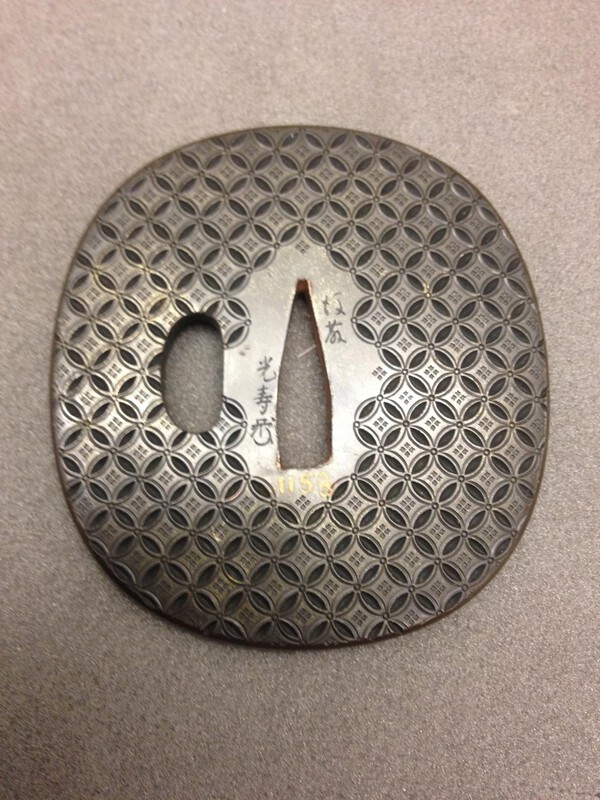
John, here's a photo of the tsuba from Ashmolean which I took myself
-
Thanks for the suggestions, chaps. I don't think it is Jakushi, however. Whilst Jakushi achieved a similar effect through etching with acid, their etching doesn't have the same level of depth as this one. Also, Jakushi school applied nunome on top of the relief, which this tsuba lacks - though there is gold inlay for the dragon's eyes. Steven and Jeremiah, I think you are right, as I was initially drawn towards Mito. I can certainly see similarities with yours Jeremiah, though the iron looks wet. Perhaps mine just needs some choji and TLC.
-
I acquired a new tachi which came mounted with this nice big iron tsuba, though I was wondering what school you think it would be attributed to. My thoughts were 'Mito', though I'm more au fait with kinko schools than tanko, so I'm not too confident. All opinions appreciated

-
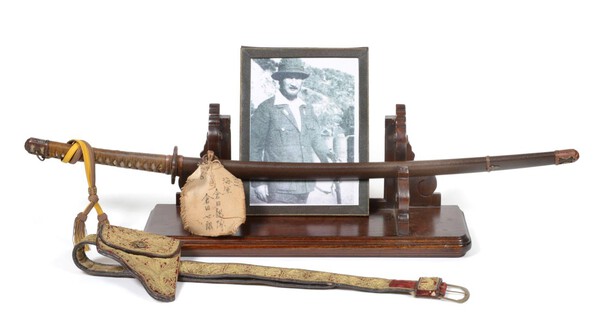
This sword recently sold at auction and seemed to have good provenance, which suggested that the sword belonged to a general. However, I was intrigued by the brown and yellow tassel. I have read about different coloured tassels being used by colonial officers and contracted civilians but never actually seen one before
-
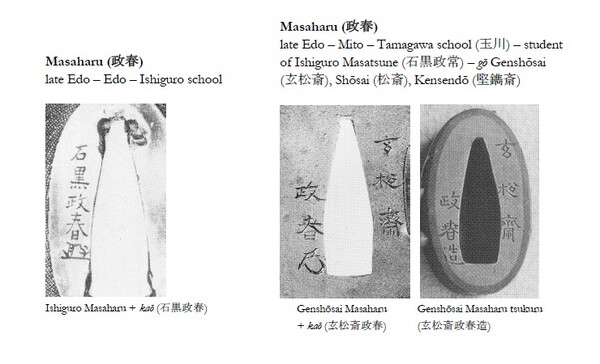
From the style, my first thought was Ishiguro school. I then checked Sesko's meikan, and there is an Ishiguro smith by the name of Masaharu. The signature on your kozuka is also much closer to Ishiguro Masaharu than Mito Masaharu. In my opinion, the author misattributed the kozuka
-
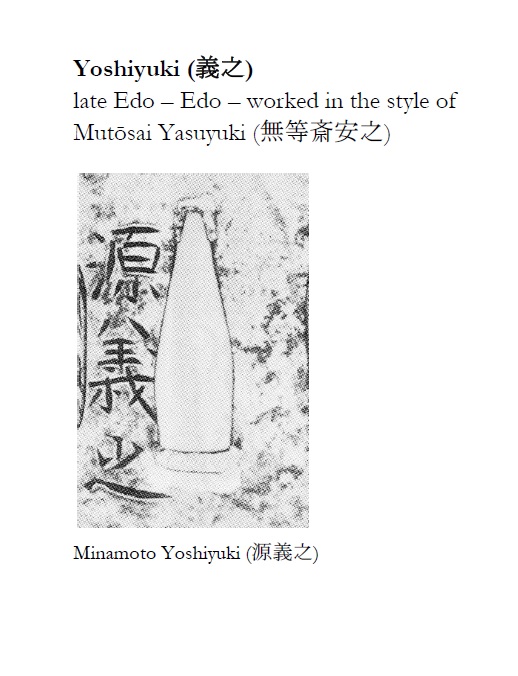
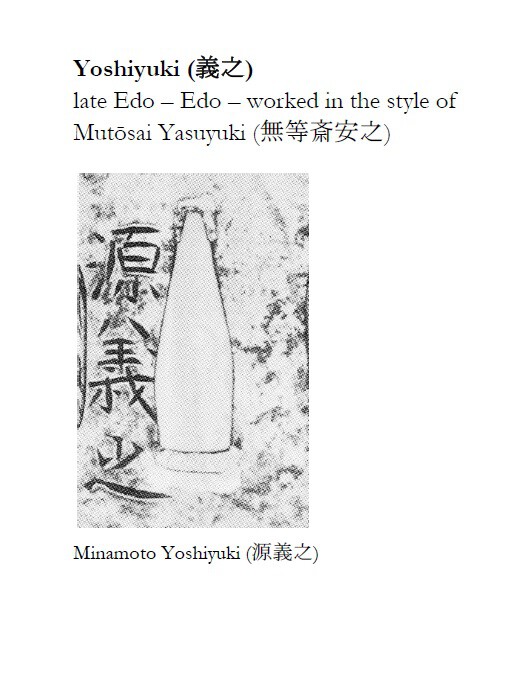
A further possibility for the middle character is 之, which could be Minamoto Yoshimitsu (源之光). In saying that, I had a quick search through Sesko's meikan, and couldn't find any tosogu smiths named 之光. I also searched for just 源, though no one comparable appeared. The closest match was Minamoto Yoshiyuki - I've included the image so you can see how '之' is written and hence my suggestion as the second kanji
-
 Bit of a last moment entry... the new academic year has been keeping me busy with preparing lecture notes and working on last-minute publications. Thanks to Peter Farrar for the reminder! My guesses - and they really are that - are: 1. Shinshinto (Tenpo) Bizen Yokoyama Sukesada (classic Bizen gunome hamon, though shape and condition suggest shinshinto) 2. Shinto (Kanbun) Hizen Tadayoshi (typical Hizen Tadayoshi traits - perhaps late generation with kesho yasuri?) 3. Koto (late Kamakura) Yamashiro (Nakajima) Rai Kuninaga (Based of the hi, what looks like coarse mokume hada, and chu-suguha)
 -
Kinko Tosogu (Fuchigashira, Menuki, Kozuka, Tanto Set)
kyushukairu replied to kyushukairu's topic in For Sale or Trade
Thanks Ray. Your photos show up the nanako really well. I'd also appreciate it if you could send me a photo of them when they're mounted - it would be nice to see them as intended The only item still available is the sentoku kozuka, which is a very nice shoji themed piece with shakudo, copper, and silver inlay -
Edward, the brass inlay appears to state that the image is by Itcho Hanabusa (英一蝶図) - who influenced Yokoya Somin to develop his katakiri-bori technique. I had a look in Sesko's meikan and the kao is very close to Somin's. However, since your images appear to be photos of an image which has been printed on paper, it's difficult to determine the quality of the tsuba itself. As Steven notes, it doesn't look like a typical Somin, and if it wasn't signed, I would have suggested that it was from the Nara school.
-
Thanks for your thoughts, Ford. The design itself is slightly different to any other coiled dragon I've seen, so it doesn't appear to be a copy of any of the more renowned Goto smith's work, which one may expect from a cast copy. (I'll add images to illustrate this later) It also seems strange that someone would go to the effort to add a tanzaku-mei but include an obscure mei, as opposed to that of a famous smith. What could have potentially caused the blackening inside? Would that have occurred if the menuki were made from brass?
-
It's a kind of turtle known as 'Minogame' (蓑亀) in Japanese. The tail is supposedly composed of seaweed which has formed over many centuries. They are usually depicted in reference to the myth of Urashimataro. In my opinion, the tsuba would have had a pattern covering the surface in nunome zogan which is unfortunately now gone
-
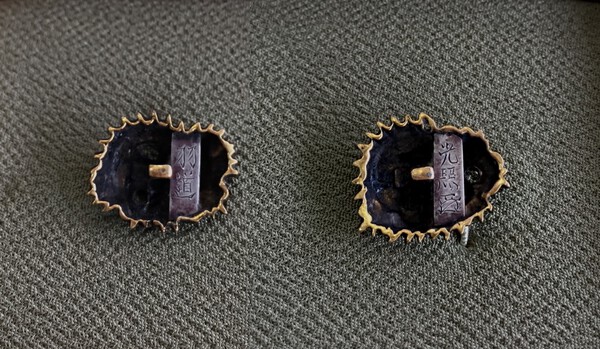
I picked up a set of Goto-style coiled dragon menuki which bear the mei 'Umichi Mitsuteru' (羽道光照), though he doesn't appear in Sesko's Signatures of Japanese Sword Fittings. If anyone has an alterative meikan I'd appreciate any references which you can find. Kind regards, Kyle
-
As I noted in my translation, these are done in *imitation*. One can only presume the names (Fusamichi and Yoshifusa) were those of renowned yanone makers. It's not uncommon to see such tribute pieces. In my own collection I have a set of menuki with a tosogu theme (depicting tsuba and fuchigashira) with the tsuba of each respectively bearing the names 'Nagatsune' (founder of Ichinomia school) and 'Mitsuyuki' (founder of Kikuoka school).
-
Hello Bernard, Going off the written kanji you've provided, I can read 'Imitation of Heianjo Fusamichi' (模平安城房道作之) 'Imitation of Iga Minamoto Ason Yuki~' (模伊賀源朝臣幸??所) It's also possible that instead of 'Minamoto' it should read Fujiwara (藤原) with the 藤 character concealed.
-
I was hoping the 'brief comment' (寸評 ) on the kanteisho might provide some further insight, but it doesn't offer any rationale as to their decision. It simply says something along the lines of 'Tachi kanagushi produced fittings for tachi from Heian to Momoyama' and then describes the tsuba as 'yamagane and kiku sukashi with 16 petals' (太刀金具の匠が作ったもので太刀が最も使用された平安期頃より桃山期までの永きに渡り製作されてきた.本作山銅地に十六花弁の菊花を透かした一鍔). On the Shibui sword page it states 'In this broad meaning the shitogi, aoi, nerikawa and other early soft metal tsuba might be called tachi-kanagushi tsuba.' So perhaps your tsuba was made by one of those schools, but there was no distinguishing feature to enable the kantei team to determine which of these it belongs to? Still, that wouldn't explain the 'tachi' attribution when it was quite clearly mounted on an uchigatana, as Mr Sinclair pointed out ...
-
My guess would also be ko-kinko, with an approximate age of mid-muromachi, and yes, the kozuka ana is original to the tsuba though may have enlarged later
-
Thank you for your comments and suggestions, chaps. It has been a most illuminating discussion, and I'm now left with a number of questions - which, as a philosopher is where I strive (Plato's Socrates famously claimed 'philosophy begins in wonder'). In a previous post I had mentioned katakiri-bori were copied from ukiyo-e, but from both of your comments it makes more sense that katakiri-bori were copies/interpretations of Hanabusa Itcho's work in particular. However, the extent to which subsequent (post-Somin) katakiri-bori was copied from Itcho is something which interests me. It also occurred that this is a good way of judging the artistic integrity of a particular piece, namely, whether a theme has been directly copied from Itcho or not enables one to determine the artist's originality. I must admit my ignorance, I didn't initially know who you meant by Itcho - although I knew Somin was influenced by a friend who was a painter, I wasn’t aware of his name. This then led me to search 'Itcho' on the board and I came across a couple of posts which discuss Furukawa Genchin as a close disciple of Somin in following the katakiri-bori technique. This now adds a further possible attribution: that of the Furukawa school. It's not as glamourous as Yokoya, but one has to be open-minded and honest in the pursuit of truth Ps. Whilst searching for work by Itcho, I came across this tsuba, supposedly by Haruaki Hogen (春明法眼作), which states the carving is a picture by Hanabusa Itcho (英一蝶画)

-
Thanks Steven, I'll take that attribution! May I ask what led to you to suggest Soyo II in particular? One of the problems with katakiri-bori (particularly in shakudo) is that it is very difficult to photograph. There are some very fine features which do not show up too well in the images, such as the hair on Shoki's arm and the cloud design on his breastplate. The clouds on the ura are also extremely well carved, and quite a striking feature of this tsuba when seen in hand. I have several katakiri-bori tsuba by Ishiyama Mototada (one of the 28 masters of metal work in Kitao Shigemasa's print) and, in my opinion, the work of this piece is on par with Mototada What do you think, George? As a collector of Soyo II, does the level of craftsmanship compare?
-
Very observant, George. I think you may actually be right. I did a quick search for Shoki and oni ukiyo-e - since many katakiri-bori themes seem to be copied from woodblock prints - and found a couple of images which depict two oni in the clouds. The first seems shows two almost human figures fleeing in a similar position to that on my tsuba, whilst the second portrays Shoki as having caught one of the oni, though the oni themselves are closer to those on my tsuba. I had actually thought the dragon's tail was wrapped around the oni's waist (who has his back to us), but having seen these ukiyo-e I now realise that it is supposed to be a fundoshi as depicted on the single fleeing oni.


-
Thanks for this George! That's from Ian Chapman's website - a collector from UK and a member here - I wonder if it was papered to Yokoya. As for the carving on the ura, I initially thought it was a dragon-oni hybrid, but when I was taking these photos it then appeared that the dragon was confronting the oni. Perhaps the artist wanted to portray the oni as so intent on escaping from Shoki that he didn't realise he was running into a dragon. Although the oni is always shown fleeing from Shoki, I've seen various variations of the oni hiding under Shoki's hat, or on his head, though these are usually depicted on okimono or netsuke, so it's nice to see something different on tosogu.
-
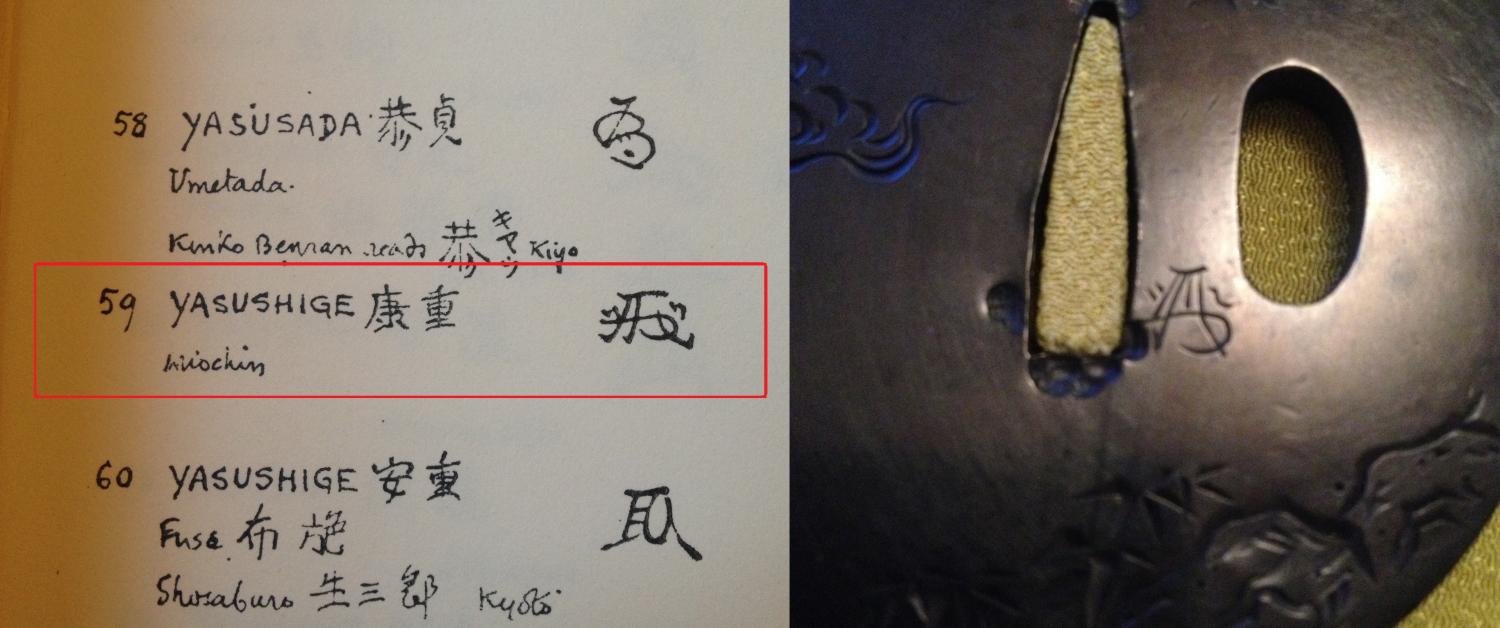
Does anyone have any thoughts as to the artist of this tsuba? It is simply signed with a kao, though I have been unable to attribute it to anyone. I have shown the tsuba to a few people and looked through Joly's Shosankenshu, though with no luck. The closest example is that of Yasushige (as attached) though it's still some way off. The tsuba itself is shakudo, katakiri-bori, and depicts an oni fleeing from Shoki and running into a dragon. Any thoughts on the kao/potential schools would be much appreciated


-
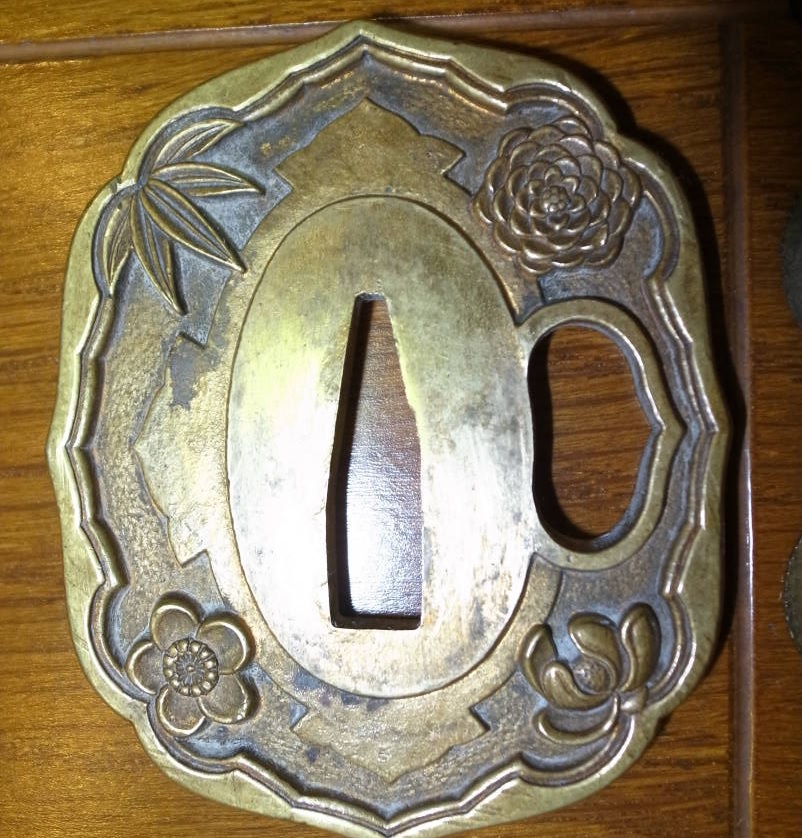
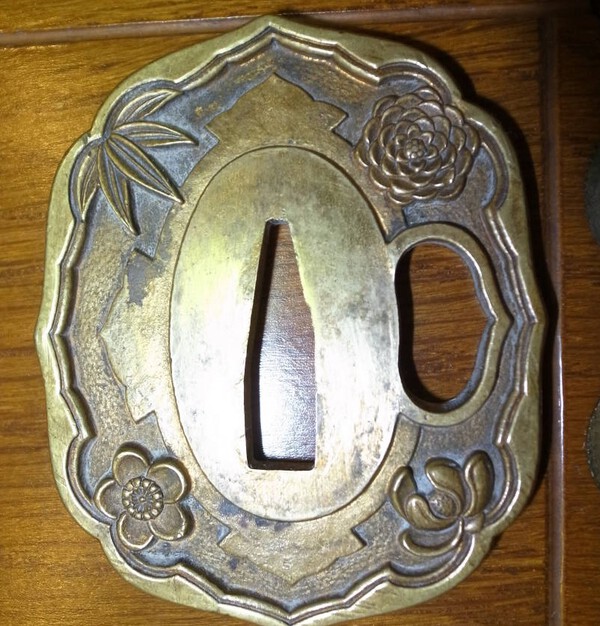
I recently came across this unusual gunto tsuba and was wondering whether anyone has encountered anything similar? At first I assumed it was a Chinese 'interpretation' but it appears to be well made and shows originality, rather than being a crude copy. That is, rather than just sakura (cherry blossom), it also portrays orchid, chrysanthemum, and bamboo in relief. If authentic, I imagine it would have been mounted on a colonial officer's sword, perhaps with each of the symbols representing a particular state (e.g. the orchid was the national flower of Manchukuo). Any thoughts?
-
Tang Translation Please And General Info
kyushukairu replied to JNT's topic in Translation Assistance
Hello JNT This is a strange example. Usually the smith will sign their name on the nakago (tang) but on this example we are only given a nengo (date inscription). The literal reading of the writing on your sword's nakago is 'a day in August on the seventh year of Enhō' (延寳七年八月日). Enhō' (延寳) was an alterative reading for Enpō (延宝), and which began in 1673. Japanese era's are usually considered to be the first year, so the seventh year of Enhō is not 1680, as you might expect, but would be 1679. Thus, your sword was made on a day in August in 1679. -
It basically just describes what's there. The main text is 'Uchigatana koshirae with black painted saya' (黒塗鞘打刀拵).
-
Wow Those Satsuma Guys Were Good!
kyushukairu replied to Shugyosha's topic in Auctions and Online Sales or Sellers
The kanteisho definitely states 'made when 6 years old' (六歳作) though the images of the nakago are not clear enough to verify if the paper is correct