Rivkin
-
Posts
2,484 -
Joined
-
Last visited
-
Days Won
20
Content Type
Profiles
Forums
Events
Store
Downloads
Gallery
Everything posted by Rivkin
-
Its really bad. Recent (past 150 years) signature with substandard execution. Tremendous damage. Modern tsuka of low quality.
-
 The signature looks sort of acceptable, the right calligraphy, the right condition. The issue is there is not much to see in the blade. Hazy suguha, hazy hada. Saiha? Can be, though sugata looks original. Very cheap dealer's polish? Another possibility. So yes, its plausible, but it does not appear to be in a collectible condition as is. One interesting thing to check on Sukesada's especially is how the shinogi is. If its very low, a good chance its original.
 -
Sorry, no idea... I am not that familiar with cast iron tsuba. I would cast soft metal before doing iron in any case.
-
Ok, writing in a "popular style" without any actual quotes because I am lazy, generally 10% though appearing in English language literature has been corrected downwards in the past 50 years. Its a typical number for Tozama daimyo (the greatest offenders would be Uesugi with like >30%, Satsuma >20%, Mori >15% - going purely by memory) due to land confiscation but the percentage drops significantly with daimyo like Maeda (special case) and all Tokugawa retainers like lesser Mitsudaira families. The overall was closer to 5% around Genroku (it was higher at the end of Muromachi, possibly towards 15%). Out of those we subtract women and small children. Daisho is a weird thing in a sense it does appears in documents and early paintings, but then it quickly disappears from sources coming back around 1800s... So did samurai wear daisho in mid Edo is not clear to most likely negative. The samurai right per se was not wearing daisho but wearing the long sword. There are however later sources specifying daisho most likely for the reason that a "semi-samurai" like Goto family was usually given a personal right to wear a daito in court processions but were not given a right to wear it at ordinary times as a daisho would have been worn after 1800s. How many swords did an ordinary samurai had? Its a very good question and general answer is that sub-100 koku samurai (i.e. 90% of the class) from a few families studied would have literally a few blades in a household - two-four waki, two-four daito. Generally the ratio of 1.5 daito per adult samurai appears plausible. Upper ranks would either be "mini-Daimyo" which is hatamoto in case of Tokugawa or similar class for Tozama with 1500-5000 koku, but they would have a large samurai retinue of their own. The "working samurai" ceiling is closer to either 150-200 koku level or the maximum of 500 koku which would be the top executive for a major Daimyo family. They would however have subservient families to pay as well... Overall "collections" of hundreds of blades start at Daimyo level and everything at and above Rai Kunimitsu cutdown waki is priced outside working bushi... Which we also see in gifts since even such "lesser" blade per modern higher end collector would in fact be a typical level of a Shogun's gift to a hakamoto in charge of a major project. Going back to numbers... Tokugawa parade in Kyoto had a roaster of more than 450,000 samurai participants which should be close to every single adult samurai who could be mustered. the total number was probably closer to 600,000. Funny enough procession required new gear but obviously we see no evidence of hundreds of thousands koshirae ordered in one year... So we have a total of about 1,000,000 daito, and possibly lesser number of wakizashi (there is no setting requiring one to wear wakizashi and not say tanto so in case of need wakizashi was not needed at all)... which is however compensated by wealthier peasants having considerable supplies of yari and naginata and merchants/wealthier peasants having wakizashi as well. So much wording and different method of calculation still arrives at the same number of about 2,500,000 swords...
-
Oy vey. Somebody chopped wood with it, let it rust for decades and then sandstormed it for visual improvement. Likely no earlier than shinshinto, now in a considerably problematic condition.
-
It wants to be shinto, maybe shinshinto Sukesada. I would search on the web for all available signatures (there should be quite a few) and try to find a close match. The writing is not terrible, so there is a chance.
-
Nakago, boshi, macro of the activity (hamon).
-
Good tsuba, the rest needs to be carefully photographed. Looks ubu, so high chance it will be clear what it is.
-
Plus: the signature is ok written per 16th century standards. Its roughly in the right place, with roughly the right strokes pressure for Sagami school. Its quite a bit rougher though than the better Soshu smiths of the period. Minus: most likely unrecorded person. But then "hiro" kanji is Soshu kanji and its not at all impossible there was one within the school. Minus: Just like with Bizen, with Sagami you do have fakes of things which raise eyebrows why on earth one would fake that. It is a very popular school even for non-great objects. Its basically for you to decide. As is it is unlikely to paper - what if the work is just completely different and therefore the papers will look stupid after its polished. If you polish and its hitatsura than there is a good chance it will be accepted as unrecorded smith. Say it comes out as a lesser work in suguha, then its again a lottery - Odawara Soshu in particular produced suguha during its earliest (1470) and latest (1570) periods, but its more difficult to accept a combination of unknown signature and weird work. So I think its up to you. Roughly 50/50 chance its real.
-
Kao is a stylized signature used on Japanese documents from ancient times. It is an addition to the name and is signature as such, signifying the document is prepared in the presence and hand signed or entirely handwritten by the said person. For example, copies of government rescripts do not bear kao, the originals do. Generally, kao would be associated with upper ranks of beaurocracy or government-recognized heads of important institutions. The use of kao on metalwork is generally a late (i.e. 19th century) tradition: swordsmiths and tosogu makers were usually not tasked with writing high ranking documents. Which is also an issue btw since if you read some 15-17th century swordsmith documents you have no idea is it the original, or its a copy made 100 years later by someone trying to prove something - I encountered this issue quite a few times.
-
I would add my general experience that all "function"-based arguments are 19th-20th century attempts to reconstruct why things were the way they were in the 12th or 14th century. Attempts often made by people with zero understanding of metallurgy (and thus not realizing their "concerns" are either false or could have been addressed easily by other methods) but most importantly the arguments produced without comparison how similar problem was addressed elsewhere. This being said it does not negate the possibility that original thinking leading to appearance of such features was also faulty (i.e. "fashion-based") and driven by some concerns that are spurrious. Its common today, it was common 1000 years ago. If you compare a Japanese made chip you will notice quite a few things like extra operations to clean the non-essential byproducts of technological processes, purposeful asymmetric arrangements of elements, which are different from American made ones with the same functionality. The reason is that the real data is noisy and its easy to come up with a theoretical "concern" which might or might not be relevant but sounds scary enough one needs to take precautions against it. Because Chief Designers in Japan and the US are generally different people, you end up with a different culture of how electronics should look like. In combat its even worse since it does not happen very often, when it happens its usually in random, multi-factor environment and participants when asked immediately afterwords have no cohesive understanding of what in hell they just went through. Its scary, its noisy and you don't see much beyond a few feet in front of you. Unless a war tool is next to unusable even novadays it often takes 2-4 decent size wars to realize what works and what's not. Were the faint signatures on early Japanese swords such because otherwise nakago would break? Its doubtful because you look at continental development of the same sword form and the nakago is even thinner in the center. Is it possible some very influential Japanese swordsmith believed it to be a concern and influenced the tradition for hundreds of years to come? Yes. There are cultures where grooves are cut off-center and asymmetric on both sides because otherwise the blade will be "too thin". And obviously the rest of the world generally dislikes asymmetric blades.
-
There were early Yukihide, but unfortunately its not at all consistent with what is seen here: yasurime especially, but also the way the kanji are carved. I almost want to say its a Meiji period's signature - they did not stop making boy swords in Meiji but the signatures are sometimes a bit more simple between Meiji and Taisho, nijimei included.
-
The signature's strokes are deep with distinctive large triangular shape, the yasurime is of a relatively modern type. This looks shinshinto or later. Unfortunately, its not clear which of the period's Yukihide signed nijimei so which yukihide it is - is difficult to determine.
-
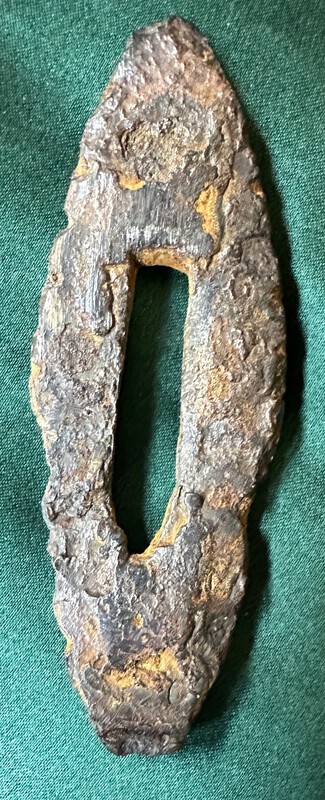
That's something considerably more rare. Most continental guards are Chinese crossguard type until 12-14th century when you can start finding the early "tsuba" form. There are however exceptions - this is 10th century continental tsuba. Its obviously considerably more narrow compared to 14th century examples and bears some limited similarity to Kofun examples. Of note here the iron habaki bears the same edge decor as the tsuba and was made by the same hand, that of a swordsmith. By comparison soft metal habaki and guards would likely be a specialized trade.

-
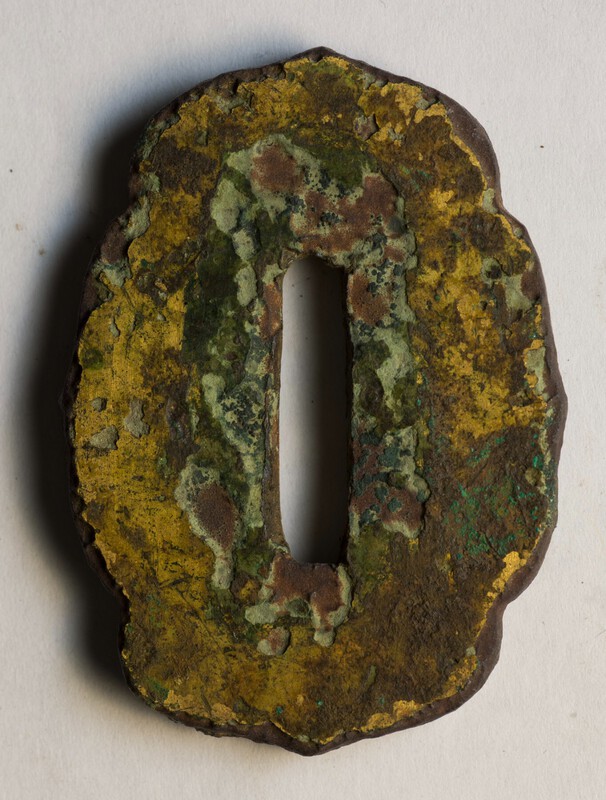
Don't know how far early one wants to go. I guess Kofun is weird copper-iron alloy, with the usual gilding, gold with a large content of tin and other elements.
-
One needs a naked sword shot directly from above to see sugata with minimal lens distortion, example of activity etc. It seems to be in modern polish, should not be too much a problem to roughly understand what it is. By itself bohi like this is not a strong-specific kantei feature unless someone wants to enlighten me.
-
Katana Help Identification - Brazil
Rivkin replied to Elielson Andreta's topic in Translation Assistance
Well, sugata is "classic" so it can be anything but signatures towards the back of nakago tend to be koto. The writing does not have shinto feeling to it, but its more forceful with well defined strokes compared to most earlier signatures... Most likely late Muromachi, for example Higo Harukuni or the likes. Decent koshirae, I like the tsuba, I sort of like the wrapping. Its a decent period piece, I don't think its great, but its fun and enjoyable. -
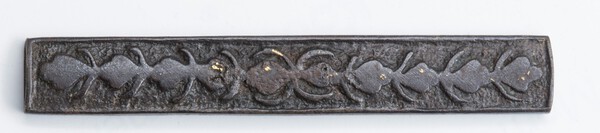
I collect iron kozuka and kogai, they tend to be early, these guys are Muromachi, the "namban-ish" style is probably Momoyama.

-
This used to belong to Bob Hanes.

-
Does not look bad. I would have send it to be shown to Tanobe sensei and if he feels its good to have it polished and then submitted for papers. As is, I still feel there is some uncertainty.
-
Thank you for your input. While living there I purchased quite a few items which had torokusho from different swords - daito with torokusho to tanto, a lot of daito with mismatched nagasa, signed blade which was noted as mumei etc. etc.. Comes out when you submit for export and its not a match.
-
Honami Family/Kinzogan Mei
Rivkin replied to William Jennings's topic in General Nihonto Related Discussion
The basic rule is if you see kinzogan to major name but no modern papers, unless the blade is clearly out of the woods - it means there is an issue. It might be a major issue or it might be that the modern attribution is similar, but two notches below, since if its just one notch below it quite often can still be papered. The general accuracy is hard to estimate since anything grossly inaccurate will be considered fake, i.e. "the attribution is wrong so the kao must be fake". And unfortunately Honami Kochu's papers have been faked with extreme accuracy. Part of the reason he also did a lot of attributions. So the acknowledged cases are most limited to Juyo+ blades where a modern sayagaki for example says - yes, kinzogan to x, but its really y. You do see certain patterns where modern attributions clearly diverge from the best Honami standards. There are also Honami whose judgements per se were not up to the standards - Nishu, to the lesser extent Koson, many others. Why there are so many kinzogan without kao, who made those, is not a well researched subject for obvious reasons, i.e. if its not signed, how do we know who did it. Reasonable guess its many side branches of Honami family, but its also of note that engraving kao was considerably (one might even say ridiculously) more expensive work compared to a signature without kao. Its possible that issuing "kinzogan without kao" was a lower cost appraisal option with some later generations. -
Yes. Most likely cause is seller having a drawer with a few dozen torokusho from which he takes one at random when he sells something. Since the export requires actual match between torokusho and the goods, when it comes out they don't, it needs to first get new torokusho and then resubmit. If it has higher papers there is an additional trouble potential - they can open an inquest to the province which issued the torokusho and ask it to resolve the mismatch... In case if its provincial bunkazai or something, so that the locals clearly state that they have no particular interest in the blade on their end.
-
Ok, probably the first photo there was some weird angle which made it look like nakago has a proper finish, this is as o-suriage as they come.
-
Maybe a bit better. It matters a lot if its a prime level smith or very old sword, otherwise plus-minus. Yes, mumei ubu can be made and attributed.