


kunitaro
-
Posts
591 -
Joined
-
Last visited
-
Days Won
11
Content Type
Profiles
Forums
Events
Store
Downloads
Gallery
Everything posted by kunitaro
-
Orikaeshi Mei. first kanji bent in 1/2
kunitaro replied to jason_mazzy's topic in Translation Assistance
I think it is 宗長 Munenaga -
You are welcome ! and we eat this 桜餅 sakura-mochi

-
It is called 葉桜 Ha-zakura. 葉 Ha=Leaves 桜 Sakura=Zakura. A few weeks after peak of Cherry blossom, the flower start to fall and fresh leaves start to grow. It is expression of "the end of spring the beginning of Summer". And Yes, It is Bushu tsuba late-end of Edo period.

-
That is pity that nakago is damaged, to be honest. I don't understand why it is issued Hozon paper !?!? You can not examine Nakago or signature with that condition, and Hamon is not typical... mmmm, What about this ??

-
You can always ask the seller if they can guarantee the item will pass NBTHK Hozon shinsa.
-
regarding NBTHK or NTHK kantei. The Kantei of Mumei blade, I am maybe a bit too frank, but, The attribution of school is not necessary to be the blade made by that school. This is judge by Saku-i(作位) some rating of the quality of the blade. it is called "Waki-mono". If it is less level of Yamato-den,older than nanbokucho, it will go to ko-Uda or ko-Mihara, And there is 'Deki(出来)" as other feature. Good workmanship of ko-uda (上出来の古宇多), etc. This is one reason the attribution changes after Polishing a blade. especially polished by master polisher, He know how NBTHK(judge) see the blade, and if he can show more what they(judge) want to see, the blade will get higher level of attribution. Plus, Healthiness is one more another feature to measure the condition of the blade. . Attributed as The name of the smith is more characteristic activities. Related to Kantei for Signed blade. I learned from old people who are(were) board member of NBTHK.
-
Exactly
-
Because, They use only super master pieces for Nyusatsu-kantei. so, very clear activities to recognized school or smith. and same time, people could see the Quality level as well. When you go home, looking normal quality blade. doesn't fit with Study... When you studying with only book, we will never understand 出来 or 作位 without understanding those, Kantei or Quality discussion will be confused. I think. However,,,,, This discssion should go another thread ?? "Whats a Kantei Point" viewtopic.php?f=9&t=14500
-
脇指 wakizashi 脇 is simplified You can write 脇差 as well.
-
Thak you all. It is helpful ! 作(construction/art work/) and 位(Rank, Rating, Level) This come to 上作 中作 下作, however, Book is showing/saying Saijo-saku,Jojo-saku,Jo-saku,Chu-saku, Not ge-saku, but, there is a Gesaku. 出来 Deki is also related to the quality of workman ship, we say that 出来の良い (deki no yoi = well done) or 上品な出来(Jouhin na deki) 激しい出来(Hageshii deki) To recognize 作位(saku-i) and 出来(deki)of the blade and hatarakis without checking a books, is an original purpose of Kantei Study. There is all different qualities of Nie, Nioi, kinsuji or Utsuri etc.. Anybody who understand, please explain for newbies. When you understand this, we can go to "Waht's a Kantei Point". viewtopic.php?f=9&t=14500
-
I think so. Same as Sword display. Ha is up for Katana, Mune up for Tachi. Signed tsuba should follow the signature.

-
Could you translate this above ? I would to like to say exact meaning without misunderstanding. Especially, 「作位 (Saku-i)」 and 「出来 (Deki)」 What is the best way to translate those? Please help me for my English study.
-
A Master Sword man "町井勲 Isao Machi 修心館 Shuushinkan" is planning Introduction of Shuushin-ryu Iai-jutsu and Tameshigiri Seminar in Europe. Summer 2013. We will hold Workshop for Iai-jutsu, Kumi-Tachi, and general Knowledge, manner and maintenance of Japanese sword. And Isao Machii is a proper trained Japanese Sword Polisher as well as a Budo-ka. so, He will be able to form a workshop for Sword polishing for Art sword polishers. I would like to support him fully and introduce in Europe. If you are interested in organizing his Seminar at your Dojo in your area, Please send message to me or Facebook Page. or If you are interested in Support to develop our Facebook page, please let us know. http://www.facebook.com/pages/Isao-Mach ... 0290977792 I will update its develop. Best

-
Dear Roy san, I found a bit more about mr.Kuroda Tomio. I called a few phone numbers in the island. found mrs.Sunagawa (88) who knows Kuroda Tomio. She said that Kuroda family was an old good family and he went to University in Tokyo, became an officer. maybe Second Lieutenant. mr.Kuroda Tomio passed away about 7-8years ago in Tokyo. (Maybe some of his family member is in Tokyo, she doesn't know) His younger brother Kuroda Tsuyoshi passed away in the island about 3-4 years ago. the wife of his brother (84) is still living at their old family house at Iibi village in the Island. I have her phone number.
-
-
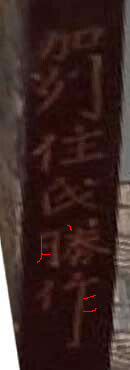
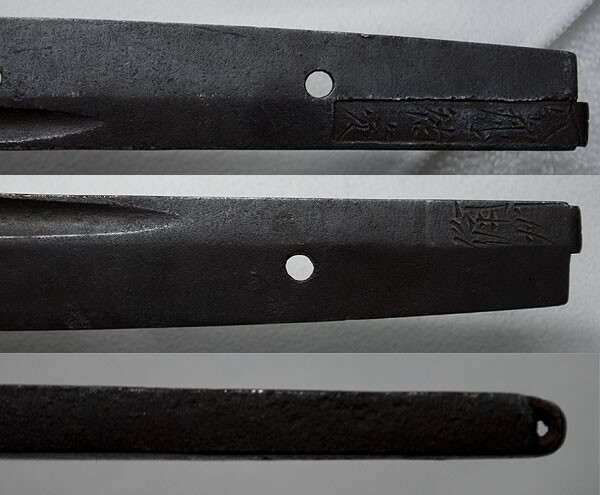
This is the proper way of Orikaeshi-mei, We can see the Mei part is extended from other side of Nakago. Photo of Kanetsune need further investigation, Especially Nakago-Jiri and Hamachi (to see how much Suriage etc.) you must examine whole Nakago and also whole blade.
-
加州住 kashu (no) ju 氏勝 作 Uji-katsu saku
-
a careless mistake; 販美 ---> 飯美 Ahh, Yes I was writing without glasses Reading "Iimi" is ok. ご指摘どうもありがとうございます。 It is very small Island. I wonder if there is some people who know about his family or descendants !?!?
-
It is address. 島根縣周吉郡 Shimane-ken Suki-gun 布施村(六x)大字飯美 Fuse-mura Ooaza Iimi (or Iibi) 黒田富夫 Kuroda Tomio Suki-gun was till 1969, Now, Shimane-ken Oki-gun It is a small Island in Japan sea. http://en.wikipedia.org/wiki/D%C5%8Dgo,_Shimane and http://hgf03030.a.la9.jp/500/R485/R485_2.htm
-
Could you please add Shinken : 真剣 Real sword (traditional made Japanese sword), or used as "Serious" in conversation in modern Japan. I want to protest Abusing Japanese Language. I met a Iai teacher in NL long time ago, He showed me his sword, Chinese steel blade, it looks like Nihonto. He was selling them to his students as "Shinken". I almost faint.... But, i found out that himself didn't know the meaning of Shinken, He thought that is the name of product (Chinese steel blade) so, all of them believe, they have Shinken... and telling everybody they have shinken... I am concerned about future, cause by this misinformation.
-
Thank you very much for follow up, Brian san, I was trying to draw, but, it is difficult... But, Brian san explained very well indeed. Yes, That is why I though this is good subject. Mune-yaki on purpose and Tobi-yaki mistake are easy to recognize. How long (minute) do you stare at sword for examine ??? I take sometime 5 minutes 10 minutes to stare at one parts of Hamon or jitetsu. (or Sugata, or Nakago) without my ego. and think about the maker how he has been done. (with my full knowledge and experience) till I have idea or clear vision. Sometime stare longer time,,,then you start to see. This is the communication with the maker. It is almost Meditation.(my art appreciation) Also, This is one of the reason why we bow to the sword. make sense ??? or not ? Studying only book without sword is not good. Studying only sword without book is not good either. PS : Good sword with Bad mune-yaki is risk of Saiba (re-tempered) also must be remembered.
-
All of the examples which we have here are Consiously made Nune-yaki. They are not Mistakes as we can see from the oshigatas. as i wrote before, when we see the sword, we can see if it is a mistake or it has been done on purpose. There is no example of (mistake) Tobi-yaki on Mune here. also, it is very diffuclt to find a bad example.... I will draw something (basic) after i go back home.... Not for advanced collectors, but for beginners.
-
Dear Eric san, Could you please post some Example ? so we can study together. Best regards,
-
飛び焼き Tobi-Yaki meaning in Japanese is separated sopted Hamon. It looks like 島 an Island. The Oshigata of Yosozaemon Sukesada, There is a few Spot hamon on Ji, Draw like a circle. like Isalnds. The black line(dark) is NIOI-KUCHI, Inside the circle is HA, outside is JI. It can be any where. 湯走り Yubashiri is a part of NIOI-KUCHI. The Oshigata of Mizuta Kunishige. dark spot (inside also Dark) on hamon, That is Yubashiri. It is a part of Nioi-kuchi, Ha and Nioi-kuchi makes Hamon. (and other Hataraki as well) 棟焼き Mune-yaki is meaning Tempered along Mune, Maybe some oshigata looks like separate, but, infact there is (almost) all way on Mune. By photo is more difficult to see (Because, Shinogi-ji and Mune are burnished by Migaki-bo) If there is only Nioi-kuchi (Yubashiri type) all way on Mune, it is still called Mune-yakki, If there is Tobiyaki (small spot) or small SPOT of Yubashiri on Mune, They are Mistake, however, When you see the blade, you can see if it is Mune-yaki on purpose, or mistake. The mistake Tobiyaki on Mune is usually very small (because, it is mistake) and we don't see so much, because, it could be fixed. Hope everybody understand what i try to say,...
-
Thank you Jacques san, Dear Adam san, Now, you have a few example of Sue-Koto Muneyaki and a few Shinto. if you look for more, you will find them. It is interesting subject (and object) to study. I will explain more about Tobi-yaki, Mune-yaki, slowly.


