Grey Doffin
-
Posts
4,209 -
Joined
-
Last visited
-
Days Won
31
Content Type
Profiles
Forums
Events
Store
Downloads
Gallery
Everything posted by Grey Doffin
-

Will it be possible to restore this sword? UPDATE-PICS PG 4!
Grey Doffin replied to DaveM4P99's topic in Nihonto
Hi Dave, The answer to your question depends on 2 things: the condition of the blade and the skill of the polisher. Nothing much you can do about the condition of the blade but the skill of the polisher is entirely up to you. If you are concerned that the best possible result be achieved and that you aren't giving money to someone who will kill the sword, make sure that someone is properly trained. There are real miracles that can be done by a polisher who knows the craft, and real disasters performed by well meaning amateurs (even some with long waiting lists). Grey -
Sorry; I don't think this will work. The shows are too crowded, too much opportunity for an accident. Also, the lighting at the shows is terrible. To do a good job on oshigata you need directed light, not the general wash of florescent you get in hotel ballrooms. Doing a good job with oshigata takes many hours of concentration and diligence. Doing a half ass job takes less time but why bother. Grey
-
Not that I'm an authority on any of the subjects being discussed, but for lack of more productive activity at the moment I'll toss in my couple cents. What bothers me about these 2 tsuba and many more from the same time, is the total disregard of the fact that these are supposed to be tsuba. By placing the bird on the seppa dai, Ichigo is telling us that he doesn't expect this will ever be used; it is just a work of art. Why even bother cutting the nakago hitsu ana? Make it a roundish metal picture and be done with it. And it's not just the non-utilitarian nature of the object that bugs me. The seppa dai is important to the art. Look at any great tsuba and imagine it without the negative space in the middle. Something is lost. Grey
-
Hi Gary, The attribution is almost certainly a fake. Sadamune is far too famous not to question the authenticity of the attribution, the attribution isn't signed (it should be), and if it were old the gold would be below the surface of the steel, not the way it is. When originally done, the gold is at the same level but over time the steel corrodes and grows, and the gold, which doesn't corrode, is left slightly recessed (learned this from a lecture given by Mr. Tanobe at the Florida show a few years back). Grey
-
Hi Clive, Nobutaro isn't found in any of the 60 or so references in my index; you might have a tough time learning anything. Grey
-
Hey guys, Can we keep the Message Board free of political rants? That's not what this site is about. Thanks, Grey
-
Brandon, 2 shaku is the starting length for long swords, which is 23.86". Your swords are very long wakizashi. Grey
-
Curran, There is no one in the States (or anywhere outside of Japan now that I think of it) who is qualified to do sayagaki. Sure, anyone with nice calligraphy could write something on your saya but sayagaki is more than nice hand writing. It is an attribution or authentication of a signature by a recognized authority. If it were done by someone who isn't an authority I think it would cheapen the sword. It certainly would decrease the sword's value for me. I'd much rather have plain shirasaya than one with a back alley sayagaki. Grey
-
I agree; fake. Grey
-
While on the subject of Yari.....Ha Giri
Grey Doffin replied to Lindus's topic in General Nihonto Related Discussion
Hi Roy, If I were looking to stab someone you might be able to sell me your yari with a ha-giri, but I'm not. I collect art and I have no use for a blade of any type with that flaw. Grey -
In order to do this research, the researcher would have to know which of 2 differing attributions, the old one or the modern one, is correct. If we knew that we wouldn't call it an attribution. Grey
-
Toyama Ju Yoshihira on the sword; not sure about on the tsuba. Grey
-
This is a fake. No question. A fake and nothing but. The hamon is cosmetic and ugly. Please do not try to cut with it. If you do you risk serious injury if/when the blade shatters. It has value only as a wall hanger, whatever someone who doesn't know better will pay. Grey
-
Thank you; most appreciated. Grey
-
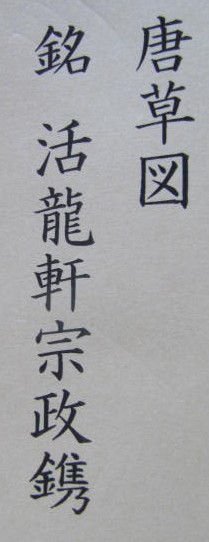
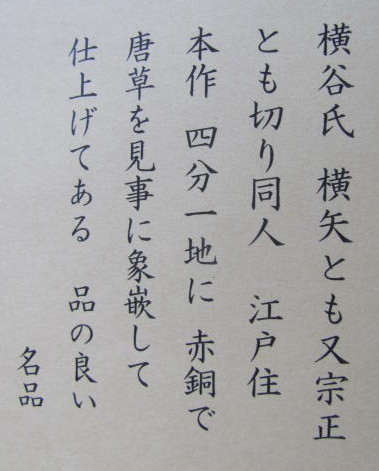
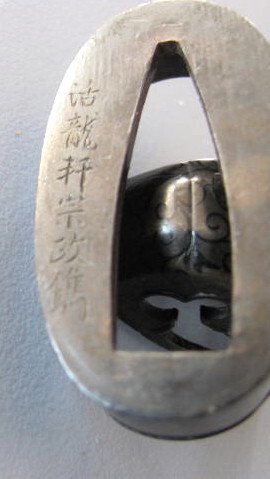
Hi guys, Can you help me with this mei and paper (I asked about the paper on the General Nihonto forum)? I think the smith is Munemasa but I'm having trouble making sense of the rest. Any and all will be greatly appreciated. Thanks, Grey


-
Katana Tang identification - Please help.
Grey Doffin replied to QuinnE's topic in Translation Assistance
Hi Quinn, Unless you're sure you know what you're doing, don't clean your sword. Improper cleaning can knock huge chunks of value off the sword. If it's covered in cosmoline you can wipe that off with a bit of alcohol on a cloth. Otherwise, best to leave it alone. Grey -
Sorry about that, Brian. I won't do it again. Grey
-
Actually, this isn't crude; pretty standard mei carving on Nihonto. Here I go again trumpeting my own horn, but I honestly believe that a set of my Kanji Flashcards is the answer to learning how to read sword signatures if you aren't going to learn how to read Japanese. The Kanji were chosen to be relevant to sword signatures (you don't have to learn the Kanji for watermelon) and they are written Kanji, not print, so they look like what you see on swords. There are a few stroke mistakes in the set but guess what, there are a few stroke mistakes in sword signatures. When I got my set 20 years ago, I went through the 270 cards once a day for a month, and at the end of the month I could regularly get all but 4 or 5 correct. With that knowledge and a copy of Hawley's book to fill in the parts of the mei I didn't know, I could read the great majority of signatures with little trouble. $25 plus postage; a bargain I think. Grey
-
Hi Peter, Even if you're wearing gloves, you still don't touch the polished portion of the blade. You can rest it on a folded soft cloth in your hand but there isn't enough thickness in glove material to prevent moisture from passing through to the blade. Grey
-
Hi Kyle, A tip, you ask? Do not try to clean/fix/improve/whatever these tsuba. I know this should be obvious, but museums have a well earned reputation for improper care of Nihonto and their fittings; they wouldn't dream of touching an oil painting but gleefully attack tsuba with Brillo pads. Grey
-
Hi Alaen, In my opinion: at best made from western steel (not from tamahagane and not folded) and water quenched. At worst the same steel and oil quenched. Some hand work went into the blade but it is far from true Nihonto. Grey
-
Seeking Opinion of Sword at auction.
Grey Doffin replied to Crescent Moon's topic in Translation Assistance
I also was interested to learn who polished the sword. Will you tell us, please. Thanks, Grey -
The new pictures spark interest; maybe there's hope. If this is a Shinto or later sword the answer is still no. Still no at late Koto I think. If earlier and the price was really attractive, then maybe. Lots of old blades have skinny boshi, and I think this boshi would survive a polish (not that I'd have this sword polished). I'd want to see all of the sword to learn about other compromised areas, and the price would have to be very sweet; possibly? Grey
-
That is a very tired sword, with a serious kizu in the hamon. I would stay away from it unless you just want a wall hanger. Grey
-
help with identifying this blade and its markings
Grey Doffin replied to mrniceguy2282's topic in Translation Assistance
Hello, whoever, Never touch the polished portion of the blade (everything other than the tang) with your hands. Acid in your sweat will leave etched marks. Here is a link to a sword care and etiquette brochure that you need to read. http://www.nbthk-ab.org/Etiquette.htm Grey